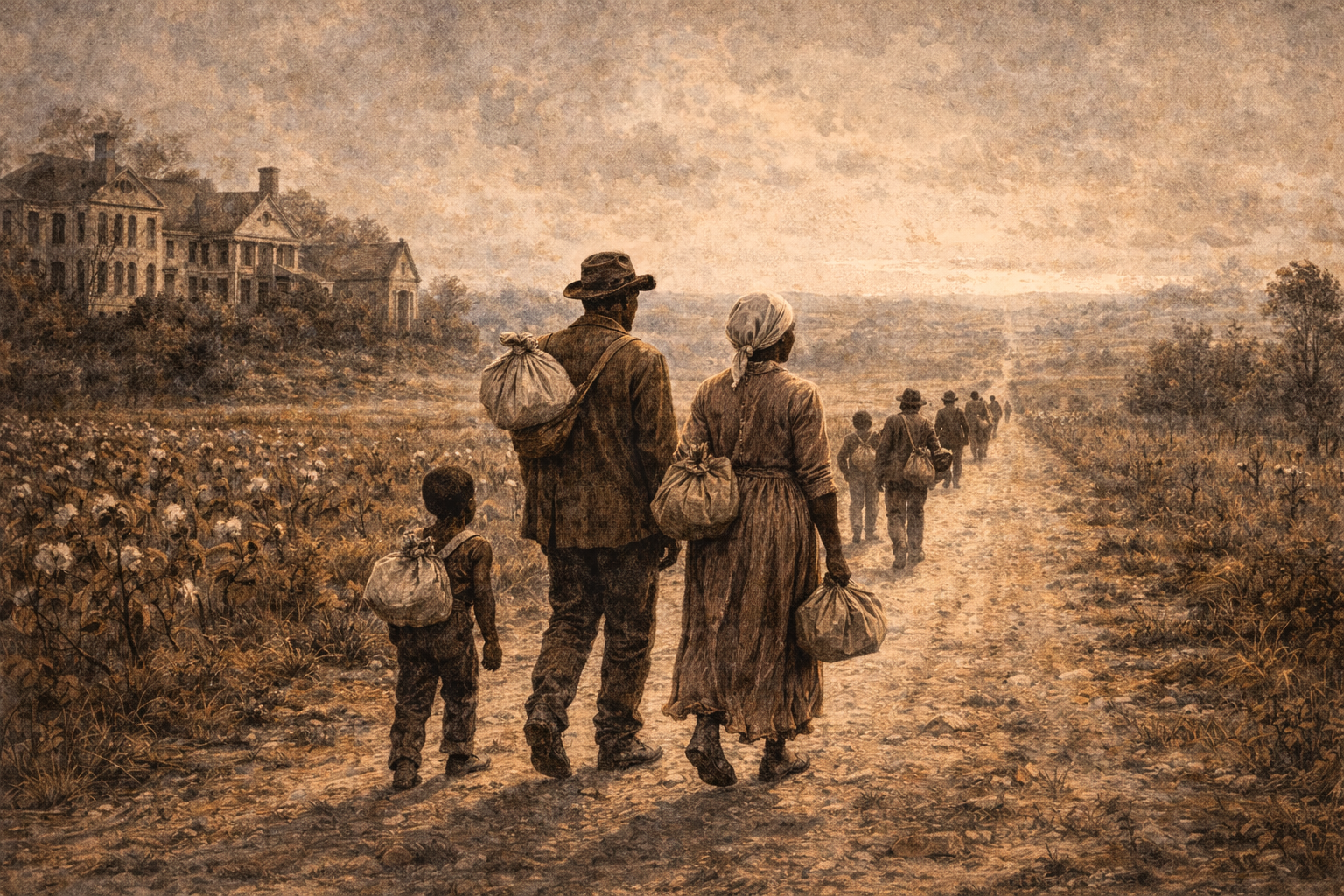
After emancipation, freedom arrived before land, wages, or economic security.
Freedom arrived in 1865 with a word that sounded like thunder across the South.
For generations, enslaved men and women had lived under a system that controlled nearly every movement of their lives. Work, family, travel, education, even the right to gather in groups were dictated by the demands of slavery.
Then the system collapsed.
The chains were broken by law. The plantations could no longer claim ownership of human lives. A door that had been locked for centuries suddenly swung open.
But stepping through that door did not mean stepping into security.
Freedom often arrived carrying hunger beside it.
Leaving the Plantation
Across the South, newly emancipated families began walking away from the plantations where they had lived and labored. Some traveled miles searching for lost relatives. Others simply moved because movement itself had been forbidden for so long.
For the first time, people could choose where to go.
Yet choice does not fill an empty stomach.
Most families left with little more than the clothes they wore and a few small bundles of belongings. The land they had worked for years did not belong to them.
In many places the same land that had been cultivated by enslaved labor remained concentrated in the hands of former plantation owners. The opportunity for ownership that many freed families hoped for never arrived.
As explored in The Land America Never Gave, the promise that freed families would receive land after the Civil War quietly faded as national priorities shifted.
The Promise That Never Came
During the final months of the Civil War, rumors spread among freed communities that land might be distributed to former slaves. The phrase “forty acres and a mule” carried hope that freedom would come with the tools needed to survive independently.
For a brief moment, that future seemed possible.
But Reconstruction policies changed direction and land redistribution never fully materialized.
Without land ownership, many freed families were forced into systems such as sharecropping. These arrangements offered the appearance of independence but often kept workers trapped in cycles of debt and unstable income.
Freedom had arrived. Stability had not.
Freedom With an Empty Table
Hunger became a quiet companion in many freed communities during the early years after emancipation.
Families worked long hours in fields that still belonged to someone else. Wages were inconsistent. Credit systems tied farmers to merchants and landowners who controlled supplies and prices.
The legal structure of slavery was gone, but the struggle to survive had not disappeared with it.
For many people, freedom meant the right to walk away from one form of control while facing the uncertainty of building a life with almost no resources.
The deeper economic forces behind this struggle are explored in Capital Before Equality, which examines how ownership and capital often determine who can transform freedom into lasting stability.
The Meaning of Freedom
Yet even in hardship, freedom carried a meaning that could not be measured only in food or wages.
Parents could decide where their children lived and worked. Families could reunite after decades of forced separation. Communities could build churches, schools, and institutions that had been forbidden before.
The ability to choose one’s own path, even when the road was difficult, carried its own quiet power.
Freedom did not erase suffering overnight. It did not immediately provide land, wealth, or stability.
But it restored something deeper.
It restored the right to build a future.
For many newly emancipated families, the years after the Civil War were marked by both struggle and determination. Hunger and hope traveled side by side along dusty roads and newly formed communities.
Freedom had arrived.
The work of turning that freedom into security would take generations.
“When there is no enemy within, the enemies outside cannot harm you.”
— African Proverb