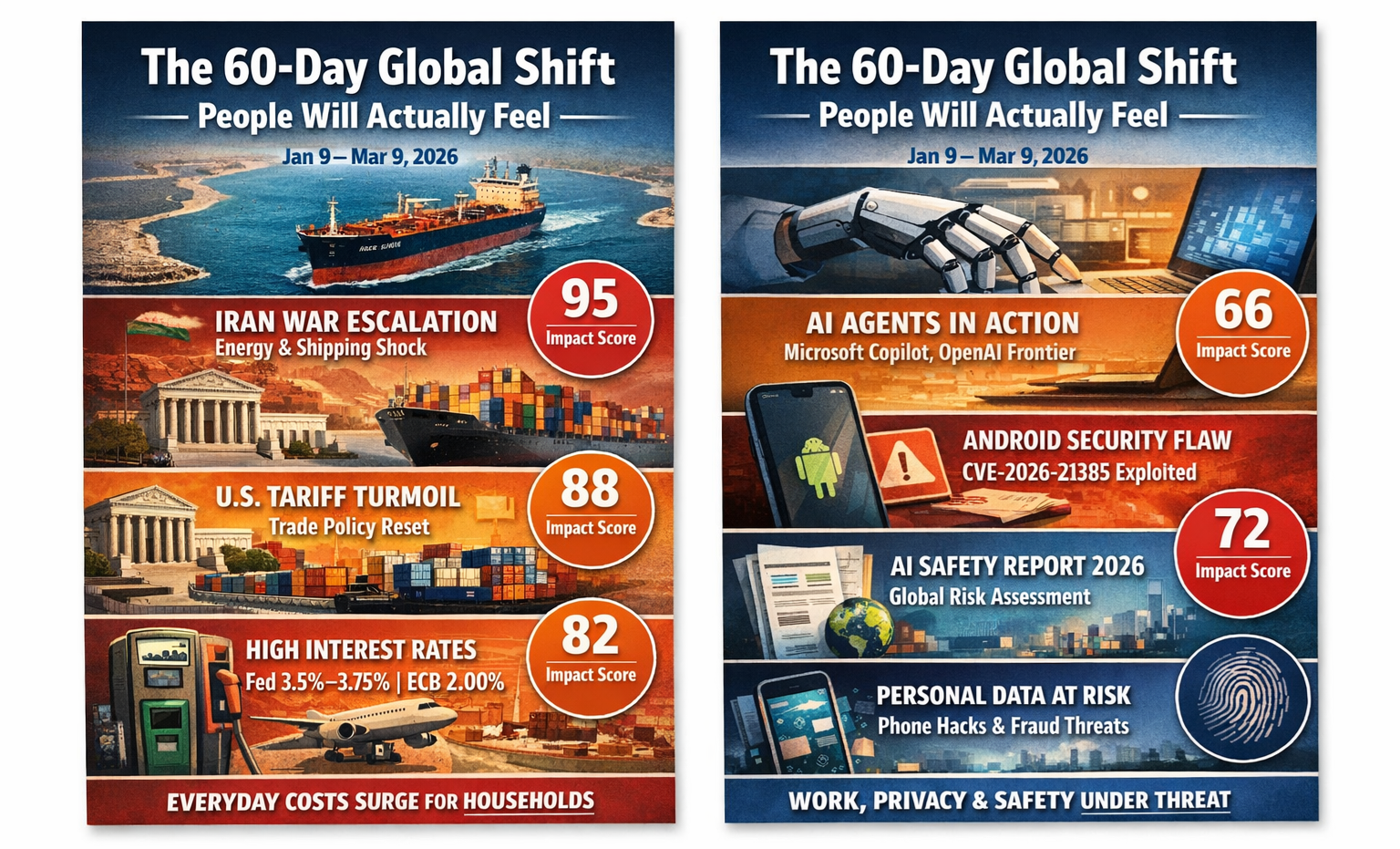
Global economic trends 2026 are already reshaping everyday life, even before most people fully recognize the pattern.
It appears first as pressure.
Fuel becomes slightly more expensive. Shipping takes longer. Loans become harder to justify. Work expectations shift quietly. Phones feel less secure than we assumed.
Behind these everyday frictions sits a larger system of forces that has shifted significantly over the past sixty days. Headlines often treat these developments as isolated stories. In reality they are connected signals moving through the same global infrastructure.
The past two months reveal three structural trends shaping everyday life: sustained geopolitical risk around energy supply, a tightening global financial environment, and the acceleration of artificial intelligence into operational systems.
Taken together, they represent a transition period in the global system rather than a single crisis.
Key Takeaways
- Energy supply disruptions are increasing transportation costs across global supply chains.
- Tariffs and trade friction are making logistics more complex and expensive.
- Central banks are maintaining higher interest rates, tightening financial conditions.
- Artificial intelligence is shifting from experimental tools to operational systems.
- Cybersecurity risks are expanding as digital infrastructure becomes central to daily life.
Global Economic Trends 2026: A System Under Pressure
The modern global economy rests on four interconnected pillars: energy supply, global trade, financial policy, and technological infrastructure.
Over the last sixty days each of these pillars has experienced new stress.
Energy markets remain sensitive to geopolitical tension. Conflicts affecting critical oil and gas shipping routes, including the Strait of Hormuz, have pushed prices higher and increased concerns about supply disruptions.
At the same time trade friction continues to reshape shipping patterns. Tariffs and counter-tariffs between major economies have forced companies to reroute cargo through intermediary hubs.
Financial policy adds another layer of pressure. Several central banks are keeping interest rates elevated while they work to bring inflation under control.
Technology is the final pillar undergoing rapid transformation. Artificial intelligence is moving from experimental tools into operational systems capable of executing workflows and automating complex processes.
When these forces move simultaneously, the result is not collapse but structural tension. Systems rarely fail overnight. They first become harder to navigate.
Global Economic Trends 2026 and the Energy Risk That Reaches the Gas Pump
Energy markets remain one of the fastest ways geopolitical instability reaches everyday life.
Disruptions to oil and gas shipping routes ripple outward through tanker availability, insurance costs, airline fuel prices, and freight logistics.
Transportation companies respond quickly when fuel prices rise because energy is one of their largest operating costs.
The result is a familiar chain reaction: higher transportation costs eventually translate into higher retail prices across many sectors.
Tariffs, Trade Friction, and Global Economic Trends 2026
Tariffs rarely stop trade entirely. More often they reroute it.
Manufacturers increasingly move production stages or shipping routes through third countries to navigate geopolitical risk and regulatory barriers.
Each additional step introduces new costs, delays, and operational risk.
The global trade system continues to function, but it requires more navigation.
Interest Rates and Global Economic Trends 2026
Interest rates remain one of the most powerful levers affecting everyday life.
After a rapid cycle of rate increases, many central banks are maintaining restrictive policy conditions to ensure inflation continues to decline.
This environment slows expansion but encourages financial discipline.
Households and businesses are forced to make borrowing decisions more carefully.
Artificial Intelligence and Global Economic Trends 2026
The most dramatic technological shift of the past sixty days has been the expansion of artificial intelligence from informational tools into operational systems.
New AI models function as agents capable of monitoring systems, initiating tasks, and coordinating workflows inside organizations.
Companies are deploying these systems across customer service, IT operations, finance, and supply chains.
This transition creates opportunity but also introduces governance challenges.
Governing Enterprise Agentic AI
Zero-trust agent identities: AI agents receive tightly controlled credentials and permissions.
Runtime guardrails: Independent systems prevent unauthorized actions.
Human oversight: High-risk actions require human approval.
Action traceability: Modern logs explain not only what the AI did but why.
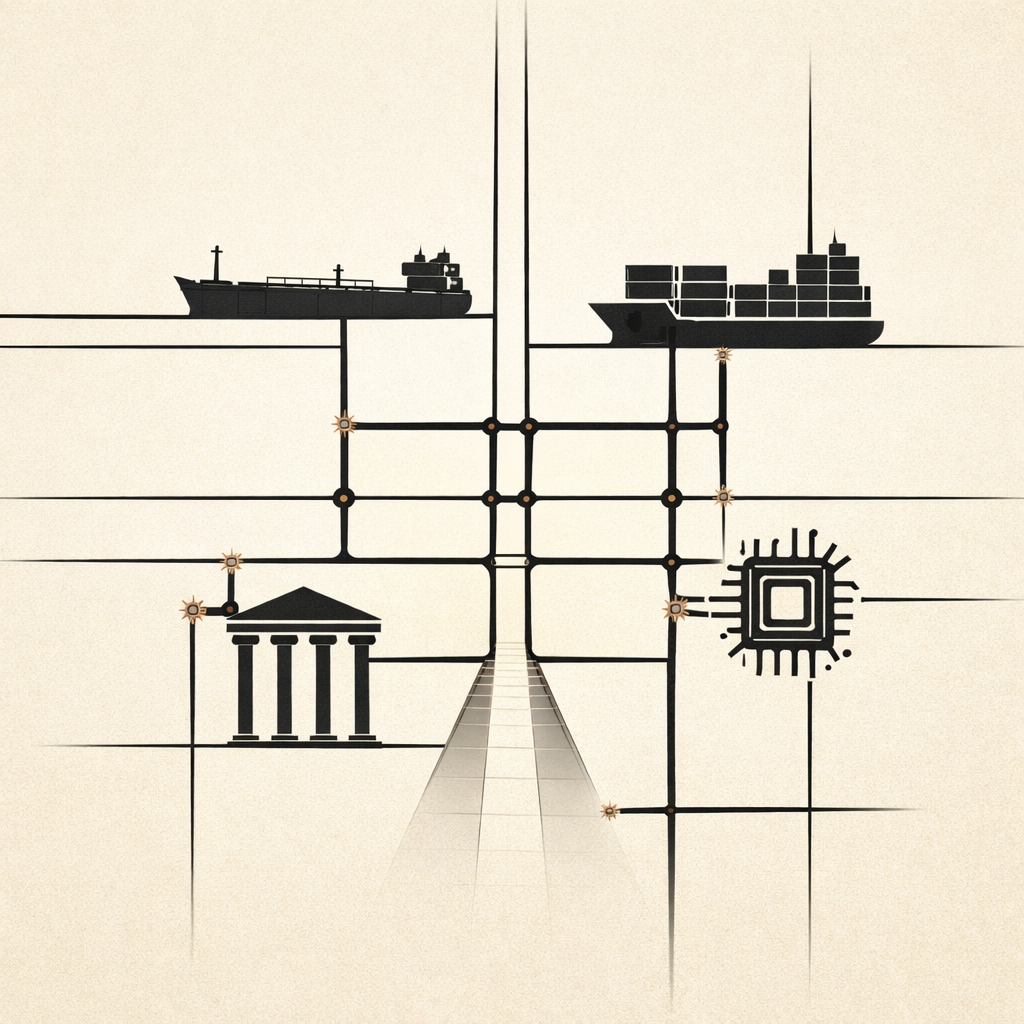
Supply Chains Adapt to Chokepoint Disruption
Recent instability has forced global shipping companies to redesign routes.
Several workarounds are emerging.
The Saudi land bridge: Pipelines and overland routes bypass the Strait of Hormuz.
Mass port diversions: Ships offload cargo at ports outside high-risk zones.
Cape of Good Hope routing: Asia-Europe shipments increasingly circle southern Africa.
Emergency air freight: High-value goods shift to aircraft when shipping becomes risky.
These adjustments keep global trade moving, but they raise distance, time, and cost. Over time that friction works its way through supply chains and into consumer prices.
The Structural Pattern Behind the Headlines
The most important insight from the past sixty days is not a single event but the interaction of several forces.
Energy markets, trade policy, financial conditions, and technology systems are all shifting simultaneously.
This pattern signals transition rather than collapse.
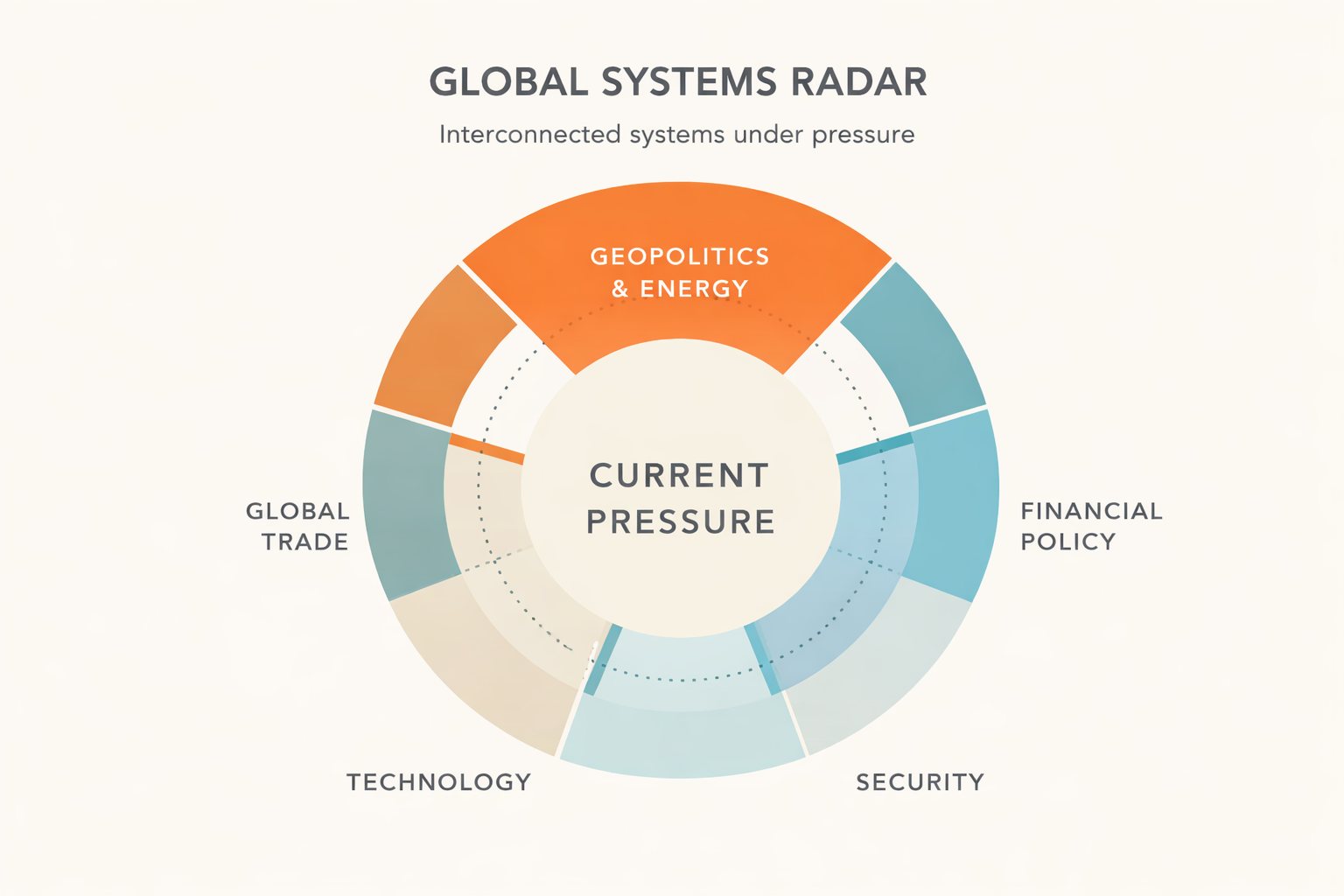
The radar shows where the system is tightening. The scorecard below shows how that pressure is most likely to be felt.
Signal Scorecard
A quick scan of the five systems shaping global economic trends 2026.
| System | Current Pressure | Everyday-Life Impact | What to Watch |
|---|---|---|---|
| Energy | High | Fuel prices, freight costs, airfare, inflation pressure | Shipping disruptions, tanker rerouting, oil price spikes |
| Global Trade | High | Delivery delays, higher input costs, product availability issues | Tariff responses, port congestion, new routing workarounds |
| Financial Policy | Medium to High | Mortgage costs, consumer credit strain, slower business investment | Central bank guidance, inflation persistence, lending conditions |
| Technology | Medium | Workflow changes, job redesign, automation gains and errors | Enterprise AI deployment, governance failures, adoption speed |
| Security | Medium to High | Fraud risk, phone vulnerability, account compromise, data loss | Patch delays, new exploits, consumer device vulnerabilities |
Five Signals to Watch in Global Economic Trends 2026
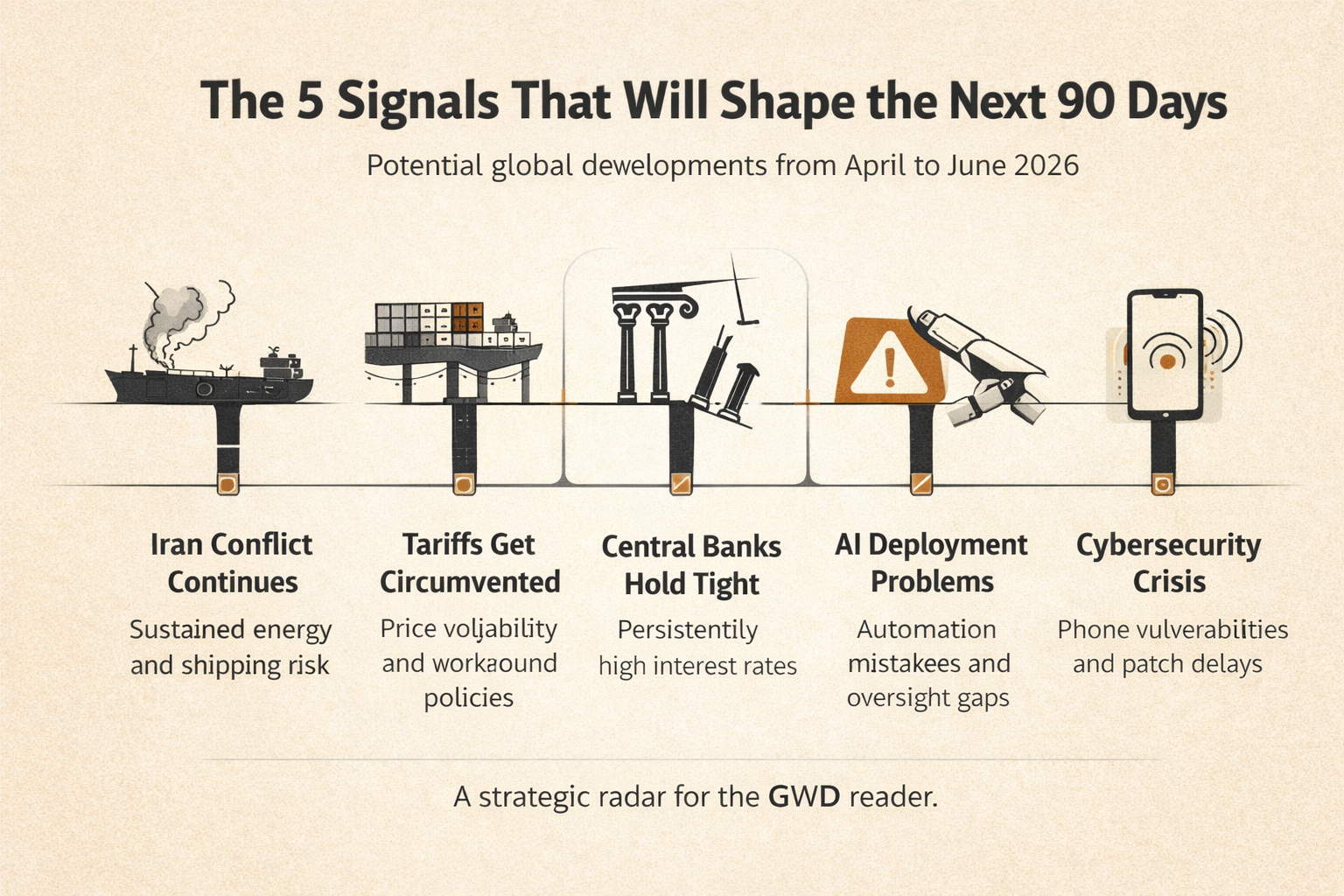
- Energy supply disruptions affecting global shipping routes
- Trade policy adjustments and tariff responses
- Central bank decisions on interest rates
- The pace of AI deployment inside enterprises
- Cybersecurity vulnerabilities affecting digital infrastructure
The Practical Lesson
Global shifts rarely arrive with dramatic announcements.
They appear as signals.
The people who navigate complex environments successfully are not the ones who react fastest. They are the ones who recognize patterns earliest.
The past sixty days show a clear pattern: the global system is not collapsing, but it is tightening.
In periods like this, stability becomes a competitive advantage.
Further Groundwork
Signal Summary
Global economic trends 2026 are currently shaped by five interacting forces:
- Energy supply risk affecting oil and shipping routes
- Trade friction and tariff workarounds reshaping logistics
- Higher interest rates tightening financial conditions
- Artificial intelligence expanding into operational systems
- Cybersecurity risks growing as digital infrastructure expands
Together these signals suggest a tightening global system rather than an immediate crisis.