
Jump to
Black hair industry economics are often discussed through culture, identity, beauty, and politics. Those conversations matter. However, they do not go far enough.
A sharper question sits underneath the surface: after the customer pays, where does the value go? With that question, a cultural conversation becomes a structural audit.
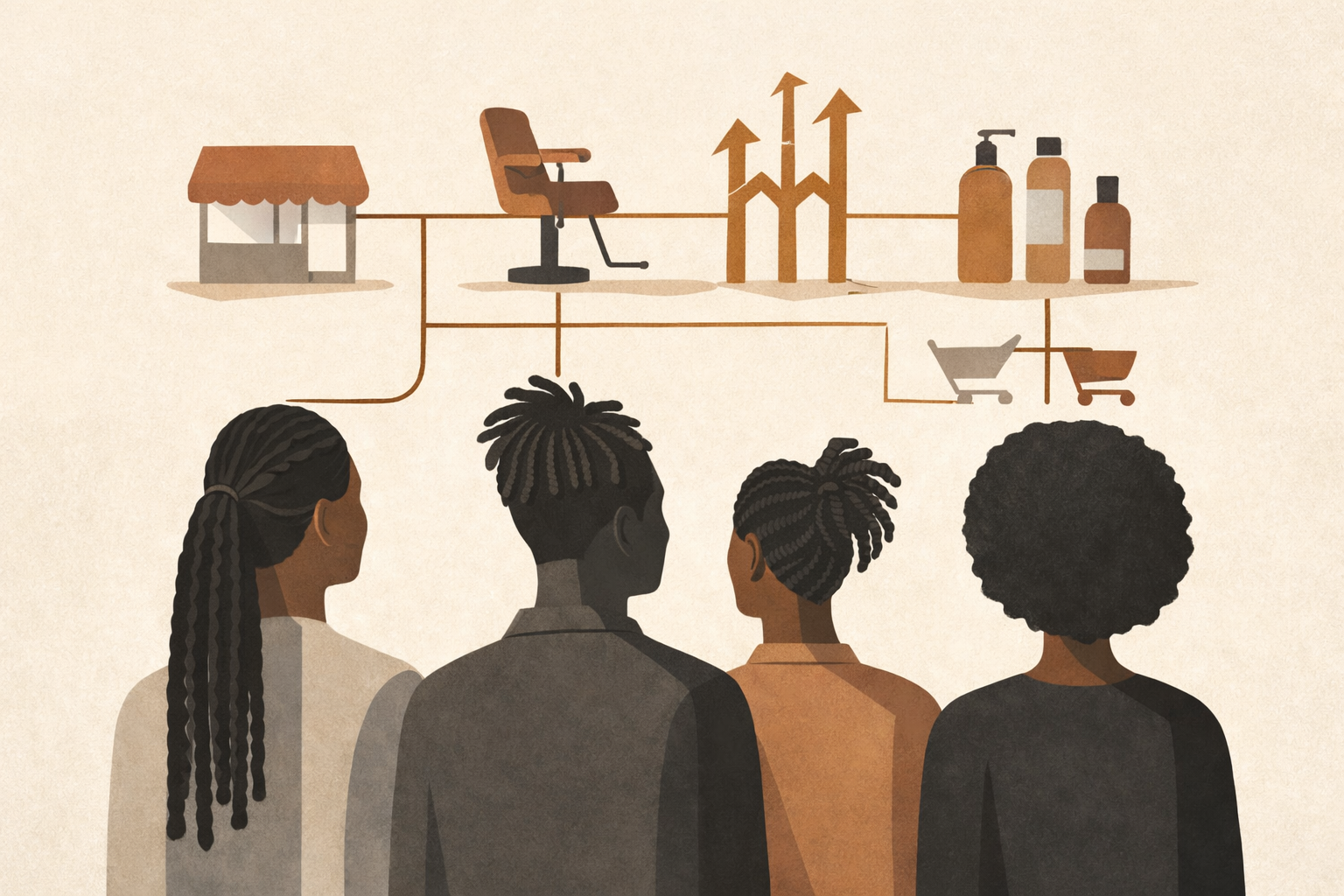
From the outside, one purchase may look simple. Behind it sits a chain of manufacturers, importers, wholesalers, beauty supply stores, salons, stylists, influencers, platforms, and payment processors. Because each layer touches the money, each layer also shapes who benefits.
Demand has never been the missing ingredient. For generations, Black consumers have created a powerful and reliable market. Even so, demand alone does not build wealth. Instead, ownership, distribution, and infrastructure decide whether spending circulates or leaves.
The financial side of this industry is inseparable from the broader politics of Black hair. Hair carries history, identity, workplace pressure, family routine, social meaning, and market power. Yet if the conversation stops at meaning, the money keeps moving without accountability.
Demand creates the market. Ownership decides who benefits from it.
Black Hair Industry Economics Begin With Demand
Markets reward predictable customers. In this category, purchasing behavior is steady because maintenance is recurring. Therefore, the Black hair market deserves to be understood as a serious economic system.
Across the category, consumers buy shampoos, conditioners, oils, gels, edge control, treatments, tools, accessories, protective styling products, extensions, wigs, and installation services. Afterward, maintenance brings them back. Over time, that pattern becomes a business signal.
Recurring demand matters because it creates repeat revenue. Repeat revenue creates planning power. In turn, planning power creates investment opportunity. For that reason, this market attracts brands, retailers, creators, and platforms.
Still, a dangerous assumption sits under many conversations about consumer spending. High spending does not automatically create community wealth. Spending begins the chain, but ownership determines whether that spending compounds.
On the surface, a customer may see a product on a shelf. Meanwhile, the market sees customer lifetime value. It sees margins, habits, loyalty, replenishment cycles, and brand attachment. Therefore, Black hair industry economics are not casual. They are structured.
Demand Does Not Equal Ownership
One weak assumption in cultural economics is the belief that spending equals control. Under pressure, that assumption fails. A community can drive demand for an industry without owning the assets that benefit most from that demand.
Ownership determines profit retention. It also shapes hiring, pricing authority, shelf access, acquisition potential, and long-term equity. In plain terms, ownership decides who keeps the upside.
Demand functions like the engine, while ownership functions like the steering wheel. Without that steering wheel, the market moves, but the destination belongs to someone else.
Once demand and ownership separate, money starts to leak. Consumers keep buying, while culture continues producing desire. At the same time, stylists shape trends and creators drive attention. Meanwhile, the strongest profit zones may sit outside the community that created the market.
This is not a moral slogan. It is a business reality. The market does not reward cultural importance by default. Instead, it rewards control of infrastructure.
Where the Money Actually Moves
The front end of the industry is easy to see. Product shelves, salon chairs, protective styles, tutorials, influencer reviews, and before-and-after videos all sit in public view. However, the deeper economics sit behind the curtain.
Most of the money moves through four major zones. Each zone has a different ceiling, risk profile, and path to scale. Together, they show why visibility and value are not the same thing.
- Product margins: shampoos, conditioners, oils, styling products, tools, and accessories.
- Service income: braids, loc maintenance, silk press, twists, treatments, wigs, installs, and consultations.
- Distribution control: wholesale relationships, retail shelf access, beauty supply stores, and logistics.
- Attention economics: influencers, tutorials, affiliate links, sponsored content, platform traffic, and customer acquisition.
Service income can be strong, but it is tied to time. Product margins can scale, although they require inventory and fulfillment. Distribution can compound, yet it requires logistics and relationships. Meanwhile, platform attention can accelerate growth, but it remains volatile.
Stronger operators understand the difference between income and infrastructure. Income pays today. By contrast, infrastructure creates leverage tomorrow.
Supply Chains Decide Where the Margin Lives
Consumers usually see the finished product. Businesses, however, see movement. That difference matters.
Before a product reaches the customer, it may pass through formulation, sourcing, packaging, warehousing, wholesale agreements, shipping, retail placement, advertising, and payment processing. Every step takes a percentage. Consequently, visibility does not always equal profitability.
In many industries, the quiet winners are not the loudest brands. Often, they are the companies that own the back end. That includes manufacturing capacity, import relationships, fulfillment systems, distribution networks, and retail access.
A product that sells for twenty dollars may carry many hidden costs. For example, production, packaging, freight, storage, retail markup, platform fees, advertising, and returns all reduce the final margin. What remains after those costs is the actual business.
For that reason, Black hair industry economics cannot be reduced to “support Black brands.” Support matters, but support without operational capacity has limits. A brand still needs reliable suppliers, strong margins, cash flow, inventory discipline, customer service, fulfillment, accounting, and product consistency.
Popularity is not the same as durability. A viral product can disappear quickly. By contrast, a well-run business can survive after the attention cycle ends.
Beauty Supply Stores and the Distribution Gate
Distribution is not glamorous. That is why it gets underestimated. Nevertheless, distribution decides winners.
A strong product hidden from customers loses. Meanwhile, an average product with national shelf access can dominate. This is why shelf space is economic power.
Beauty supply stores function as both access points and filters. They influence what customers see, what stylists recommend, what local shoppers trust, and what becomes familiar. Therefore, retail access is not a side issue. It is a control point.
When a product cannot get into local stores, it loses impulse buying. When stock runs out, trust declines. If wholesale pricing is weak, margins shrink. Likewise, momentum fades when volume does not move.
Digital storefronts have changed part of this equation. Direct-to-consumer brands can bypass some retail gates. However, they inherit new costs. Digital sales require traffic, and traffic requires content, ads, email lists, search visibility, or social reach. None of that is free.
The gate changed shape. It did not disappear.
Salon Economics: Why Skill Alone Hits a Ceiling
Salons are one of the strongest entrepreneurial entry points in the Black hair economy. They convert skill into cash flow quickly. A strong stylist can build reputation, loyalty, and premium pricing. That is real value.
Even so, service businesses carry a structural constraint. Time limits the model. One stylist has only so many hours, and one chair has only so much capacity. Although a booked calendar feels successful, it can also become a ceiling.
For growth to continue, strong salon operators usually layer income. The progression often looks like this:
- Services create trust.
- That trust creates repeat clients.
- Repeat clients create product opportunities.
- Those products create scalable income.
- Education creates authority.
- Authority creates brand equity.
- Brand equity creates leverage.
This progression changes the business model. A stylist who only sells time stays trapped inside the calendar. By contrast, a stylist who builds systems can turn trust into assets.
Not every stylist should become a product founder. That advice is too shallow. Instead, every operator should understand the business model they are inside. Some businesses create income. Others create equity. Confusing the two creates frustration.
Platform Economics and the Speed of Discovery
Social media changed the hair economy. Through one phone, a stylist can build a national audience. Likewise, a product can move from unknown to viral in days. A tutorial can also create demand faster than a traditional ad campaign.
That is the opportunity. However, the risk is volatility. Platforms reward attention, while customers reward results. Those incentives are not always aligned.
A product can trend without retaining customers. Likewise, a creator can generate views without building owned assets. In addition, a stylist can become visible without becoming financially stable. For that reason, attention should be treated as a door, not the house.
The strongest operators use platforms to capture audience, then move that audience into owned systems. Those systems may include email lists, booking platforms, product subscriptions, courses, community platforms, and retail partnerships.
The principle is simple. Do not build the entire business on land someone else owns.
From Revenue to Wealth
This industry generates money. However, revenue is not the same as wealth. Revenue is movement. Wealth is retained value.
Revenue pays bills. Wealth survives time. Many independent operators generate strong income while building little transferable value. That is not failure. It is a business model issue.
Wealth usually appears through assets. Those assets may include owned brands, product formulas, customer data, real estate, retail channels, education systems, or intellectual property. Once assets exist, the business can outlive the operator’s daily labor.
At this point, the conversation has to mature. The goal is not to shame consumption. Rather, the goal is to identify where value compounds.
A community with demand has power. A community with ownership has leverage. Although those ideas are related, they are not the same.
Policy, Access, and the Economics of Participation
Hair policy conversations often focus on discrimination. That work matters. The CROWN Act conversation shows why appearance standards are not neutral. Workplace rules can shape income, opportunity, and dignity.
At the same time, economic access deserves equal attention. Business financing, commercial leases, distributor meetings, retail placement, technical support, and manufacturing access all shape who can compete. Without those access points, talent alone is not enough.
Motivation does not solve these barriers by itself. Systems do. Therefore, access points matter if the industry is going to become more than a spending category. Business education matters. Capital matters. Cooperative purchasing matters. Retail ownership matters. Training matters.
Policy does not replace entrepreneurship. Still, it can reduce friction for capable operators. That distinction matters because markets are not only shaped by talent. They are also shaped by access.
A Practical Ownership Playbook
The practical takeaway is not that everyone needs to launch a hair brand tomorrow. That would be shallow. A better move is to understand progression.
- Master one customer problem. Solve a real need, not a vague market fantasy.
- Create repeatable delivery. If the result cannot be repeated, the business cannot scale.
- Capture customer information ethically. Owned customer relationships matter more than borrowed attention.
- Build recurring offers. Maintenance, subscriptions, education, and product bundles create stability.
- Reduce dependence on one platform. Algorithm risk is business risk.
- Document operations. A business that only lives in one person’s head cannot grow cleanly.
- Reinvest deliberately. Revenue without reinvestment becomes lifestyle inflation.
This is the difference between hustle and infrastructure. Hustle chases the next transaction. Infrastructure builds the next layer.
For Groundwork Daily, that distinction is the whole point. The objective is not louder participation in the market. Instead, the objective is better position inside the market.
The Bottom Line
Black hair industry economics reveal something larger than beauty. Markets do not reward importance. They reward structure.
Demand matters. Culture matters. Identity matters. Still, ownership changes outcomes. Infrastructure compounds, distribution scales, and customer trust becomes an asset. Over time, systems decide where the value stays.
The market clearly exists. The real question is whether participation ends at purchase or continues into position. That is the line between consumption and leverage.
When ownership and distribution align with the customer base, spending stops being a leak and starts becoming a ladder.
The Politics of Black Hair: History, Identity, and Power
Hair Discrimination in the Workplace: The CROWN Act Explained
Understanding Natural Hair: Texture, Science, and Maintenance
Hair Types Explained: The 1A–4C Curl Pattern Guide
System Updates: When Language Becomes Self-Weaponization
Real Talk Blueprint: When We Start Talking About Ourselves Like the Enemy
Language Builds the Mirror We Live In
