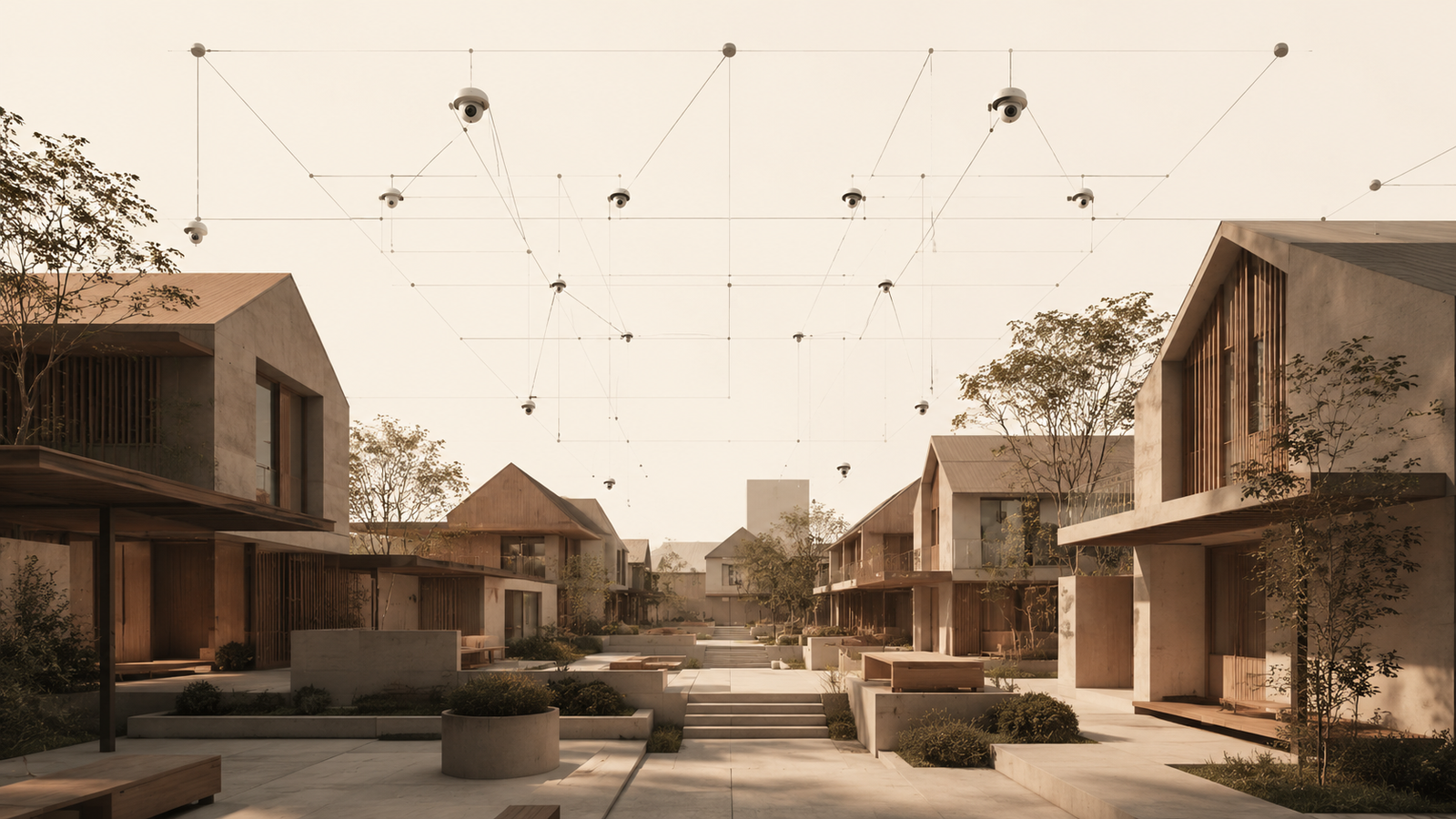
Community surveillance trust begins with a difficult truth: safety can protect a neighborhood, but constant monitoring can change the way that neighborhood breathes.
People want safety. That should not require an apology. Parents want children to come home. Elders want peace on the block. Businesses want less theft. Neighbors want fewer break-ins, fewer threats, and fewer moments where danger feels normal.
Those desires are real.
Still, safety is not the only thing a community needs.
A community also needs trust. It needs familiarity. It needs room for people to belong without feeling studied. It needs the kind of everyday peace that grows when neighbors know one another, correct one another, and care enough to stay connected.
The trouble begins when protection becomes observation.
A camera may help solve a problem. A network of cameras may start changing the culture. A safety system may reduce risk. Constant monitoring may increase suspicion. Those truths can stand together without contradiction.
Community Surveillance Trust Is Fragile
Community surveillance trust depends on balance.
Too little safety weakens a neighborhood. Too much suspicion does the same thing. A healthy community needs protection, but it also needs relationships strong enough to carry daily life without fear becoming the default language.
That is where the cost of constant monitoring shows up.
People behave differently when they feel watched. Children play differently. Teenagers gather differently. Neighbors speak with more caution. Families move through shared space with a different kind of alertness.
Some caution is useful. Not all caution is healthy.
When observation becomes normal, people may start treating one another as potential threats before they treat one another as neighbors. That is a quiet loss. It does not always appear in a budget, crime report, or public safety dashboard.
But the loss is real.
Privacy and Safety Need the Same Table
Privacy and safety often get framed as enemies.
That framing is too small.
Privacy without safety can leave people exposed. Safety without privacy can leave people controlled. A serious community should reject both extremes.
The question is not whether neighborhoods should care about safety. Of course they should.
The sharper question is whether safety tools can operate without hollowing out the social trust that makes a neighborhood worth protecting in the first place.
People do not only need protection from crime. They also need protection from unnecessary suspicion. Families need to know that systems built for safety will not become tools for humiliation, profiling, overreach, or casual monitoring.
That requires structure.
Good intentions are not enough. A camera cannot explain itself. A database cannot show restraint on its own. A platform cannot build trust without rules around access, use, storage, correction, and accountability.
Safety Without Relationship Becomes Distance
Before technology became the default answer, communities relied on relationships.
Neighbors noticed patterns. Elders corrected children. Parents knew who lived nearby. Store owners recognized regular faces. People watched out for one another because connection carried responsibility.
That model was never perfect.
Some communities ignored real harm. Some families carried too much silence. Informal authority sometimes created its own problems. Nostalgia should not clean up what was complicated.
Even so, relationship-based accountability did something technology cannot fully replace.
It made safety personal.
A neighbor who knows your name sees more than movement. A camera sees motion. A person sees context. A neighbor may know the difference between a threat, a misunderstanding, a child making a bad decision, or a young man who needs correction before punishment.
That distinction matters.
When communities lose relationship and replace it only with monitoring, safety becomes colder. It may become faster. It may become more efficient. But it can also become less humane.
Community Surveillance Trust and Social Infrastructure
Social trust holds a community together when formal systems are not enough.
It tells people that the neighbor next door is not automatically an enemy. It teaches children that shared spaces belong to everyone. It helps families ask for help before crisis arrives. It makes correction possible without every conflict becoming a formal report.
Once social trust weakens, every problem gets heavier.
People stop talking. Neighbors gather less often. Families check in less frequently. Trust begins to erode as fewer people assume good faith.
That is not community strength.
It is managed fear.
Constant monitoring can speed up this decline if it teaches people to outsource trust to devices instead of rebuilding trust with one another.
A neighborhood cannot become strong if everyone feels safer behind suspicion than inside relationship.
This is why community surveillance trust must be treated as social infrastructure, not just a technology concern.
Children Learn the Meaning of Public Space
Children pay attention to the atmosphere around them.
Children notice when adults are relaxed. They also recognize when adults become guarded. Many quickly sense when shared spaces feel heavily monitored.
That shapes them.
A child raised under constant monitoring may learn that public space is not shared space. It is inspected space. A teenager may learn that gathering looks suspicious before it looks social. A young person may begin to shrink in places where confidence, responsibility, and belonging should grow.
This is not a small issue.
Communities pass down more than property, values, and stories. They pass down emotional maps. They teach the next generation what it means to walk outside, speak in public, make a mistake, and still remain part of the community.
When every mistake feels recorded, growth becomes harder.
Accountability should teach. Constant suspicion often only warns.
The Difference Between Being Protected and Being Watched
Protection and surveillance are not the same thing.
Protection carries a duty of care. Surveillance carries a duty of attention. Those duties can overlap, but they are not identical.
Protection asks, “What keeps people safe?”
Surveillance asks, “What can be seen?”
A healthy community needs the first question to govern the second. If the ability to see becomes the main standard, the system will keep expanding. More cameras. More data. More access. More storage. More reasons to keep watching.
That is how a tool becomes a habit.
The habit then becomes culture.
Once watching becomes culture, trust has to fight uphill.
Good Families Need Good Public Systems
Family stability does not exist in isolation.
Families are shaped by the conditions around them. Housing, schools, public safety, work, transportation, and neighborhood trust all affect what families can sustain.
That is why this conversation belongs inside Family, Gender & Relationships.
Surveillance is not only a policy issue. It becomes a family issue when it changes how children experience their block. It becomes a relationship issue when neighbors stop assuming good faith. Over time, it becomes a legacy issue when one generation teaches the next that safety means being watched instead of being known.
That is not the inheritance any strong community should accept without question.
Good families need safe streets.
They also need public systems that respect dignity.
Where Accountability Belongs
Safety systems need accountability before they become permanent.
That means clear rules about where monitoring happens, why it happens, who can access information, how long data stays, and how leaders handle misuse.
It also means community members should understand the system before officials ask them to live under it.
Too often, officials announce a system after they make the decision. That is not engagement. That is notification.
Real accountability requires more.
- Residents should know what agencies collect.
- Families should know how officials may use the data.
- Communities should know who can access the system.
- Public agencies should explain how they correct errors.
- Independent review should exist before anyone demands trust.
Without those basics, public safety becomes something done to a community instead of something built with a community.
Why Community Surveillance Trust Must Come First
Trust is easiest to protect before it breaks.
Once people believe authorities are using a system unfairly, every future explanation meets resistance. Once a community feels watched but not heard, every new tool feels like another wall. After families begin to hear safety language as a cover for control, repair takes longer.
That is why governance must come early.
The first article in this cluster, Governance Before Capability, established the central principle. Capability is not permission. The second article, When Public Safety Becomes Infrastructure, showed how safety tools become permanent systems.
This piece brings the question home.
What happens to people when those systems become part of the neighborhood?
The answer depends on whether community surveillance trust grows alongside technology.
Legacy in Motion
A legacy is not only what a family owns.
It is what a family learns to expect from the world.
If children inherit a neighborhood where safety means connection, they learn responsibility. They learn that people can correct each other without destroying each other. They learn that public space can carry dignity.
A different outcome emerges when safety becomes synonymous with constant monitoring. Children may learn caution before confidence. Suspicion before belonging. Visibility before trust.
That is too expensive.
Strong communities do not reject safety. They refuse to let safety become a substitute for relationship.
The real work is not choosing between protection and trust.
The real work is building systems where both can stand.
That is the long-term test of community surveillance trust.
→ Governance Before Capability
→ When Public Safety Becomes Infrastructure
→ Who Governs the Data?
For broader research on privacy, technology, and public trust, see the Pew Research Center’s work on privacy and technology.