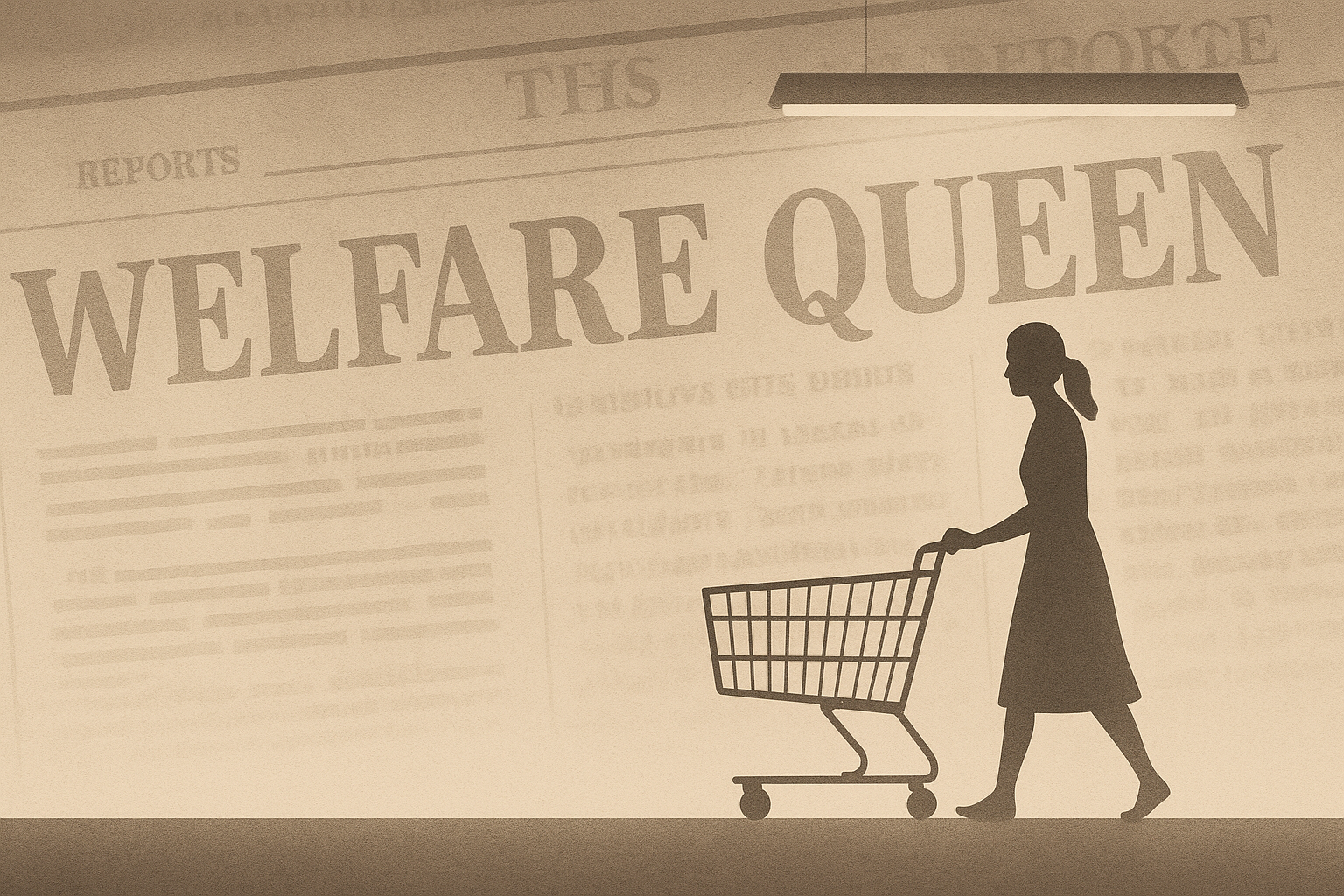
The welfare queen myth became one of the most powerful political stories in modern American welfare policy. It did not describe most families receiving assistance. Instead, it turned rare abuse, racialized suspicion, and political convenience into administrative architecture.
The Welfare Queen Myth Became Policy Design
Every public policy begins with a story. Sometimes the story is supported by evidence. Other times, it is supported by repetition. Over time, repetition can become stronger than evidence because it gives the public a simple villain, a simple explanation, and a simple emotional target.
That is what happened with the welfare queen myth. Once the story hardened, it changed the design logic of welfare policy. Stability stopped being the organizing goal. Control took its place.
As a result, policy attention moved away from low wages, housing volatility, unstable schedules, child care scarcity, family stress, and bureaucratic fragmentation. In their place came verification, sanctions, monitoring, recertification, and administrative friction.
The system stopped asking what families needed to stand. Instead, it started asking whether they could be trusted.
Where the Welfare Queen Myth Came From
The welfare queen narrative gained power because it was emotionally efficient. A handful of fraud stories were elevated into a governing story about public assistance itself. The exception became the frame, and the frame became politically useful.
That story turned structural instability into individual misconduct. It allowed policymakers to speak about poverty as if it were mainly a matter of bad character rather than weak wages, uneven access, housing instability, care burdens, or policy failure.
Once a system is explained through a villain instead of conditions, reform follows the wrong target. Policy begins disciplining people instead of correcting the environment around them. That is the first failure.
This is why the welfare queen myth belongs inside Building Institutional Literacy. The issue is not only what people believed. The issue is how belief moved through institutions and changed the rules families had to survive.
Timeline: From Anecdote to Architecture
The timeline matters because policy memory is long. A phrase can outlive the moment that produced it. Likewise, a stereotype can remain inside a system long after polite language changes.
- 1970s: High-profile fraud stories help turn welfare into a national morality debate.
- 1980s: Political messaging links public assistance with dependency, fraud, and failed personal responsibility.
- 1996: The Personal Responsibility and Work Opportunity Reconciliation Act replaces AFDC with TANF.
- 2000s: Time limits, work requirements, sanctions, and recertification systems become central features of assistance policy.
- Today: Public debate still carries the old frame, even when data points toward instability rather than mass abuse.
The point is not that one phrase alone created every welfare policy change. That would be lazy history. The stronger point is that the phrase gave political language to a broader policy mood: suspicion first, support second.
Why the Story Worked Politically
The narrative did not spread because it was accurate. It spread because it was useful. It gave political actors a clean moral story, justified tighter budgets without sounding openly indifferent, and shifted blame from institutions to recipients.
In addition, the myth turned underinvestment into virtue and restriction into responsibility. That is the quiet trick at the center of the story. A government could fail to build stable conditions and still perform seriousness by building stricter gates.
This is the same operating logic Groundwork Daily has explored in Pander Economics. When the system rewards emotional simplicity, public leaders learn to repeat the story that travels fastest.
Why Political Myths Outlive Evidence
Stories travel faster than datasets. They are easier to repeat, easier to remember, and easier to weaponize. A spreadsheet asks the public to think, while a caricature asks the public to react.
That difference gives the caricature power. Once a stereotype becomes moral shorthand, correcting it requires more effort than repeating it. The public must unlearn a story before it can hear the structure beneath it.
Therefore, political myths do not disappear simply because better data exists. Data needs translation, repetition, trusted messengers, and institutional reinforcement. Otherwise, the myth remains the operating language even after the evidence has moved on.
Who Benefited from the Welfare Queen Narrative
The greatest beneficiary was the policymaker who wanted to appear serious without confronting structural failure. Punitive policy could now be sold as prudence. A government that failed to build stable conditions could still perform discipline by building stricter gates.
In that arrangement, the myth did more than stigmatize recipients. It protected weak governance from deeper scrutiny. Instead of asking why families faced recurring instability, the system asked whether families deserved help.
That question changed the architecture. Once deservingness became the center, stability became secondary. This is where welfare policy drifted away from family support and toward administrative suspicion.
How Narratives Become Public Policy
A narrative does not become policy all at once. It moves through a chain. First, a story defines the problem. Then public opinion absorbs the frame. After that, political incentives reward leaders who repeat it.
Eventually, law turns the story into eligibility rules, limits, penalties, and mandates. Agencies then convert the law into forms, notices, appointments, compliance systems, and sanctions. Finally, households encounter the original story as paperwork, waiting, surveillance, and loss of time.
- Story: A repeated claim defines the problem.
- Public opinion: Voters absorb the frame and treat it as common sense.
- Political incentive: Elected officials respond because the frame creates electoral reward.
- Legislation: Law turns the story into eligibility rules, limits, penalties, and mandates.
- Agency rules: Administrators convert law into forms, notices, appointments, and compliance systems.
- Family experience: Households encounter the story as paperwork, waiting, surveillance, and instability.
That is how myth becomes infrastructure. It does not need to remain visible. It only needs to shape the rules.
How the Welfare Queen Myth Distorts Reality
Real life does not look like the caricature. Most families who use public assistance are navigating work instability, caregiving demands, inconsistent income, temporary job loss, housing pressure, health stress, or periods of economic disruption.
Many move through systems that are already strict, time-limited, conditional, and bureaucratically difficult. The myth erases those constraints and flattens lived instability into presumed avoidance.
That distortion does not stay in opinion. It changes how the public interprets need and how policy justifies obstruction. Over time, the system becomes more interested in guarding against the imagined abuser than stabilizing the real household.
What Families Actually Face
Eligible families often encounter repeated documentation requests, recertification cycles, sanctions, office delays, digital portal failures, appointment conflicts, transportation barriers, and eligibility churn. These are not minor administrative side effects.
They are operational burdens built into the experience of seeking help. Moreover, they land hardest on households already managing time poverty, unstable work schedules, child care gaps, and limited transportation options.
Administrative Burden Is a Policy Choice
Administrative burden is what a person must learn, prove, submit, repeat, and endure before support becomes real. It is not neutral. It is design.
There are learning costs. Families must figure out rules, deadlines, portals, office hours, required documents, eligibility exceptions, and appeal rights. Meanwhile, the system often assumes users already know how to navigate it.
There are compliance costs. Families must gather paperwork, attend appointments, answer notices, arrange transportation, correct errors, upload documents, wait on phone lines, and prove information that agencies may already hold elsewhere.
There are also psychological costs. Families must absorb suspicion, shame, confusion, delay, and the threat that one missed step can remove support. These burdens do not hit stable households the hardest. They hit households already under pressure.
That is why friction becomes policy by another name.
Welfare Policy by Story Instead of Evidence
Once suspicion becomes the operating logic, systems stop optimizing for stability. Instead, they optimize for control. Monitoring expands, access tightens, friction increases, and success gets measured by how aggressively a system can guard itself.
That is a bad metric. A system can be strict and still fail families. It can also reduce access without reducing poverty. In practice, the question is not whether a system can perform seriousness. The question is whether it improves stability.
When Oversight Becomes the Point
Fraud exists. That has to be said plainly. However, fraud is not the center of the system. Good governance investigates misuse. It does not design an entire safety net around rare abuse.
Airports screen passengers, but they do not assume every traveler is a terrorist. Insurance companies investigate claims, but they do not presume every claimant is committing fraud. Public assistance should follow the same standard.
Oversight belongs inside the system. It should not become the purpose of the system. When oversight becomes the priority, access becomes the casualty.
The result is predictable. Eligible families lose time, continuity, and sometimes support altogether because the system was built to detect misuse more aggressively than it was built to reduce instability.
What the Numbers Reveal
TANF replaced AFDC in 1996 and became a fixed block grant to states. That structure gave states broad flexibility, but it also weakened the direct cash safety net because funding no longer automatically adjusted to need in the same way.
The federal TANF block grant has remained at $16.5 billion each year since 1996. According to CBPP, after inflation, its real value has fallen by roughly 40 percent. That dated source context matters because it shows how a fixed nominal figure can quietly lose stabilizing power over time.
TANF also reaches far fewer poor families than the prior AFDC system. CBPP reports that in 2020, only 21 out of every 100 families in poverty received TANF benefits, compared with 68 out of every 100 in 1996.
The same evidence shows another design problem. In 2020, states spent only 22 percent of TANF funds on basic assistance and only 10 percent on work, education, and training. These numbers do not support the myth of runaway generosity.
Instead, they show a narrowed safety net, reduced reach, weakened cash assistance, and a program often organized around control rather than family stability.
Why the Year of Welfare Data Matters
Welfare data must be dated because program rules, poverty rates, inflation, state policy, labor markets, and benefit access change over time. A TANF statistic from 1996, 2020, or 2024 does not carry the same meaning unless the reader knows the year and the source.
This is not cosmetic. It is credibility infrastructure. Dated data helps readers see whether a claim describes a historical baseline, a current condition, or a long-term trend.
For this article, the 1996 comparison matters because that was the year welfare reform replaced AFDC with TANF. The 2020 data matters because it shows how far TANF reach and spending priorities had shifted after more than two decades of implementation.
The article should not pretend all welfare data is timeless. It is not. Policy design changes. State choices change. Funding loses value. Administrative burdens grow or shrink. Therefore, the year must travel with the claim.
What Evidence-Based Welfare Design Should Measure
Serious policy does not begin with deservingness theater. It begins with outcomes. A competent welfare system should ask whether families are becoming more stable over time.
That means measuring housing continuity, school attendance, employment consistency, income durability, reduced crisis recurrence, child well-being, and the ability of families to move through temporary disruption without falling into deeper instability.
Compliance matters, but compliance alone is not a success metric. A family can complete paperwork and remain unstable. Likewise, a system can sanction many households and still fail to reduce hardship.
Design for Real Conditions
Good design accounts for the conditions families actually live inside. Work schedules change. Child care breaks. Transit fails. Income fluctuates. Health needs interrupt plans. Digital access varies. Notices get missed because households are already overloaded.
Systems that ignore those realities do not produce discipline. They produce churn. This is where Policy Is Parenting at Scale becomes central. Public systems shape the home before private choices begin.
The Governing Question
The real question is not whether a system can appear strict. The real question is whether it can reliably help people regain footing without forcing them through unnecessary barriers first.
- Measure durability: track housing, employment, school continuity, and income stability over time.
- Reduce friction: simplify documentation loops and recertification processes that punish time poverty.
- Design for real life: build around shift work, caregiving burdens, transit unreliability, and uneven earnings.
- Audit policy language: remove administrative assumptions of guilt and replace them with stabilization logic.
- Separate fraud control from program purpose: investigate misuse without treating every applicant as a suspect.
The Systems Model
The welfare queen myth matters because it shows how a story becomes a system. The path is not mysterious. Narrative creates public opinion. Public opinion creates political incentive. Political incentive creates law. Law creates agency rules.
Then agency rules become paperwork, sanctions, appointments, waiting rooms, portals, notices, deadlines, and churn. By the time the family encounters the system, the myth no longer sounds like a speech. It feels like process.
- Narrative: poverty gets framed as fraud.
- Public opinion: suspicion becomes common sense.
- Political incentive: leaders gain reward for sounding tough.
- Legislation: moral judgment becomes law.
- Agency rules: law becomes forms, sanctions, and compliance checks.
- Administrative burden: families lose time, access, and continuity.
- Family stability: the household absorbs the cost.
That chain is the real lesson. Bad stories do not stay in speeches. They become process.
The System: Updated
The welfare queen myth did not endure because it was true. It endured because it was convenient.
It gave the state a villain instead of forcing it to confront structural fragility. It let policy perform toughness while delivering friction. It turned suspicion into design.
However, convenience is not a governing principle. Stability is.
A welfare system should not be judged by how well it dramatizes abuse. It should be judged by whether it reduces recurrence, lowers friction, and helps families build continuity that lasts.
The next step is not softer language. It is stronger design. Measure what stabilizes families, remove what only proves suspicion, and build policy that can tell the difference.
The Groundwork
Political myths become dangerous when they stop sounding like rhetoric and start operating as rules. The welfare queen myth became administrative architecture. A serious welfare system must reverse that design by replacing suspicion with evidence, friction with access, and control with durable family stability.
FAQ: Welfare Queen Myth and Welfare Policy
Is the welfare queen stereotype true?
No. The stereotype exaggerates rare fraud cases and treats them as representative. Most people receiving assistance are dealing with work instability, caregiving demands, temporary hardship, or economic disruption.
How did the welfare queen myth influence welfare policy?
The myth helped normalize stricter eligibility rules, more monitoring, sanctions, time limits, and heavier administrative burdens. As a result, the policy frame shifted toward fraud prevention and away from long-term stability outcomes.
Why is the welfare queen narrative misleading?
It turns structural pressure into a story about personal failure. That obscures the real drivers of instability, including low wages, high housing costs, inconsistent work hours, child care shortages, and bureaucratic complexity.
What is administrative burden?
Administrative burden is the time, knowledge, paperwork, travel, stress, and compliance effort people must spend to access a public benefit or service.
What is TANF?
TANF stands for Temporary Assistance for Needy Families. It replaced Aid to Families with Dependent Children in 1996 and gives states flexible federal block grant funding for certain family assistance purposes.
Why does TANF data need dates?
TANF data needs dates because funding value, state rules, poverty conditions, access rates, and spending patterns change over time. A dated source helps readers understand what the number measures and when it was true.
What should welfare systems measure instead?
Welfare systems should measure whether families become more stable over time through stronger housing continuity, employment consistency, school attendance, income durability, and reduced recurrence of crisis.
Understand the Systems Behind Public Policy
Groundwork Daily explains how institutions, incentives, myths, budgets, and policy systems shape everyday life.
Subscribe for clear analysis that separates structure from spectacle.
Subscribe to Groundwork Daily