CROWN Act Explained
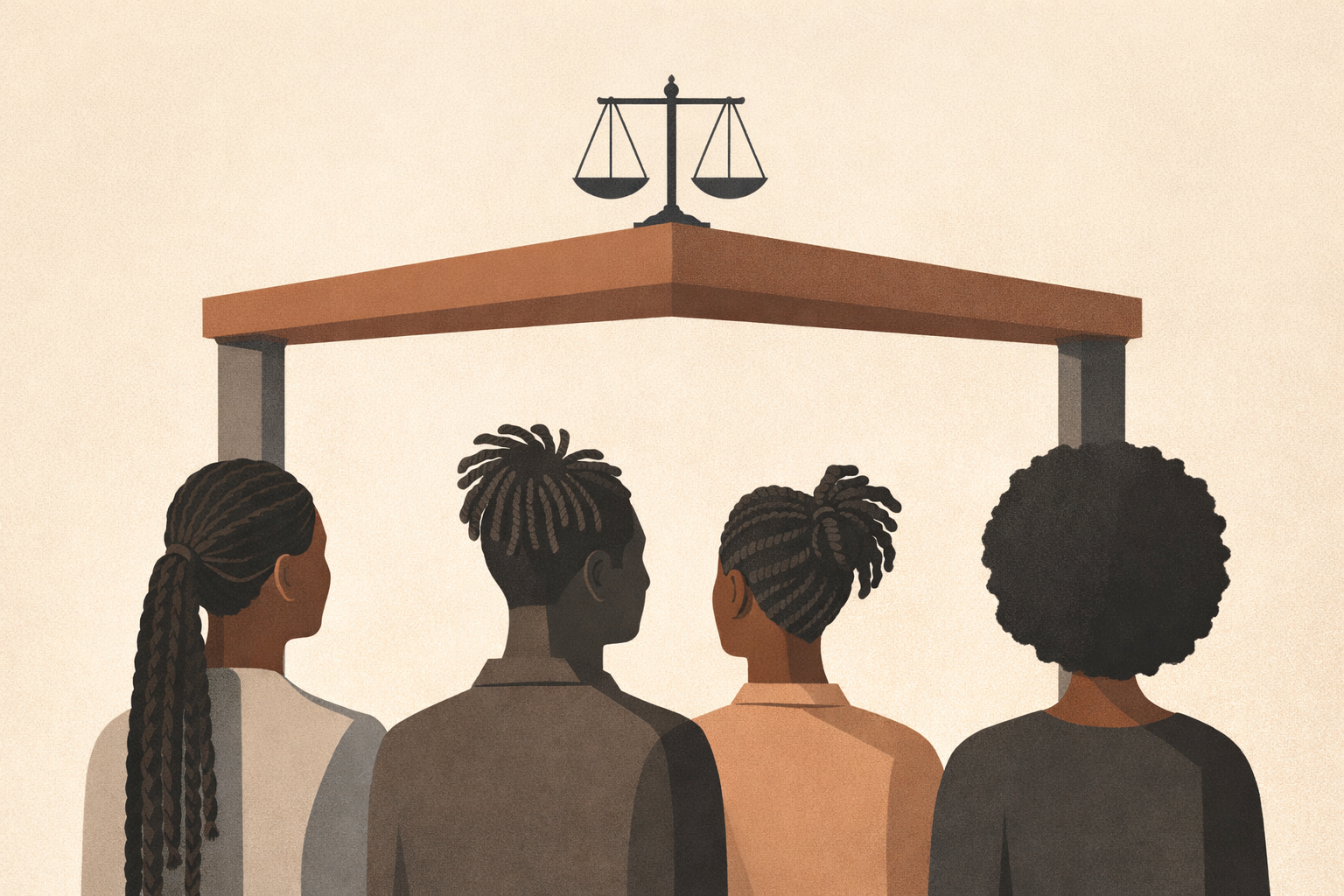
CROWN Act explained: The CROWN Act, short for Create a Respectful and Open World for Natural Hair, is legislation designed to prevent discrimination tied to natural hair texture and protective hairstyles such as braids, locs, twists, knots, and afros.
The law exists because hair discrimination often hides inside ordinary language. A policy may say “professional,” “neat,” “conservative,” or “appropriate.” On paper, those words appear neutral. In practice, they can carry cultural assumptions about whose appearance belongs in a workplace and whose appearance must be corrected before entering it.
That is the core issue.
The CROWN Act is not about removing standards. It is about making sure standards do not become a quiet mechanism for racial exclusion.
Workplace appearance policies often present themselves as neutral rules of professionalism. But many grooming standards developed around narrow cultural norms. When those norms treat straight hair as clean, polished, and acceptable while treating tightly coiled hair or protective styles as unprofessional, the issue moves beyond style.
It becomes access.
Debates about grooming policies do not exist in isolation. They sit within the broader politics of Black hair, where history, culture, workplace policy, identity, and institutional power intersect. Understanding that larger context helps explain why hair discrimination has become a legal and social issue rather than simply a matter of personal preference.
The CROWN Act protects natural hair texture and protective hairstyles from discrimination in jurisdictions where it has been adopted.
The law addresses policies that appear neutral but disproportionately affect Black people and others with textured hair.
Workplace standards are still allowed when they are tied to safety, hygiene, or legitimate job requirements.
The issue is not whether employers can have rules. The issue is whether those rules unfairly penalize cultural identity.
What the CROWN Act Changes
The CROWN Act clarifies that discrimination based on natural hair texture and protective styles can fall within race-based civil rights protections.
That clarification matters because discrimination does not always appear as a direct racial statement. An employer may not say that Black employees are unwelcome. A school may not say that Black students are being singled out. Instead, the institution may ban certain hairstyles and claim the rule applies to everyone equally.
The problem is that equal wording does not always create equal impact.
A rule that bans locs, braids, twists, afros, or other natural styles may appear race-neutral. But if those styles are strongly connected to Black identity, hair texture, maintenance, and culture, the policy can function as indirect discrimination.
The CROWN Act closes that gap.
It recognizes that race is not only about skin color. Race can also be connected to traits historically associated with race, including hair texture and protective styles.
That is the law’s central move.
It shifts the conversation from surface appearance to protected identity.
Why the CROWN Act Was Needed
The CROWN Act was needed because traditional civil rights language did not always capture the way appearance-based discrimination works.
In many workplaces, Black employees have faced pressure to cut, straighten, cover, or alter their hair to fit a narrow idea of professionalism. In schools, students have faced discipline or exclusion because their hair did not comply with dress codes. In public-facing roles, employees have sometimes been told their natural hair was distracting, inappropriate, or inconsistent with brand image.
That pattern is not small.
It creates a choice no person should be forced to make: keep cultural identity visible and risk penalty, or conform to an external standard to preserve access.
This is where the legal issue becomes structural.
Hair discrimination can affect hiring. It can affect promotion. It can affect discipline. It can affect school participation. It can affect confidence, belonging, and economic mobility.
Once an appearance policy creates those consequences, it is no longer a minor grooming matter.
It becomes a governance problem.
Why Workplace Policy Became the Battleground
Workplaces became the battleground because employment is where appearance standards often carry financial consequences.
A person can ignore a stranger’s opinion. It is harder to ignore an employer’s rule when income, advancement, health insurance, scheduling, reputation, and career mobility are attached to compliance.
That is why workplace grooming policies matter.
The issue is not whether employees should meet standards. They should. The issue is whether those standards are tied to actual job requirements or merely inherited assumptions about what professionalism is supposed to look like.
A food service employer can require hair restraints for hygiene. A manufacturing employer can require hair to be secured for safety. A theater, hospital, school, or office can require reasonable grooming standards tied to operations.
Those are functional requirements.
But when a policy bans locs because they are seen as unpolished, restricts braids because they are considered distracting, or treats afros as inherently less professional, the rule leaves operations and enters discrimination.
That is where the CROWN Act enters.
It forces institutions to separate legitimate standards from cultural bias.
Why “Professionalism” Can Become a Code Word
Professionalism should describe behavior.
It should point to reliability, competence, preparation, communication, role clarity, timeliness, judgment, and respect for the work.
But professionalism has often been expanded to include appearance norms that reflect one cultural standard more than others.
That is the danger.
When professionalism becomes a code word for assimilation, institutions can penalize difference while claiming to protect standards.
This does not mean appearance is irrelevant. Presentation still matters. Context matters. Role requirements matter. Hygiene matters. Safety matters.
But precision matters too.
If a rule protects health, safety, or operational function, it should be written that way. If a rule simply reflects discomfort with natural hair or protective styles, it should not survive scrutiny.
That distinction is not political correctness.
It is policy discipline.
Hair Discrimination in Schools
The CROWN Act is often discussed through employment, but schools are just as important.
For many children, school is the first institution that teaches them whether their natural appearance is acceptable. Dress codes, uniform rules, photo policies, athletic rules, graduation policies, and disciplinary standards all communicate what belongs.
When a student is punished for braids, beads, locs, twists, or natural volume, the message lands deeper than the rule itself.
The student learns that identity can be treated as disruption.
That lesson has consequences.
It can shape confidence. It can affect attendance. It can interrupt learning. It can create unnecessary conflict between families and schools. It can also teach other students that some forms of cultural expression deserve correction.
Schools should maintain standards. But those standards must be tied to learning, safety, and order, not cultural erasure.
If a hair policy creates exclusion where no real operational problem exists, the rule is not protecting education.
It is producing harm.
State, Local, and Federal Legal Status
The CROWN Act has been adopted in many states and local jurisdictions, but coverage is not uniform across the United States.
That distinction matters.
Some states have enacted CROWN Act protections. Some cities and counties have adopted related measures. Federal legislation has been introduced, but nationwide protection remains incomplete unless and until federal law is enacted.
That means protection may depend on location, employer type, school system, and the specific legal language adopted in that jurisdiction.
This is where weak explanations often fail.
It is not accurate to say that the CROWN Act automatically protects everyone everywhere in the United States. It is more accurate to say that the CROWN Act is a legislative model and policy movement that has produced protections in many jurisdictions while federal adoption remains a continuing issue.
For workers, students, parents, and employers, this means the first step is always local verification.
Look at state law. Look at city or county rules. Review employer policy. Review school policy. Then compare the policy language against the protections that apply where the person lives, works, or studies.
What Employers Should Do
Employers should not wait for conflict before reviewing grooming policies.
The smarter move is policy audit before complaint.
A strong employer review should ask several practical questions.
Does the policy clearly explain the operational reason for each appearance requirement?
Does the policy distinguish safety and hygiene rules from subjective appearance preferences?
Does the language unfairly target or burden hairstyles associated with race, ethnicity, religion, or culture?
Are managers trained to apply grooming standards consistently?
Is there a process for requesting clarification or accommodation?
Are employees being evaluated on job performance or on cultural comfort?
These questions are not paperwork exercises. They reduce risk. They also improve organizational trust.
Good policy protects the employer and the employee at the same time.
Bad policy creates ambiguity, resentment, liability, and reputational damage.
What the CROWN Act Does Not Mean
The CROWN Act does not mean all grooming standards disappear.
That is a lazy objection.
Employers and schools may still maintain legitimate standards. They may still require cleanliness. They may still enforce safety rules. They may still set expectations related to uniforms, protective equipment, food handling, machinery, athletics, laboratory work, performance environments, or other role-specific conditions.
The key issue is justification.
A standard tied to safety is different from a standard tied to discomfort.
A requirement to secure hair around equipment is different from a ban on locs.
A rule requiring hair to be clean and maintained is different from a rule requiring hair to resemble a Eurocentric idea of neatness.
That is the line.
The CROWN Act does not eliminate standards. It disciplines them.
Examples of Policy Language That Needs Review
Many problematic rules do not appear openly discriminatory. They appear vague.
That vagueness gives managers room to enforce personal bias.
Policies should be reviewed carefully when they use phrases such as “extreme hairstyles,” “distracting hair,” “unkempt appearance,” “conservative styles only,” “neat professional hair,” or “hair must be appropriate for the brand” without defining what those terms mean.
Those phrases may not be automatically unlawful. But they should raise a governance flag.
Vague standards create inconsistent enforcement. Inconsistent enforcement creates risk.
Better policy language should define the business reason. If the concern is food safety, say food safety. If the concern is machinery, say machinery. If the concern is visibility of protective equipment, say protective equipment.
Precision protects everyone.
Why This Is Not Just About Hair
The CROWN Act is about hair, but the deeper issue is identity under institutional pressure.
Hair is one of the most visible ways culture travels through everyday life. It appears before a person speaks. It can signal family, faith, region, history, care practice, fashion, self-expression, or community belonging.
That visibility makes hair vulnerable to regulation.
Institutions often control what they can see.
That is why hair becomes a policy issue. It sits at the intersection of appearance, identity, economics, and authority. The employer sees it. The school sees it. The public sees it. Then the institution decides whether it belongs.
That decision carries power.
When institutions define normal too narrowly, they force people to edit themselves to gain access.
The CROWN Act challenges that bargain.
How This Fits the Black Hair Cluster
This article is the legal and workplace branch of the broader Black hair discussion.
The larger historical and cultural framework belongs in The Politics of Black Hair. That piece explains how hair became tied to power, identity, beauty standards, and public life.
The economic side belongs in The Economics of the Black Hair Industry, where consumer demand, ownership, product markets, and beauty supply systems become the main issue.
The technical side belongs in Understanding Natural Hair: Texture, Science, and Maintenance and Hair Types Explained: The 1A–4C Curl Pattern Guide.
Together, these pieces form a stronger system.
History explains the pressure. Law responds to the pressure. Economics follows the demand. Science explains the maintenance. Identity explains why it matters.
The Groundwork Perspective
The CROWN Act explained properly is not a story about special treatment.
It is a story about whether institutions can tell the difference between standards and bias.
That difference matters.
Standards protect the function of an institution. Bias protects the comfort of people who already define the norm.
When a workplace or school bans natural hair textures or protective styles without a legitimate reason, it is not preserving professionalism. It is narrowing access.
The stronger institution does not need vague rules to maintain order.
It writes precise rules. It trains managers. It reviews outcomes. It corrects bias before conflict becomes public.
The CROWN Act does not ask institutions to abandon standards.
It asks them to prove the standard is real.
That is the work.
- The Politics of Black Hair: History, Identity, and Power
- The Economics of the Black Hair Industry
- Understanding Natural Hair: Texture, Science, and Maintenance
- Hair Types Explained: The 1A–4C Curl Pattern Guide
- Language Builds the Mirror We Live In
- System Updates: When Language Becomes Self-Weaponization
Frequently Asked Questions About the CROWN Act
What does the CROWN Act stand for?
The CROWN Act stands for Create a Respectful and Open World for Natural Hair. It is designed to prevent discrimination based on natural hair texture and protective hairstyles.
What hairstyles does the CROWN Act protect?
The CROWN Act commonly protects natural hair textures and protective hairstyles such as braids, locs, twists, knots, afros, and similar styles associated with race and cultural identity.
Does the CROWN Act apply everywhere in the United States?
No. Many states and local jurisdictions have adopted CROWN Act protections or similar laws, but nationwide federal protection remains incomplete unless federal legislation is enacted. Legal coverage depends on location and specific policy language.
Can employers still have grooming standards?
Yes. Employers can still enforce grooming standards tied to safety, hygiene, uniforms, protective equipment, or legitimate job requirements. The issue is whether the standard is functional or discriminatory.
Why is hair discrimination considered race discrimination?
Hair discrimination can be considered race discrimination when a rule targets or disproportionately burdens traits historically associated with race, including natural hair texture and protective hairstyles common among Black people.
What should employees do if they believe a hair policy is discriminatory?
Employees should document the policy, save related communications, review local and state protections, consult human resources if appropriate, and seek guidance from an employment rights organization or qualified legal professional.