

The CROWN Act is not simply a dispute about hairstyles. It asks a deeper institutional question: when a workplace or school regulates appearance, is the rule protecting a legitimate function, or is it converting a cultural preference into a condition of access?
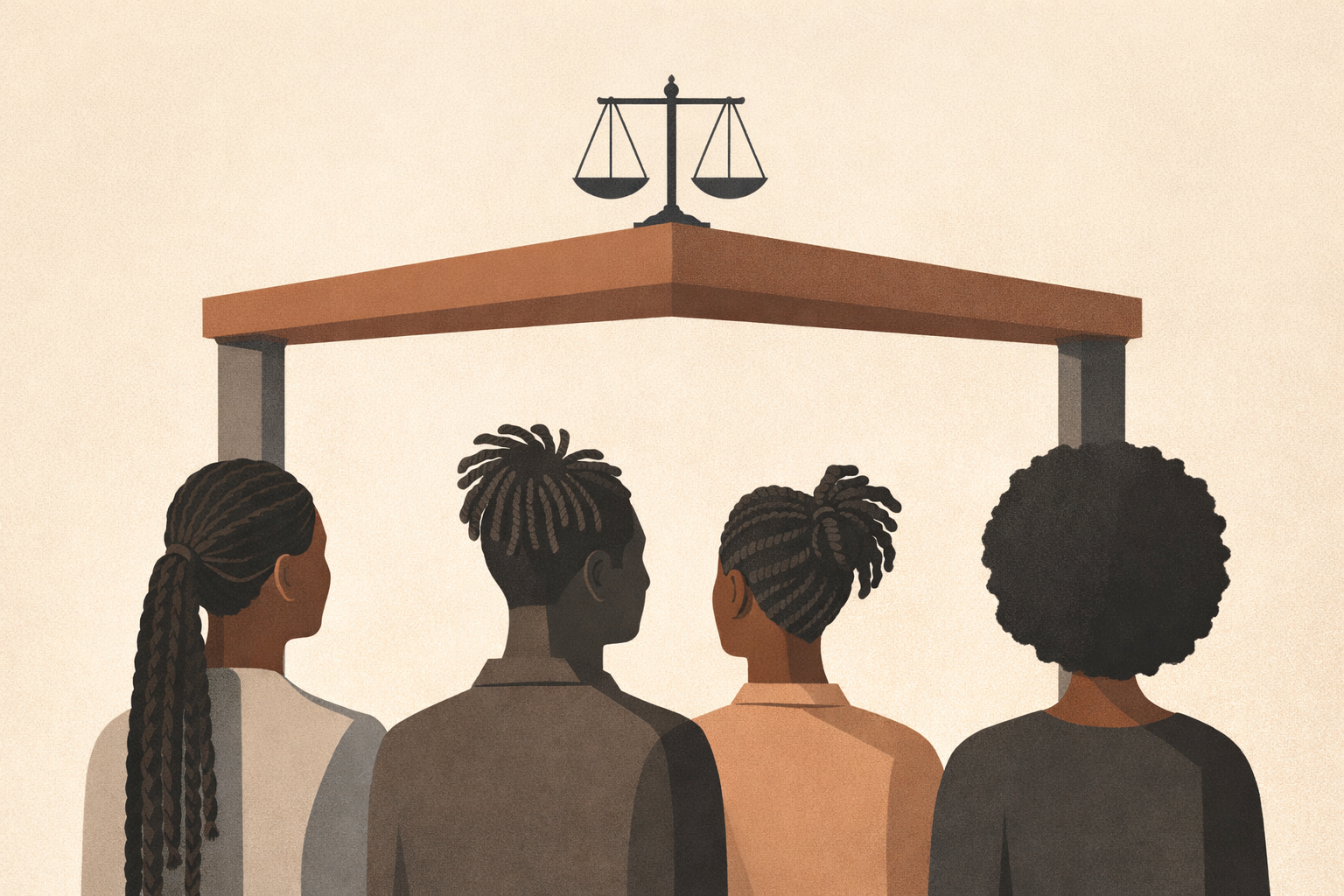
The CROWN Act explained simply: it is a legal effort to make clear that discrimination based on natural hair texture and protective hairstyles associated with race can constitute race discrimination.
The name stands for Create a Respectful and Open World for Natural Hair. Versions of the law have been adopted in states and local jurisdictions across the United States. The exact protection available to a worker, student, applicant, or family therefore depends on where the person lives and which law governs the institution involved.
But the policy problem is larger than the acronym. For generations, schools and employers have used appearance rules that treated straightened or Eurocentric hair conventions as ordinary while treating Afros, braids, locs, twists, knots, and other Black hair practices as unusual, distracting, unprofessional, or inappropriate.
Standards are legitimate when they protect a defensible function. They become harder to defend when cultural preference is disguised as institutional necessity.
That distinction is the center of this article. The CROWN Act is about hair, but it is also about how institutions build standards, how those standards acquire authority, and what happens when a supposedly neutral rule carries a cultural assumption inside it.
What the CROWN Act Actually Changes
Existing federal civil-rights law already prohibits race discrimination in employment. Hair texture and other physical characteristics associated with race can fall within that protection. Federal enforcement guidance also recognizes that grooming practices and appearance standards can create discrimination when they are applied differently, enforced unevenly, or produce unlawful racial effects.
The problem has been less simple when disputes involve a hairstyle rather than hair texture itself. Courts and institutions have not always treated protective hairstyles and natural hair practices in the same way. That distinction created room for rules that could prohibit braids, locs, twists, or similar styles while being presented as race-neutral grooming policies.
CROWN Act legislation responds by making the connection more explicit. Depending on the jurisdiction, the law may define race to include traits historically associated with race, including hair texture and protective hairstyles.
A legal protection is easier to apply when the protected characteristic is named. Explicit statutory language reduces the space between an institution saying “we do not discriminate by race” and a policy that nevertheless penalizes a race-associated hairstyle.
That does not mean every hair dispute automatically becomes unlawful discrimination. It means the institution has a more demanding question to answer about what its rule restricts, why the restriction exists, and how the rule is enforced.
Why Existing Discrimination Law Left a Gap
Anti-discrimination law often has to decide where identity ends and personal choice begins. That sounds straightforward until the characteristic in question sits at the intersection of biology, culture, maintenance, expression, and social expectation.
Hair exposes that difficulty clearly. Texture can be a physical characteristic associated with race. Hairstyle involves choice, but the available choices are shaped by that texture, cultural practice, maintenance needs, history, cost, and workplace expectations.
Older legal reasoning sometimes placed significant weight on whether a characteristic was considered changeable. That approach could produce a strange institutional result: discrimination against natural texture might receive scrutiny while a rule requiring a person to alter how that texture is worn could be treated differently.
The CROWN Act movement challenges that gap. It asks lawmakers and institutions to look beyond the narrow question of whether hair can physically be changed and examine whether the demanded change itself carries a racial burden.
The Real Issue Is Institutional Standards
Institutions need standards. A hospital can require hair to be secured around equipment. A food-service operation can enforce sanitation rules. A laboratory can require protective equipment to fit correctly. A school can regulate genuine safety hazards. Employers can establish reasonable appearance expectations.
The existence of a standard is not the problem.
The harder question is what the standard is actually doing.
Protects safety, sanitation, identification, equipment operation, job performance, or another legitimate institutional requirement.
Treats one aesthetic convention as inherently cleaner, more orderly, more serious, or more professional without a defensible operational reason.
Institutions get into trouble when they confuse those categories.
Consider words such as neat, professional, appropriate, conservative, or well-groomed. Those words are not automatically discriminatory. Yet they are interpretive. Someone must decide what they mean.
If the unstated visual reference point is straight hair, a policy can impose a cultural hierarchy without ever naming race.
When “Professionalism” Becomes a Code Word
Professionalism is useful when it describes conduct: reliability, competence, preparation, communication, ethical behavior, respect for colleagues, and the ability to perform the work.
It becomes less reliable when an institution uses the word to enforce aesthetic familiarity. At that point, “professional” can quietly mean “looks like the people who historically held authority here.”
That is how a cultural preference can become an access rule.
A manager may believe a hairstyle looks informal. A hiring committee may think locs are distracting. A school administrator may describe braids as inconsistent with a traditional appearance policy. None of those judgments needs to be expressed in explicitly racial language for the rule to deserve scrutiny.
Ask four questions:
- What legitimate function is this appearance rule protecting?
- Would that function still be protected if the employee or student wore the disputed hairstyle?
- Is the rule enforced consistently across racial and cultural groups?
- Are we regulating performance or merely regulating familiarity?
If the institution cannot answer those questions clearly, the standard deserves review.
How Hair Discrimination Appears at Work
Hair discrimination does not always arrive as a written policy saying that Black hairstyles are prohibited. More often, it appears through discretionary judgments made during hiring, promotion, customer-facing assignments, performance conversations, or enforcement of a broadly written grooming code.
An applicant may be told that locs do not fit the company image. An employee may be encouraged to straighten natural hair for an important presentation. Braids may suddenly become a problem when an employee moves into a customer-facing role. A policy may allow considerable variation among some employees while treating Black hairstyles as exceptions.
These situations matter because employment systems do not distribute opportunity only through salaries and job titles. They also distribute opportunity through subjective judgments about who appears credible, polished, leadership-ready, or representative of the organization.
When appearance becomes part of that judgment, cultural assumptions can enter decisions that look unrelated to race.
What Employers Should Review
Employers do not need to abandon grooming policies. They do need to know what those policies are accomplishing.
- Remove blanket prohibitions on race-associated natural and protective hairstyles unless a specific lawful justification applies.
- Replace vague aesthetic language with objective operational requirements where possible.
- Separate safety and sanitation requirements from personal taste.
- Review whether managers enforce the same rule differently across employees.
- Train supervisors to distinguish job-performance concerns from assumptions about appearance.
- Review hiring, promotion, and customer-facing standards for coded appearance expectations.
- Check state and local law rather than assuming federal law is the only governing authority.
A strong policy should be explainable without relying on “that is just how professional people look here.”
Hair Discrimination in Schools
The same institutional problem can appear in schools, where dress codes and grooming rules govern students who have far less bargaining power than adult employees.
A student may be told that locs violate a length rule, that braids violate an appearance standard, or that a protective hairstyle is distracting. The immediate consequence may be discipline, exclusion from an activity, pressure to alter the hairstyle, or lost classroom time.
The larger consequence is institutional. A school is teaching students which forms of presentation count as ordinary and which require correction.
That is why the issue cannot be reduced to personal preference. School rules communicate civic and social expectations at the same time that they enforce conduct.
Schools still retain legitimate interests in safety, participation, uniforms, identification, and orderly operations. The institutional responsibility is to write those requirements around the actual function rather than around an inherited cultural image of what a compliant student should look like.
Where CROWN Act Protections Apply
There is no single answer that applies identically to every person in the United States. Hair-discrimination law is a layered system.
Federal civil-rights law can already reach certain forms of race-based hair discrimination, particularly discrimination involving hair texture, unequal treatment, or employment practices that violate Title VII. State and local CROWN laws can provide more explicit protection for natural hair and protective hairstyles.
As a result, two similar incidents in different jurisdictions may involve different statutes, agencies, definitions, filing procedures, remedies, and legal theories.
- Identify the state and locality where the conduct occurred.
- Determine whether the issue involves employment, education, housing, public accommodations, or another setting.
- Check whether state or local law expressly protects hair texture or protective hairstyles.
- Review applicable federal civil-rights protections.
- Check filing deadlines before delaying action on a specific dispute.
Legal rights depend on jurisdiction and facts. A national article can explain the structure, but it cannot substitute for checking the law that governs a particular case.
What Workers and Families Should Look For
Not every uncomfortable comment creates a legal claim, and not every grooming rule is discriminatory. Still, people can evaluate the structure of a dispute more effectively when they preserve the relevant facts.
If a workplace or school challenges a hairstyle, useful information may include the written grooming policy, emails or messages about the rule, photographs where relevant, disciplinary records, dates, names of decision-makers, and examples of how comparable rules were applied to other people.
The objective is not to turn every disagreement into litigation. It is to move the question away from memory and impression and toward the operating record.
Accountability gets stronger when the standard and its enforcement can both be examined.
What the CROWN Act Does Not Mean
The CROWN Act is sometimes discussed as though it eliminates grooming standards. That is not the governing idea.
Institutions can still establish rules connected to legitimate operations. Depending on the setting and applicable law, employers and schools may address safety hazards, hygiene, protective equipment, contamination risks, identification requirements, uniform rules, or other genuine functional concerns.
The difference is that the institution should be able to explain the restriction in terms of the function being protected.
Requiring long hair to be secured around moving machinery regardless of texture or style.
Declaring locs or braids inherently unprofessional without identifying a job-related function.
Requiring hair containment in a food-production environment for sanitation reasons.
Applying a vague “neat appearance” rule more aggressively to Black employees or students.
This is why the strongest version of the debate is not “rules versus freedom.” It is defensible standards versus inherited assumptions.
Policy Language That Deserves Review
Some policy language creates risk because it prohibits a specific race-associated hairstyle. Other language creates risk because it gives decision-makers broad discretion without defining the operational standard.
Terms such as “extreme hairstyles,” “distracting hair,” “unconventional styles,” or “professional appearance” should prompt a simple question: professional according to what measurable requirement?
The solution is not necessarily a longer handbook. Often, the better solution is a more precise one.
Instead of regulating the cultural form of the hairstyle, regulate the actual operational issue.
If the concern is machinery, define the securing requirement. If the concern is sanitation, define containment. If the concern is identification, define visibility. If the concern is protective equipment, define fit and safety.
Precision makes the rule easier to understand, easier to enforce consistently, and easier to defend.
Why Hair Cannot Be Separated From the Larger System
The legal debate makes more sense when hair is understood as more than an aesthetic choice. Groundwork Daily’s analysis of the politics of Black hair examines how appearance became connected to identity, respectability, authority, and social acceptance.
There is also an economic layer. The economics of the Black hair industry show how maintenance, products, services, ownership, and consumer behavior form a substantial system around the choices people are expected or encouraged to make.
At the individual level, understanding natural hair texture and maintenance helps explain why a supposedly simple instruction to “change the hairstyle” can carry different costs depending on texture and routine. Readers looking for the underlying texture vocabulary can also use Groundwork Daily’s 1A–4C curl-pattern guide.
These are different parts of the same institutional story. Culture defines expectations. Markets respond to those expectations. Individuals absorb them. Institutions then decide which expectations become rules.
Frequently Asked Questions About the CROWN Act
What does CROWN Act stand for?
CROWN stands for Create a Respectful and Open World for Natural Hair. CROWN Act laws generally seek to protect people from discrimination involving natural hair texture and protective hairstyles associated with race.
What hairstyles can CROWN Act laws protect?
Exact statutory language varies by jurisdiction. CROWN laws commonly address natural hair texture and protective hairstyles such as braids, locs, twists, knots, Afros, and related styles associated with race.
Does the CROWN Act apply everywhere in the United States?
No single state or local CROWN statute applies nationwide. Federal civil-rights law already prohibits certain forms of race-based hair discrimination, while states and localities may provide additional explicit protections. Readers should verify the law governing their jurisdiction.
Can an employer still require employees to follow grooming standards?
Yes. Employers can maintain lawful grooming and appearance standards, including legitimate safety, sanitation, equipment, and operational requirements. Problems arise when a rule is discriminatory, lacks a defensible job-related basis where one is legally required, or is enforced unequally.
Can a school regulate student hair?
Schools can maintain lawful rules connected to legitimate institutional needs, but their authority is also limited by applicable federal, state, and local law. Some jurisdictions expressly prohibit hair discrimination in education.
Why can hair discrimination be race discrimination?
Hair texture is a physical characteristic associated with race, and grooming practices or hairstyles can also be closely associated with racial and cultural identity. The legal analysis depends on the specific policy, conduct, jurisdiction, and applicable law.
What should an employee do if a hair policy may be discriminatory?
Preserve the written policy and relevant communications, document how the rule was applied, check current federal, state, and local protections, and pay attention to filing deadlines. Depending on the circumstances, an employee may also want guidance from a civil-rights agency, employment-rights organization, union, or qualified attorney.
Receipts
These sources support the legal and institutional framework used in this article. Because legislation and enforcement guidance can change, readers should verify current law before relying on a source for a specific legal matter.
- The CROWN Act — background on the CROWN movement, legislative definitions, and jurisdictional adoption.
- NAACP Legal Defense Fund — CROWN Act — civil-rights context and analysis of race-based hair discrimination.
- U.S. Equal Employment Opportunity Commission — Race and Color Discrimination — federal guidance addressing race-related physical characteristics, cultural characteristics, appearance standards, grooming rules, hair texture, and enforcement.
- U.S. Equal Employment Opportunity Commission — Facts About Race/Color Discrimination — federal explanation of Title VII protection for race-related characteristics including hair texture.
- EEOC — American Screening Race Discrimination Settlement — a modern enforcement example involving a Black employee’s natural hair texture and workplace professionalism expectations.
- Congress.gov — official federal legislative record for current and prior federal CROWN Act proposals.
Source availability: External links were available during editorial review. Legislation, agency guidance, webpages, and source locations may be amended, updated, or moved.
The Stronger Standard Is the One an Institution Can Explain
The CROWN Act matters because rules do not become neutral simply because they avoid mentioning race.
Institutions translate values into operating conditions through standards. Those standards determine what people must do to enter, remain, advance, participate, or be taken seriously. That makes the design of a standard an exercise of power.
Some appearance rules protect real functions. Others survive because nobody has forced the institution to separate operational necessity from inherited taste.
That is the useful lesson beyond hair.
When a standard affects access, the institution should be able to identify the function being