Attention creates economic value. Ownership determines who is positioned to keep it.
Walter Johnson became recognizable online as “Mr. Tendernism” after videos built around his distinctive way of describing exceptionally tender barbecue spread across social media.
Then the cultural moment became an ownership question.
Who controlled Tendernism as a commercial asset?
That question is more useful than the internet drama surrounding the dispute because it exposes a recurring weakness in the creator ownership economy. A creator can generate attention faster than contracts, trademarks, licensing structures, and business entities can be built around it.
By the time everyone realizes a cultural moment has economic value, several parties may already have an incentive to claim part of it.
That is exactly why virality and ownership should never be treated as the same thing.
Contents
- What Is the Creator Ownership Economy?
- Why Tendernism Became an Ownership Case
- Attention Is Not Ownership
- Platforms Monetize Attention at Scale
- Income and Ownership Produce Different Economics
- Intellectual Property Can Convert Culture Into an Asset
- A Trademark Filing Is Not the Whole Story
- Community Recognition Is Not a Substitute for Control
- Creators Need Infrastructure Before the Moment Arrives
- Why Creator Ownership Scales Differently
- What Tendernism Reveals About the Creator Economy
- What the Numbers Reveal
What Is the Creator Ownership Economy?
The creator ownership economy describes an economic model in which creators build control over the assets connected to their work rather than relying only on payments generated by producing content.
That distinction matters.
A creator can earn money from sponsorships, platform advertising, appearances, subscriptions, affiliate links, consulting, or branded content. Those income streams can be valuable, but most depend on continued activity or continued access to someone else’s distribution system.
Ownership operates differently.
A trademark, media format, product brand, licensing agreement, catalog, business entity, or other intellectual property right can become an asset around which future transactions are organized.
In other words, income pays for activity. Ownership can create leverage beyond the activity itself.
That does not mean every viral phrase automatically becomes valuable intellectual property. Most do not. However, when a phrase becomes closely associated with a creator, begins driving audience behavior, appears on merchandise, supports products or services, or becomes recognizable as a commercial identifier, the ownership question becomes much harder to ignore.
Why Tendernism Became an Ownership Case
Tendernism provides an unusually clean example because the cultural signal moved quickly.
Walter Johnson became widely associated with the term while appearing in content connected with Destination Smokehouse. The phrase spread well beyond barbecue videos and began functioning as a recognizable part of his public identity.
Then formal trademark activity followed.
Public reporting documented competing interests around the term. Attorney Kenneth Harris filed intent-to-use applications for TENDERNISM in November 2025, including applications covering clothing and restaurant services. Diamond Smokehouse Enterprises later filed applications asserting commercial use connected with apparel and restaurant-related services.
By March 2026, reporting indicated that Harris had transferred his claimed rights in the mark to Johnson.
The legal details matter, but the economic sequence is even more revealing.
First came the cultural signal. Then came widespread attention. After that came commercial interest. Finally, the fight over formal ownership became visible.
Value appeared before the ownership structure was settled.
That sequence is common in digital culture because attention can scale in hours while legal and business infrastructure usually moves much more slowly.
Attention Is Not Ownership
Social platforms can make a person look powerful very quickly.
Millions of views create visibility. Followers create distribution. Reposts create cultural reach. Comments, remixes, reaction videos, and press coverage can make a creator seem inseparable from a phrase or idea.
Economically, however, recognition is not the same thing as control.
A creator may be the person audiences associate with a cultural moment while still lacking clear contractual or intellectual property rights over the commercial assets surrounding it.
That difference is where creator economics often become uncomfortable.
The audience sees authorship.
The market eventually asks about ownership.
Those questions can produce different answers.
I think this is where creator culture still carries an outdated assumption: if everyone knows the idea came from you, the economics will somehow sort themselves out.
They often do not.
Markets reward enforceable rights, contracts, distribution, and control far more reliably than they reward collective memory.
Platforms Monetize Attention at Scale
The ownership problem becomes clearer when placed inside the broader platform economy.
Creators make the videos, jokes, commentary, music, tutorials, reviews, characters, trends, and conversations that keep audiences engaged. Platforms then aggregate that attention at enormous scale.
From there, the platform can monetize engagement through advertising, subscriptions, commerce, data, or other revenue systems.
The creator receives access to distribution and, depending on the platform, may receive some combination of direct payments, advertising revenue, subscriptions, gifts, or commercial opportunities.
Still, the creator generally does not own the distribution infrastructure.
That dependence changes the economic relationship.
An algorithm change can reduce reach. A policy change can alter monetization. An account suspension can interrupt distribution. A platform can decline while the creator has little control over the underlying system.
As a result, sophisticated creator businesses increasingly need assets that can travel beyond a single feed.
That can mean an email list, an independent site, a product company, licensing rights, a trademark portfolio, owned media, memberships, direct customer relationships, or some combination of those structures.
The point is not to abandon platforms.
The point is to stop confusing access with ownership.
Income and Ownership Produce Different Economics
The creator economy contains two broad financial layers.
Activity-Based Income
- Brand sponsorships
- Platform advertising payouts
- Affiliate commissions
- Appearance fees
- Promotional campaigns
- Paid subscriptions
- Speaking or consulting work
These streams can generate significant income. However, most require continued activity, audience access, or an ongoing commercial relationship.
Ownership-Based Assets
- Trademarks
- Copyrighted catalogs and works
- Licensing rights
- Product brands
- Media formats
- Owned businesses
- Equity interests
- Direct customer infrastructure
These assets operate differently because they can create value through control, licensing, transfer, expansion, or continued commercial use.
The distinction is not that ownership eliminates labor. Usually it does not.
Instead, ownership changes the relationship between labor and future value.
A sponsored post pays once. An owned brand may support transactions repeatedly.
A speaking appearance pays for the appearance. An owned format may be licensed to other producers or markets.
That is why the creator ownership economy matters. It shifts the question from How much did this moment pay? to What asset remains after the moment is over?
Intellectual Property Can Convert Culture Into an Asset
Intellectual property is often discussed as if it were merely paperwork.
Economically, it can be infrastructure.
Trademarks, for example, help identify the source of goods or services in commerce. Copyright protects qualifying original works of authorship. Licensing agreements can define how another party may use protected material or brand assets.
These protections do different jobs, which is why creators should not treat “IP” as one interchangeable category.
Still, the economic principle is consistent.
Formal rights can make an intangible cultural signal easier to organize commercially.
That matters because culture itself is difficult to own.
People can repeat an idea. Audiences can imitate a style. Memes can travel. Language can spread beyond the person who popularized it.
The commercial system therefore depends on more specific rights and relationships.
Who owns the mark?
Who owns the copyrighted work?
Who controls the business?
Who has permission to license the asset?
Who owns the customer relationship?
Those questions determine where economic leverage actually sits.
A Trademark Filing Is Not the Whole Story
This is where the Tendernism story needs careful handling.
A trademark application is important, but filing an application does not automatically settle every ownership question.
Under U.S. trademark law, rights can depend on facts such as actual use in commerce, priority, the goods or services associated with the mark, the type of application filed, and the strength or distinctiveness of the mark.
An intent-to-use application allows an applicant with a bona fide intention to use a mark in commerce to seek federal registration before actual commercial use begins. However, the applicant generally must later establish qualifying use before registration is completed.
Meanwhile, parties already using a mark may have rights that cannot be understood merely by comparing filing dates.
That is why “someone filed first” is too simplistic as a legal conclusion.
For creators, however, there is still an obvious operational lesson.
Waiting until a phrase or identity becomes commercially valuable can create avoidable complexity.
Early review of ownership, contracts, business relationships, trademark availability, and commercial use can clarify rights before multiple parties have economic incentives to contest them.
This article is economic analysis, not legal advice. Trademark rights depend on specific facts, and creators facing an ownership dispute should consult qualified intellectual property counsel.
Community Recognition Is Not a Substitute for Control
The Tendernism dispute also demonstrated the power of public recognition.
Audiences strongly associated Walter Johnson with the phrase, and public discussion increasingly framed him as the person who should benefit from the brand surrounding it.
That cultural support matters.
It can create reputational pressure. It can increase bargaining leverage. It can also make companies reluctant to take actions that audiences view as unfair.
But community recognition has limits.
An audience cannot replace a contract.
Public sentiment cannot perform the same function as an ownership interest.
Virality can strengthen someone’s bargaining position, yet a creator still needs infrastructure that survives after the feed moves on.
The internet remembers intensely and briefly.
Ownership is built for the period after everyone stops talking.
Creators Need Infrastructure Before the Moment Arrives
The most important lesson is not that every creator should rush to trademark every phrase they say online.
That would be expensive, impractical, and economically unserious.
The better lesson is that creators need a process for recognizing when ordinary content is becoming a commercial asset.
Several questions can help identify that transition:
- Are audiences beginning to associate a phrase, character, format, or symbol specifically with the creator?
- Is the phrase or identity beginning to appear on merchandise, products, live events, or paid services?
- Are third parties beginning to imitate or commercially use the concept?
- Is the creator generating meaningful demand for another business through the identity?
- Are collaborators, employers, managers, or business partners involved in creating or distributing the work?
- Does the creator know what existing agreements say about ownership?
Those questions should trigger a business review before the cultural moment becomes a dispute.
Depending on the situation, that review may involve trademark research, contracts, entity structure, copyright questions, licensing terms, domain names, product strategy, accounting, tax planning, and professional legal advice.
Notice what this is not.
It is not a five-step promise that filing paperwork guarantees wealth.
Ownership itself does not create demand.
A trademark with no audience, product, distribution, or business model may have very little economic value.
The opportunity appears when cultural relevance and commercial infrastructure reinforce each other.
Why Creator Ownership Scales Differently
Labor has a natural capacity limit.
A person can only film so many videos, attend so many events, take so many sponsorships, or perform so many services.
Ownership can change that constraint because the asset may support multiple transactions at once.
A trademark can identify multiple product categories. A catalog can generate licensing revenue while the creator works elsewhere. A format can be adapted for another market. Equity can participate in business growth without requiring the owner to personally perform every transaction.
That is leverage.
But leverage only becomes valuable when there is something worth leveraging.
The creator still needs demand, audience trust, distribution, execution, and a business model capable of converting recognition into transactions.
Ownership is therefore not the alternative to creating value.
It is one way of retaining a claim on value after it has been created.
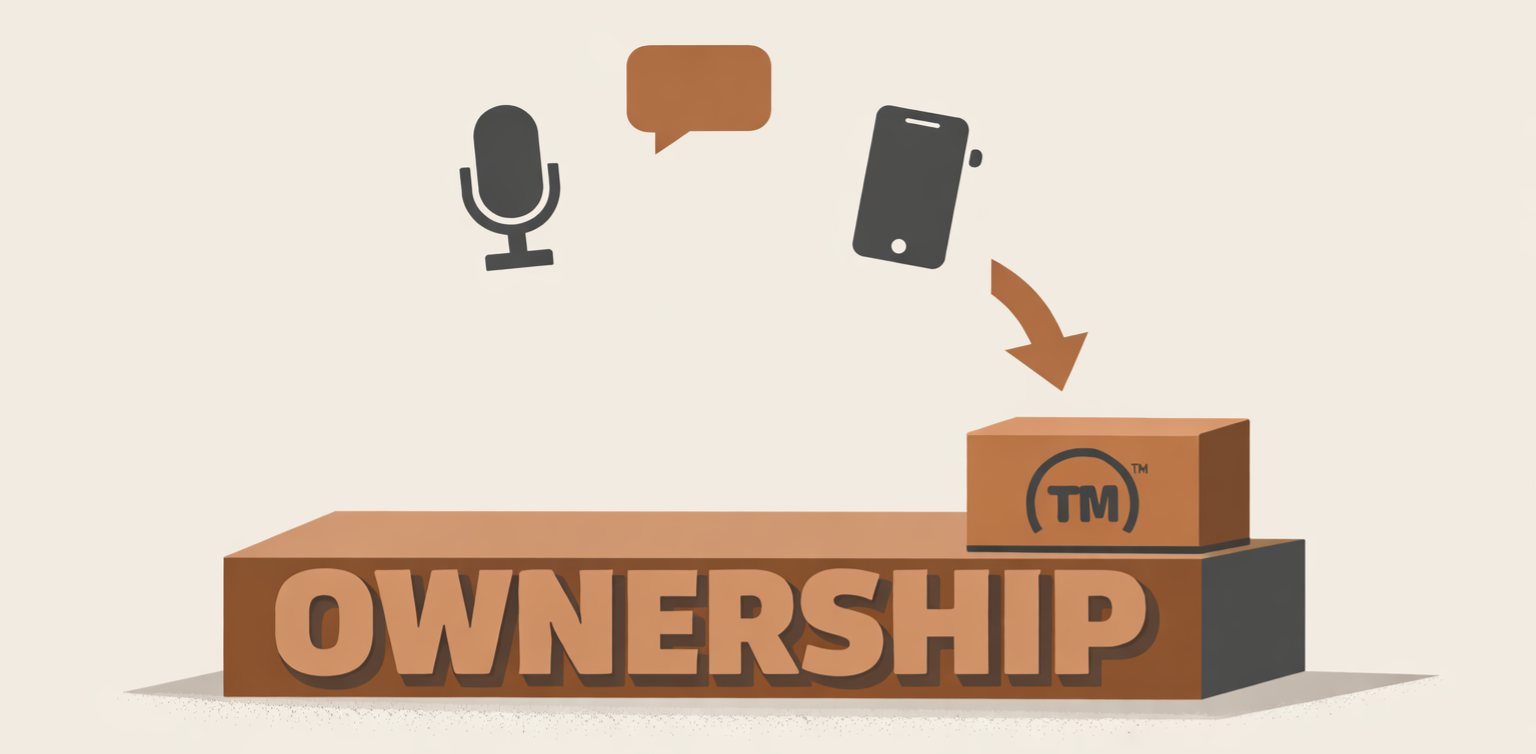
What Tendernism Reveals About the Creator Economy
The Tendernism case is useful because it compresses several creator-economy problems into one cultural moment.
First, the person who generates recognition may not begin with formal ownership of the surrounding commercial asset.
Second, employers, collaborators, outside businesses, and third parties can all develop competing economic interests once a phrase becomes valuable.
Third, public recognition may produce bargaining power without resolving the underlying legal structure.
Finally, timing matters.
Creators often build the audience first because that is what the platform rewards. Ownership questions arrive later because legal infrastructure does not produce likes, shares, or immediate visibility.
Economically, that order is backward.
Once a creator has evidence that something is becoming commercially significant, ownership deserves attention precisely because everyone else can see the same opportunity.
- The Ownership Equation — How control over assets changes who captures durable economic value.
- Structure Builds Freedom — Why durable systems create options that effort alone cannot.
- Discipline Before Dollars — Why financial structure matters before opportunity arrives.
What the Numbers Reveal
The creator economy tends to celebrate the moment when attention arrives. Economically, the more important moment may come immediately afterward.
Attention makes value visible, but visibility also attracts competing claims on that value. Platforms have distribution. Employers may have contracts. Business partners may control commercial infrastructure. Outside parties may see a brand opportunity before the creator has decided whether a brand even exists.
That is why creator ownership is not mainly about filing paperwork after something goes viral. It is about building enough economic infrastructure to know what should be owned, by whom, and under what terms before the value becomes obvious to everyone else.
Tendernism became culturally recognizable first and an ownership problem second.
The creator businesses built to last will try to reverse that sequence.
Economy Commentary follows the systems that determine who creates value, who owns it, and where economic leverage ultimately accumulates. Subscribe to Groundwork Daily for new structural economic analysis.