
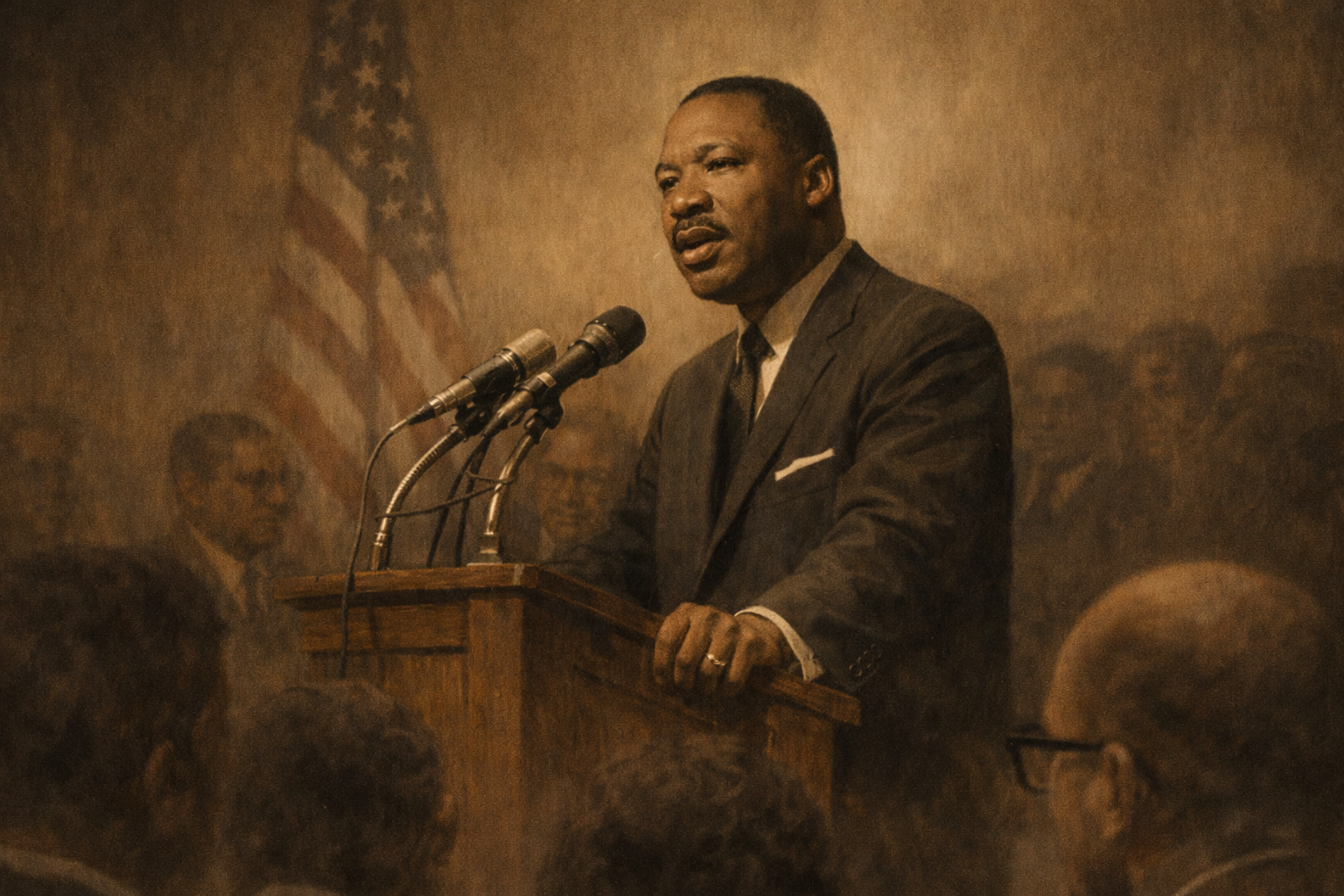
Martin Luther King Jr used the image of a “bootless man” to challenge simplistic ideas about opportunity and economic justice.
In one of his speeches on economic justice, Martin Luther King Jr offered a vivid image that still resonates today. He described the contradiction of telling someone to “pull themselves up by their bootstraps” when that person has no boots.
Many readers search for the MLK bootless man quote meaning because the phrase sounds memorable, but its deeper argument about opportunity and economic structure is often missed.
King’s answer was direct. A society cannot expect people to rise through effort alone if they begin without the basic tools required to participate in economic life.
The idea connects closely to another phrase he used when describing the aftermath of slavery: freedom to hunger .
Both ideas point to the same underlying problem. Political freedom may exist on paper, but economic reality can still leave people trapped in poverty.
MLK Bootless Man Quote Meaning and the Logic Behind It
The phrase about the bootless man was King’s way of criticizing a common argument about poverty.
In public debate, economic hardship is often explained through individual choices. Hard work, discipline, and determination are treated as the primary drivers of success.
Those qualities matter. King did not dismiss them. In his speeches and writing he frequently acknowledged the importance of personal dignity, discipline, and ambition. His argument was not that individual effort is irrelevant. It was that effort alone cannot compensate for conditions that were never equally distributed in the first place.
Effort can only operate within the opportunities available to a person. When people begin life without land, capital, education, or institutional protection, the path forward becomes far steeper.
The “bootless man” metaphor captures that imbalance. It highlights the gap between the advice society gives and the conditions many people actually face.
From Slavery to Economic Vulnerability
King’s argument was grounded in American history.
After the Civil War, millions of formerly enslaved people entered freedom without property, savings, or economic security. They were no longer owned by another person, but they also lacked the resources that often make independence possible.
The promise of land redistribution — most famously associated with the phrase “forty acres and a mule” — was largely withdrawn after President Andrew Johnson reversed General Sherman’s field orders in 1865. The original order, preserved by the National Archives , briefly redistributed land to formerly enslaved families before it was overturned and returned to former Confederate landowners.
What followed was a system of sharecropping and tenant farming that spread across the South and proved difficult to escape. Landowners extended credit for seeds, tools, and food against future harvests. Interest rates were high and accounting was controlled by the landowner. Many families ended each season deeper in debt than they had begun, a legal mechanism that functioned, in practice, as a form of debt peonage.
King believed that starting point shaped economic outcomes for generations.
Telling people to simply work harder under those conditions ignored the deeper structural realities of the economy.
Why the Bootless Man Problem Still Matters
The image of the bootless man continues to resonate because it describes a broader pattern in economic life.
Opportunities are rarely distributed evenly at the starting line.
Some people inherit property, networks, and financial stability. Others begin with far fewer resources. Research from the Brookings Institution shows that parental wealth remains one of the strongest predictors of future wealth, a pattern that persists across generations.
King’s point was that opportunity itself is shaped by institutions, policies, and historical conditions.
Ignoring those forces leads to misleading explanations about poverty.
A Question About Systems
The deeper question raised by the bootless man quote is not simply about individuals.
It is about systems.
Economic systems determine who has access to land, capital, education, and credit. Those resources influence the possibilities available to individuals long before personal choices enter the picture.
That insight helps explain why King eventually focused more attention on economic justice and poverty in the later years of his life.
He believed meaningful freedom required more than civil rights protections alone. It required economic structures that allowed people to build stable lives.
That argument is explored more directly in the next article in this series: Freedom Without Capital: King’s Economic Argument .
Together, these ideas form a consistent theme in King’s thinking about justice.
Freedom without resources can become fragile freedom. And telling a bootless man to pull himself up by his bootstraps does little to change the reality he faces.
Further Groundwork
