
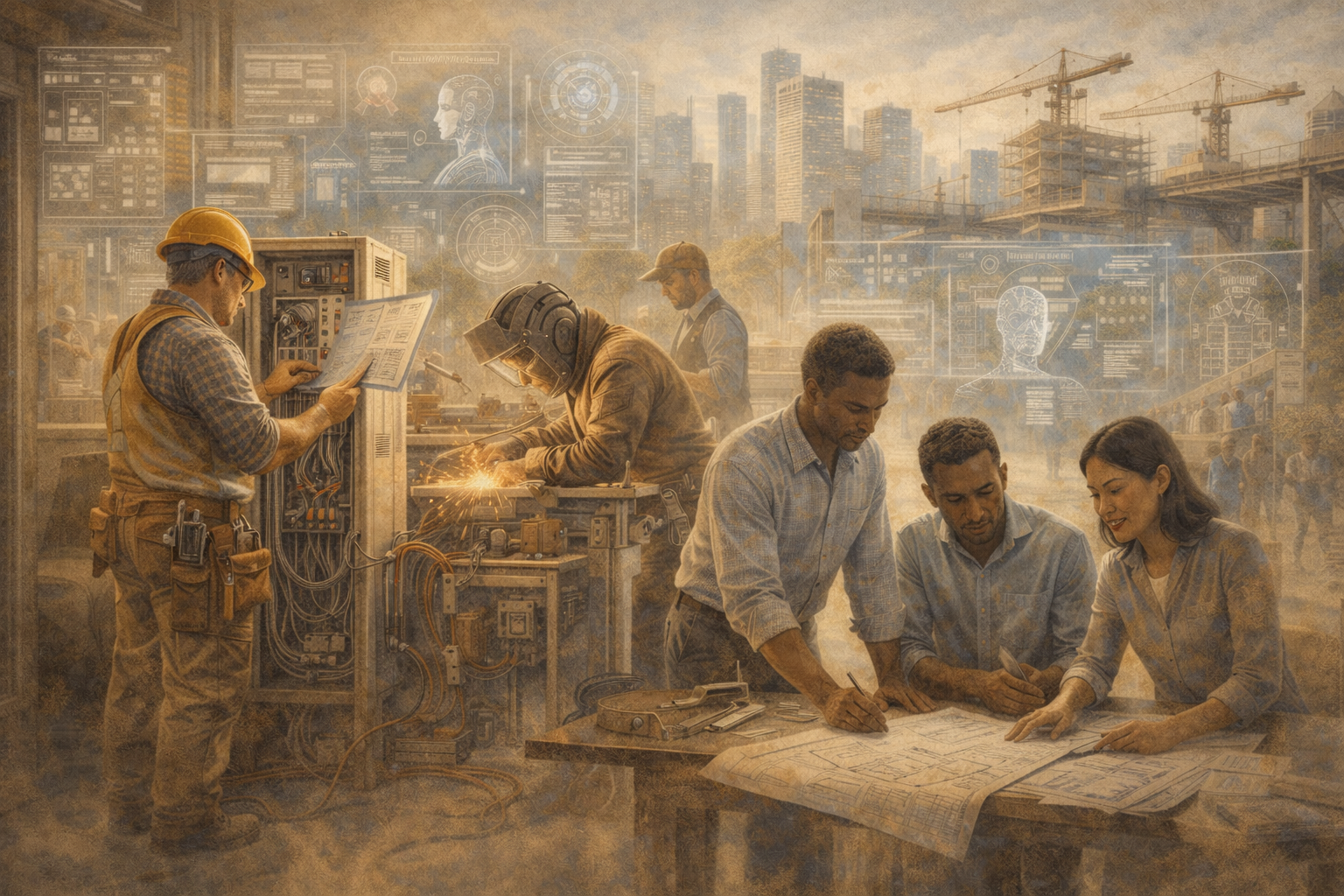
The future of human skills is not about competing with artificial intelligence at machine speed.
That is the wrong fight.
AI can process information quickly. It can summarize, sort, generate, compare, and optimize. However, speed is not the same as judgment. Pattern recognition is not the same as wisdom. Automation is not the same as human capability under real pressure.
The better question is not, “What can AI do?”
The better question is, “What human skills still matter when more tasks become automated?”
This distinction matters because the future of work will not be shaped only by technology. It will also be shaped by the people who can make sound decisions, adapt under pressure, solve physical problems, coordinate with others, and use tools without surrendering responsibility.
The Future of Human Skills Is Capability, Not Panic
There is too much noise around artificial intelligence.
Some of it is inflated marketing. Some of it is real concern. Both can blur the central issue.
The real issue is not whether machines can perform tasks. Of course they can.
The sharper issue is which forms of human capability remain valuable when routine tasks become faster, cheaper, and easier to automate.
This is where future literacy matters. A changing economy rewards people who can read conditions clearly, identify what is shifting, and build skills that travel across tools, industries, and disruptions.
The workers who matter most in the future may not be the ones who merely use AI.
They may be the ones who understand where AI stops being enough.
What Skills AI Cannot Replace
Artificial intelligence can automate tasks, analyze data, and generate content. Still, several human capabilities remain difficult to replace.
- Judgment: weighing context, risk, timing, and consequence.
- Adaptability: adjusting when tools, systems, or conditions change.
- Hands-on problem solving: diagnosing real-world issues involving tools, materials, and physical systems.
- Team coordination: building trust, communicating clearly, and stabilizing work under pressure.
- Practical intelligence: combining experience, observation, and technical knowledge to solve unfamiliar problems.
These skills explain why the human skills future still matters.
AI may change the work. However, it does not remove the need for capable people.
Judgment Still Matters When Conditions Change
Judgment is one of the most durable human skills.
It is the ability to interpret context, weigh tradeoffs, and make sound decisions when a situation is incomplete, messy, or unstable.
Real life rarely arrives in clean categories.
A machine can offer options. A person still decides what matters most, what risk is acceptable, and what consequence is worth carrying.
This becomes especially visible in skilled work.
An electrician diagnosing an unusual systems issue is not simply following instructions. A technician reading a machine failure is not just matching data. A supervisor adjusting to unexpected site conditions is not only executing a checklist.
Each person is making live decisions inside changing conditions.
That is where judgment anchors the future of human skills.
Why Judgment Cannot Be Outsourced
AI can assist judgment, but it cannot fully carry accountability.
Someone still has to own the decision. Someone must understand context. Someone must consider what happens if the recommendation is wrong.
That is the part weak AI hype usually skips.
Automation can produce an answer. Human judgment has to decide whether the answer should be trusted.
Adaptability Is Harder to Automate Than Repetition
AI performs best when patterns are stable and rules are legible.
Human beings become most valuable when conditions shift, priorities collide, and the script stops working.
Adaptability is not flashy. Still, it is powerful.
It is the ability to absorb new information, adjust behavior, and keep moving without freezing when uncertainty appears.
This capability matters because the modern economy evolves faster than many training systems. Workers who adapt across tools, technologies, and environments will have an advantage over those who only know how to operate inside one fixed process.
This is why College vs Apprenticeship: The New Labor Pipeline and How Apprenticeships Build Real Skills matter.
Both point toward a larger truth: skill formation is not only about credentials. It is about building flexible capability.
Hands-On Problem Solving Remains Deeply Human
Hands-on problem solving remains one of the hardest areas to automate fully.
This includes diagnosing real-world failures, working with tools and materials, reading physical systems, and solving problems where touch, timing, environment, and judgment all matter at once.
A blueprint can be digitized. A machine can suggest a solution.
However, when a system behaves unpredictably in the field, someone still has to interpret what is happening in front of them.
Practical intelligence remains critical.
The future will still belong, in part, to people who can build, repair, test, adjust, and solve problems where reality refuses to behave like a clean dataset.
Why Physical Context Matters
Real environments are not always clean.
Materials age. Buildings settle. Tools fail. Weather changes. People improvise. Prior repairs leave hidden consequences.
Because of that, hands-on workers often solve problems that no model can fully see from a distance.
This is not nostalgia for manual labor.
It is a practical recognition that physical systems require human interpretation.
Teamwork and Trust Remain Essential
Many conversations about AI focus only on individual productivity.
That view is incomplete.
Work still happens through teams, relationships, handoffs, and trust. People must communicate clearly, coordinate under pressure, and respond to one another with enough maturity to keep systems functioning.
Social intelligence remains part of the human skills future.
Not because “soft skills” are fashionable. That label is weak.
These are structural skills. Every serious environment depends on people who can think clearly with others.
Trust is difficult to automate. So is accountability. So is the ability to stabilize a team when uncertainty rises.
Practical Intelligence Will Become More Valuable
Practical intelligence is the ability to combine knowledge, observation, and experience in a real situation.
It does not live only in books. It develops through repetition, correction, feedback, and exposure to actual problems.
This is why skilled workers often know things that are hard to explain on paper.
They notice a sound. They feel resistance in a tool. They see a small misalignment. They remember a similar failure from years ago.
That kind of intelligence matters.
AI may support it. However, it does not erase the value of human experience.
The Future Belongs to Human Capability With Structure
The strongest workers in an AI-shaped economy will likely combine technical fluency with durable human skills.
Not people who panic about automation.
Not people who worship it either.
The real advantage belongs to people who understand how to work with new tools without outsourcing judgment, responsibility, or practical intelligence.
This perspective connects to how automation is changing work. As machines remove routine tasks, the value of oversight, interpretation, and human decision-making rises.
AI will reshape workflows. It will redesign some roles. It will eliminate certain tasks.
Even so, it will not remove the need for capable people who can interpret ambiguity, solve real-world problems, communicate with others, and make decisions under pressure.
The Path Forward
The future of work still belongs to people willing to build skills that remain useful when the software updates again.
That is the real takeaway.
The future will not reward people simply for being human. That assumption is lazy.
It will reward workers who build judgment, adaptability, practical intelligence, coordination, and the discipline to use new tools without losing their own capability.
Start there.
Build one human skill. Strengthen one technical skill. Learn one tool without becoming dependent on it. Practice judgment before speed.
AI can support the work.
Human capability still has to carry the weight.
The Groundwork
The future will not reward people simply for being human. It will reward workers who build judgment, adaptability, practical intelligence, and the discipline to use new tools without losing their own capability.
Further Groundwork
College vs Apprenticeship: The New Labor Pipeline
How different learning pathways are shaping the future workforce.
How Apprenticeships Build Real Skills
Why capability grows through repetition, correction, and hands-on learning.
Why Skilled Workers Became Invisible
How culture overlooked the workers whose practical intelligence keeps systems running.
Receipts
OECD Skills Outlook
Research on how automation and technology are changing global skill demand.
U.S. Bureau of Labor Statistics
Labor market data on occupations, skill demand, and workforce change.
Pew Research Center · Internet & Technology
Research on technology adoption and digital labor patterns.
