Buying local is not economic development.
That sentence sounds wrong at first.
Most communities have been told that the first step toward strength is simple. Support neighborhood businesses. Spend money with people who live nearby. Keep dollars close to home. Choose the storefront on the block instead of the large chain across town.
That instinct is not wrong.
But it is incomplete.
Buying local can support a community. It can help a business survive a slow month. It can keep a corridor active. It can make people feel more connected to the place where they live.
Still, spending money nearby does not automatically build a durable local economy.
A neighborhood can have customers and still lack ownership.
It can have storefronts and still lack supplier relationships.
It can have activity and still lack coordination.
It can have pride and still lack the systems required to hold value over time.
This is where a lot of community conversations get too soft. People confuse economic motion with economic structure.
They are not the same thing.
Spending is movement.
Development is capacity.
One happens at the register.
The other happens through systems that allow a community to produce, retain, coordinate, and reinvest value.
The Observation: A Busy Block Can Still Be Fragile
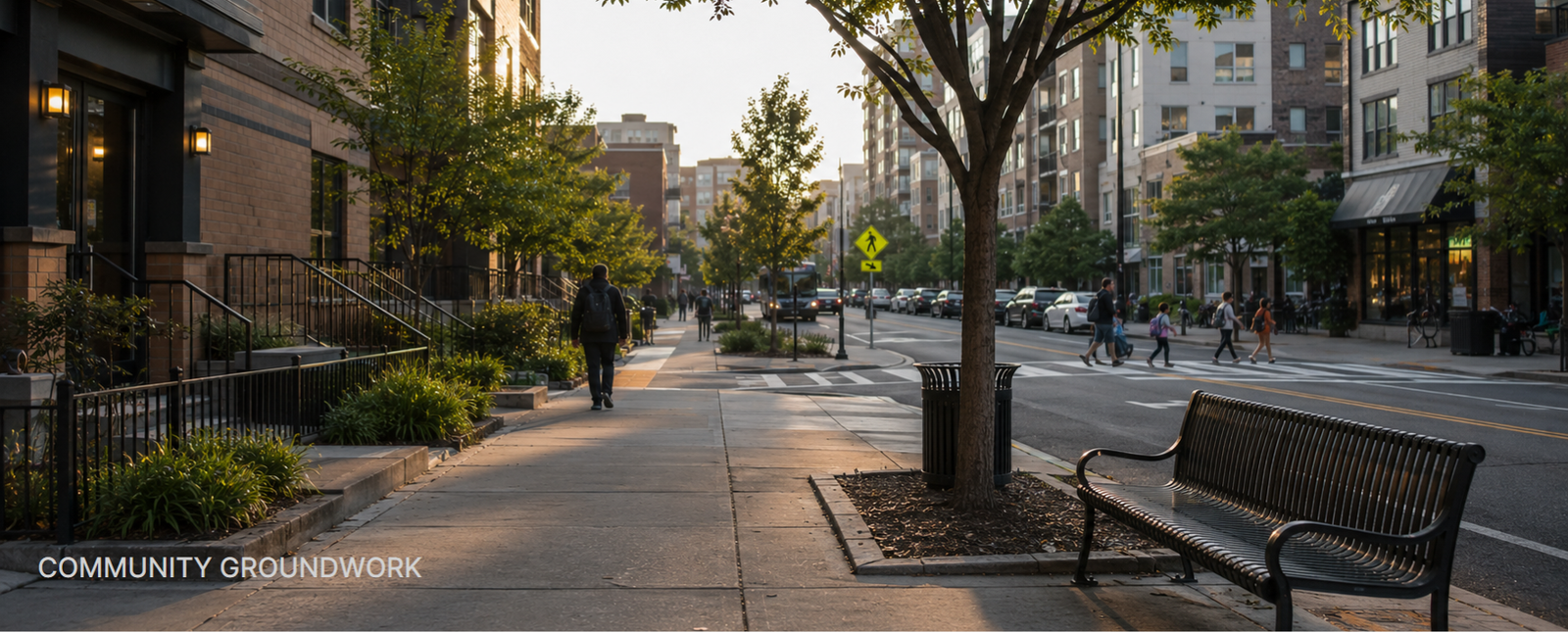
You can learn a lot by watching a neighborhood commercial corridor before noon.
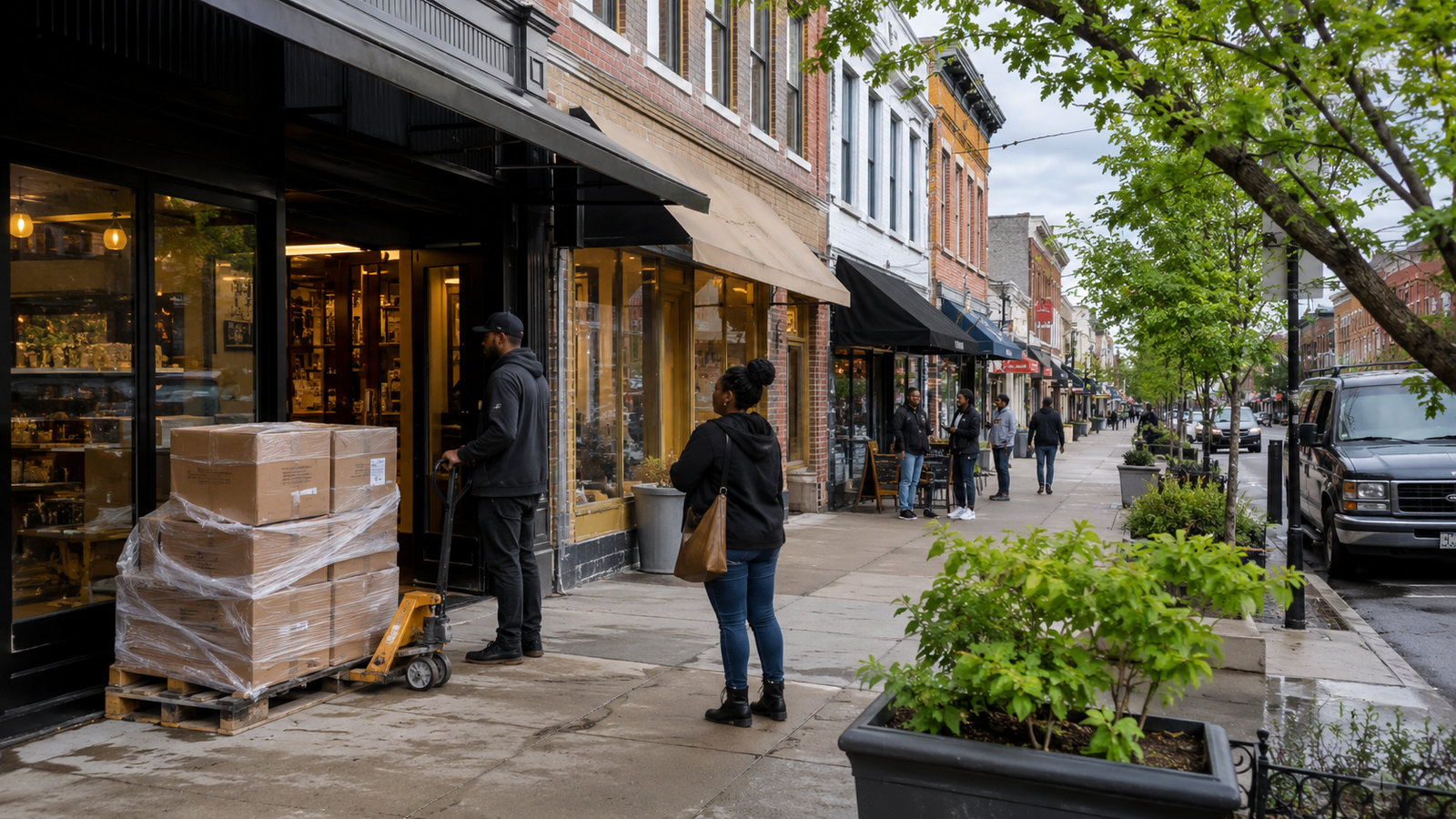
A delivery driver drops off boxes near a small storefront. A regular customer stops inside because the owner knows what she usually buys. A worker sweeps near the entrance. A few doors down, another business opens late. Someone waits outside. A truck idles near the curb. People pass by, some entering, some looking, some moving through without stopping.
From a distance, the corridor looks active.
Activity matters. Empty storefronts change the feeling of a block. A working business gives people a reason to walk, stop, talk, and return. It also gives other businesses a chance to benefit from nearby movement.
But activity can hide weakness.
The business receiving boxes may not own its building. The supplier may be outside the community. The delivery terms may be expensive. The owner may have no cash reserve. The employee may not be trained to manage the operation if the owner gets sick. The lease may rise next year. The customer base may depend on temporary enthusiasm. The corridor may have no shared marketing, no local procurement relationships, no business association, no cooperative purchasing, and no succession path.
On the surface, money is moving.
Underneath, nothing may be compounding.
That is the difference.
A block can look alive and still remain economically thin.
Community Groundwork starts there. Not with slogans. Not with celebration. With the plain question:
What is actually holding this system together?
The Pattern: Communities Often Stop at Consumer Support
The common pattern is easy to recognize.
A community notices that too much money leaves the neighborhood. People talk about supporting local businesses. A campaign forms. A few businesses get attention. Social media posts circulate. Customers arrive. The block feels energized.
Then the harder part begins.
People have to return when the campaign is over.
Owners have to deliver consistently when the spotlight moves elsewhere.
Businesses have to handle inventory, payroll, taxes, insurance, rent, customer service, bookkeeping, and training.
Residents have to adjust habits, not just emotions.
Institutions have to procure locally where possible.
Local government, nonprofits, churches, schools, and anchor organizations have to become part of the economic loop instead of treating local business support as a seasonal gesture.
That is where many efforts weaken.
Consumer support is easier to organize than economic development.
It asks less of the community.
It asks people to buy something.
Development asks people to build something.
There is a difference between a customer base and an economic base.
A customer base shows that people are willing to spend.
An economic base shows that a community can support production, employment, ownership, and reinvestment over time.
Most local campaigns are built around the first one.
Durable communities require the second.
Why the Register Is Not the Whole System
The register only shows the final transaction.
It does not show who owns the building.
It does not show who financed the inventory.
It does not show whether profits stay in the area.
It does not show whether the business has access to affordable credit.
It does not show whether the owner has technical support, accounting help, legal guidance, procurement access, or a trained replacement.
That is why buying local can feel powerful while still remaining structurally limited.
A purchase helps. But a purchase alone does not answer the deeper questions.
Can the business scale without breaking?
Can the owner survive a slow season?
Can the corridor coordinate around shared challenges?
Can new entrepreneurs enter the market without being isolated?
Can customers find reliable quality, clear hours, and consistent service?
Can local institutions turn community support into actual contracts?
These are not inspirational questions.
They are operating questions.
If the answers are weak, the economy is weak, even if people are spending.
The Participation Shift: From Buyer to Builder
Local economic development begins when participation changes shape.
The resident cannot only be a buyer.
The business owner cannot only be a seller.
The church cannot only be a meeting space.
The school cannot only be a public institution nearby.
The nonprofit cannot only issue statements about community empowerment.
The city cannot only cut ribbons.
Each participant has to carry a different part of the system.
That is what makes a local economy durable.
The buyer becomes a repeat customer and referral source.
The owner becomes a collaborator, not just a competitor.
The institution becomes a purchaser where possible.
The local lender, credit union, or community development finance partner becomes part of the capital pathway.
The business association becomes a coordination table.
The corridor becomes more than a row of individual storefronts.
It becomes a shared system.
That shift is not sentimental. It is practical.
Communities remain fragile when every business has to solve the same problems alone.
One owner figures out insurance.
Another figures out suppliers.
Another figures out point-of-sale systems.
Another figures out hiring.
Another figures out a lease problem.
Another figures out digital marketing.
When knowledge stays isolated, the corridor stays weak.
When knowledge circulates, the corridor gains capacity.
That is development.
What Buying Local Can Actually Do
Buying local has value when it becomes part of a larger system.
It can help a business stabilize revenue.
It can make demand more predictable.
It can help owners justify better inventory.
It can give employees more consistent hours.
It can create a public signal that the community values its own commercial life.
It can also teach residents what businesses already exist nearby.
That matters.
Many people do not avoid local businesses because they are hostile to them. They avoid them because the habit is not formed. They do not know what is available. They do not trust the hours. They cannot find the information. They had one bad experience and never returned. Or the business never made the pathway clear.
Buying local can repair some of that distance.
But only if the business side is also ready.
A community cannot build an economy by guilt.
Customers may show up once because of loyalty.
They return because the business works.
That means local business support cannot become an excuse for weak service, poor communication, inconsistent operations, or unclear standards.
Community loyalty and operational discipline have to meet each other.
When they do, spending becomes trust.
When they do not, spending becomes charity.
Charity does not build strong commercial systems.
The Incentive: Money Follows Convenience Unless Structure Redirects It
Most people do not spend according to values every day.
They spend according to convenience.
They buy what is easy to find, easy to trust, easy to access, and easy to repeat.
That is not always a moral failure.
It is how behavior works.
Large retailers understand this. Chains understand this. Delivery platforms understand this. Online marketplaces understand this. They reduce friction until the customer barely has to think.
Local economies often do the opposite.
The business may be good, but the hours are unclear.
The product may be strong, but the website is outdated.
The service may be personal, but the checkout is slow.
The owner may be committed, but inventory is unreliable.
The community may care, but nobody has built a simple way to coordinate demand.
So money follows the smoother pathway.
This is why moral appeals have limits.
Telling people to support local can create awareness.
But awareness does not defeat friction forever.
If the local system is harder to use, many people will eventually return to the system that works with less effort.
That does not mean people do not care.
It means the structure is stronger than the message.
A serious community has to design for this.
Make the local option easier to find.
Make quality consistent.
Make hours dependable.
Make payment simple.
Make referrals normal.
Make local procurement visible.
Make customer experience a standard, not an accident.
When the system becomes easier to participate in, behavior changes more reliably.
Why Ownership Matters More Than Activity
Ownership determines where power settles.
A business can operate locally while the most valuable parts of the system sit somewhere else.
The building may be owned by an outside landlord.
The platform may take the margin.
The supplier may control pricing.
The financing terms may drain the business.
The brand may be local in appearance but not local in control.
This is why economic development has to look beyond storefront visibility.
Visibility is not ownership.
Traffic is not ownership.
A full lobby is not ownership.
A viral post is not ownership.
Ownership shows up in who controls land, contracts, capital, data, supply, and succession.
If a community wants to hold economic power, it has to care about those layers.
That does not mean every business must own its building immediately.
But it does mean the community should understand the direction of travel.
Are businesses gaining leverage or losing it?
Are owners building reserves or surviving week to week?
Are young people learning how these businesses work?
Are institutions buying from local vendors when possible?
Are property owners aligned with corridor stability?
Are there pathways from customer activity to asset control?
If not, the community may be circulating money without building power.
The Real-World Connection: A Delivery Tells a Bigger Story
A delivery outside a storefront seems ordinary.
Boxes arrive. Someone unloads them. The business opens. Customers enter. The day continues.
But that delivery contains a whole map.
Who selected the product?
Who supplied it?
Who financed the order?
Who carries the risk if it does not sell?
Who earns from the sale?
Who restocks the shelves?
Who trains the next worker?
Who maintains the building?
Who benefits if the corridor becomes more valuable?
These questions turn a simple scene into a system.
That is the Community Groundwork lens.
It does not stop at what looks positive.
It asks what is durable.
It asks what repeats.
It asks who carries the load.
It asks what happens if attention moves away.
Because communities do not fail only when people stop caring.
They also fail when care never becomes structure.
The Groundwork: What Communities Should Build Next
If buying local is going to become economic development, the next layer has to be practical.
Start with visibility.
People cannot support what they cannot find. Every neighborhood should know what businesses exist, what they sell, when they are open, and how to reach them.
Then build reliability.
Local businesses need consistent hours, clear communication, dependable service, and basic operational standards. Community support cannot carry chaos forever.
Then build coordination.
Business owners need ways to share information, solve common problems, and identify shared costs. A corridor where every owner struggles alone is not a system. It is a row of isolated risks.
Then build procurement pathways.
Local institutions should know which neighborhood businesses can meet their needs. Churches, nonprofits, schools, cultural organizations, and civic groups all spend money. Some of that spending can become local demand if the pathway is clear.
Then build capital access.
Small businesses often need more than customers. They need credit, reserves, technical assistance, bookkeeping support, and help preparing for growth. Without those supports, increased demand can create pressure instead of stability.
Then build succession.
A business that dies when one owner steps away is not yet institutional. The community has to think about training, management, documentation, and ownership transition. That is how value survives beyond one person’s stamina.
Finally, build measurement.
Do not only ask whether people are buying local.
Ask better questions:
- How many local businesses are hiring?
- How many have stable supplier relationships?
- How many have cash reserves?
- How many receive institutional contracts?
- How many own property or have secure leases?
- How many young people are being trained inside local enterprises?
- How much spending stays in the area long enough to become reinvestment?
Those questions are harder.
They are also more useful.
Why Communities Need Standards Alongside Solidarity
Solidarity without standards becomes fragile.
People will support a local business for reasons of identity, pride, loyalty, or shared interest. But long-term support requires trust.
Trust comes from repeated performance.
That means standards are not the enemy of community support.
They are what protect it.
If a business wants community loyalty, it has to respect the community’s time, money, and expectations.
If customers want local businesses to survive, they have to understand that stability requires more than occasional spending. It requires patience, feedback, referrals, and repeat behavior.
If institutions want to speak about local empowerment, they have to examine where their own dollars go.
Everyone has a part.
That is the point.
Economic development is not something the community watches.
It is something the community participates in.
The Cost of Staying at the Slogan Level
The slogan level feels good.
It is clean.
It is shareable.
It gives people language.
But slogans can let communities avoid the harder work.
A slogan can say buy local.
It cannot build a supplier network.
A slogan can say circulate the dollar.
It cannot negotiate a lease.
A slogan can say support the block.
It cannot train a bookkeeper.
A slogan can say build community wealth.
It cannot create reserves, contracts, ownership structures, or succession plans.
That is why communities have to be careful with language that feels bigger than the system underneath it.
Big language can inspire action.
But if the structure does not follow, the language becomes another memory of what people meant to build.
Structural Takeaway
Buying local matters.
But it is not enough.
Buying local becomes economic development only when repeat customers, capable businesses, local institutions, capital pathways, supplier relationships, shared standards, and ownership strategies begin to connect.
That is the difference between a moment and a system.
A moment can fill a store.
A system can keep a corridor alive.
A moment can redirect attention.
A system can retain value.
A moment can make people proud.
A system can make a community durable.
The question is not whether people should buy local.
They should, when the business is real, useful, reliable, and connected to the life of the community.
The better question is whether local buying is being converted into local capacity.
If the answer is no, the work is not finished.
The register is only the beginning.
The system is the assignment.
Continue Building
This piece is part of a larger framework. Move from local spending into the community systems that make participation durable.
→ Framework: Community Groundwork
→ Mechanism: Contribution Must Be Visible or It Disappears
→ Mechanism: Why Grocery Stores Matter More Than Grocery Stores
Receipts
→ U.S. Economic Development Administration: Building Economic Capacity
→ U.S. Small Business Administration: Small Business Development Centers
→ USDA Economic Research Service: Local Food Systems and Economic Development
→ Urban Institute: Supporting Small Businesses and Local Entrepreneurs