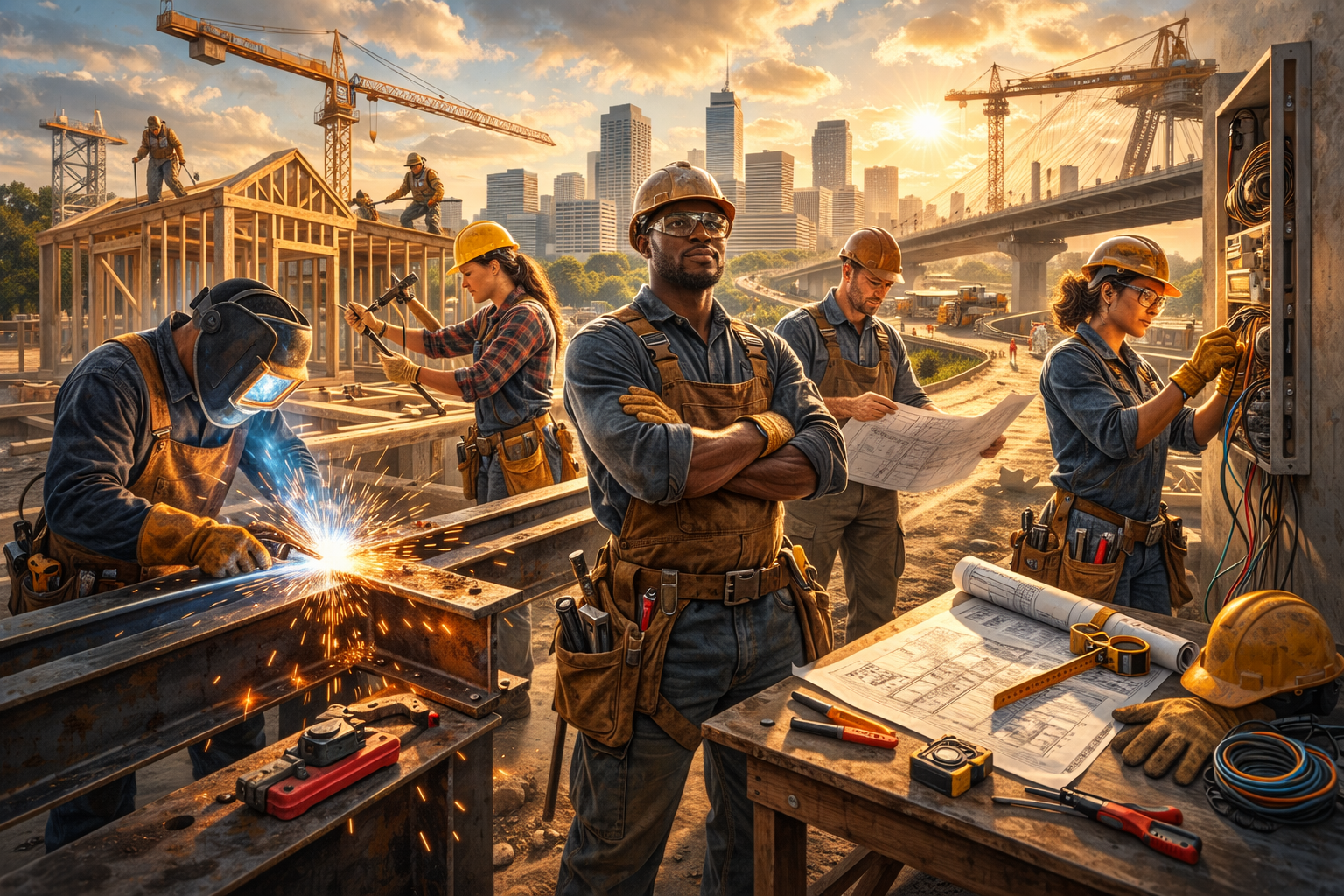
Work Hands · Skilled Work and Culture — The dignity of skilled labor does not come from nostalgia, labor shortages, or applause. It grows from competent people accepting responsibility for work that other people must be able to trust.
Modern life depends on people who can build, install, repair, measure, inspect, maintain, troubleshoot, and finish physical work.
Electricians keep power moving. Mechanics keep equipment operating. Carpenters turn drawings into structures. Pipefitters build systems that have to hold pressure, while lineworkers maintain electrical infrastructure under demanding conditions.
None of this makes skilled labor morally superior to other work.
That would simply replace one status hierarchy with another.
What it does expose is a cultural mistake. Practical competence has too often been treated as a lesser form of intelligence because it happens through tools, materials, machines, and physical systems rather than behind a desk.
The economy never stopped depending on that competence.
The dignity of skilled labor begins there: people deserve serious regard when they accept real responsibility for outcomes other people depend on.
What the Dignity of Skilled Labor Actually Means
Dignity is easy to praise and easy to misuse.
The term therefore needs boundaries.
It cannot mean that every job becomes noble simply because someone performs it. Nor should it become sentimental language used to make poor working conditions sound honorable.
The stronger idea is more demanding.
Workers deserve respect as people. Skilled work also deserves professional respect when it requires competence, judgment, accountability, and useful contribution.
The Dignity of Skilled Labor Is Not the Same as Prestige
Prestige comes from social ranking.
Dignity does not require that ranking.
An electrician does not need to be declared more important than an accountant. A machinist does not need to defeat a software developer in an imaginary contest for social value.
Both comparisons miss the point.
A healthy economy contains different forms of useful expertise. Problems begin when one form of expertise is treated as inherently sophisticated while another is treated as evidence that somebody failed to pursue something better.
Skilled labor deserves correction of that bias, not reversal of it.
Dignity Does Not Depend on Scarcity
Labor shortages can raise attention, wages, bargaining power, and employer urgency.
Scarcity still does not create dignity.
If an occupation suddenly had more workers than employers needed, the people performing it would not become less deserving of respect.
Likewise, high wages may demonstrate market value, but wages and dignity measure different things.
The dignity of skilled labor therefore has to survive both boom and slowdown.
Useful Work Deserves Serious Regard
There is something clarifying about work that produces a result another person can use.
A circuit operates safely. A machine returns to service. A structure meets its requirement. A leak stops. A measurement verifies that an assembly is correct.
The worker does not need applause for the result to matter.
The finished condition becomes the evidence.
Why Competence, Responsibility, and Standards Matter
Skilled work is not dignified merely because it is physically difficult.
Difficulty alone proves very little.
The more important quality is responsibility.
Someone has to understand the requirement, use the correct tools, adapt to changing conditions, protect safety, verify the result, and recognize when the work has moved outside normal expectations.
Competence Is More Than Manual Ability
The word “manual” can hide how much thinking occurs inside skilled work.
A competent worker may need to interpret drawings, calculate dimensions, diagnose failure, recognize hazards, select tools, understand material behavior, and coordinate with other trades.
That worker may also need to make decisions with incomplete information.
The hands matter.
So does the judgment guiding them.
Skill becomes dependable only when it operates through standards, verification, and correction. The Work Hands field manual begins with Skilled Labor Discipline and Earned Respect because execution only becomes trustworthy when the requirement survives pressure.
Responsibility Makes Skill Consequential
A worker performing consequential work carries more than a task list.
The result may affect the person who operates the equipment tomorrow. Another crew may build on that work next week. A family may occupy the finished structure years later.
That connection creates responsibility beyond immediate production.
Good workers understand that the person receiving the work may never know their name.
Even so, the standard still has to hold.
Professional Character Appears Through Repeated Choices
An earlier Work Hands idea described competence as character made visible. That formulation is useful, but it needs a boundary.
Technical competence does not prove somebody is a good person.
What the work can reveal is professional character: whether someone checks instead of assumes, reports instead of hides, and corrects instead of explaining away a problem.
Over time, those choices build trust.
In that narrower sense, competence can make professional character visible.
Skilled Labor Builds and Maintains the Visible World
Skilled work leaves physical evidence.
Buildings, electrical systems, water systems, machinery, roads, transportation equipment, production lines, heating systems, and structural components all depend on people who can translate requirements into functioning conditions.
Ironically, that work often becomes most visible when something stops working.
Infrastructure Is Not Self-Executing
Plans matter. Design matters. Capital and technology matter.
But a design does not install itself.
A machine does not maintain itself merely because it contains advanced electronics. An electrical system does not become safe simply because its schematic is accurate.
Eventually, the physical system meets human execution.
That is where competence becomes tangible.
Maintenance Is Productive Work
Culture tends to celebrate creation more easily than maintenance.
A new bridge photographs better than preventive maintenance. A new machine attracts more attention than the mechanic who keeps an existing production line inside operating condition.
Yet mature systems survive through maintenance.
BLS places millions of workers inside installation, maintenance, and repair occupations, a group with a May 2024 median annual wage of $58,230.[2]
Keeping systems alive should therefore be understood as productive work, not merely background work.
Repair Requires Technical Judgment
Repair begins with uncertainty.
Something is wrong, but the cause may not be obvious.
The worker must observe, test, isolate, compare, diagnose, correct, and verify.
That process connects directly to Failure Analysis Without Blame.
At its best, repair is not simply replacing parts.
It is disciplined reasoning against a physical system.
How the Status Hierarchy Misread Skilled Work
For decades, many families and institutions absorbed a simplistic hierarchy.
Four-year college represented advancement, while trade education often sounded like a fallback.
Office work suggested success. Physically grounded work could be treated as something to escape.
That hierarchy was intellectually weak because it ranked the setting of work rather than its quality, complexity, or value.
A Credential Is Not the Same Thing as Capability
Credentials can matter enormously.
Some occupations require degrees, licenses, certificates, or formal education for good reason.
The mistake is treating the credential as proof of human or economic value by itself.
Capability still has to reach the real world.
That principle cuts in both directions.
A college degree does not guarantee competence. Owning a toolbox, finishing an apprenticeship, or accumulating years in a trade does not guarantee it either.
Ultimately, standards have to judge the work.
Respect for Skilled Work Is Not an Anti-College Argument
The strongest defense of the trades does not require attacking higher education.
That would be lazy positioning.
Engineering, medicine, architecture, accounting, science, teaching, law, and many other fields rely on deep academic preparation.
The issue is pathway fit.
A society should not force every occupation through one model of preparation or treat one training pathway as the symbolic definition of success.
Readers can see that distinction more clearly in How Apprenticeships Build Real Skills, which examines how paid work, related instruction, mentorship, and progressive responsibility operate together.
Status Distortion Can Affect Workforce Pipelines
Cultural messages eventually influence labor pipelines.
If young people repeatedly hear that practical occupations represent lower ambition, fewer may investigate those pathways seriously.
Perception is only one factor.
Demographics, retirement, regional demand, construction cycles, investment, technology, and occupation-specific growth also shape workforce needs.
Even so, a workforce system cannot recruit effectively into occupations it describes apologetically.
What the Economy Actually Says About Skilled Labor
Economic evidence does not support one simple story.
Some skilled occupations are growing quickly. Others are growing near the economy-wide average. Some production occupations face slower growth or decline.
“The trades are booming” is therefore too broad to be analytically useful.
| Occupation / group | May 2024 median wage | 2024–2034 outlook |
|---|---|---|
| All occupations | $49,500 | 3% benchmark |
| Construction and extraction occupations | $58,360 | Overall group projected to grow faster than average |
| Installation, maintenance, and repair occupations | $58,230 | Group projection: 5% |
| Electricians | $62,350 | 9% |
| Plumbers, pipefitters, and steamfitters | $62,970 | 4% |
| Industrial machinery mechanics, maintenance workers, and millwrights | $63,510 | 13% |
| Electrical power-line installers and repairers | $92,560 | Essential power-infrastructure occupation |
Source: U.S. Bureau of Labor Statistics Occupational Outlook Handbook.[1][2][3][4][5][6]
Openings Do Not Mean Every Job Is Newly Created
Projected openings need context.
BLS projects about 649,300 openings per year across construction and extraction occupations from 2024 through 2034.[1]
Those openings come from both employment growth and the need to replace people who permanently leave occupations.
That distinction matters.
An economy can need large numbers of entrants even when an occupation is not growing rapidly because retirements, career changes, and other exits continue to create replacement demand.
Some Skilled Occupations Are Growing Faster Than Others
Electricians provide one example.
BLS projects 9% employment growth from 2024 through 2034 and about 81,000 openings per year on average.[3]
Industrial machinery mechanics, machinery maintenance workers, and millwrights are projected to grow 13%, with about 54,200 openings per year.[6]
By contrast, plumbers, pipefitters, and steamfitters are projected at 4%, close to the economy-wide average, while still generating about 44,000 openings per year.[4]
The labor market is not delivering one message.
It is delivering occupation-specific messages.
Apprenticeship Shows Employers Are Still Building Skill Pipelines
Construction Registered Apprenticeship served 480,399 apprentices in 2025, according to Apprenticeship.gov. That represented 28% growth over five years.[7]
Registered Apprenticeship combines paid work, mentorship, progressive wage increases, related instruction, and a portable nationally recognized credential.[8]
The model matters culturally as well as economically.
It demonstrates that serious workforce development can combine productive work with structured learning.
Why Respect Must Reach Working Conditions and Career Pathways
Respect for skilled labor cannot mean romanticizing hardship.
Danger is not dignity.
Exhaustion is not proof of professionalism.
Poor scheduling, bad supervision, weak training, inadequate tools, or preventable exposure do not become honorable simply because the work is skilled.
Hard Work Is Not Automatically Good Work
The Work Hands series rejects the romance of effort without standards.
A worker can push harder and still create rework.
A crew can endure miserable conditions created by weak planning without becoming more professional.
Suffering is the wrong measure.
The useful measure is whether effort becomes a safe, reliable result.
Respect Has to Reach Working Conditions
An employer cannot credibly praise skilled workers while treating their development, safety, tools, time, and judgment as disposable.
Respect has operational consequences.
It means competent supervision, safe equipment, adequate training, and enough information to complete the work correctly.
Compensation structures should also recognize increasing capability and responsibility.
Dignity Does Not Require Silence
Professional pride should not prevent workers from saying that a condition is unsafe, a standard is unclear, or the wrong tool has been provided.
Workers should also be able to identify when a schedule is forcing poor decisions.
Silence is not toughness.
Mature organizations treat accurate reporting as part of protecting the work.
Families Need Better Information, Not Another Sales Pitch
Young people should not be pushed toward the trades simply because college can be expensive.
That creates another weak binary.
Families need accurate information about occupational requirements, wages, working conditions, licensing, apprenticeship options, advancement, geography, and physical demands.
The right path depends on both the occupation and the person.
Respect means taking that decision seriously.
Schools Should Show More Than One Form of Competence
A student may excel at mechanical reasoning, fabrication, diagnostics, spatial work, electrical systems, or applied mathematics.
That student should not have to discover years later that those abilities represented serious career pathways.
Academic education and career-technical education should not operate as competing moral categories.
They should function as parts of a larger preparation system.
Employers Have to Build the Pipeline They Say They Need
Complaining about a lack of experienced workers while refusing to train less-experienced workers is not a workforce strategy.
Some employers cannot support full apprenticeship programs on their own.
Even so, organizations that depend on skilled labor need mechanisms for teaching, supervised practice, verification, advancement, and knowledge transfer.
Registered Apprenticeship is one structured version of that system.[8]
For a deeper look at that pipeline, see Why Apprenticeships Are Growing Again.
Public Language Should Stop Treating Trades as a Consolation Prize
“College wasn’t for him, so he became an electrician” carries a hierarchy inside the sentence.
The assumption that somebody who works with tools must have lacked academic options is equally weak.
Some people choose skilled work because the work suits their ability, interests, temperament, economics, or preferred way of learning.
That is a career decision, not an apology.
How Standards Turn Respect Into Professional Trust
Respect without standards becomes empty praise.
The Work Hands argument is more demanding.
If skilled work deserves serious regard, then skilled workers and employers also inherit serious obligations.
The Dignity of Skilled Labor Includes Verification
Pride cannot replace inspection.
Experience cannot replace measurement where measurement is required.
Confidence cannot redefine tolerance either.
Inspection Beats Intuition develops that point directly.
Respecting craft also means respecting the standard enough to let evidence judge the work.
Professionalism Includes Correction
Mistakes do not erase dignity.
Hiding them damages trust.
Skilled workers strengthen the system when they surface defects early, correct problems before they travel, and help improve the process when recurring conditions appear.
The goal is not flawless people.
The goal is disciplined work that makes quality repeatable.
The Dignity of Skilled Labor Includes Knowledge Transfer
A craft becomes fragile when all of its knowledge remains inside the most experienced worker.
Training and handoffs turn individual mastery into continuity.
Training the Next Set of Hands examines how standards move into another worker.
The Discipline of the Handoff examines how work status survives transitions.
Dignity therefore includes stewardship.
The work should remain dependable after an experienced worker leaves.
Commit to a Framework
The dignity of skilled labor becomes credible when respect reaches both the worker and the standard.
- Respect the person — human worth does not depend on occupation or status.
- Respect the skill — recognize the knowledge, judgment, and practice required for competent work.
- Respect the standard — judge outcomes by evidence rather than image or confidence.
- Respect the conditions — do not romanticize preventable danger, exhaustion, or poor management.
- Respect the pathway — provide credible routes into skilled work through education, apprenticeship, and supervised practice.
- Respect the responsibility — expect workers and organizations to correct problems rather than hide them.
- Respect continuity — transfer knowledge so competence survives beyond one set of hands.
Where the Dignity of Skilled Labor Fits Inside Work Hands
The Work Hands field manual focuses on how dependable work functions.
Discipline establishes the operating posture.
Process makes standards repeatable, while field feedback tests assumptions.
Tools extend capability and inspection verifies the result.
Training transfers the method, handoffs protect continuity, and failure analysis sends evidence back through the system.
This article asks the cultural question around that operating system:
How should we regard the people who carry that responsibility?
The answer should not be worship.
It should be respect calibrated to reality.
Skilled labor is consequential work performed by people who deserve safe conditions, honest pathways, competent training, fair opportunity, and standards worthy of their effort.
At the same time, professional trust grows through the quality, reliability, and integrity of what workers leave behind.
That is more durable than status.
The dignity of skilled labor is not a slogan about hardworking people. It is a compact between capability, responsibility, standards, and respect.
The Groundwork
Skilled work does not need to be romanticized to be respected. Its value becomes visible through competence, responsibility, useful outcomes, and the systems people can still depend on after the worker leaves the jobsite.
Further Groundwork
- How Apprenticeships Build Real Skills — how paid work, instruction, mentorship, and progressive responsibility develop competence.
- Why Apprenticeships Are Growing Again — how workforce systems are rebuilding structured pathways into skilled occupations.
- The Skilled Worker Economy — why practical capability remains economically important across physical systems and infrastructure.
- The Trades Are Back — a closer look at workforce pipelines behind renewed attention to skilled trades.
- Why Skilled Trades Are Rising Again — where demand, replacement needs, and changing infrastructure requirements are creating openings.
- Work Hands: Training the Next Set of Hands — how standards survive when experience has to transfer to another worker.
Source Ledger
- U.S. Bureau of Labor Statistics, Construction and Extraction Occupations. BLS reports a May 2024 median annual wage of $58,360 for the occupational group, compared with $49,500 for all occupations, and projects about 649,300 openings per year from 2024 through 2034. View source →
- U.S. Bureau of Labor Statistics, Installation, Maintenance, and Repair Occupations. BLS reports a May 2024 median annual wage of $58,230 for this occupational group. View source →
- U.S. Bureau of Labor Statistics, Electricians. BLS reports a May 2024 median annual wage of $62,350 and projects 9% employment growth from 2024 through 2034, with about 81,000 openings per year on average. View source →
- U.S. Bureau of Labor Statistics, Plumbers, Pipefitters, and Steamfitters. BLS reports a May 2024 median annual wage of $62,970 and projects 4% employment growth from 2024 through 2034, with about 44,000 openings per year. View source →
- U.S. Bureau of Labor Statistics, Electrical Power-Line Installers and Repairers. BLS reports a May 2024 median annual wage of $92,560 for electrical power-line installers and repairers. View source →
- U.S. Bureau of Labor Statistics, Industrial Machinery Mechanics, Machinery Maintenance Workers, and Millwrights. BLS reports a May 2024 median annual wage of $63,510 and projects 13% employment growth from 2024 through 2034, with about 54,200 openings per year. View source →
- U.S. Department of Labor, Apprenticeship.gov, Construction. Apprenticeship.gov reports 480,399 registered apprentices served in construction in 2025, a 28% increase over the prior five years. View source →
- U.S. Department of Labor, Apprenticeship.gov, Registered Apprenticeship Program. DOL defines Registered Apprenticeship as an industry-driven pathway combining paid work experience, mentorship, progressive wage increases, related instruction, and a portable nationally recognized credential. View source →
Last verified August 14, 2026. Wage figures are national medians and do not describe every worker, employer, region, union agreement, or experience level. Occupational outlooks also vary substantially across trades.
Frequently Asked Questions About the Dignity of Skilled Labor
What does the dignity of skilled labor mean?
The dignity of skilled labor means taking practical work, the people who perform it, and the responsibility attached to it seriously. It does not mean skilled workers are more valuable as people than workers in other occupations. It recognizes that competence, useful contribution, judgment, and accountability deserve respect regardless of whether the work happens in an office, shop, plant, vehicle, mechanical room, or jobsite.
Does skilled labor pay well?
Some skilled occupations pay above the national median, while others do not. For example, BLS reports May 2024 median annual wages of $62,350 for electricians, $62,970 for plumbers, pipefitters, and steamfitters, and $92,560 for electrical power-line installers and repairers.[3][4][5] Pay also varies by occupation, geography, experience, industry, licensing, overtime, and other factors.
Are skilled trades growing?
There is no single growth rate for “the trades.” Electricians are projected to grow 9% from 2024 through 2034, while plumbers, pipefitters, and steamfitters are projected at 4%. Industrial machinery mechanics, machinery maintenance workers, and millwrights are projected at 13%. The accurate answer is therefore occupation-specific.[3][4][6]
Is choosing a trade better than going to college?
Not as a universal rule. Different careers require different pathways. The better question is which combination of education, apprenticeship, licensing, supervised practice, and credentialing fits the occupation and the individual.

Build Better. Every Day.
Keep Building With Groundwork Daily
Get new Groundwork Daily essays, field manuals, frameworks, and practical systems delivered through the Groundwork List.