

System Updates
Alert Systems. A public alert is the visible end of a much longer decision process. This System Update explains California’s Ebony Alert, the cases it is designed to reach, how activation works, and why the system should not be confused with AMBER Alert.
What Is an Ebony Alert?
An Ebony Alert is a state-created missing-person alert designed to increase public visibility for qualifying cases involving missing Black people. California operates a statewide Ebony Alert program for qualifying missing Black people ages 12 through 25, inclusive, when the case meets the risk conditions established by state law.
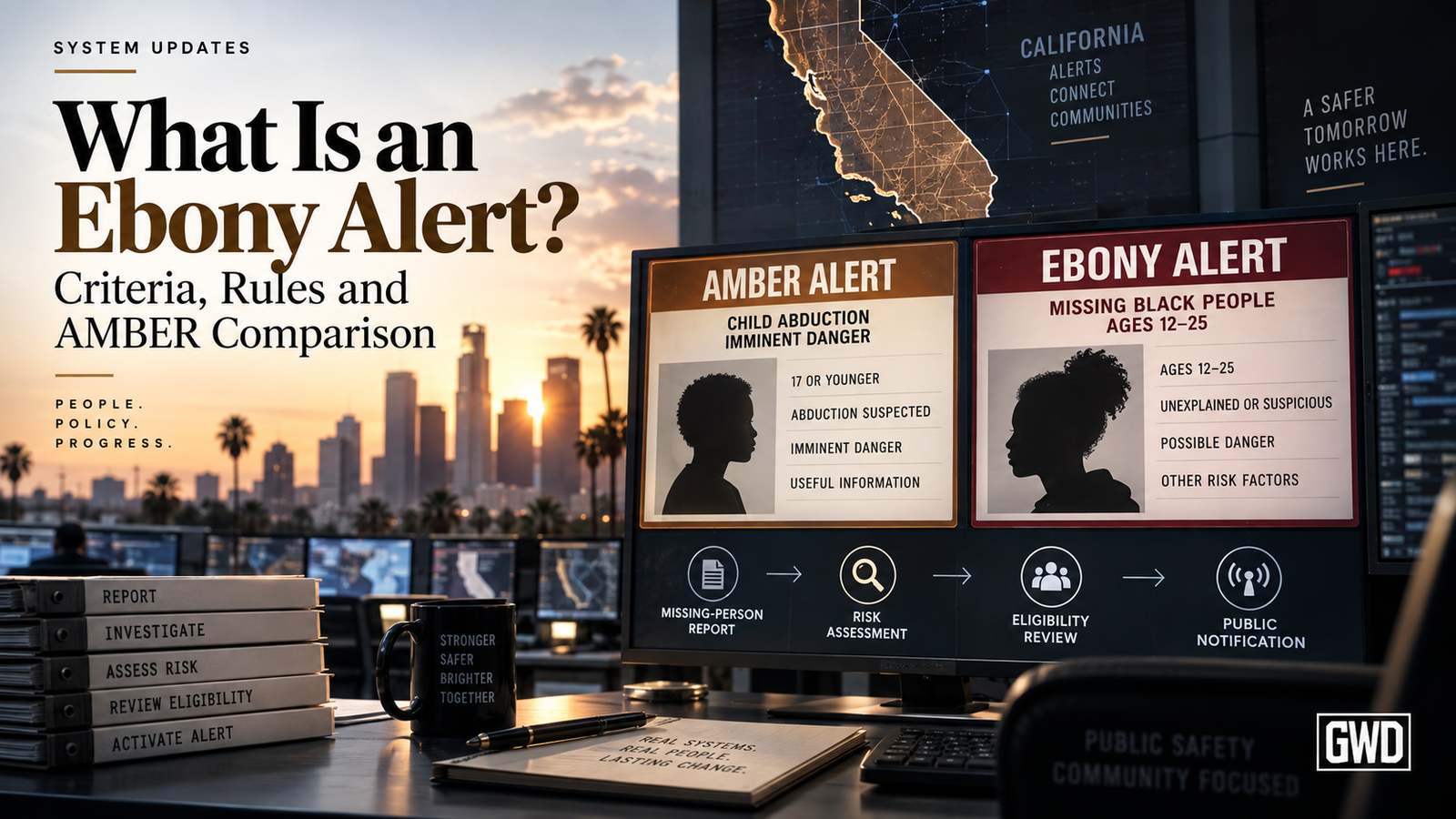
Ebony Alert and AMBER Alert use different eligibility gates. The U.S. Department of Justice recommends AMBER activation when law enforcement reasonably believes a child abduction occurred, believes the child faces imminent danger of serious bodily injury or death, has enough descriptive information to help recovery, meets the recommended age standard, and enters critical case information into the National Crime Information Center.
California’s Ebony Alert can apply without first establishing an abduction. Instead, an investigating agency can rely on qualifying unexplained, suspicious, trafficking, danger, disability, environmental, or other peril circumstances. In practical terms, Ebony Alert creates another route through the missing-person response system rather than simply renaming AMBER Alert.
How Does an Ebony Alert Work?
Law enforcement uses an Ebony Alert as one public-notification tool inside a larger missing-person investigation. California gives investigating agencies this option when a missing Black person meets the state’s eligibility requirements and public notification may help locate the person.
The alert does not replace ordinary investigative work. Officers still take the missing-person report, gather facts, assess risk, use available local resources, and determine which response pathway fits the case. If the agency believes Ebony Alert criteria are satisfied, it can contact the California Highway Patrol for statewide alert assistance.
How the Public May See an Ebony Alert
California’s missing-person alert system can use several communication channels. Depending on the case and affected region, notification can involve law-enforcement networks, media organizations, transportation infrastructure, websites, digital platforms, social media, and other alert tools.
An Ebony Alert therefore should not be understood as a guaranteed statewide warning sent to every mobile phone. CHP can tailor activation geographically, and the distribution methods depend on the investigation and the alert tools selected for the case.
Why Was the Ebony Alert Created?
California created the program after concerns that existing alert pathways did not always provide adequate visibility for missing Black youth and young adults. One structural problem is that a serious missing-person case can fall outside AMBER Alert criteria when investigators cannot establish the kind of abduction required by that alert framework.
That does not mean the person is safe. It means a particular public-alert tool may not fit the evidence available at that point in the investigation.
The Gap the Policy Tries to Address
Ebony Alert gives California law enforcement another escalation route. Current criteria allow agencies to consider unexplained or suspicious circumstances, possible trafficking, danger to physical safety, health or disability, environmental or weather conditions, dangerous company, and other factors indicating that the missing person may be in peril.
The racial design of the policy is explicit. California built the program for qualifying missing Black people in the covered age range. That makes the accountability question concrete: does the new pathway improve access to review, public visibility, consistency, and the quality of the response for the cases it was intended to reach?
Who Qualifies for an Ebony Alert in California?
California’s current program covers qualifying missing Black people from 12 through 25 years of age, inclusive. Age and race alone are not enough. The investigating agency must use available local resources and identify qualifying risk circumstances before requesting activation.
California Ebony Alert Criteria
- The missing person is 12 through 25 years old, inclusive.
- The investigating agency has used available local resources.
- The disappearance may involve unexplained or suspicious circumstances.
- The missing person’s physical safety may be endangered.
- The missing person may be subject to trafficking.
- Age, health, mental or physical disability, environmental or weather conditions, dangerous company, or other factors may indicate peril.
California law also directs that the relevant risk provisions be broadly construed to carry out the legislative purpose of the program.
California’s Rules Are Not Nationwide Rules
There is no single federal Ebony Alert statute establishing one nationwide eligibility standard. Another jurisdiction can choose a different age range, covered population, activation authority, risk threshold, or distribution system. An active case should therefore be evaluated under the rules governing the agency handling that case.
Ebony Alert vs. AMBER Alert: What Is the Difference?
Eligibility is the core difference. The U.S. Department of Justice recommends AMBER activation when law enforcement reasonably believes an abduction occurred, believes the child faces imminent danger of serious bodily injury or death, has enough descriptive information to help recovery, applies the recommended age standard of 17 or younger, and enters critical information into the National Crime Information Center.
Two Different Purposes
States administer their own AMBER plans, so DOJ’s criteria operate as national guidance rather than one identical state statute. California’s Ebony Alert serves another purpose. It can provide a public-notification route when statutory indicators of danger or suspicious circumstances exist without first requiring law enforcement to establish an abduction.
AMBER Alert and California Ebony Alert Compared
| Question | AMBER Alert | California Ebony Alert |
|---|---|---|
| Who is covered? | DOJ recommends children 17 or younger. | Qualifying missing Black people ages 12 through 25. |
| Must law enforcement believe an abduction occurred? | Yes, under DOJ’s recommended criteria. | No. Other qualifying statutory risk circumstances can support review. |
| What type of risk matters? | Imminent danger of serious bodily injury or death. | Suspicious, unexplained, trafficking, danger, disability, environmental, or other peril conditions. |
| What role does the alert play? | Rapid public assistance in qualifying child-abduction cases. | Additional public visibility for qualifying cases outside the AMBER gate. |
The Systems Are Different Tools, Not Substitutes
AMBER Alert’s narrower gate protects a high-intensity alert designed around qualifying child abductions. Ebony Alert gives California another route when the facts present serious risk but do not fit that framework. Treating one alert as a replacement for the other misses the institutional design.
Groundwork Daily examines that architecture more directly in When Alert Systems Grow: Is Ebony Alert a Structural Patch or a Parallel Pipeline? .
How Is an Ebony Alert Activated in California?
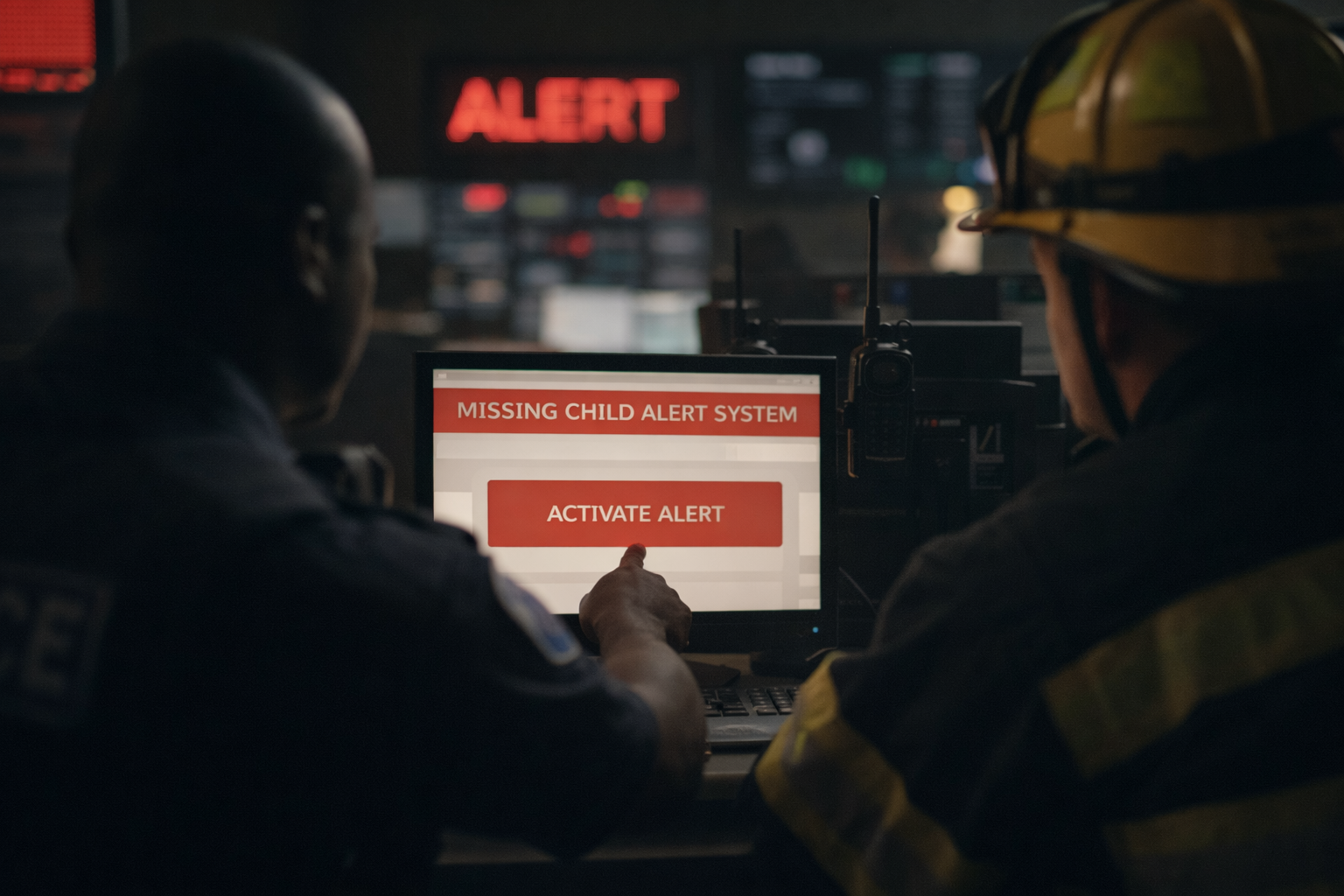
Families do not activate the alert directly. Instead, they report the disappearance to law enforcement and provide relevant facts, evidence, and updates. The investigating agency evaluates the case, uses available local resources, and decides whether statewide alert assistance may be appropriate.
The California Highway Patrol’s Emergency Notification and Tactical Alert Center, or ENTAC, is the statewide coordinator for California missing-person alerts. The investigating agency contacts CHP, and the agency and CHP review the incident and activation criteria together. When the requirements are met, CHP identifies the affected region and activates the appropriate alert on behalf of the investigating agency.
California Ebony Alert Activation Process
- A family or reporting party files a missing-person report.
- The investigating agency gathers facts and uses available local resources.
- Investigators compare the case with the relevant alert criteria.
- The agency contacts CHP when it seeks statewide alert assistance.
- CHP and the investigating agency review the circumstances and criteria.
- If the criteria are met, CHP identifies the affected region and activates the alert.
- The underlying missing-person investigation continues.
Why the Activation Chain Matters
The public sees the alert near the end of the process. Before that, fact collection, classification, risk assessment, local investigation, agency judgment, and escalation can all occur. Measuring only the activation itself therefore misses much of the system’s actual performance.
What Can Families Do When Someone Is Missing?
Families cannot usually order an Ebony Alert, but they can strengthen the information available to investigators. The immediate priority is to report the person missing and provide concrete facts that help law enforcement understand the circumstances and level of risk.
Useful information can include a recent photograph, last known location, clothing description, vehicle information, known contacts, unusual communications, threats, health or disability information, possible trafficking indicators, and reasons the disappearance differs from the person’s normal behavior. Families should preserve relevant communications and keep track of material developments because new evidence can change the risk assessment.
What Families Control and What Agencies Control
When Might an Ebony Alert Not Be Issued?
A serious disappearance does not automatically trigger an Ebony Alert. Eligibility rules exist because alert systems need defined purposes and because excessive or poorly targeted notifications can weaken public attention. A case that does not receive an Ebony Alert can still be actively investigated.
Why a Case May Follow Another Path
The missing person may fall outside the program’s age range. The available facts may not establish the required circumstances. Investigators may still be gathering critical information, or another alert or advisory may fit better. California’s statewide alert system includes AMBER Alert, Blue Alert, Silver Alert, Feather Alert, Ebony Alert, and the Endangered Missing Advisory.
What Accountability Should Look Like
Strong policy should make activation rules understandable, identify who holds decision authority, document important review points, and allow a case to be reconsidered when material new evidence changes the risk picture. Clear rules will not eliminate every disagreement, but they make institutional decisions easier to inspect.
Why Missing-Person Classification Still Matters
Ebony Alert does not erase the decisions that happen before alert review. Investigators still interpret the circumstances of a disappearance, assess current danger, gather new evidence, and decide whether escalation is warranted. A new notification category cannot fully compensate for a weak upstream assessment.
Terms such as voluntary departure, runaway, endangered, abducted, and suspicious do not answer the same questions. The important analytical distinction is between how the disappearance may have begun and what risk exists now.
Groundwork Daily’s Missing Person Classification: Runaway vs Endangered explains how those early judgments can shape investigation, reassessment, and alert eligibility.
The Public Sees the Alert, Not the Gate
A notification is visible. The classification and eligibility decisions that precede it usually are not. That makes the upstream gate easy to overlook even though it helps determine whether the alert system ever becomes relevant to the case.
Is There an Ebony Alert in Every State?
No. There is no federal Ebony Alert program establishing one national set of rules. California currently operates a statewide Ebony Alert system. Other jurisdictions can propose or create their own policies, but those programs should be evaluated under their own statutory language rather than treated as copies of California’s system.
Does New York Have an Ebony Alert?
As of September 2026, New York does not operate an enacted statewide Ebony Alert program. Senate Bill S6865A remains in the legislative process in the Senate Codes Committee. The proposal would create an Ebony Alert system for missing Black youth, but a bill in committee is not an operating statewide program.
Why State Differences Matter
A state can choose different ages, populations, activation authorities, risk standards, or notification tools. The phrase Ebony Alert therefore should not be treated as shorthand for one uniform national system.
Does the Ebony Alert Work?
The existence of the program cannot answer that question, and alert counts cannot answer it by themselves. More activations could mean eligible cases are reaching review more consistently. They could also reflect wider use without showing that review became faster or the response became more effective.
Measure the Decision Chain
A serious evaluation should examine what happens before activation, how quickly agencies request assistance, how long activation takes, whether classification changes when risk changes, how consistently decisions are documented, and how public notification is distributed.
Recovery timing matters too, but it sits farther downstream. Investigation, geography, digital evidence, public cooperation, offender behavior, the missing person’s circumstances, and many other variables can affect recovery. Performance analysis should therefore be cautious when attributing changes in recovery directly to the alert itself.
What an Ebony Alert Performance Dashboard Should Track
- Total documented alert requests
- Number and share activated
- Number and share not activated
- Documented reasons for non-activation where available
- Time from missing-person report to alert review
- Time from review to alert request
- Time from request to activation
- Classification and reclassification history
- Public-notification channels and geographic scope
- Recovery timing and outcomes, interpreted cautiously
Groundwork Daily’s Ebony Alert Impact Audit establishes the prospective framework for moving from legislative intent to measurable system performance.
What Are the Strengths and Limits of the Ebony Alert?
Where the Framework Can Add Value
The strongest argument for Ebony Alert is structural. It gives California a formal public-notification pathway for qualifying cases that may not satisfy AMBER Alert’s abduction-centered gate. That can expand the set of cases eligible for coordinated public visibility.
Whether it actually improves review speed, consistency, notification, or downstream outcomes remains an empirical question. A useful policy should be judged by what changes after implementation, not simply by the existence of the new category.
Where the Framework Can Break Down
Poorly understood criteria can produce inconsistent decisions. Too many overlapping categories can confuse agencies, families, media organizations, and the public. Alert overuse can also weaken attention. More infrastructure only adds value when it improves the underlying response rather than adding another layer of process.
An Alert Cannot Repair Every Upstream Failure
A public notification cannot automatically repair weak fact collection, misread risk, poor documentation, or delayed escalation. If the upstream process fails to identify the circumstances that make a case eligible for review, another alert category may never become operationally relevant.
Missing-person cases also create costs outside law enforcement. Families can face missed work, travel expenses, caregiving disruption, search costs, legal expenses, and longer-term instability. Groundwork Daily’s Financial Impact of Missing Persons follows those consequences beyond the alert system.
Frequently Asked Questions About Ebony Alerts
Is an Ebony Alert a federal program?
No. There is no single federal Ebony Alert program establishing one nationwide set of eligibility and activation rules.
Who qualifies for an Ebony Alert in California?
California’s current program covers qualifying missing Black people ages 12 through 25. The investigating agency must also use available local resources and identify qualifying circumstances involving unexplained or suspicious disappearance, trafficking, danger, disability, environmental conditions, or another form of peril.
How is an Ebony Alert different from an AMBER Alert?
DOJ’s recommended AMBER criteria focus on qualifying child-abduction cases and imminent danger. California’s Ebony Alert can apply without first establishing an abduction when other statutory risk conditions are present.
Can a family activate an Ebony Alert?
Not directly. Families report the disappearance and provide facts and updates. The investigating agency evaluates the case, and California Highway Patrol coordinates statewide activation when the criteria are met.
Does every missing Black person qualify?
No. California uses specific age, resource, and risk criteria. Race alone does not activate the program.
Does an Ebony Alert go to every phone?
No. California uses multiple notification tools and can tailor alerts to an affected region. An Ebony Alert should not be assumed to function as a nationwide Wireless Emergency Alert sent to every device.
Does New York have an Ebony Alert?
Not as an enacted statewide program as of September 2026. Legislation remains pending in the New York Senate.
Does an Ebony Alert guarantee faster recovery?
No. No alert guarantees recovery. The outcome also depends on investigative work, activation timing, information quality, coordination, public response, geography, and the circumstances of the disappearance.
The Groundwork
Public visibility does not happen automatically. Before anyone sees an Ebony Alert, institutions receive a report, gather facts, assess risk, use available resources, evaluate eligibility, request assistance, and decide how widely the notification should travel.
A new alert category can strengthen that system when it closes a real eligibility gap. It can also add process without adding much capability if upstream decisions remain slow, inconsistent, or difficult to inspect.
Ebony Alert should therefore be understood as more than a notification. It is a new gate inside an existing institutional chain. The durable question is whether that gate helps the right cases move through the system more clearly, consistently, and quickly.
The System: Updated.
Previous model: an Ebony Alert is simply another missing-person notification sent when a Black person disappears.
Updated model: California’s Ebony Alert is a defined public-notification pathway inside a larger response chain: report → facts → risk assessment → local resources → eligibility review → CHP activation → public notification → continued investigation. Its value depends on how well that chain works, not merely on whether the alert category exists.

Join the Groundwork List
Build Better. Every Day.
Get selected Groundwork Daily essays, systems analysis, new frameworks, and work worth returning to.
Continue Building
Follow the alert-system cluster from upstream classification into system architecture, measurable performance, and the wider consequences of a disappearance.
Classification:
Missing Person Classification: Runaway vs Endangered
Understand the upstream risk decisions that can determine whether alert review
becomes relevant.
System Design:
When Alert Systems Grow
Ask whether another alert pathway closes a structural gap or adds a parallel
layer.
Accountability:
Ebony Alert Impact Audit
Move from program design to a prospective framework for measuring performance.
Human Pattern:
When a Disappearance Is Called a Runaway
Examine how institutional classification is experienced by families.
Expansion:
The Financial Impact of Missing Persons
Follow the household and institutional costs beyond the alert itself.
Meet the Builder

Langston Reed
Builder, Civic Power & Policy
Langston Reed examines institutions, governance, public policy, incentives, and infrastructure by tracing how authority and rules behave once they meet real conditions. His work builds institutional literacy so readers can judge systems by their mechanisms and outcomes, not just their stated intentions.
Continue through System Updates, Building Institutional Literacy, or Civic Power & Policy.
Receipts
Current program rules and legislative status can change. Government and legislative sources carry the greatest weight for the time-sensitive claims in this guide.
California Ebony Alert
- California Highway Patrol: Ebony Alert – Current statewide eligibility criteria, public guidance, and statutory risk conditions.
- California Highway Patrol: State of California Missing Person Alert Plan – State coordinator, activation process, regional activation, and statewide alert architecture.
- California Highway Patrol Manual 100.28, Chapter 7: Ebony Alert – CHP operational policy covering the purpose, criteria, request process, and activation of an Ebony Alert.
AMBER Alert Comparison
- U.S. Department of Justice: AMBER Alert Frequently Asked Questions – Current explanation of DOJ’s recommended AMBER Alert criteria.
- U.S. Department of Justice: Guidelines for Issuing AMBER Alerts – Recommended activation criteria and the rationale for maintaining a controlled alert threshold.
New York Legislative Status
- New York State Senate: S6865A – Proposed Ebony Alert legislation. The measure remained in the Senate Codes Committee during the September 2026 review.
Source status: California eligibility and activation guidance, DOJ AMBER criteria, and New York legislative status were re-checked in September 2026. Readers dealing with an active missing-person case should rely on current instructions from the responsible law-enforcement agency.
External links were live and accessible when this article was published or last substantively updated. Third-party pages may change, move, or be removed over time.