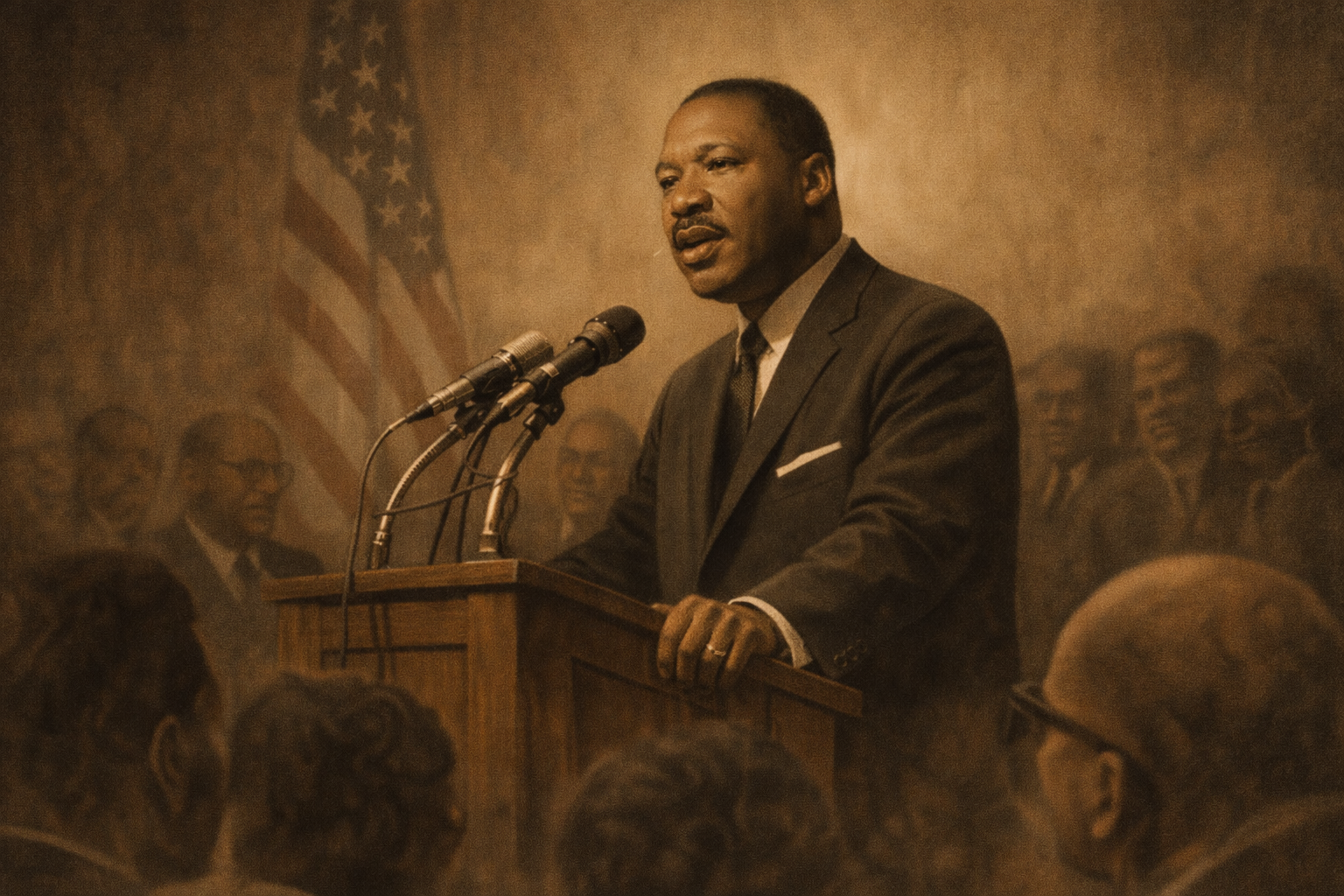
Martin Luther King Jr believed civil rights alone could not eliminate poverty without addressing deeper economic systems.
When people search for the MLK economic justice argument, they often expect a brief explanation of Martin Luther King Jr’s views on poverty. What they find instead is a larger claim about how economic systems shape opportunity across entire societies.
In the later years of his life, Martin Luther King Jr turned more directly toward the structural causes of poverty in the United States. While he remained a central leader of the civil rights movement, his speeches increasingly focused on economic inequality, employment, and how resources were distributed across society.
King argued that political rights alone could not create genuine freedom if large numbers of people remained trapped in economic insecurity.
This argument built on ideas he had already expressed in earlier speeches, including his description of emancipation as freedom to hunger and his metaphor about the bootless man .
Both ideas pointed toward the same insight. Freedom without economic foundations can become fragile freedom.
The Structure of King’s Economic Justice Argument
At the heart of the MLK economic justice argument was a simple observation about how societies actually function.
Opportunities are not created in isolation. They are shaped by institutions, public policy, economic systems, and historical conditions.
When King examined poverty in the United States, he concluded that many people were struggling not simply because of personal choices but because of barriers that had accumulated across generations.
Those barriers included unequal access to education, restricted opportunity in many communities, and the long afterlife of slavery and segregation.
King believed that ignoring those realities led to shallow explanations about poverty that focused only on individual behavior.
He made that point with particular directness in his 1967 speech Where Do We Go from Here, delivered to the Southern Christian Leadership Conference:
“We must recognize that we can’t solve our problem now until there is a radical redistribution of economic and political power… this means a revolution of values and other things. We must see now that the evils of racism, economic exploitation, and militarism are all tied together, and you can’t really get rid of one without getting rid of the others.”
— Martin Luther King Jr, Where Do We Go from Here, Southern Christian Leadership Conference, Atlanta, August 16, 1967
The passage is significant because it shows King moving beyond a narrow civil rights framing. He was not simply asking for inclusion within the existing economic order. He was questioning whether that order, left unchanged, could deliver genuine justice at all.
The Poor People’s Campaign
King’s economic thinking became most visible in the final phase of his life when he helped organize the Poor People’s Campaign in late 1967 and early 1968.
The campaign aimed to bring a multiracial coalition of Americans to Washington D.C. to demand federal action on poverty. Participants included Black Americans from the rural South, Latino farmworkers, Native Americans, and poor white families from Appalachia. What united them was not race but the shared experience of economic exclusion.
King and the Southern Christian Leadership Conference called for specific policy changes: a federal jobs program that would guarantee employment to those who needed it, stronger labor protections, expanded access to housing, and a guaranteed annual income for families living below the poverty line.
King argued that poverty was not an isolated local failure. It was a national problem rooted in how opportunity, work, and resources were distributed, and it required a response at the same scale.
For King, economic justice was not separate from civil rights. It was the next phase of the same moral struggle.
Why Economic Foundations Matter
The logic behind the MLK economic justice argument can be understood through a broader principle about freedom.
Political freedom protects individuals from domination.
Economic foundations make it possible for people to use that freedom in meaningful ways.
Without stable employment, access to education, and basic financial security, individuals often struggle to convert legal rights into long-term stability.
King captured this tension directly in Where Do We Go from Here: Chaos or Community?, the book he published in 1967:
“The black revolution is much more than a struggle for the rights of Negroes. It is forcing America to face all its interrelated flaws—racism, poverty, militarism, and materialism. It is exposing evils that are rooted deeply in the whole structure of our society.”
— Martin Luther King Jr, Where Do We Go from Here: Chaos or Community?, 1967
King believed that a society committed to justice should pay attention not only to rights but also to the economic systems that shape whether those rights can be exercised in practice.
A Systems Perspective
What made King’s later economic argument distinctive was its insistence on looking at interconnected causes rather than isolated symptoms.
Earlier civil rights arguments had focused on dismantling legal barriers. Segregation was visible, codified, and could be challenged in courts and through legislation. Economic inequality was harder to target because it emerged from a web of overlapping forces: hiring practices, access to capital, geographic concentration of poverty, underfunded schools, and the compounding disadvantages that follow families across generations.
King’s speeches in the late 1960s increasingly addressed those layered forces. He was not abandoning the moral language of the earlier civil rights movement. He was extending it into territory that required a different kind of analysis.
That systems perspective continues to shape discussions about economic mobility, public policy, and the long-term consequences of structural inequality.
Understanding the MLK economic justice argument requires looking beyond individual success stories and examining the deeper structures that shape opportunity. That was King’s warning in the final phase of his life. Legal rights may exist on paper, but without economic foundations those rights can remain fragile in practice. A society that celebrates freedom while ignoring the conditions required to exercise it is not solving the problem. It is simply redefining it.
Further Groundwork