

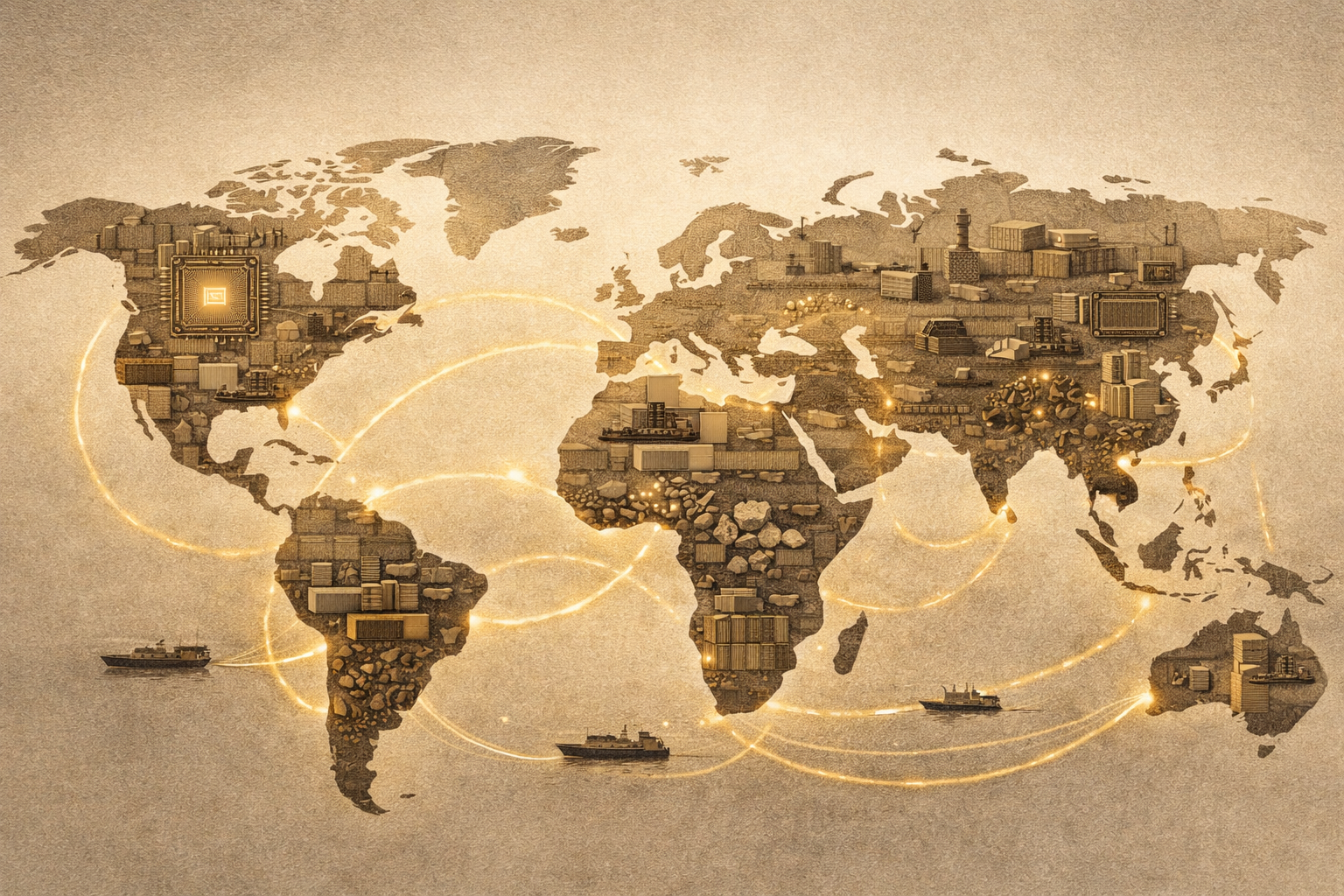
Technology supply chains in geopolitics now shape national power because modern states depend on systems they do not fully control. Semiconductors, critical minerals, manufacturing equipment, energy systems, shipping routes, data networks, and industrial expertise sit underneath everything from smartphones and automobiles to artificial intelligence and military readiness.
When those systems work, they look like commerce. When access breaks, governments discover how much strategy was hiding inside the supply chain.
That distinction changes how economic strength should be understood. A country can have world-class companies, enormous capital markets, advanced universities, and powerful armed forces while still relying on another country for a material, manufacturing process, machine, route, or component that cannot be replaced quickly.
Access creates capability during normal conditions. Control, substitution, throughput, and recovery determine how much of that capability survives disruption. Modern geopolitical competition therefore reaches far beyond who owns the finished technology. It reaches backward through the chain that makes the technology possible.
Groundwork Guide
The Strategic Chain
Raw Materials → Processing → Components → Manufacturing → Energy → Logistics → Digital Networks → End Use
Strategic leverage can emerge wherever capacity is concentrated and replacement is difficult. A country does not need to dominate the entire chain. Control of one hard-to-substitute layer can create dependence across everything downstream.
Why Technology Supply Chains Became a Geopolitical System
Global production networks were built largely around specialization and efficiency. Firms placed different stages of production where suppliers could perform them cheaply, reliably, or at extraordinary technical quality. That model reduced costs, expanded markets, and helped accelerate technological development.
Specialization also created concentration. A product may cross several countries and involve hundreds of suppliers while still depending heavily on one location for a particular material, manufacturing step, machine, software tool, or transportation route. During stable periods, that arrangement can look efficient. During disruption, the same structure can become a strategic vulnerability.
Governments therefore ask questions that firms do not always need to prioritize. What happens if a critical supplier becomes unavailable? How quickly can another producer qualify? Is the replacement technologically equivalent? Can energy, transportation, workforce, and supporting infrastructure absorb the shift?
This is the system beneath the policy debate. The objective has moved from maximizing efficiency alone toward balancing efficiency with security, redundancy, resilience, and the ability to recover when the preferred pathway closes.
Semiconductors Show What Concentrated Capability Looks Like
Semiconductors offer one of the clearest examples because chips sit inside an extraordinary range of civilian and strategic systems. Automobiles, medical equipment, telecommunications, industrial machinery, smartphones, artificial intelligence systems, satellites, sensors, data centers, and military platforms all depend on semiconductor technology.
Yet there is no single semiconductor supply chain. Chip design, fabrication, lithography, process equipment, materials, electronic design software, advanced packaging, testing, and memory each depend on different firms and geographic clusters. Strength in one layer does not eliminate dependence in another.
Taiwan remains central to the most advanced end of this system. The U.S. International Trade Administration reported in late 2025 that Taiwan accounted for more than 60 percent of global foundry revenue and more than 90 percent of leading-edge chip manufacturing. That concentration explains why semiconductor security discussions cannot be separated from the stability of East Asia.
A disruption in advanced fabrication would not remain a problem for chip companies. It would move downstream into computing, telecommunications, defense, artificial intelligence, and any industry unable to obtain equivalent processors elsewhere.
A Semiconductor Chokepoint Is Larger Than a Fab
Public discussion often reduces semiconductor resilience to building more fabrication plants. Fabs matter, but the factory is only one visible layer of a much larger industrial ecosystem.
Production also depends on specialized manufacturing equipment, gases, chemicals, wafers, software, precision components, water, electricity, engineering knowledge, technicians, maintenance systems, packaging, logistics, and suppliers capable of meeting exacting quality standards. Some capabilities require years of accumulated process knowledge.
U.S. semiconductor policy increasingly recognizes that problem. Commerce Department CHIPS programs have funded not only fabrication capacity but also semiconductor-grade polysilicon, optical components, vacuum equipment, research infrastructure, workforce development, and other parts of the supporting ecosystem.
The distinction matters. Production capacity is an ecosystem, not a building. A new factory can reduce one dependency while leaving several others untouched.
Export Controls Turn Technology Into State Power
Once a technology becomes strategically important, access to that technology can become an instrument of statecraft. The United States has used export controls to restrict access to certain advanced computing chips, semiconductor manufacturing equipment, software, and related technologies connected to advanced semiconductor production in China.
Those rules also show why supply-chain power should not be treated as static. Controls change as technology, commercial incentives, enforcement concerns, and national-security judgments change. In January 2026, for example, the Bureau of Industry and Security revised its licensing policy so applications involving Nvidia H200, AMD MI325X, and certain similar chips for approved customers in China could receive case-by-case review if specified security requirements were met.
The broader structure remained visible: governments were deciding whether access to particular commercial technologies should continue under ordinary market rules or become conditional on strategic policy.
That is supply-chain leverage in practice. The state does not need to own the factory or the chip. It may exercise power through jurisdiction over the technology, equipment, software, company, transaction, or end use.
Critical Minerals Reveal Why Refining Can Matter More Than Mining
Minerals create a similar misunderstanding. Finding a resource underground does not automatically create industrial power. Extraction is only the beginning. Many materials require beneficiation, separation, refining, chemical conversion, component manufacturing, and integration into finished products before they become technologically useful.
The International Energy Agency’s 2026 critical-minerals analysis shows why the distinction matters. Refining concentration reached new highs in 2025. Across several strategic minerals, China remained the dominant refiner, while Indonesia held the leading position in nickel. For gallium, graphite, manganese, and magnet rare earths, the IEA reports that China’s refining share exceeds 90 percent.
Rare earths make the structure especially clear. The IEA reports that China accounted for about 60 percent of global magnet-rare-earth mining in 2024, but roughly 91 percent of refining and 94 percent of sintered permanent-magnet production. The chain becomes more concentrated as material moves toward usable industrial capability.
Resource ownership therefore tells only part of the story. The stronger question is whether the resource can be converted into the material, component, or product that industry actually needs.
Geopolitical Leverage Lives Where Replacement Gets Hard
A chokepoint matters because alternatives are limited, expensive, technically inferior, geographically constrained, or slow to scale. It can exist in mineral refining, advanced manufacturing equipment, semiconductor fabrication, software, shipping, energy, financing, technical standards, or infrastructure.
Absolute monopoly is not required. A supplier gains strategic importance when enough of the system depends on its contribution and replacing that contribution would take substantial time, capital, expertise, or political coordination.
The International Energy Agency documented how mineral concentration moved from theoretical risk into operational disruption during 2025. New export restrictions affected rare earths and other strategic materials, exposing downstream manufacturers to supply constraints and forcing firms and governments to confront dependencies that had previously been treated as manageable.
This suggests a practical test for geopolitical exposure: if this supplier disappeared tomorrow, what would stop, how long would substitution take, and what else would fail while replacement capacity was being built?
Infrastructure Is the Load-Bearing Layer Beneath Technology
Supply chains do not move through abstraction. Ports load components. Trucks and railways move materials. Warehouses hold inventory. Power systems run fabs, refineries, and data centers. Water systems support semiconductor production. Communications networks coordinate factories, suppliers, and markets.
Digital systems are physical as well. Submarine cables carry the overwhelming majority of intercontinental internet traffic. Data centers require electricity, cooling, land, chips, networking equipment, and reliable fiber connections. Satellites depend on launch systems, ground stations, spectrum, components, and software.
Groundwork Daily’s Digital Infrastructure Isn’t Virtual: How the Internet Physically Works follows that architecture in more detail. Services that feel intangible at the user level still depend on assets that can be built, regulated, damaged, defended, rerouted, or denied.
Infrastructure belongs inside geopolitical analysis because access to advanced technology means little if the underlying systems cannot keep it operating.
Ownership Matters, but Throughput Reveals Whether the System Works
Governments often focus on visible assets because factories, mines, ports, and infrastructure projects are easy to announce. Ownership matters, but ownership alone can exaggerate real capability.
A mineral deposit without processing does not supply a manufacturer. A semiconductor plant without equipment, water, power, materials, maintenance, and skilled workers does not produce competitive chips. A port without sufficient rail, road, warehousing, and inland distribution capacity cannot move enough material to solve a logistics problem.
The real measure is throughput: whether the full chain can repeatedly convert inputs into usable output at the scale, quality, and speed the wider system requires.
That distinction separates industrial substance from industrial symbolism. Durable strategic capacity is not the existence of an asset. It is reliable production.
Economics and National Security Now Share the Same Infrastructure
The boundary between commercial policy and security policy has narrowed because many modern technologies serve both civilian and strategic purposes. Advanced computing powers scientific research and commercial artificial intelligence, but it also supports intelligence analysis, cyber operations, military simulation, and weapons development.
Telecommunications infrastructure supports daily communication and national networks. Batteries support consumer vehicles and grid storage while influencing industrial and energy resilience. Satellites provide civilian navigation and weather services while supporting defense communications and surveillance.
Governments therefore use tools once treated mainly as economic policy inside strategic competition: export controls, investment screening, subsidies, procurement rules, research restrictions, sanctions, licensing requirements, and industrial incentives.
This does not make every commercial dispute a security crisis. It means certain dependencies are now judged by a harder standard: whether access would survive a serious deterioration in political or security relations.
Resilience Can Create a Security Dilemma
Reducing dependence can itself generate strategic tension. One country subsidizes domestic semiconductor manufacturing because it fears disruption. A competitor may interpret the same policy as an effort to weaken its industrial position. Export controls designed to restrict sensitive technology can accelerate the targeted country’s effort to replace foreign technology.
Groundwork Daily’s analysis of the security dilemma helps explain the feedback loop. A measure intended as protection can appear offensive to the other side, especially when neither side can know where resilience ends and containment begins.
Industrial competition can then begin to resemble other forms of strategic rivalry. Subsidies invite counter-subsidies. Restrictions encourage substitution. Investment barriers accelerate alternative financing networks. Supply diversification can produce parallel production and trade systems.
The result may be stronger resilience inside individual blocs while the global system becomes more fragmented and expensive. That trade-off should be acknowledged rather than hidden beneath the language of security.
The Material Still Matters, but the System Determines Its Power
Competition over strategic resources is not new. States have long competed over oil, metals, land, ports, waterways, and transportation corridors. Modern production systems add another layer because raw material increasingly depends on technical knowledge and processing infrastructure before it can become strategic capability.
Groundwork Daily’s Are Wars Really About Resources? examines the longer argument about resources, economic power, and geopolitical conflict. Technology supply chains extend that analysis by showing why possession and control are not always the same thing.
One country may possess lithium but lack competitive battery manufacturing. Another may lack major mineral reserves but control processing. A third may dominate neither mining nor refining while retaining leverage through technology, software, intellectual property, financing, equipment, or market access.
Geopolitical power therefore emerges from combinations of capabilities. The better question is not simply who has the resource. It is who controls enough of the operating chain to influence what everyone else can do with it.
Resilience Does Not Mean Producing Everything at Home
The most simplistic answer to supply-chain vulnerability is complete domestic production. That can sound secure while becoming economically unrealistic. Advanced industries depend on deep specialization, and duplicating every layer in one country can raise costs, slow innovation, waste capital, and still leave important dependencies unresolved.
Real resilience is more selective. Governments and firms can diversify suppliers, maintain strategic inventories, create alternate transportation routes, strengthen domestic capacity where failure would be unusually damaging, support recycling, and build deeper production relationships with trusted partners.
Alliances therefore have an industrial dimension. Countries can distribute different capabilities across partners while reducing reliance on a single supplier or geography. That is not independence. It is a more deliberate architecture of interdependence.
The objective is not to eliminate dependence. Complex economies cannot do that. The objective is to prevent one broken relationship from removing every credible option at once.
Geopolitical Strategy Eventually Becomes Economic Geography
Supply-chain policy eventually reaches households, workers, businesses, universities, investors, and local governments. Semiconductor investment can change where factories are built and which technical skills become valuable. Mineral-processing projects can redirect capital. Export controls can affect product availability, business models, research partnerships, and markets.
New industrial capacity can create demand for engineers, technicians, electricians, construction workers, equipment specialists, logistics professionals, software workers, utilities, transportation infrastructure, and supplier networks. Yet announcements should not be confused with durable opportunity. Projects matter most when facilities are financed, built, staffed, connected to customers, and capable of surviving changes in political leadership or subsidy policy.
Communities also need to recognize concentration risk in their own economies. A region that becomes dependent on one subsidized plant, one employer, one technology, or one customer can recreate at the local level the same vulnerability national governments are trying to reduce.
Institutional literacy matters here because geopolitical policy does not remain in capitals. It changes where capital flows, which industries scale, which skills become scarce, and which communities inherit both the opportunity and the exposure.
The Hard Trade-Off Is Efficiency Versus Strategic Resilience
Resilience has a price. Global specialization reduced costs partly because companies did not maintain duplicate suppliers, factories, inventories, and transportation networks for every possible disruption. Redundancy reverses some of that efficiency.
New fabs, refining facilities, inventories, alternate routes, supplier networks, and domestic industrial capacity require capital. Some replacement capacity will also operate at higher cost than the concentrated system it is designed to insure against. The IEA’s 2026 work notes that refining projects outside dominant suppliers can face substantially higher capital and operating costs.
Yet optimizing exclusively for cost can create brittleness. A cheap system becomes expensive quickly when a concentrated supplier fails and there is no substitute.
Strong policy therefore has to distinguish ordinary commercial dependence from dependencies whose interruption would produce disproportionate economic or security damage. Redundancy earns its cost where failure would be harder to absorb than prevention.
What to Watch in Technology Supply Chains and Geopolitics
Watch investment before rhetoric. New fabrication plants, mineral-processing facilities, battery plants, ports, power infrastructure, data centers, packaging capacity, and supplier networks reveal where governments and companies expect strategic demand to persist. Announcements are signals. Production is evidence.
Watch the middle of the chain. Mining projects often attract more public attention than processing, refining, equipment, packaging, maintenance, and supplier capacity. Yet those less visible layers can determine whether diversification actually creates usable output.
Watch export-control and licensing changes as well. They reveal which technologies governments are treating as strategically sensitive, but they also change over time. A policy should therefore be read as part of an evolving system rather than as a permanent wall.
Finally, watch replacement time. Ask which country, company, route, machine, material, or processing step would be hardest to replace. Then ask how long substitution would take and which downstream systems would lose capacity while replacement was underway.
That is the most useful way to read technology supply chains in geopolitics. Start with the finished product, then follow its dependencies backward until you reach the point where substitution stops being easy.
The Groundwork
Access Is Not the Same as Control
Technology supply chains expose a weakness in how national strength is often measured. A country can consume advanced products, host successful companies, and participate deeply in global markets while still depending on capabilities it cannot replace quickly. Normal access can hide strategic fragility.
The answer is not autarky. No advanced economy can efficiently own every material, factory, machine, route, technology, and supplier it needs. The stronger objective is to understand where concentration becomes dangerous and build enough alternatives that one failure does not become systemic failure.
Modern geopolitical power is increasingly operational. It belongs not only to countries that possess technology or resources, but to systems capable of continuing when the easiest supplier, route, or relationship is no longer available.
System Updates
The System: Updated.
What looked like the system: Countries trade technology and materials according to price, specialization, and market demand.
What the system reveals: Every advanced technology sits on top of concentrated materials, equipment, production, energy, logistics, and knowledge. Any difficult-to-replace layer can become strategic leverage.
Updated model: National power depends not only on what a country can buy or invent, but on whether the systems underneath that capability can absorb disruption, find substitutes, restore throughput, and continue operating.
Continue Building
Follow the Architecture of Strategic Power
Technology supply chains connect material resources, infrastructure, security policy, and institutional competition. These paths extend the analysis into the systems that make geopolitical leverage possible.
Foundation · Material Power
Are Wars Really About Resources?
Follow the longer argument about resources, production, economic incentives, and geopolitical conflict.
Related System · Strategic Competition
The Security Dilemma: Why Nations Compete Even When They Don’t Want War
See how defensive measures can generate new threat perceptions and strategic feedback loops.
Go Deeper · Digital Infrastructure
Digital Infrastructure Isn’t Virtual: How the Internet Physically Works
Follow digital power into the cables, data centers, energy systems, and physical infrastructure carrying modern connectivity.
Continue · System Updates
Explore System Updates
Continue beneath visible events into the institutions, incentives, infrastructure, and feedback loops producing recurring outcomes.

Meet the Builder
Langston Reed
Builder, Civic Power & Policy
Langston Reed examines how institutions, governance, public policy, infrastructure, incentives, and authority shape everyday life. His work builds institutional literacy by tracing the systems operating beneath visible outcomes.
Research Trail
Receipts
These sources support the article’s analysis of semiconductor concentration, critical-mineral processing, export controls, industrial ecosystems, and infrastructure risk.
Data & Research
International Energy Agency · Global Critical Minerals Outlook 2026
Documents refining concentration, supply risk, export restrictions, substitution constraints, diversification costs, and the difference between mining capacity and downstream processing capability.
International Energy Agency · Rare Earth Elements
Maps the rare-earth value chain from mining through separation, refining, alloying, and permanent-magnet production, including geographic concentration at each stage.
Semiconductor System
U.S. International Trade Administration · Taiwan: Semiconductors Including Chip Design for AI
Provides current U.S. government analysis of Taiwan’s role in global foundry revenue and leading-edge semiconductor manufacturing.
U.S. Department of Commerce · CHIPS Supply-Chain Investments
Shows how semiconductor industrial policy extends beyond fabrication into equipment, optical components, supply-chain capacity, and related manufacturing infrastructure.
Export Controls
U.S. Bureau of Industry and Security · Advanced Semiconductor Export Controls
Documents controls involving semiconductor manufacturing equipment, software, high-bandwidth memory, and advanced-node production.
U.S. Bureau of Industry and Security · January 2026 Semiconductor Licensing Revision
Records the 2026 shift to case-by-case license review for certain advanced processors exported to approved customers in China under specified conditions.
Digital Infrastructure
Federal Communications Commission · Submarine Cable Infrastructure
Provides U.S. regulatory context for the strategic importance and security of submarine communications cables carrying global internet traffic.
External links were live and accessible when this article was published or last substantively updated. Third-party pages may change, move, or be removed over time.