
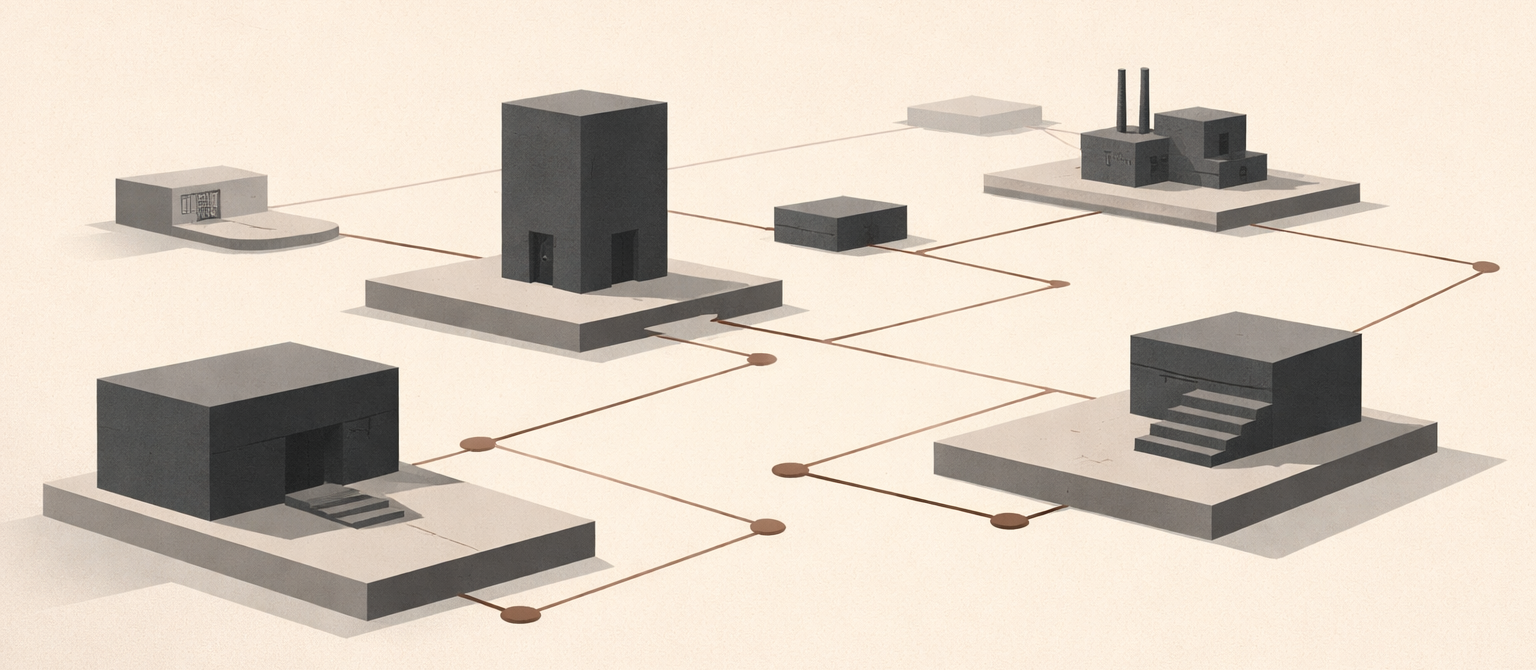
Modern forced labor did not emerge because slavery returned. It exists because slavery never fully disappeared. It changed form.
When legal ownership of people became politically and morally untenable, the system adapted. Control moved away from explicit ownership and into contracts, prisons, migration systems, and supply chains. The structure survived. The visibility did not.
This post explains how slavery systems decentralized instead of ending, and why that matters for understanding forced labor today.
What changed after abolition
Formal abolition ended chattel ownership in many countries during the nineteenth century. What it did not end was the economic demand for cheap, controllable labor.
Rather than disappear, coercive labor systems shifted:
- From ownership to obligation
- From plantations to contracts
- From private masters to state and corporate intermediaries
This transition did not require new cruelty. It required new mechanisms.
Decentralization as a survival strategy
Earlier slavery systems were centralized. Ownership was visible. Responsibility was traceable. Abolition targeted that visibility.
Modern forced labor works differently. Control is fragmented across:
- Recruiters
- Subcontractors
- Employers
- States
No single actor appears to “own” the laborer. Each actor claims partial responsibility. The result is a system where accountability dissolves while coercion remains intact.
This decentralization makes modern forced labor harder to identify, prosecute, and dismantle.
The dominant modern forms of forced labor
Debt bondage
Debt bondage remains the most widespread form of modern forced labor. Workers are trapped by loans, recruitment fees, or wage advances that cannot realistically be repaid. Exit is legally possible but practically blocked.
Penal labor
States continue to use forced labor as punishment or political control. In some systems, incarceration becomes a labor reservoir where legal rights are suspended and labor extraction is normalized.
Trafficking and coerced migration
Migrants are especially vulnerable to forced labor due to legal precarity, language barriers, and dependency on sponsors or employers. Control operates through threat of deportation rather than physical chains.
Supply chain coercion
Forced labor is often embedded deep within global supply chains. End consumers may never see it, and corporations may plausibly deny direct involvement, even while benefiting economically.
This analysis treats forced labor as a structural control system, not a moral deviation.
Why modern forced labor mirrors closed systems
Modern forced labor resembles historical closed systems more than open ones.
In many cases:
- Exit routes exist on paper but not in practice
- Status traps workers through debt, criminal records, or legal dependency
- Social and economic recovery after escape is limited or impossible
Like closed slavery systems of the past, modern forced labor produces lasting harm not because of visible brutality, but because it denies viable exit.
This structural continuity explains why forced labor persists despite international bans.
Why abolition language is no longer sufficient
Modern forced labor exposes the limits of abolition as a framework.
When slavery is defined only as ownership, systems built on obligation, punishment, or dependency are rendered legally invisible—even when coercion remains total.
This is why modern forced labor statistics often feel abstract. The harm is distributed, hidden, and normalized through legal and economic systems.
The issue is not that laws are missing. It is that structure still rewards coercion.
Continuity across the series
This post completes a structural arc:
- The Worst Forms of Slavery in History identifies systems by impact.
- Open vs. Closed Slavery Systems explains why some systems scar societies longer.
- This post shows how those same structures persist under new names.
Slavery did not end. It decentralized.
What to take from this audit
- Modern forced labor is structural, not accidental.
- Decentralization protects systems from accountability.
- Exit determines harm more than intent.
In practice, recruitment and subcontracting chains can distribute control so widely that coercion persists while legal responsibility becomes difficult to assign.
History shows that when systems deny exit, coercion survives every reform.
