
Pillars · Systems & Structure
Modern forced labor does not require legal ownership of another human being. Instead, it requires something more basic: enough control over a person’s choices, movement, status, debt, safety, or livelihood that refusing work or leaving becomes dangerous, impossible, or prohibitively costly.
Modern forced labor changes how labor coercion must be analyzed because ownership is not the only mechanism capable of restricting human freedom.
Chattel slavery was a specific legal and economic institution built around the ownership of human beings. Modern forced labor is not identical to that system. Therefore, treating every form of labor exploitation as interchangeable with historical slavery weakens rather than strengthens the argument.
Abolition, however, did not eliminate every mechanism capable of coercing labor.
Debt can constrain exit. Immigration status can do the same. Likewise, confiscated identity documents, threats, withheld wages, fraudulent recruitment, incarceration, isolation, and dependency can narrow a worker’s practical freedom.
Ownership is therefore only one possible architecture of labor control.
The deeper structural question becomes:
How much freedom does a worker actually have to refuse, leave, recover, and survive?
The Architecture
Dependency → Control → Restricted Exit → Extracted Benefit
Modern forced labor can emerge when a worker becomes dependent on a person, employer, recruiter, institution, debt arrangement, or legal status that also possesses the power to punish refusal or make exit materially dangerous.
Consequently, the system does not need legal ownership if it can make departure functionally unavailable.
Start With the Definition
What Is Modern Forced Labor?
The International Labour Organization defines forced or compulsory labour around two central conditions: work is exacted under the threat of a penalty, and the worker has not offered that labor voluntarily.
That definition matters because coercion does not have to look like physical captivity.
For example, the ILO identifies mechanisms that can include threats, accumulated debt, retention of identity documents, withheld wages, intimidation, deception, restrictions on movement, and threats involving immigration authorities.
Therefore, the visible question is not simply whether a person appears to be working. The structural question is whether meaningful refusal still exists.
Structural Distinction
Exploitation becomes forced labor when the worker’s freedom to enter, refuse, or leave the work is overridden through coercion or the threat of penalty.
The Scale
The Global Scale of Modern Forced Labor
The International Labour Organization’s global estimates place approximately 27.6 million people in forced labor.
Of that total, the estimates identify approximately:
- 17.3 million people exploited in the private economy
- 6.3 million people in forced commercial sexual exploitation
- 3.9 million people in state-imposed forced labor
Moreover, migrant workers face substantially greater exposure. ILO estimates indicate that migrant workers are about three times more likely to experience forced labor than non-migrant workers.
Those numbers reveal something important: modern forced labor is not organized through one institution, one industry, one country, or one legal structure.
Instead, the system is distributed.
Historical Transition
Modern Forced Labor After Abolition
Abolition mattered because legal ownership mattered.
Chattel slavery gave enslavers formal authority to treat people as property, transfer them, extract their labor, separate families, and deny their legal autonomy.
Ending that legal architecture was not symbolic reform. It destroyed a central institutional foundation of the system.
Yet abolition did not eliminate every incentive for obtaining labor cheaply. Nor did it automatically remove every institution capable of creating dependency and coercion.
That is where the continuity must be described carefully.
Modern forced labor is not simply historical chattel slavery continuing unchanged. Rather, the structural problem of extracting labor from people who cannot meaningfully refuse can reappear through different mechanisms.
In short, the mechanism changes while the question of power remains.
The Structural Shift
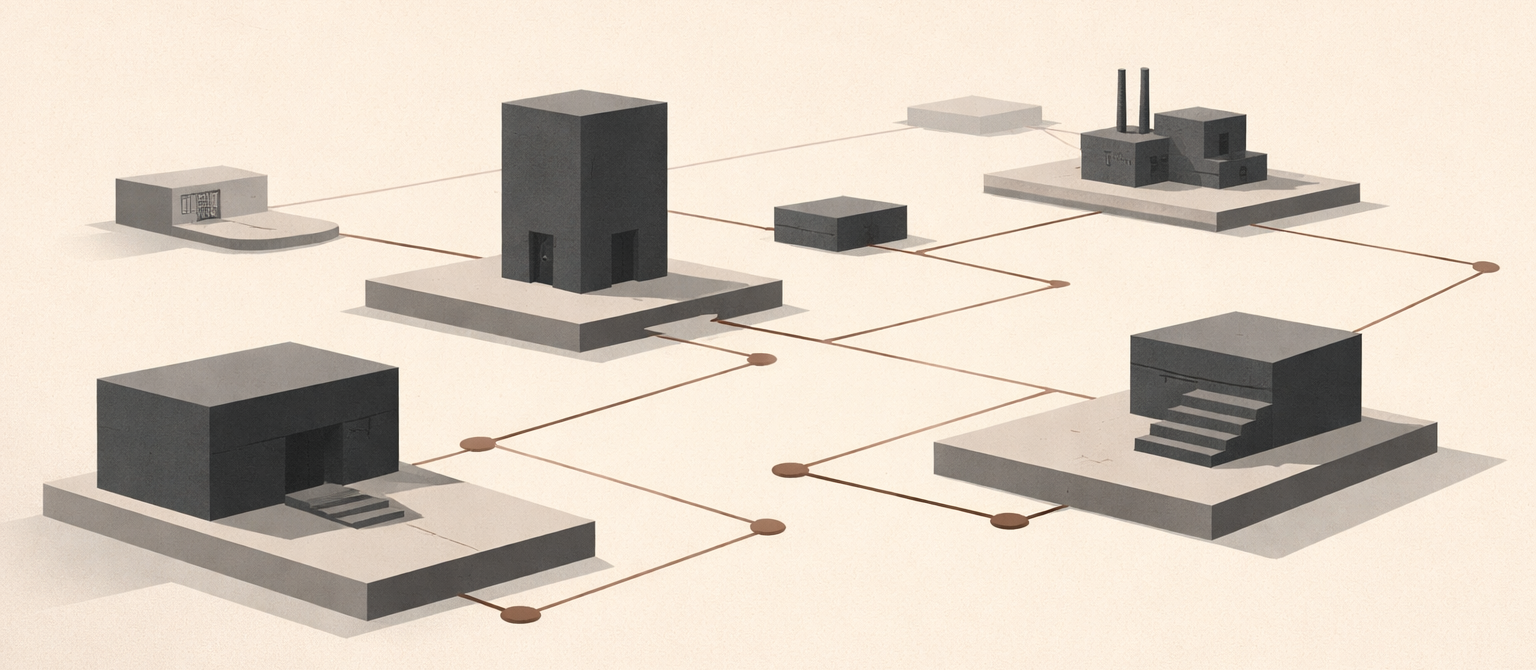
How Modern Forced Labor Becomes Decentralized
A centralized coercive system makes power easier to see. One institution owns, one authority commands, and one relationship defines the worker’s legal position.
Decentralized control is harder to map because different actors may control different parts of the worker’s reality.
Recruiter
Controls Entry
Recruitment debt, false promises, placement fees, travel arrangements, or deceptive contracts can create dependency before work even begins.
Employer
Controls Work
Wages, schedules, housing, documents, transportation, threats, and access to basic resources can become instruments of control.
Intermediary
Controls Distance
Contractors and subcontractors can separate the entity receiving economic value from the actor directly managing workers.
State
Controls Status
Immigration rules, criminal penalties, detention, state labor programs, or political authority can determine how safely a worker can refuse or leave.
Fragmented Control Creates Fragmented Accountability
Once these functions are separated, accountability can become fragmented.
For example, the recruiter may say the employer created the abuse. The employer may point to the labor contractor, while the contractor points to market pressure. Meanwhile, the purchasing company may point to contractual compliance, and government authorities may point back to private actors.
As a result, everyone can appear one step removed from the coercion while the worker remains inside it.
Decentralized Accountability
Buyer → Supplier → Subcontractor → Recruiter → Worker
Distance can weaken visibility without weakening economic benefit.
Accordingly, the farther responsibility is divided across the chain, the easier it becomes for each participant to describe the abuse as somebody else’s problem.
Mechanisms of Control
How Modern Forced Labor Operates
Modern forced labor is better understood through mechanisms than labels because the same mechanism can appear in different industries, countries, or legal environments.
Debt and Recruitment Fees
A worker may begin employment already owing money for recruitment, travel, placement, housing, equipment, or documents.
Debt alone does not create forced labor. However, the structural danger appears when debt becomes part of a coercive arrangement that prevents the worker from leaving or makes departure impossible without severe penalty.
For that reason, international fair-recruitment standards emphasize that workers should not bear recruitment fees or related costs.
Document Retention and Restricted Movement
Passports, identity documents, permits, or other records can become mechanisms of control when workers cannot freely access them.
A locked door is not the only way to restrict movement. If leaving means becoming undocumented, stranded, unable to travel, or exposed to authorities, a document can become part of the barrier.
Withheld Wages
Delaying or withholding wages can convert past labor into leverage over future labor.
For instance, a worker who is owed several months of pay may technically be free to leave while being financially unable to abandon the wages already earned.
Therefore, the relevant question is not merely whether wages are late. It is whether withheld pay is being used to compel continued work.
Threats and Immigration Dependency
Migrant workers can face a particularly dangerous concentration of dependency when employment, housing, legal status, transportation, and income all run through the same employer or sponsor.
Under those conditions, losing a job may mean losing far more than a paycheck. Consequently, threats involving deportation or immigration authorities can function as powerful forms of coercion.
State-Imposed Forced Labor
States can also impose forced labor, but this category requires precision.
Prison labor, penal labor, and forced labor are not automatically synonymous. International labor standards recognize limited exceptions for certain prison work under defined conditions.
Therefore, the relevant issue is whether labor falls within lawful exceptions or becomes compulsory labor imposed outside those protections, including through political coercion, abusive detention, or other state authority.
Trafficking and Modern Forced Labor
Human trafficking and forced labor overlap, but they are not identical legal concepts.
Trafficking can involve recruitment, movement, harboring, deception, coercion, or exploitation. By contrast, forced labor focuses specifically on whether labor is being exacted involuntarily under threat of penalty.
Keeping those definitions distinct improves the analysis.
Groundwork Diagnostic
The Modern Forced Labor Exit Test
The most useful way to evaluate a labor system is not to ask whether it resembles a historical plantation. Instead, ask whether the worker retains meaningful exit.
01
Dependency
What does the worker depend on the controlling actor to provide?
02
Control
What resources, documents, wages, status, movement, or information can the actor control?
03
Exit
What realistically happens if the worker refuses, reports abuse, or leaves?
04
Benefit
Who receives economic or institutional benefit from the worker remaining inside the system?
Together, these four questions move the analysis away from appearance and toward structure.
A worker may receive wages and still face coercion. Likewise, a signed contract does not guarantee that meaningful freedom will continue throughout the employment relationship.
Most importantly, a worker may technically be allowed to leave while facing penalties severe enough to make departure functionally unavailable.
Formal permission, therefore, is not always practical freedom.
Closed Systems
Restricted Exit and Modern Forced Labor
Groundwork’s earlier analysis of open and closed slavery systems provides a useful structural lens.
Closed systems do more than impose hardship. They restrict the routes through which a person can leave one condition and re-enter ordinary social or economic life.
That logic matters in modern forced labor because the severity of control is often found in what happens after attempted exit.
Can the worker leave without losing legal status or forfeiting months of wages?
Can the worker leave without inheriting an impossible debt or exposing themselves to retaliation?
Can the worker return home and rebuild afterward?
Ultimately, a system becomes more coercive as viable exit routes disappear.
Economic Distance
Modern Forced Labor in Global Supply Chains
Global supply chains divide economic activity across countries, contractors, factories, farms, recruiters, shipping networks, processors, and purchasing companies.
That architecture creates enormous productive capacity. At the same time, it can create distance between the organization benefiting from a product and the workers performing the most vulnerable labor inside its production.
Walk Free’s Global Slavery Index has documented the connection between higher-income consumer markets and goods considered at risk of modern slavery in complex global supply chains.
Distance Can Obscure Responsibility
The structural problem is opacity.
A purchasing company may have no direct employment relationship with workers several tiers down its supply chain. Nevertheless, its pricing, delivery deadlines, procurement standards, purchasing volume, and supplier relationships can still influence the economic environment in which those workers operate.
This does not mean every company automatically possesses direct legal responsibility for every abusive act committed somewhere in its supply chain.
Rather, it means distance should not be confused with irrelevance.
Systems can distribute responsibility while concentrating benefit.
Systems Principle
Cheap Labor Creates an Incentive. Weak Accountability Creates an Opening.
Forced labor should not be reduced to the existence of unusually cruel individuals.
Individual abuse matters. However, systems analysis asks why abuse can continue, produce value, remain hidden, and survive across time.
Where labor is difficult to inspect, workers have little bargaining power, recruitment is opaque, legal status creates dependency, and responsibility is distributed across several entities, coercion becomes easier to conceal.
In other words, the system does not need every participant to intend the same outcome. It only needs incentives and blind spots that allow the outcome to persist.
Necessary Boundary
Not Every Bad Job Is Modern Forced Labor
Precision matters here.
Low wages, unsafe conditions, unfair contracts, and economic inequality can all produce serious harm. However, none automatically constitutes forced labor.
A worker can therefore be exploited without meeting the legal or analytical threshold for forced labor.
Blurring those distinctions may sound morally forceful, but it produces weak analysis.
Forced labor requires the additional element of coercion: work extracted under circumstances in which voluntary consent or meaningful freedom to leave has been overridden.
That distinction protects the seriousness of the category.
Continuity Without False Equivalence
Modern Forced Labor and Historical Slavery
Historical comparison becomes useful when it identifies mechanisms rather than pretending different institutions are identical.
| Structural Question | Chattel Slavery | Modern Forced Labor |
|---|---|---|
| Legal ownership | Central to the system | Generally absent |
| Labor extraction | Compulsory | Compulsory where forced labor exists |
| Exit | Denied through ownership and law | May be blocked through threats, debt, status, documents, violence, or other penalties |
| Accountability | Ownership often made authority identifiable | Responsibility may be distributed across multiple actors |
| Economic benefit | Labor value captured through ownership | Labor value may be captured across employers, contractors, intermediaries, and markets |
The comparison does not erase historical differences. Instead, it reveals a recurring systems problem: labor can be coerced through more than one architecture.
The Analytical Limit
Why Modern Forced Labor Requires a Wider Vocabulary
Abolition remains essential historical and legal language.
However, if slavery is understood only through formal ownership, modern systems of coercive labor can become conceptually difficult to recognize.
A person does not need to be legally owned for another actor to gain extraordinary power over that person’s labor.
Therefore, the modern vocabulary has to examine:
- consent
- penalty
- dependency
- freedom of movement
- control over documents
- control over wages
- legal vulnerability
- ability to leave
Together, these mechanics make coercion easier to identify even when legal ownership is absent.
The Larger Structural Audit
Modern Forced Labor Completes a Three-Part Analysis
This piece becomes more useful when read as the third stage of Groundwork’s structural examination of slavery systems.
Impact
The Worst Forms of Slavery in History
Examines slavery systems by the scale of violence, extraction, social destruction, and long-term consequence.
Durability
Open vs. Closed Slavery Systems
Examines why some coercive systems leave deeper structural legacies by restricting exit, reintegration, and social recovery.
This article adds the third question:
What happens when coercion survives without ownership?
What to Look For
A Structural Audit for Modern Forced Labor
When evaluating a labor arrangement, look beyond the job title and formal contract.
- Identify the dependency. Determine what the worker cannot easily replace: housing, immigration status, wages already earned, transportation, documents, debt relief, or physical safety.
- Identify the penalty. Ask what happens if the worker refuses instructions or leaves.
- Identify who controls the exit route. Determine whether the same actor controlling labor also controls documents, transportation, status, debt, or access to authorities.
- Follow the economic benefit. Identify which organizations or intermediaries gain from the labor arrangement.
- Map the accountability chain. Determine whether responsibility is clear or distributed across enough actors that nobody appears fully accountable.
This audit does not determine a legal case by itself. Instead, it reveals where deeper investigation belongs.
The Groundwork
Ownership Was One Architecture of Coercion. It Was Never the Only One.
Chattel slavery made domination brutally visible because the law itself declared who possessed authority over another person’s body and labor.
Modern forced labor can be harder to see because control is often divided among several actors.
One actor may create the debt while another controls the job. A third may control immigration status, while another purchases the product or sits several contractual layers away from the worker.
Consequently, no ownership document is required.
What matters is whether the system can make refusal dangerous, exit unrealistic, and continued labor profitable.
That is why modern forced labor requires systems analysis. The visible institution changed, but the structural question did not.
When freedom exists only on paper, the system still owns the decision that matters most: whether a person can leave.
Continue Building
This piece is part of a larger structural audit of coercion, exit, and institutional durability. Move through the system below.
→ Framework: Open vs. Closed Slavery Systems
→ Historical Audit: The Worst Forms of Slavery in History
→ Series Map: Slavery Didn’t End. It Changed Form.
Build Better. Every Day.
Learn to See the Structure Beneath the Headline
Groundwork Daily examines the systems beneath power, work, institutions, money, relationships, culture, and everyday decisions. The goal is not more information. It is better structural judgment.
Groundwork Architecture
Explore Systems & Structure
Continue through Groundwork Daily’s structural analysis of incentives, institutions, power, accountability, coordination, and the systems that determine what outcomes become durable.
