
Speed feels like progress until it outruns judgment.
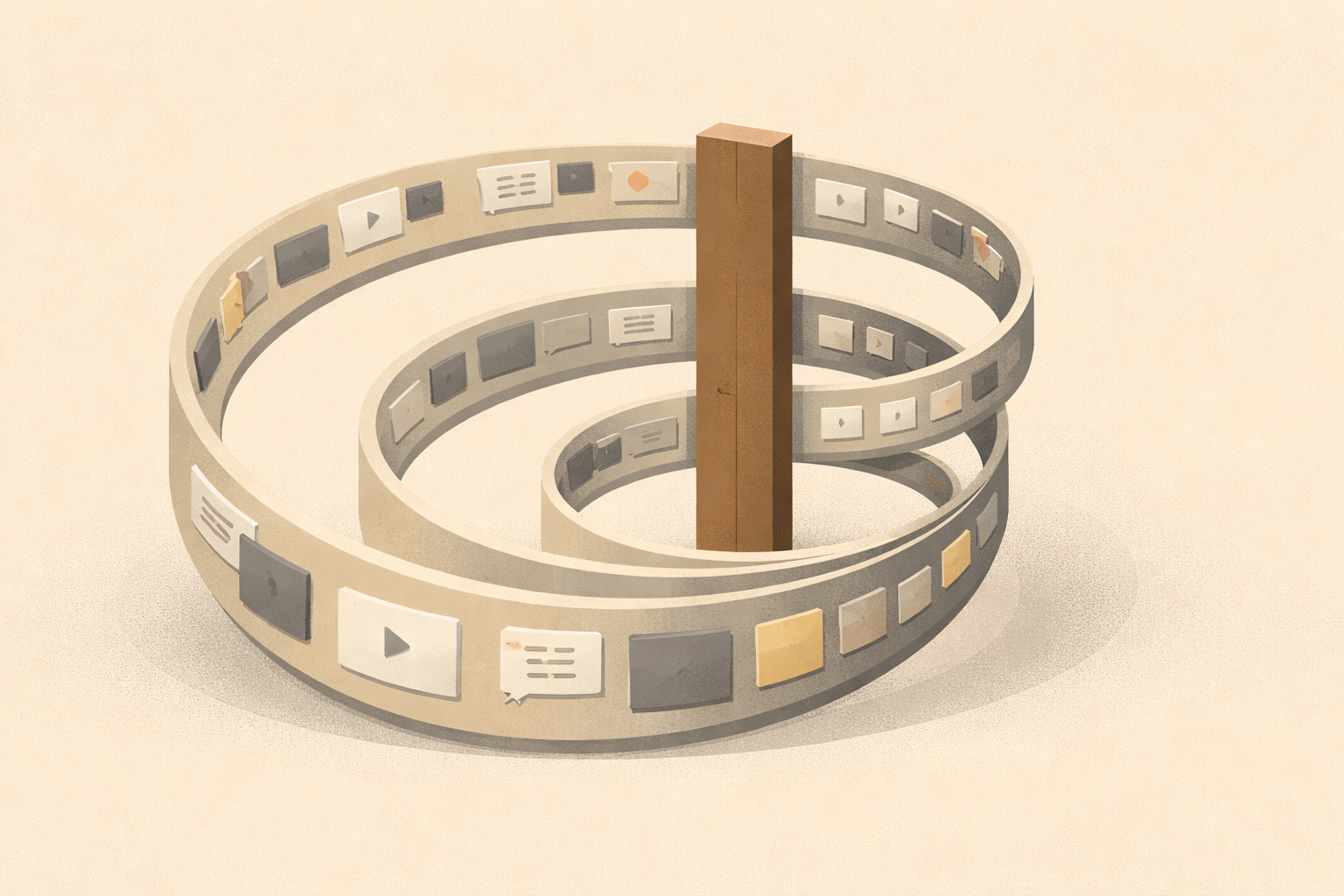
A social media feedback loop is what happens when a platform stops reflecting your attention and starts shaping it. The loop feels harmless because it is quiet. It scrolls smoothly. It refreshes on demand. However, the system is not built for your clarity. It is built for measurable engagement.
The image captures it: a pathway that tightens with every pass. First you react. Then the system learns. Then it repeats the pattern, slightly stronger each time. Consequently, what you see becomes narrower, not because you chose narrowness, but because the loop rewards what it can count.
Social media feedback loop mechanics
A social media feedback loop works in four steps. First, you give signals (pauses, shares, comments, rewatches). Next, the platform interprets those signals as preference. Then, it serves more of what produced the strongest reaction. Finally, it watches whether you react again. That cycle is the loop.
Over time, the loop becomes a training engine. It trains your habits by repeating the same emotional temperatures. In addition, it trains your expectations by reducing surprise. The feed becomes familiar. The familiar becomes believable. Then belief becomes behavior.
Why a social media feedback loop beats reflection
Reflection is slow. Reaction is fast. Therefore, the loop naturally elevates what triggers you over what teaches you. A platform does not need to lie to distort reality. It only needs to over-represent one angle until it feels like the whole landscape.
That is also why the loop pairs so well with fragmented news consumption. If you have not already, read When the Newsfeed Becomes the World. The point is simple: the feed can become a substitute for a shared reality, and the loop tightens that substitution every day.
How the loop narrows information over time
At first, the feed is diverse because the system is learning. Then, it narrows because narrowing improves predictability. Predictability increases consumption. Consumption increases ad value. So the loop does what it was designed to do.
Meanwhile, nuance loses. Nuance requires context. Context requires time. Time reduces velocity. Velocity reduces profit. So the loop chooses speed and calls it personalization.
Where the harm lands when the loop tightens
The harm is not evenly distributed. Communities with less institutional protection feel it faster. When the loop amplifies fear, outrage, and suspicion, it increases social heat without increasing social capacity. As a result, people carry stress, distrust, and confusion while the platform collects the margin.
This is not just a media issue. It is a systems issue. The loop changes how people interpret neighbors, institutions, and even themselves. In the end, the platform does not have to break communities directly. It only has to accelerate the conditions that strain them.
What breaks a social media feedback loop
The loop breaks at the point where structure interrupts momentum. That can happen personally, product-wise, or publicly.
- Personal structure: time windows, intentional follows, and deliberate input variety so the feed cannot collapse your world into one lane.
- Product structure: friction before resharing, clearer controls, and less exploitative defaults that do not treat attention like an open vein.
- Public structure: transparency expectations and accountability requirements when platform incentives create predictable social harm.
For credible reporting and data on how Americans get news and how platforms shape distribution, reference Pew Research Center’s work on journalism and media. Pew Research Center – Journalism & Media.
The Bottom Line
A social media feedback loop narrows the world by rewarding what is measurable, not what is true. If the loop learns faster than people can reflect, then structure must slow it down. Otherwise, the system will keep shaping outcomes before anyone notices, and it will call that “engagement.”

