
Structure reveals truth.
Future Literacy · Digital Infrastructure
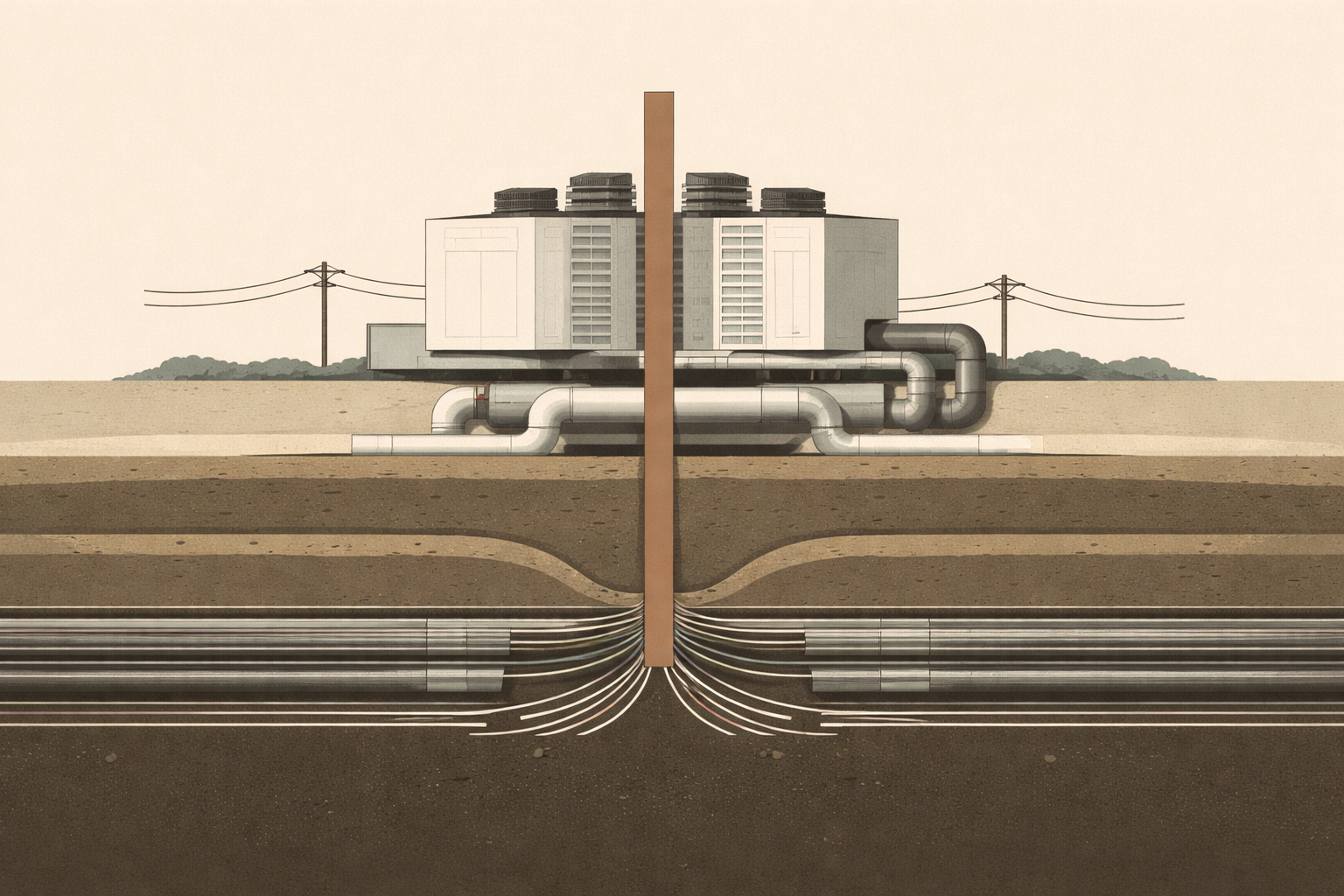
The internet feels almost weightless because most of its machinery has been designed to disappear from view.
A message arrives in seconds. A movie starts without a reel. A photograph moves into the cloud. An AI system answers a question before most of us have thought about where the computation happened.
That convenience makes it easy to misunderstand how the internet physically works.
The internet is not floating above the world. It is built into it.
It depends on fiber-optic cables, routers, network exchanges, data centers, substations, cooling systems, electricity, water, land, technical workers, utility agreements, and physical rights of way.
Even the word cloud can obscure more than it explains. The cloud is somebody else’s hardware, housed somewhere, connected to something, drawing power every second it remains available.
Understanding that physical layer is increasingly important. Digital systems now influence work, education, communication, finance, entertainment, government, and artificial intelligence. If those systems are becoming more important, then understanding what carries them is part of basic future literacy.
The digital economy does not escape infrastructure. It hides infrastructure behind a cleaner interface.
Infrastructure
How the Internet Physically Works
Start with something ordinary: opening a website.
The screen makes the process look immediate. Underneath it, several systems have to coordinate.
Your device first sends a request through a local connection. That connection may begin through Wi-Fi, Ethernet, a cable network, a fiber connection, or a cellular tower. From there, the request enters a larger network operated by an internet service provider.
Routers decide where the request should go next. Fiber-optic networks carry data across cities and regions. Internet exchange points help networks pass traffic between one another. If the destination is far away, the route may eventually cross an undersea cable connecting continents.
At the other end sits physical computing equipment.
Servers process the request. Storage systems retrieve data. Network switches move information inside the facility. Then a response travels back through the network toward your device.
A phone, computer, television, or connected device asks a network for information.
Routers, exchanges, and fiber connections move the request toward the correct destination.
Physical machines process the request, retrieve information, and send the result back.
The path can be far more complex than those three stages, but the underlying lesson is simple.
Digital activity is physical movement translated into signals.
Streaming a video, making a bank transfer, uploading a document, joining a video call, or generating an AI response may feel different on the screen. Underneath, each activity relies on a chain of real equipment carrying electrical or optical signals through a real network.
That is the first piece of physical internet literacy: the interface may be virtual, but the system carrying it is not.
Centers
Why Data Centers Matter to the Internet
Data centers are among the most visible pieces of infrastructure once the digital system is viewed physically.
At first glance, many resemble large warehouses. Inside, however, they are engineered environments built around continuous computing.
Rows of servers process requests and store information. Networking equipment moves enormous volumes of data. Power systems keep the equipment operating. Backup systems prepare for outages. Cooling systems remove heat. Security systems protect both the site and the equipment.
Reliability is the point.
Users expect online services to work at any hour. That expectation requires infrastructure capable of operating continuously while surviving equipment failures, maintenance, heat, traffic spikes, and interruptions elsewhere in the system.
Servers perform the calculations that run websites, platforms, applications, cloud services, and AI systems.
Physical drives and storage systems hold files, databases, backups, media, and application data.
Switches, routers, fiber connections, and network equipment move information into, out of, and through the facility.
Heat generated by computing equipment must be removed so hardware can continue operating reliably.
Utility connections, transformers, backup generators, batteries, and other systems keep electrical service available.
Technicians, engineers, security teams, facilities staff, and vendors maintain the physical system behind digital availability.
This is where the language of the cloud becomes especially misleading.
The cloud is not soft. It is racks, steel, concrete, copper, glass fiber, transformers, backup systems, cooling equipment, land, and labor.
The internet appears effortless only because enormous amounts of physical effort happen somewhere else.
That physical dependency is explored further in The Physical Cost of Digital Ambition .
Power
Energy and Cooling Reveal the Internet’s Hidden Load
The internet’s material footprint becomes easiest to see when computation is translated into energy.
Servers require electricity. Storage requires electricity. Networking equipment requires electricity. Cooling requires electricity. Building systems, lighting, monitoring, security, batteries, and backup infrastructure add additional demand.
As digital activity expands, that load grows.
The International Energy Agency projects that global electricity consumption from data centers will more than double by 2030, reaching roughly 945 terawatt-hours. Artificial intelligence is one factor driving that growth, alongside traditional cloud computing, streaming, storage, business systems, and broader digital demand.
Electricity is only one part of the picture.
Computation produces heat. Heat has to go somewhere.
Some facilities use air-based cooling systems. Others use evaporative cooling, chilled-water systems, direct liquid cooling, or combinations of several approaches. The exact footprint depends heavily on the design of the facility and the climate where it operates.
That means there is no single answer to the question, “How much water does a data center use?”
The better Future Literacy question is: what cooling architecture does this facility use, under what local conditions, and what resources carry that design?
Once the question is framed that way, the physical system becomes easier to understand.
Geography
Why Internet Infrastructure Has to Live Somewhere
Digital systems can serve the world, but the infrastructure supporting them occupies particular places.
Data centers need land. They need access to electrical capacity. They need high-capacity fiber connections. They need construction access, utility agreements, zoning approval, and an operating environment capable of supporting continuous service.
Location therefore becomes part of system design.
Developers may consider the cost of land, proximity to network routes, energy availability, tax policy, climate, permitting, natural-disaster exposure, and distance from major population or business centers.
Those choices matter beyond the property line.
A large facility can create new electrical demand on a regional grid. That may require new substations, transmission equipment, generation capacity, or other utility investment. Water demand can matter in places where cooling systems rely heavily on local supply. Construction may affect roads, land use, and nearby development.
None of that means a data center is automatically harmful or beneficial.
It means the word digital does not eliminate geography.
A global service can still create a very local engineering problem.
That is why physical internet literacy matters for more than technologists. Local officials, utility planners, residents, businesses, investors, and workers may all encounter different parts of the same infrastructure system.
Capacity
Digital Growth Eventually Becomes a Capacity Question
Once the internet is understood as infrastructure, a more useful question appears.
Not simply: How much technology can we build?
But: What can the physical system reliably carry?
Networks have capacity. Electrical grids have capacity. Cooling equipment has capacity. Water systems have capacity. Roads, substations, transmission lines, and construction workforces all have limits.
Demand can grow faster than those supporting systems.
That is where digital expansion stops being only a technology story and becomes an infrastructure story.
| Digital Demand | Physical System | Capacity Question |
|---|---|---|
| More cloud computing | Data centers and fiber networks | Can facilities and network routes carry additional traffic reliably? |
| More AI computation | Servers, accelerators, power and cooling | Can electrical and thermal systems support higher-density computing? |
| More streaming and storage | Storage systems, content networks and data centers | Can storage and delivery capacity grow without reducing reliability? |
| More facilities in one region | Local utilities and land systems | Can the regional grid, water system and permitting structure carry the new load? |
This is an important distinction because technology discussions often focus on capability at the device or software level.
Infrastructure asks a different question: what must exist underneath that capability for it to remain available at scale?
The answer is almost always more physical than the interface suggests.
Pattern
The Physical Pattern Is Older Than the Internet
New technologies often feel unprecedented because the interface changes.
Infrastructure is less novel.
Railroads needed tracks, terminals, land, maintenance, labor, and capital. Electrification needed generators, substations, transmission lines, poles, wires, and local distribution. Highways required rights of way, concrete, bridges, maintenance systems, and public planning.
Digital infrastructure follows the same broad law: a system can feel transformative while still depending on physical networks underneath it.
| Infrastructure Era | Visible Service | Physical Layer | What Users Often Stop Seeing |
|---|---|---|---|
| Rail | Faster movement | Track, terminals, bridges, land | Maintenance and network coordination |
| Electricity | Power on demand | Generation, transmission, substations | Grid balancing and infrastructure upkeep |
| Highways | Personal mobility | Roads, bridges, interchanges, rights of way | Land use, repair and system capacity |
| Internet | Instant digital access | Fiber, data centers, power, cooling, networks | The physical load beneath the interface |
The comparison is useful because it prevents one of the easiest mistakes in technology thinking: treating a new interface as if it has escaped the old rules of infrastructure.
It has not.
Systems still need capacity. Physical assets still need maintenance. Location still matters. Resources still have limits.
The future does not abolish those rules. It rearranges where we encounter them.
Literacy
Why Physical Internet Literacy Matters
Digital literacy is usually taught from the user side.
People learn how to search, communicate, identify misinformation, protect passwords, use software, navigate platforms, and increasingly work with artificial intelligence.
Those skills matter.
But they are incomplete if the digital world is understood only through screens.
Physical internet literacy adds another layer. It asks readers to understand what makes the digital system possible in the first place.
Where is the computation happening?
What network carries the information?
What does the facility require to remain operational?
How much electrical capacity is available?
What happens when digital demand grows faster than local infrastructure?
Who maintains the system when something fails?
Those are not merely engineering questions. They are increasingly questions of economic literacy, civic literacy, workforce literacy, and technological literacy.
That is where this subject belongs inside Future Literacy .
Being prepared for technological change requires more than learning the newest interface. It requires understanding the systems beneath the interface well enough to recognize what is actually changing.
The Groundwork
The Internet Is Physical Infrastructure
The internet feels virtual because its physical systems have become remarkably good at staying out of the user’s way.
That does not make those systems less real.
Every search, stream, upload, transaction, cloud application, and AI request depends on a chain of physical capacity.
Fiber carries it. Servers process it. Data centers house it. Electricity powers it. Cooling protects it. Workers maintain it. Land gives it somewhere to exist.
Once that becomes visible, digital change becomes easier to read.
The digital economy is physical infrastructure with a cleaner interface.
Future literacy begins by learning to see both.
FAQ
Questions About How the Internet Physically Works
Is the internet actually physical?
Yes. The internet depends on physical infrastructure including fiber-optic cables, routers, network exchanges, data centers, servers, power systems, cooling equipment, land, utility grids, and technical workers.
Where does internet data actually travel?
Data moves through combinations of local networks, internet service providers, routers, fiber-optic networks, exchange points, data centers, and sometimes undersea cables connecting different regions of the world.
What is a data center?
A data center is a facility designed to house computing, networking, and storage equipment. It also includes the power, cooling, security, backup, and operational systems required to keep that equipment available.
Why do data centers use so much electricity?
Electricity powers servers, storage, networking equipment, cooling systems, building systems, monitoring, security, and backup infrastructure. Larger computing workloads increase the amount of electrical capacity required.
Do data centers use water?
Some do. Direct water use depends on the facility’s cooling design and local climate. Water impacts may also occur indirectly through the electricity system that supplies the facility.
Why does data center location matter?
Location affects access to power, fiber, land, cooling resources, construction capacity, tax structures, and permitting. It also determines which local infrastructure systems must carry the facility’s physical load.
What is physical internet literacy?
Physical internet literacy means understanding the material infrastructure beneath digital services. It connects online activity to networks, computing facilities, electricity, cooling, land, labor, maintenance, and system capacity.
Further Groundwork
→ The Physical Cost of Digital Ambition
Receipts
→ International Energy Agency: Energy and AI
What Sits Beneath This Article
This piece strengthens one Groundwork Core Principle and one primary Condition. The Principle establishes what should remain true. The Condition identifies the structural job carrying the outcome.
Structure Builds Freedom
Structure makes invisible relationships readable. Understanding the architecture beneath a digital system gives people more useful freedom than interacting with the interface alone.
Structure
Structure organizes the pathways, relationships, constraints, and physical architecture that allow a system to function. The internet works because those layers coordinate beneath the interface.

Groundwork Daily Builder
Jordan Avery
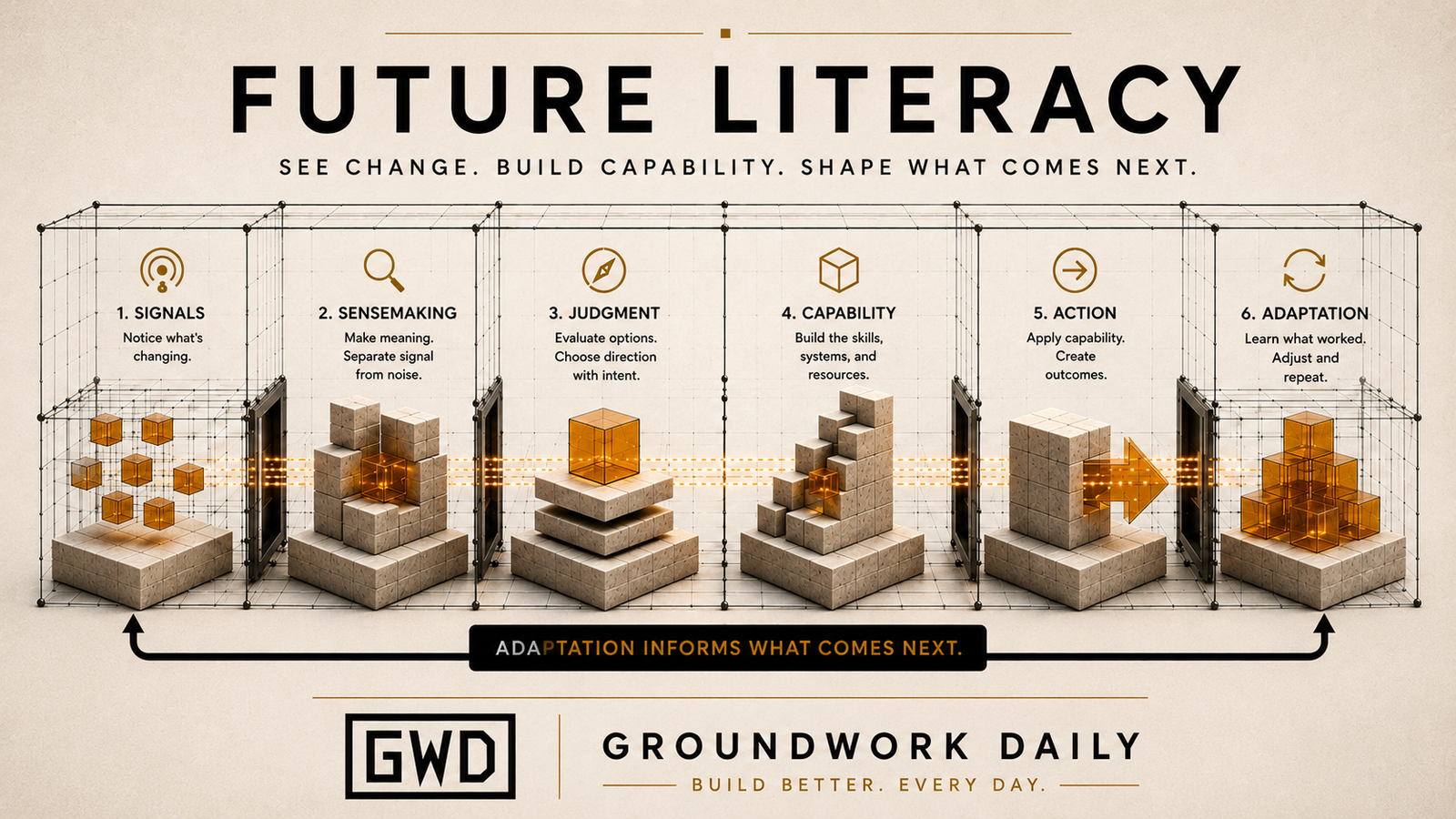
Jordan Avery builds Future Literacy , examining how people can recognize change early, think clearly under uncertainty, understand emerging systems, and build capabilities that remain useful as conditions evolve.