Your brain can feel full even when your calendar looks manageable.
That mismatch is the bandwidth trap: having time on paper without having enough usable cognitive capacity to think, decide, and act cleanly.
The day may look simple. There may be few meetings and only a modest task list. Still, small decisions feel heavier than expected. Simple actions take longer. Focus slips. You reread the same message without answering it.
The problem is not always lack of discipline or motivation. Sometimes the load is already being carried somewhere else.
Unfinished obligations, uncertainty, repeated task switching, digital interruptions, emotional residue, and dozens of small decisions can all compete for attention before the most important work begins.
This third article in Groundwork Daily’s Future Literacy series builds directly on How to Think Clearly When Everything Pulls at You. Post 02 showed how to restore clarity. This article asks a different question: what is consuming the capacity required for clear thinking in the first place?
Future literacy requires more than intelligence or information. It requires enough available bandwidth to notice signals, interpret them, make decisions, and adapt.
What the Bandwidth Trap Actually Is
Bandwidth is not the same thing as time.
It is also not identical to energy or motivation.
In this framework, mental bandwidth is the cognitive capacity currently available to process information, hold priorities, make decisions, regulate responses, and direct attention toward useful action.
When enough bandwidth is available, you can compare options, hold context, make tradeoffs, and stay with a problem long enough to understand it.
When bandwidth is constrained, ordinary demands become more expensive. You may still have an open hour on the calendar. Yet that hour does not automatically contain an hour of usable judgment.
That distinction matters because time-management advice often assumes that an empty block of time equals available capacity.
It does not.
Calendar capacity → time that appears available.
Cognitive load → information, decisions, obligations, and unresolved demands currently competing for mental resources.
Usable bandwidth → the capacity left for deliberate thought and action after that load is accounted for.
Common Signs of the Bandwidth Trap
No single sign proves that cognitive load is the problem. However, several patterns can tell you that your available capacity deserves inspection.
- Small decisions feel unusually expensive.
- Simple tasks take longer than expected.
- You repeatedly postpone actions that are objectively small.
- Your attention keeps returning to unfinished issues.
- You reread messages without processing them.
- You move between tasks without making meaningful progress on any of them.
- You know what matters but struggle to hold attention on it.
These experiences can have many causes. The useful question is not, “What is wrong with me?” It is: what is currently consuming capacity?
That question turns a vague feeling into something you can investigate.
Three Hidden Drains on Mental Bandwidth
Visible work is only part of cognitive load.
A calendar can be cleaned while the mind remains crowded because not every demand occupies a scheduled block. Some pressures persist as unfinished intentions, uncertainty, or repeated interruptions.
Three drains are especially useful to inspect: open loops, ambient uncertainty, and attention fragmentation.
1. Open Loops
An open loop is something your mind still treats as unfinished or unresolved.
It might be a bill that needs review, an unanswered message, a form you have not submitted, a conversation you need to schedule, a promise without a date, or a decision that remains undefined.
Individually, these items can look trivial. Collectively, they create a large field of unresolved status.
The important distinction is that not every open loop needs immediate completion.
Some need to be finished. Others simply need to be captured, scheduled, delegated, declined, or given a clear next review point.
How to Reduce Open-Loop Load
Ask of each unresolved item:
- Does this require action?
- What is the next concrete step?
- Who owns it?
- When will it be handled?
- Can it be consciously dropped?
Once an issue has a defined status, you no longer need to keep rediscovering the decision.
That is more useful than trying to finish every small thing simply for the psychological relief of completion.
2. Ambient Uncertainty
Ambient uncertainty is unresolved pressure whose boundaries remain unclear.
It can come from work, money, family, health, housing, relationships, or any other condition where the next state is not yet known.
An unclear expectation at work creates one kind of uncertainty. An expense without a funding plan creates another. A family situation with changing responsibilities creates another.
The future does not have to be fully knowable for uncertainty to become more manageable.
Often, the first improvement comes from giving the uncertainty a defined shape.
Turn Uncertainty Into Questions
Instead of carrying “I don’t know what is happening,” convert the pressure into questions:
- What do I know?
- What remains unknown?
- When could new information arrive?
- What decision can wait?
- What preparation would still be useful across several outcomes?
The uncertainty remains. However, the thinking environment becomes more structured.
That distinction sits at the center of Future Literacy: you do not need perfect prediction before you can prepare intelligently.
3. Attention Fragmentation
Attention fragmentation occurs when focus is repeatedly broken across tasks, channels, messages, alerts, and context switches.
The problem is not simply that interruptions consume seconds.
Switching between different cognitive tasks also requires the mind to reorient to a new set of goals, rules, and information. When that happens repeatedly, meaningful work can become harder to sustain.
A day filled with short interruptions can therefore feel cognitively expensive even when no individual interruption seemed important.
How to Reduce Fragmentation
Do not begin with a total digital detox.
Instead, create one period in which fewer channels are permitted to compete.
For example:
- check messages at defined intervals rather than continuously;
- close tabs unrelated to the current task;
- disable nonessential notifications;
- keep one document or workspace active during focused work;
- move the phone away from the immediate workspace when it is not required.
The objective is not digital purity. It is reducing unnecessary switching.
Why the Bandwidth Trap Matters
The bandwidth trap becomes costly when the wrong problem receives the wrong solution.
If reduced capacity is interpreted only as a discipline failure, the response may be to demand more effort from an already overloaded system.
If it is interpreted only as a motivation problem, the response may be another motivational strategy that does nothing about the underlying load.
If it is treated only as a productivity problem, another app, dashboard, or workflow may add one more system to maintain.
Better diagnosis comes before better intervention.
Low Bandwidth Changes the Decision Environment
Cognitive load does not merely affect how much work gets done. It changes the environment in which decisions are made.
When too many demands compete for attention, it becomes harder to hold several variables in mind, compare tradeoffs, return to interrupted work, and distinguish what deserves immediate action from what can wait.
That matters beyond productivity.
Career decisions, financial decisions, learning, communication, planning, and adaptation all require some combination of attention, working memory, and judgment.
In other words, bandwidth is not the goal. It is infrastructure for other capabilities.
Bandwidth Is a Future Literacy Constraint
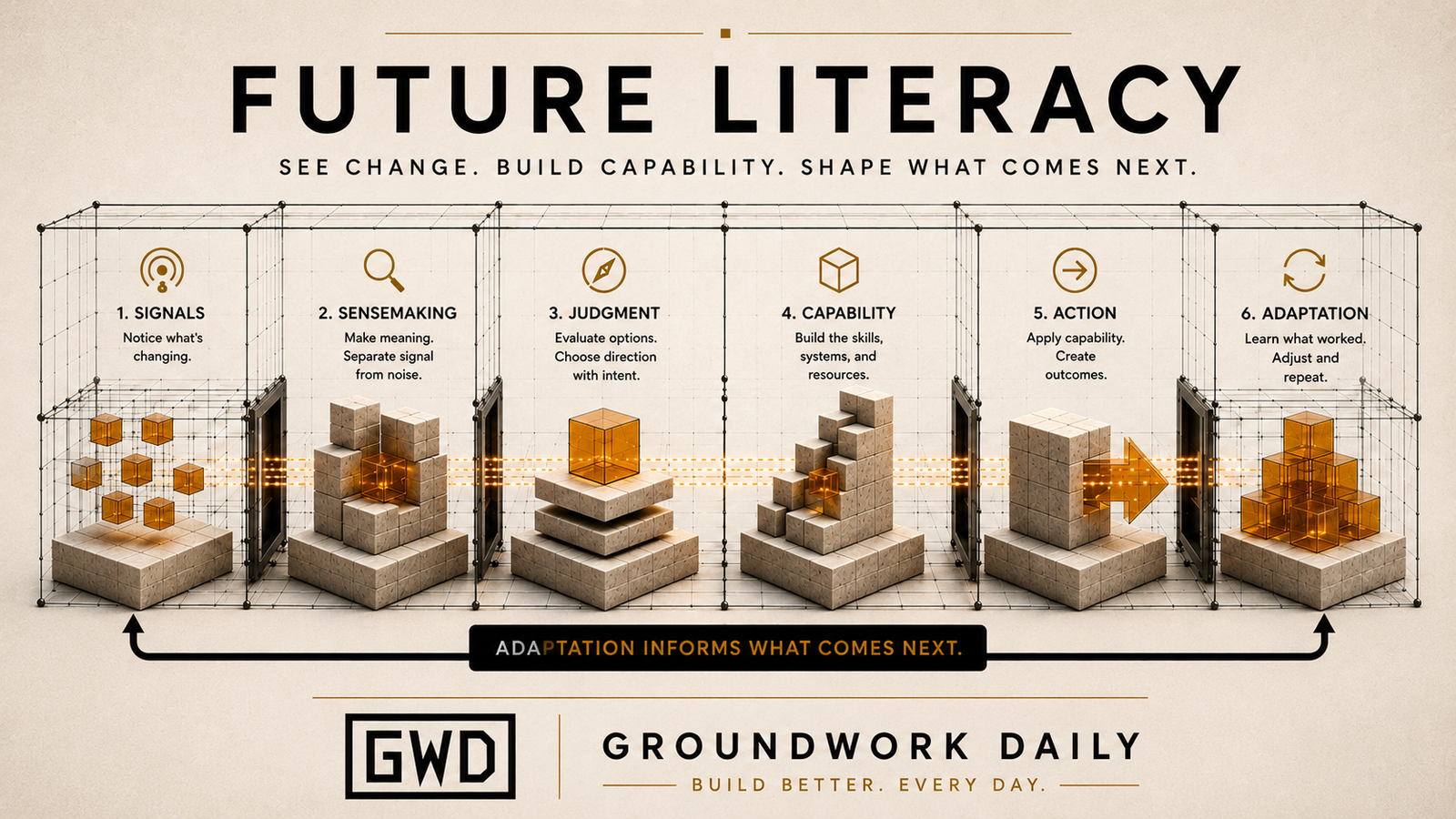
The Future Literacy framework moves through:
Signals → Sensemaking → Judgment → Capability → Action → Adaptation
Every stage depends on some available cognitive capacity.
If attention is badly fragmented, signals become harder to interpret. If judgment is overloaded, tradeoffs become harder to evaluate. If the system is constantly recovering from interruptions, even good plans can become difficult to execute.
Protecting bandwidth therefore strengthens more than concentration. It protects the operating conditions required for the rest of the framework.
The Four-Step Bandwidth Reset
The bandwidth reset is deliberately simple.
Use it when your mind feels crowded, the next step is difficult to hold, or a relatively ordinary day is demanding more effort than expected.
1. Resolve One Loop → finish it or give it a defined status.
2. Reduce One Input → remove one unnecessary stream of interruption.
3. Reset the Physical State → briefly move, pause, hydrate, or change environments.
4. Choose One Anchor Task → give the next block of attention a clear center.
Step One: Resolve One Loop
Choose one unresolved item that can be given a clean status.
Send the reply. Schedule the appointment. Pay the bill if appropriate. Add the task to a real date. Delegate it. Decline it. Write down the next action.
The point is not to chase easy tasks all day.
Instead, use one clean resolution to reduce unnecessary background tracking before returning to higher-value work.
Step Two: Reduce One Input Source
Next, remove one stream of incoming information.
Silence a notification category. Close unused tabs. Pause an unnecessary feed. Mute a group conversation during focused work. Put one device away.
Do not aim for a perfectly quiet environment.
Reduce the competition enough that attention has somewhere stable to land.
Step Three: Reset the Physical State
Cognitive work does not happen separately from the body.
If you have been sitting, staring at a screen, or carrying tension for a long period, make a brief physical change.
Stand. Stretch. Walk for a minute or two. Drink water. Step outside if practical. Change rooms. Relax a posture you have been holding unconsciously.
This is not a cure for cognitive overload. It is a short transition that can interrupt the pattern and create a cleaner return to the work.
Step Four: Choose One Anchor Task
Finally, decide what the next block of attention is for.
An anchor task gives the period a center of gravity.
It does not necessarily have to be the hardest or largest task. Instead, choose the action that makes the rest of the day easier to govern.
For example, the anchor might be:
- finishing the document that determines several later decisions;
- reviewing cash flow before making spending choices;
- sending the message required to unblock a project;
- planning tomorrow before the current day closes;
- organizing the information needed for a difficult decision.
Once an anchor is explicit, unrelated demands no longer need to compete as though they are equally important.
Protect Bandwidth Before You Need a Reset
A reset is useful. A system that reduces the need for constant resets is better.
The longer-term goal is not to recover from overload faster every day. It is to build conditions that produce less unnecessary overload in the first place.
Give Open Loops a Home
Do not rely on your mind to store every unresolved commitment.
Use one trusted place for tasks, follow-ups, appointments, and decisions that need another review.
The tool matters less than the rule: capture it somewhere you will actually return to.
Create Communication Windows
Not every message deserves immediate response.
Where your responsibilities allow it, establish periods for communication and periods for focused work.
That separation reduces the number of times one type of task repeatedly interrupts another.
Make Priorities Visible
If five priorities are competing, there is no real priority hierarchy.
Choose one meaningful outcome for the current block of time and make it visible.
A written priority makes it easier to evaluate whether a new request deserves to replace the work already underway.
Reduce Decisions That Repeat
Recurring decisions can often become rules.
A recurring meal, workout time, savings transfer, meeting structure, file location, notification setting, or planning ritual does not need to be renegotiated every day.
Useful defaults preserve decision capacity for problems that genuinely require judgment.
How to Know Your Bandwidth Is Returning
More available capacity usually shows up through ordinary changes rather than a dramatic sense of transformation.
Small Decisions Become Smaller Again
Routine choices stop feeling disproportionately expensive because fewer unresolved demands are competing in the background.
You Can Stay With One Task Longer
Attention becomes easier to hold because fewer signals are asking for immediate reorientation.
You Know What the Day Is For
Instead of treating every incoming request as equal, you have a clearer hierarchy of what deserves the current block of attention.
Unfinished Work Has a Defined Status
Not everything is complete. However, important open loops are captured, scheduled, delegated, or consciously deferred.
Recovery Requires Less Negotiation
When the day becomes noisy, you already know what to do: reduce input, resolve one loop, reset briefly, and return to an anchor.
That is the difference between depending on motivation and having an operating procedure.
How the Bandwidth Trap Fits Into Future Literacy
The first three Future Literacy articles form a deliberate progression.
Post 01: The Skill Stack You Actually Need in 2026 establishes the capability foundation.
Post 02: How to Think Clearly When Everything Pulls at You develops clarity as a working capability.
Post 03: The Bandwidth Trap identifies the hidden load that can make that clarity difficult to access.
The sequence is straightforward:
Capability → Clarity → Bandwidth → Daily Structure
The next article, How to Build a Daily System That Protects Your Time, Energy, and Clarity, turns bandwidth protection into a repeatable operating structure.
That transition matters. Awareness of overload is useful, but Future Literacy is built around capability. Eventually, the insight has to become a system you can use.
The Path Forward
If your brain feels full on a relatively light day, do not assume the calendar tells the whole story.
Inspect what else is consuming capacity.
Look for unfinished obligations without a defined status. Identify uncertainty that has never been turned into a concrete question. Notice how often attention is switching between unrelated inputs.
Then make the system smaller.
Resolve one loop. Reduce one input. Reset briefly. Choose one anchor task.
After that, look beyond the reset and redesign the conditions that keep recreating the overload.
The objective is not to protect your attention from every demand. That is unrealistic.
The objective is to stop spending scarce cognitive capacity on friction that can be removed, structured, scheduled, or governed.
Your calendar measures time. Your systems determine how much of that time you can actually use.
Further Groundwork
How to Think Clearly When Everything Pulls at You
Return to the clarity framework that comes immediately before bandwidth protection in the Future Literacy sequence.
How to Build a Daily System That Protects Your Time, Energy, and Clarity
Continue into Post 04 and turn bandwidth protection into repeatable daily structure.
The Quiet Bandwidth Audit
Inspect the open loops, recurring demands, and environmental friction quietly consuming usable capacity.
Structure Builds Freedom
Explore why reducing recurring friction creates more room for deliberate action.
Education & Skills
Explore Groundwork Daily’s broader work on learning, capability, technology, and practical skill development.
Receipts
PubMed · Task Switching
A research review describing the measurable performance costs that occur when people repeatedly switch between cognitive tasks.
PMC · Being Tired or Having Much Left Undone
A diary study examining how fatigue and unfinished tasks relate to work-related rumination after the workday.
PMC · Weekly Planning, Unfinished Tasks, and Cognitive Flexibility
A field experiment examining planning behavior, unfinished work, rumination, and cognitive flexibility.
OECD Skills Outlook 2025
Research on literacy, numeracy, adaptive problem solving, and information-processing capabilities relevant to changing environments.