A daily system protects your time, energy, and clarity before competing demands spend them for you.
Goals matter. Motivation can help. However, neither provides much protection when the day becomes crowded with interruptions, logistics, decisions, changing priorities, and other people’s urgency.
That is where structure earns its value.
A useful daily system does not attempt to control every hour. Instead, it creates enough architecture around the day that important work, necessary support, and recovery each have somewhere to live.
This fourth article in Groundwork Daily’s Future Literacy series builds directly on The Bandwidth Trap. Post 03 examined why usable cognitive capacity can disappear even when the calendar looks manageable. Post 04 turns that diagnosis into operating structure.
The core model is deliberately simple: protect three assets, organize three blocks, use a small number of decision rules, and maintain a minimum version for hard days.
What a Daily System Actually Is
A daily system is a small operating structure designed to protect important resources before the day becomes reactive.
It is different from a routine.
A routine describes what you usually do. A system defines how the day still functions when conditions change.
That distinction matters because ideal conditions are unreliable. Sleep varies. Work changes. Family responsibilities move. Meetings appear. Energy fluctuates. Unexpected problems arrive.
A system therefore needs more than repetition. It needs priorities, boundaries, fallback rules, and a way to recover.
Routine → what you prefer to repeat when conditions cooperate.
System → the structure that governs priorities and resources when conditions vary.
Resilient system → a system with both a full version and a minimum version.
A strong daily system answers a few important questions before the pressure arrives:
- What work deserves my strongest available attention?
- When am I realistically most capable of doing it?
- What kinds of interruption need boundaries?
- Where will logistics and communication live?
- How will unfinished work receive a defined status?
- What helps me recover enough to use the system again tomorrow?
Answering those questions reduces the amount of life that must be renegotiated in real time.
Why Daily Routines Often Collapse
A routine can look disciplined and still be structurally fragile.
The problem appears when the routine works only under a narrow set of conditions: enough sleep, a quiet environment, predictable work, no caregiving disruption, stable energy, and no unexpected demand.
Once those assumptions fail, the routine can fail with them.
That does not necessarily mean the person lacks discipline. Sometimes the design simply has no tolerance for variation.
Five Common Failure Points
- Too much complexity: too many steps must happen correctly for the system to count as successful.
- Too little flexibility: a changed meeting, poor night of sleep, or family demand breaks the entire structure.
- No protection: high-value work remains exposed to constant interruption.
- No recovery: the system allocates effort but does not account for restoration.
- No fallback: there is no minimum version for days when normal capacity is unavailable.
A resilient system solves a different problem. It does not ask, “How do I execute the perfect day?”
It asks: what structure is worth preserving across several different kinds of day?
The Three Assets Your Daily System Must Protect
A useful daily system protects three related assets: time, energy, and clarity.
They are not interchangeable.
Time tells you what space exists. Energy affects what kind of effort is realistic inside that space. Clarity determines where the effort should go.
1. Time
Time is the visible asset.
It appears on the calendar, which makes it easier to schedule and measure than the other two assets.
However, calendar availability is not the same as usable capacity.
Two open hours can produce very different outcomes depending on interruptions, fatigue, uncertainty, preparation, and the complexity of the work.
Therefore, time blocks are useful only when the system also considers what those blocks are capable of supporting.
2. Energy
Energy is the variable asset.
Capacity changes across the day and across different days. Sleep, health, stress, physical demands, caregiving, work conditions, food, and recovery can all affect what kind of effort is available.
That makes rigid prescriptions weak.
The right question is not, “Should everyone do their hardest work at 6 a.m.?”
It is: when does your environment usually give you the best combination of attention, energy, and control?
Place cognitively demanding work there when your responsibilities allow it.
3. Clarity
Clarity is the directing asset.
Available time and energy have limited value when the priority is undefined.
This is why the earlier Future Literacy articles matter. Post 02 develops clarity. Post 03 protects the capacity needed to use it.
Post 04 turns both into daily structure.
A functioning system therefore needs a mechanism for deciding what matters before every incoming demand gets a vote.
The Three-Block Day
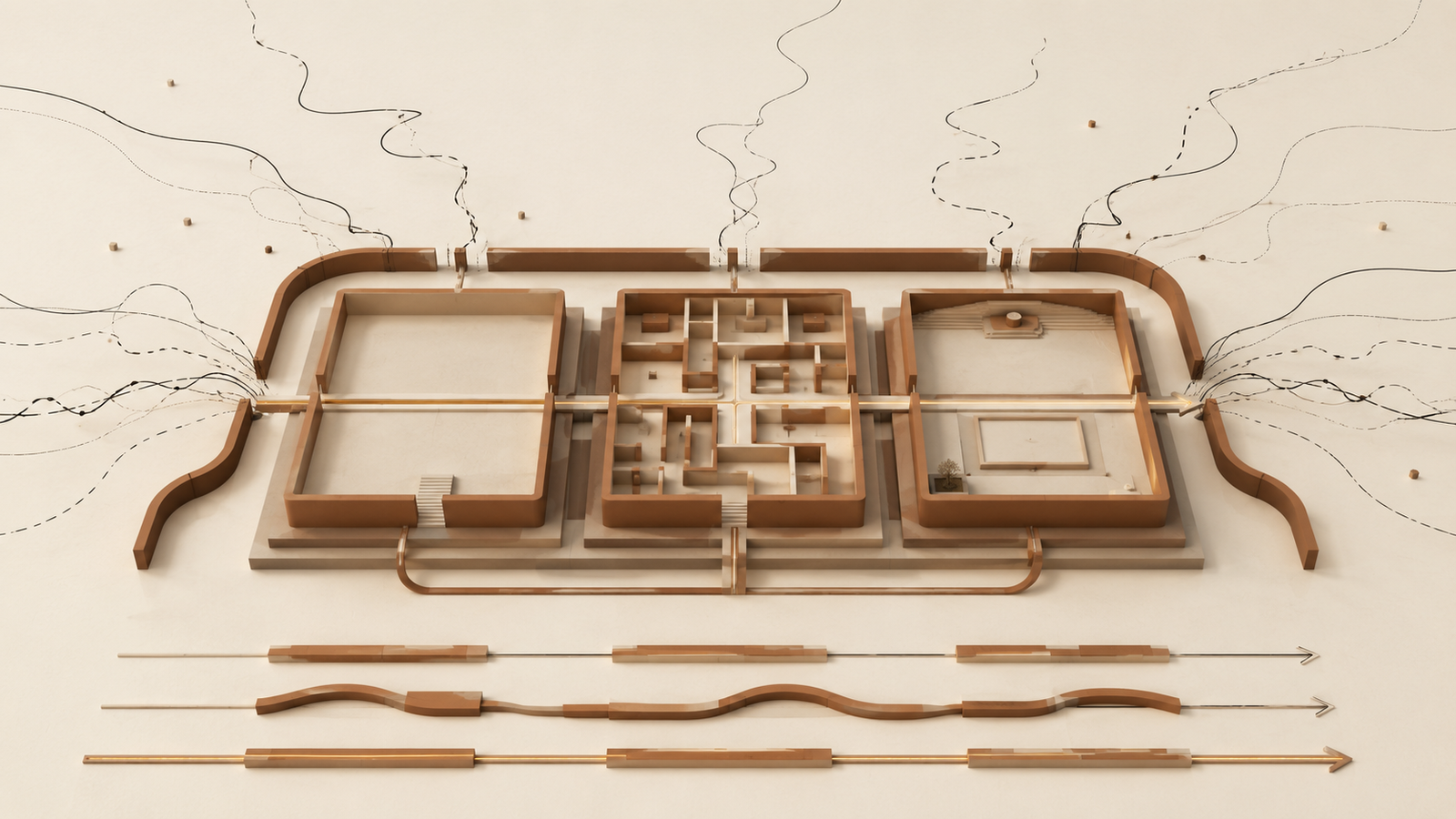
The simplest version of the system uses three functional blocks:
Focus Block → meaningful work requiring sustained attention or judgment.
Support Block → communication, logistics, coordination, administration, and maintenance.
Recovery + Reset Block → restore capacity, close loops, and prepare the next operating cycle.
The names matter more than the clock.
For one person, the Focus Block may happen before breakfast. For another, it may begin after school drop-off, after a shift change, during an afternoon quiet period, or in the evening.
The sequence can also change when responsibilities require it.
The operating principle is not “morning equals deep work.” The operating principle is: match the work to the conditions most likely to support it.
Block One: Focus Work
The Focus Block is reserved for work where fragmented attention creates a meaningful cost.
Examples include writing, learning, planning, analysis, design, difficult problem-solving, financial review, strategic work, or any task requiring sustained context.
This block deserves protection because interruptions do more than consume the duration of the interruption itself. Returning to the original task can also require cognitive reorientation.
Protect the Focus Block
Protection does not require disappearing for four hours.
A useful Focus Block might be 25 minutes, 45 minutes, 90 minutes, or longer depending on the work and the person’s circumstances.
During that block:
- define the intended outcome before starting;
- reduce unrelated tabs and channels;
- silence nonessential notifications;
- keep required information within reach;
- capture unrelated thoughts rather than immediately acting on them.
The goal is sustained context, not performative isolation.
Block Two: Support Work
The Support Block handles the work required to keep everything else moving.
That may include email, calls, scheduling, forms, household logistics, updates, coordination, routine transactions, or administrative tasks.
Support work matters. However, it has an expansion problem.
If every message receives immediate access to the day, support work can become the day.
Contain Support Work
Where responsibilities allow it, group similar administrative work into one or more defined windows.
This does not mean ignoring urgent responsibilities. It means distinguishing actual urgency from continuous availability.
Containment reduces unnecessary switching between fundamentally different kinds of work.
Block Three: Recovery and Reset
Recovery is not a prize awarded after every task is complete.
It is maintenance for the system producing the work.
Recovery may include sleep, movement, quiet, reading, prayer, conversation, time outside, a meal without work, preparation, or simply stopping.
The exact form depends on the person. The principle does not: a system that only spends capacity eventually becomes harder to operate.
The Reset component handles closure.
Before ending the operating cycle, give unfinished work a status and identify the next anchor. That reduces the amount of ambiguity carried forward.
Build the Blocks Around Your Actual Day
The Three-Block Day is not a rigid schedule. It is a planning architecture.
Begin with constraints that are real rather than pretending they do not exist.
Step One: Map the Fixed Constraints
Start with obligations you cannot casually move:
- work shifts;
- school or caregiving responsibilities;
- commutes;
- appointments;
- standing meetings;
- sleep requirements;
- other non-negotiable responsibilities.
The system has to fit around reality. A beautiful plan that depends on ignoring fixed constraints is not a serious system.
Step Two: Find the Best Available Focus Window
Next, identify the strongest realistic window for cognitively demanding work.
Do not search for the perfect window. Search for the best available one.
For some people, that means early morning. For others, it means midday, late afternoon, evening, a lunch break, or several smaller protected blocks.
Consistency can help, but usefulness matters more than aesthetics.
Step Three: Contain the Administrative Surface Area
Identify when support work can be grouped.
You may need several windows rather than one. The point is simply to prevent every administrative input from becoming an immediate context switch.
Where immediate response is part of the job, use smaller protected focus intervals rather than pretending interruption can be eliminated.
Step Four: Design the Closing Reset
A useful closing reset can take only a few minutes.
Ask:
- What was completed?
- What remains open?
- Does each important open item have a next action or review point?
- What should receive the first meaningful attention in the next cycle?
The objective is not inbox zero or perfect closure.
It is reducing unnecessary ambiguity before you disengage.
Use Decision Rules as Guardrails
A system becomes more useful when recurring decisions stop requiring fresh negotiation.
Decision rules are pre-committed defaults for situations you expect to encounter repeatedly.
They are not moral commandments. They are friction-reduction tools.
Examples of Useful Daily Rules
- I define the Focus Block outcome before opening unrelated communication.
- I capture new commitments before agreeing to them.
- I check the calendar before adding a new obligation.
- I give unresolved work a next action or review date before ending the day.
- I avoid high-consequence decisions when I know I am significantly fatigued whenever delay is practical.
- I treat nonessential notifications as optional inputs rather than default interruptions.
The right rules depend on the recurring failure points in your own environment.
If the rule does not solve a real pattern, it is probably unnecessary.
Start with two or three.
Build a Minimum Viable Day for Hard Conditions
A resilient system needs a reduced operating mode.
This is where many routines fail. The full version becomes impossible, so the entire structure disappears.
A better system asks: what is the smallest version worth preserving?
One Anchor → identify the single meaningful outcome that deserves protection.
One Support Window → handle only the logistics that genuinely need attention.
One Reset → close or define the most important open loops before the next day.
Reduce the Size, Not the Architecture
On a difficult day, the Focus Block may shrink from 90 minutes to 20.
The support list may shrink to two essential actions.
Recovery may mean protecting sleep and eliminating optional commitments rather than completing an elaborate evening ritual.
That still counts.
The system has survived because the underlying architecture remains intact.
Hard Days Are Part of the Design
A bad night, illness, family disruption, work emergency, emotional strain, or unexpected obligation should not be treated as proof that the system failed.
Variation is normal.
The relevant test is whether the system tells you what to preserve when capacity contracts.
That is adaptive capability at the daily level.
How to Know the Daily System Is Working
A daily system should be judged by whether it improves operating conditions, not by how impressive it looks.
Important Work Receives Better Attention
You are less likely to discover at the end of the day that every small demand was handled while the most consequential work remained untouched.
Administrative Work Has Boundaries
Messages and logistics still happen, but they consume less unplanned territory.
Open Loops Have Clearer Status
Not everything is finished. However, more unfinished work is captured, scheduled, delegated, declined, or consciously deferred.
Tomorrow Requires Less Reconstruction
You do not need to rebuild the entire priority system from memory every morning because the previous cycle left useful context behind.
The System Can Shrink Without Disappearing
Hard days still have a recognizable structure.
That may be the strongest signal of all.
A system that survives imperfect conditions is more valuable than one that looks extraordinary only on ideal days.
How the Daily System Fits Into Future Literacy
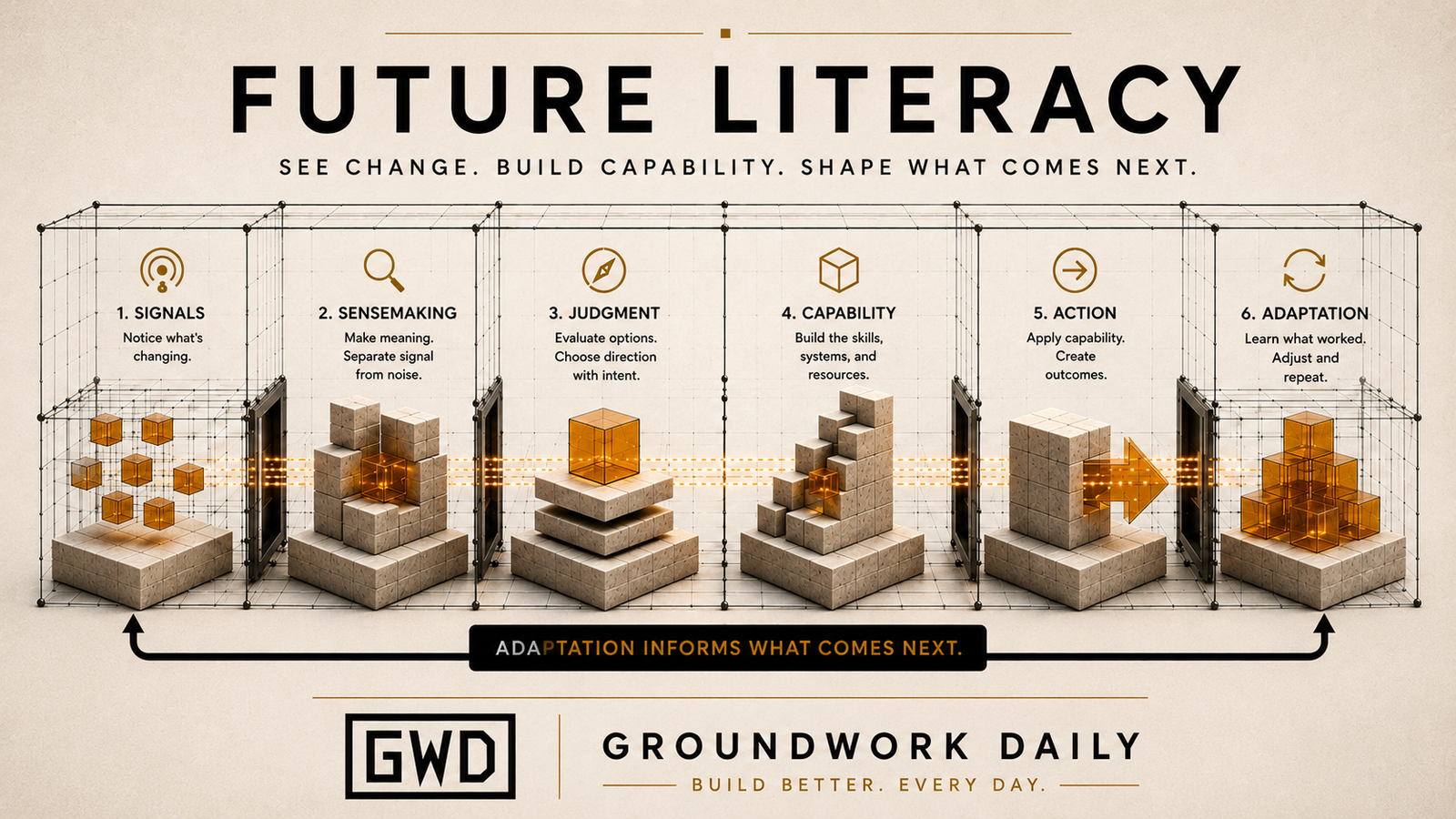
The first four Future Literacy articles build one layer at a time.
Post 01: The Skill Stack You Actually Need in 2026 establishes the capability foundation.
Post 02: How to Think Clearly When Everything Pulls at You develops clarity under pressure.
Post 03: The Bandwidth Trap examines what quietly consumes usable cognitive capacity.
Post 04 turns those ideas into daily operating structure.
Capability → Clarity → Bandwidth → Daily Structure → Adaptation
The progression matters because Future Literacy is not merely a way to think about change.
It is a capability system for operating inside change.
The next article, How to Stay Capable When the Future Moves Faster Than You Do, expands the question beyond a single day: how do you keep learning and adapting when tools, expectations, and conditions continue to move?
The Path Forward
A daily system does not need to make your life rigid.
It needs to make your priorities harder to erase.
Protect time, but do not confuse time with capacity. Pay attention to energy without turning every fluctuation into a verdict. Use clarity to decide where the available resources belong.
Then give the day three functional homes: focus, support, and recovery.
Add a few guardrails for recurring failure points.
Most importantly, build a smaller version for days when the full system is unrealistic.
That is what makes the structure durable.
Your best day is not the real test of the system.
The real test is whether the structure remains useful on an ordinary Tuesday when plans shift, energy changes, messages arrive, and the world refuses to cooperate.
Build for the day you actually live. Then make the system strong enough to travel with you.
Further Groundwork
The Bandwidth Trap
Return to the cognitive-capacity framework that explains why a daily system needs to protect more than calendar time.
How to Stay Capable When the Future Moves Faster Than You Do
Continue into Post 05 and extend daily structure into ongoing adaptation and capability.
How to Think Clearly When Everything Pulls at You
Revisit the clarity framework that helps determine what deserves protected attention.
Structure Builds Freedom
Explore the larger Groundwork Daily argument for using structure to reduce recurring friction.
Education & Skills
Explore Groundwork Daily’s broader work on learning, capability, technology, and practical skill development.
Receipts
PubMed · The Effect of Task Interruption on Working Memory Performance
Experimental research examining how task interruptions affect working-memory performance, including the cumulative effects of repeated interruptions.
PubMed · Refocusing Attention After Interruption
Research examining how interruptions disrupt primary-task performance and the cognitive process required to refocus attention when work resumes.
PubMed · Sleep and Cognitive Performance in Healthy Adults
Research on sleep duration and stability in relation to working memory, response inhibition, and cognitive performance.
OECD Skills Outlook 2025
Research on literacy, numeracy, adaptive problem solving, and the information-processing capabilities needed to operate in changing environments.