
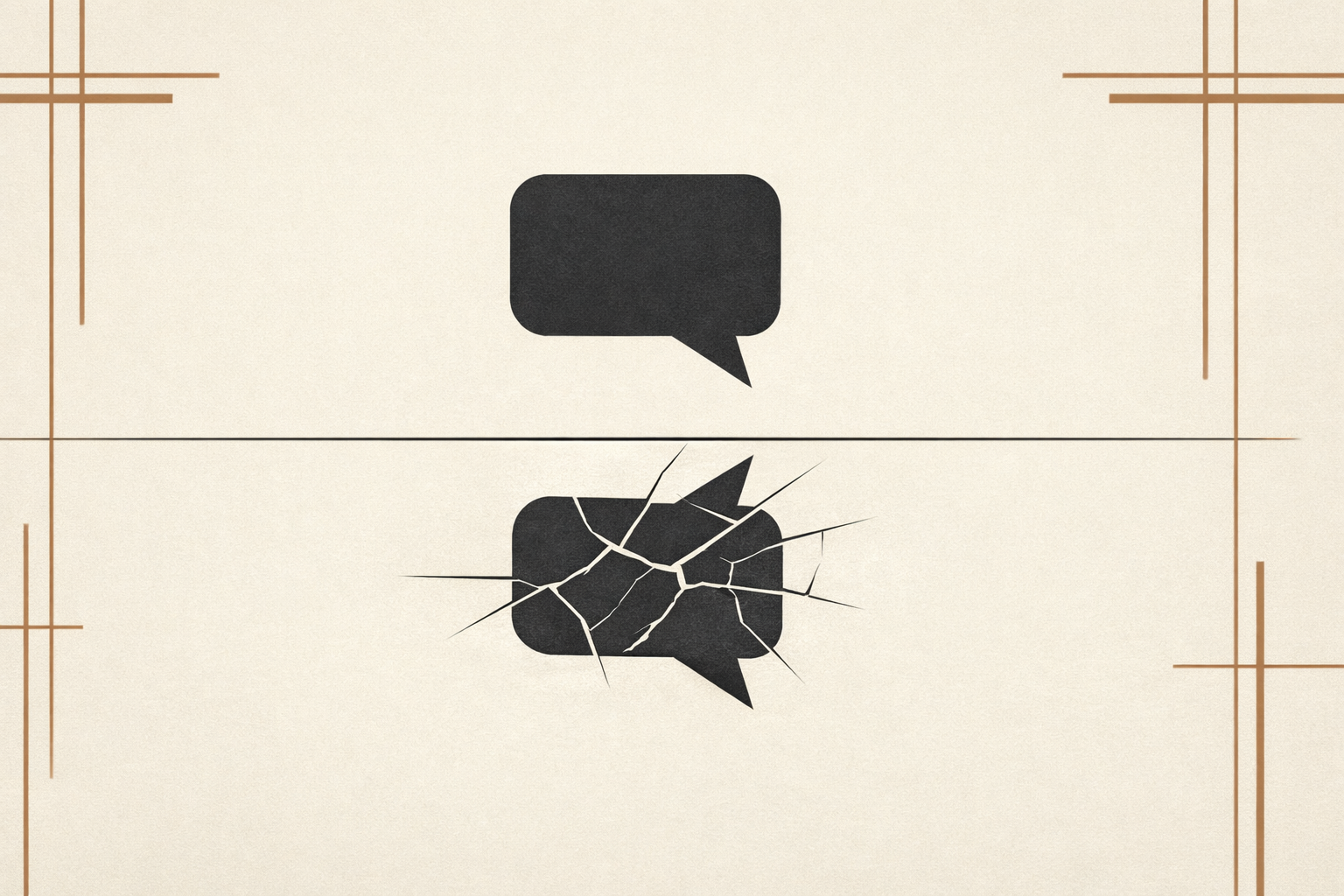
Language and identity narratives influence how people understand themselves, one another, and the social expectations attached to belonging. Words do not determine identity on their own. Yet repeated labels can carry stereotypes, histories, judgments, and assumptions that accumulate meaning over time.
The process becomes more important when those meanings travel beyond private conversation. Families repeat them. Friends normalize them. Entertainment popularizes them. Employers may attach assumptions to them. Schools can discipline around them, while digital platforms can amplify them far beyond the communities where they began.
A dispute about language is therefore rarely only a dispute about vocabulary. The stronger questions concern what meaning has been attached to a term, which expectations travel with it, who benefits from those expectations, and what happens when people begin repeating the same categories about themselves.
The Operating Loop
Label → Repetition → Social Meaning → Expectation → Interpretation → Reinforcement
The loop is not destiny. People reject labels, reinterpret language, switch codes, reclaim terms, build counter-narratives, and disagree within the same community. The point is narrower: repeated language can become one input into a larger system of social categorization and expectation.
What Language and Identity Narratives Actually Mean
Groundwork Daily uses internalized identity narratives to describe recurring social stories about who people are, what their group represents, and which behaviors supposedly belong to them. The phrase is useful as an editorial framework. It should not be presented as one standardized psychological diagnosis.
Established research traditions explain parts of the mechanism. Social identity theory examines how group membership contributes to self-concept. Self-categorization theory considers how people classify themselves and others into groups. Labeling theory examines how social descriptions and subsequent treatment can influence expectations and behavior.
Research on internalized stigma provides another, narrower point of comparison. That literature examines circumstances in which people subjected to stigmatized categories may come to accept or apply negative stereotypes associated with those categories. The findings depend on population and context, so they should not be stretched into a universal explanation for every cultural disagreement.
Together, these fields support a careful conclusion. Social categories and repeated descriptions can contribute to how people interpret themselves and others, while identity itself remains dynamic, contextual, and contested. Language participates in that process without controlling it.
How Language and Identity Narratives Become Social Infrastructure
Every social environment develops a working vocabulary. Some terms simply identify people, objects, or activities. Others accumulate judgments about competence, class, race, gender, geography, education, danger, respectability, attractiveness, or status.
Once those associations become familiar, people no longer encounter the word by itself. They encounter the network of meaning surrounding it. A description can begin arriving before the individual does.
That is where language starts to resemble infrastructure. Physical infrastructure shapes what moves easily through a system and where friction occurs. Social language can perform a comparable function by making some interpretations feel immediate, ordinary, or self-evident.
When Social Meaning Becomes Institutional Consequence
The mechanism becomes more consequential when language intersects with formal authority. A workplace can treat one style of speech as professional and another as inappropriate. A school can interpret behavior through assumptions already attached to a student. Media descriptions can frame similar conduct as threatening, troubled, ambitious, disruptive, authentic, or respectable.
Language in those environments is no longer merely symbolic. Categories can influence who receives credibility, suspicion, opportunity, discipline, sympathy, or scrutiny. The relevant issue then moves beyond whether an individual approves of a particular word.
Once a narrative begins influencing rules or institutional interpretation, authority enters the system. That shift matters because institutions possess powers that ordinary conversation does not: hiring, firing, grading, disciplining, regulating, financing, policing, promoting, excluding, and legitimizing.
Identity Rules Often Hide Inside Ordinary Standards
Cultural standards rarely introduce themselves as identity systems. They appear instead as ordinary judgments about what is polished, appropriate, attractive, employable, respectable, threatening, educated, or serious. The language can sound neutral because the assumptions underneath it have become familiar.
Groundwork Daily’s analysis of The Politics of Black Hair: History, Identity, and Power provides a useful parallel. Hair is physical, but the meanings attached to particular styles are cultural and institutional. Those meanings can become entangled with assumptions about professionalism, respectability, race, gender, and belonging.
The institutional layer becomes even clearer in Hair Discrimination in the Workplace: The CROWN Act Explained . Once an identity-linked judgment affects employment or institutional treatment, the question is no longer simply whether someone personally approves of a style. Rules, enforcement, organizational culture, legal protection, and authority enter the picture.
Language follows a similar path. Social description becomes more consequential when institutions begin attaching decisions to the meaning. The critical question becomes not only what a label means, but what happens after that meaning has been assigned.
When Language and Identity Narratives Become Self-Weaponization
Self-weaponization is an editorial term used here, not a clinical diagnosis. Groundwork uses it to describe situations in which people adopt a degrading or limiting narrative associated with their own group and then help reproduce the same social meaning that has historically been used against them.
The reproduction may be serious, humorous, defensive, ironic, affectionate, commercial, or deliberately provocative. Those distinctions matter because identical language can perform different functions in different settings. In-group speech is not automatically equivalent to hostile out-group speech.
Reclamation can change meaning. Relationship can change meaning. Tone, audience, history, and context can all change meaning. Communities regularly transform language that outsiders once used as a weapon.
The useful concern is therefore not linguistic purity. It is whether repeated self-description begins strengthening a limiting category that people would reject if someone with greater institutional or social power imposed it on them.
Reclaiming Language Is Not the Same as Surrendering to It
Any serious analysis of language and identity narratives has to leave room for reclamation. Communities routinely take language associated with exclusion or stigma and repurpose it as humor, solidarity, resistance, art, intimacy, or cultural recognition. People are not passive recipients of inherited meaning.
Reclamation, however, does not produce universal control over interpretation. A community may change how a term functions internally while employers, media institutions, algorithms, political actors, advertisers, or outsiders continue attaching older meanings to it.
The same term can therefore function as intimacy in one setting, entertainment in another, insult in another, and evidence for an external stereotype somewhere else. Those meanings can coexist without canceling one another.
Intellectual honesty requires holding both realities at once. Historical meaning is not the only meaning a word can possess, but new usage does not automatically erase every older association.
Language and Identity Narratives Also Police Belonging
Language does more than separate one group from another. It can also regulate belonging inside groups. Dialect, slang, tone, style, cultural references, neighborhood vocabulary, and shared jokes can establish trust because they signal familiarity with common experiences.
Those same mechanisms can create internal hierarchies. People may be described as too assimilated, too educated, too loud, too soft, too proper, too different, insufficiently authentic, or disconnected from whichever version of the group has been treated as legitimate.
Identity narratives therefore travel in more than one direction. External stereotypes can influence internal conversation, but communities also create their own standards, counter-narratives, status systems, and boundaries.
A stronger analysis recognizes both forces. People inherit language from systems they did not design, and they still make choices about which meanings they repeat, challenge, transform, or abandon.
No Community Has One Identity Narrative
Discussions of internalized identity can become careless when they imply that an entire population thinks about itself in the same way. Communities contain differences in region, generation, class, education, gender, religion, occupation, migration history, neighborhood, family culture, and personal experience.
Those differences influence which words carry meaning and which narratives people accept. A term that feels familiar in one family, city, generation, or subculture may carry a different meaning somewhere else.
Broad claims such as “the community thinks” or “we call ourselves” therefore deserve scrutiny. Who is speaking? Which population is being described? How common is the behavior? Does the evidence represent ordinary life, or does it represent the people most visible in media and online conflict?
Precision matters because a critique of stereotyping can reproduce another stereotype when millions of people are reduced to one cultural personality.
Repeated Language Can Become a Mirror
Groundwork Daily’s companion analysis Language Builds the Mirror We Live In approaches the subject from the self-perception side. A mirror does not create the person standing before it, but it influences what becomes visible and which features receive attention.
Language can work similarly. Repeated descriptions focus attention on particular traits and make certain interpretations easier to retrieve. If intelligence, danger, beauty, irresponsibility, strength, weakness, criminality, sophistication, or failure repeatedly becomes attached to a group label, people still retain agency while navigating an environment where those associations already exist.
The issue becomes more consequential when expectation changes behavior. People may anticipate how others will interpret them and respond by rejecting the category, challenging the standard, code-switching, accommodating it, joking about it, capitalizing on it, or accepting some part of it.
None of those responses proves that words control identity. They demonstrate something more useful: people act inside social environments, and language is one of the systems through which those environments communicate expectations.
Digital Platforms Scale Language and Identity Narratives
The internet did not invent identity conflict, but it transformed distribution. A phrase that once circulated within a family, neighborhood, workplace, school, or subculture can now reach millions of people with almost none of its original context.
Content also moves between audiences that do not share the speaker’s history, relationships, humor, or assumptions. A term used affectionately among friends can appear in a workplace screenshot. A joke intended for one audience can become evidence in another argument.
Platform incentives add another layer. Content that generates outrage or disagreement can produce replies, reposts, reaction videos, commentary, and counter-commentary. High visibility therefore does not necessarily prove that the underlying belief is widespread.
That creates an important analytical trap: visibility can be mistaken for prevalence. The loudest identity narrative online may not be the most common one in everyday life. It may simply be unusually effective at generating attention.
Why Online Language Disputes Become Performance
Online identity conflicts often move through a familiar sequence. Someone uses a loaded term, and listeners interpret its historical or social meaning. The speaker then explains intention or context, while critics emphasize impact and supporters defend humor, authenticity, group membership, or freedom of expression.
Once the dispute attracts attention, the incentive structure changes. Participants begin speaking to audiences beyond the original conversation. Statements become more absolute because certainty often travels faster than qualification.
Clarification can then look like surrender, while nuance can look like disloyalty. The argument becomes a performance of group membership rather than an attempt to improve understanding.
The platform did not create the underlying disagreement. It changed what the disagreement rewards. That distinction matters because the surrounding system can encourage escalation even when the original conflict was small enough to resolve.
Intent and Impact Answer Different Questions
Public language debates often become trapped because intent and impact are treated as competing verdicts. Intent addresses what the speaker meant to communicate. Impact addresses what happened after the communication entered a particular social environment.
A person can lack malicious intent and still produce a harmful result. A listener can experience a negative impact without proving that the speaker possesses hateful character. Separating those judgments makes correction possible without turning every disagreement into a verdict on someone’s entire identity.
The distinction also strengthens accountability. If intent becomes the only standard, speakers never have to learn from consequences they did not anticipate. If impact becomes the only standard, people can be held responsible for every interpretation regardless of context or reasonable foreseeability.
A better question follows both: What should change now that more is known about how the language was received? That moves the conversation from accusation toward correction.
Language Discipline Cannot Replace Institutional Accountability
Personal speech matters, but careful vocabulary cannot solve structural discrimination. Someone can speak with extraordinary precision and still encounter unequal enforcement, workplace bias, discriminatory rules, media stereotyping, or institutions that attach consequences to identity.
Responsibility therefore operates at several levels. Individuals control their own speech and can examine the narratives they reproduce. Families and communities influence norms. Media organizations choose framing. Employers and schools establish rules. Platforms design distribution systems, while governments determine when discriminatory treatment enters law and public policy.
Confusing those layers produces weak remedies. Telling people to change their vocabulary when the actual problem is discriminatory employment policy assigns responsibility to the wrong actor. Pretending personal choices do not matter because institutions also hold power creates the opposite error.
Institutional literacy requires locating the authority before prescribing the solution. Language can be personal, cultural, commercial, institutional, and political at the same time, but those layers do not possess equal power.
A Better Standard for Language and Identity Narratives
The goal should not be a permanent list of forbidden words. Language changes, communities disagree internally, and context can transform meaning. A rigid purity standard would create another system of social policing rather than improve judgment.
A better standard examines the narrative being reinforced. What category does the language create? What behavior does it normalize? Which assumptions become easier to make? Who gains status from repeating it? Who bears the cost?
Another useful test is institutional portability. Would the underlying category still feel acceptable if an employer, teacher, news organization, advertiser, politician, or government agency used it to make judgments about the same people?
Mature judgment does not require every language dispute to produce one universal rule. It requires understanding what the language is doing inside the system where it is being used.
What to Watch as Identity Narratives Move Through a System
Start by watching what happens after a label leaves ordinary conversation. Does it enter workplace rules, school discipline, political messaging, advertising, news framing, algorithmic categorization, or public policy? Institutional adoption changes the stakes because the narrative can now produce consequences beyond interpersonal disagreement.
Next, examine who receives permission to use the language and who receives punishment. Different rules may reflect meaningful differences in history, relationship, and context. They can also expose status hierarchies that remain invisible until someone crosses a boundary.
Evidence of scale matters as well. Viral language may represent a subculture, a performance, a controversy, or a small group whose behavior generates disproportionate attention. Online visibility should not automatically become evidence about an entire population.
Healthy Identity Leaves Room for Revision
The final question is whether people remain free to revise the narrative. A culture becomes brittle when every inherited term has to be defended merely because it is familiar. Tradition alone does not prove that a description still serves the people carrying it.
Revision does not require rejecting history or abandoning cultural intimacy. It means deciding consciously which meanings remain useful, which have changed, and which continue reproducing expectations that no longer deserve protection.
Healthy identity does not depend on freezing language in place. It requires enough confidence to distinguish inheritance from obligation.
Research Trail
Receipts
These references support the established concepts used in this analysis. “Self-weaponization” remains Groundwork Daily’s editorial language and should not be read as a clinical diagnosis.
American Psychological Association — Social Identity
Background on the relationship between group membership and self-concept.
American Psychological Association — Self-Categorization Theory
Background on how people classify themselves and others through social categories.
American Psychological Association — Labeling Theory
Background on theories concerning social labels, treatment, expectations, and behavior.
American Psychological Association — Multicultural Guidelines
Guidance emphasizing the complexity, context, and fluidity of identity rather than treating broad populations as internally uniform.
International Journal of Social Psychiatry — Internalized Stigma and Self-Stigma: A Scoping Review
A research review useful for understanding internalized stigma as a narrower analogue rather than a universal explanation for identity language.
The Groundwork
The Question Is What the Language Keeps Building
Language does not determine identity, but repeated language can help establish categories through which identity is interpreted. Those categories can remain cultural, or they can move into institutions and begin influencing credibility, discipline, opportunity, employment, representation, and belonging.
People are not powerless inside that system. Communities reclaim language, reject labels, create counter-narratives, change norms, and decide which inherited meanings deserve to survive. That agency is real. So are the institutions capable of reinforcing a narrative regardless of what one individual chooses.
The durable standard is neither linguistic purity nor indifference. It is accountability for the social meaning we help reproduce, combined with enough institutional literacy to recognize when the problem has moved beyond personal speech. Words matter most when they stop being only words and begin organizing expectations about who people are allowed to be.
System Updates
The System: Updated.
What looked like the problem: People are arguing over offensive or controversial words.
What the system reveals: Language carries categories, expectations, history, group boundaries, institutional judgments, and platform incentives.
Updated model: The deeper issue is not whether words magically create identity. It is whether repeated narratives become part of the social and institutional environment through which identity is interpreted.
Groundwork Principle
Accountability Is a Form of Strength
Accountability becomes useful when the conversation moves beyond defending intent. A person, community, organization, or institution can ask whether the language being normalized actually aligns with the standard it claims to value.
Correction does not require self-condemnation. It requires enough strength to revise what no longer holds up. Ask what narrative is being repeated and whether that narrative would still seem defensible if someone with greater power used it to judge the same people.
Continue Building
Follow Identity From Language Into Institutions
Language and identity narratives connect self-perception, culture, appearance, workplace standards, and institutional authority. These paths continue through the strongest related Groundwork analysis.
Go Deeper — Identity & Language
Language Builds the Mirror We Live In
Examine repeated social description, self-perception, and the narratives people encounter about who they are expected to be.
Application — Conversation
Real Talk Blueprint: When We Start Talking About Ourselves Like the Enemy
Move from system diagnosis into a direct examination of how degrading language can become normalized in everyday conversation.
Related System — Cultural Standards
The Politics of Black Hair: History, Identity, and Power
See how appearance, language, respectability, cultural meaning, and institutional expectations can reinforce one another.
Institutional Application — Workplace Rules
Hair Discrimination in the Workplace: The CROWN Act Explained
Follow an identity-linked cultural standard into employment, organizational authority, legal protection, and enforcement.
Continue — System Updates
Explore System Updates
Continue beneath visible disputes into the institutions, incentives, rules, and feedback loops producing recurring outcomes.
System Updates · Civic Power & Policy · Groundwork Daily

Meet the Builder
Langston Reed
Builder, Civic Power & Policy
Langston Reed helps readers understand how institutions, governance, and public systems shape everyday life. His work develops institutional literacy by tracing the rules, incentives, authority, infrastructure, and social mechanisms operating beneath visible outcomes.