Community Groundwork
Community food systems are not built at the checkout line. They are built through ownership, distribution, access, habit, and repeated decisions about where food comes from.
A grocery store looks simple from the sidewalk. Doors open. Shelves fill. People shop. Bags leave.
However, that is only the visible layer.
Underneath the store is a larger system. Someone decides which suppliers get shelf space. Someone decides whether fresh produce is treated as central or optional.
In addition, someone decides whether local growers are part of the supply chain or locked outside it. Someone also decides whether the store belongs to the neighborhood or merely extracts from it.
That is why grocery stores matter more than grocery stores.
The Problem Is Bigger Than Food Access
Food access is usually discussed as a distance problem. The store is too far. The produce is too expensive. The neighborhood has too many convenience stores and not enough full-service grocery options.
Those things matter. Still, distance is not the whole issue.
A community can have food nearby and still lack control over its food system. The shelves may be filled by outside distributors. Prices may be shaped by outside ownership. Profits may leave the same neighborhood that keeps the store alive.
That is not just a retail problem. It is an infrastructure problem.
When a neighborhood cannot reliably access fresh food, the cost shows up everywhere. It shows up in health, time, stress, and money.
Parents travel farther. Elders rely on whoever can help. Households adjust meals around what is reachable instead of what is nourishing.
Over time, that strain becomes normal. The community adapts to shortage. Yet that adaptation is not free.
Community Food Systems Are Local Infrastructure
A working food system is not one store. It is a chain of relationships.
Farms grow. Distributors move. Grocers select. Workers prepare. Residents buy. Families cook. Waste is handled. Habits form. Money circulates or leaves.
Each part affects the next.
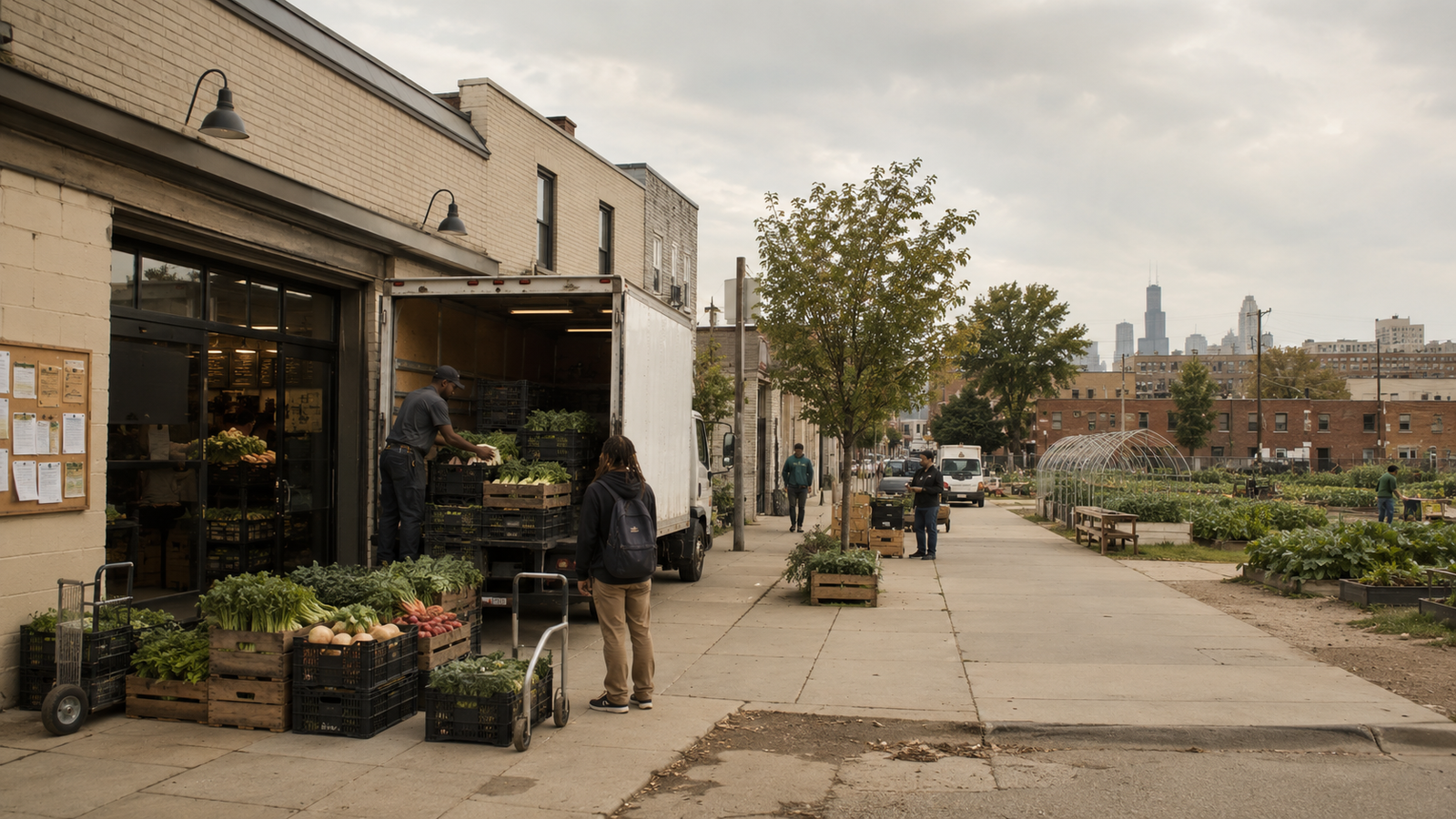
When local growers have a route into local stores, the system becomes stronger. A grocery store that buys from regional farms creates more than inventory. It creates a pathway.
Then, when residents support that store consistently, the pathway has a reason to remain open.
This is where local food security becomes more than emergency language. It becomes everyday capacity.
A neighborhood with a functioning grocery anchor does not have to wait for every solution to arrive from outside. It has a place where supply, demand, information, and relationships can meet.
A grocery store can notice what people actually buy. It can support local vendors. It can hire locally. During pressure, it can also become a distribution point.
However, that does not happen automatically.
A store becomes infrastructure only when it is connected to the life around it. Without that connection, it is just a building with transactions inside.
The Capital Question Is the Quiet Question
People often talk about supporting local businesses as a moral choice. That is fine, but morality is not enough to explain the system.
The harder question is structural:
Where does the money go after the purchase?
If every dollar spent on food leaves the neighborhood immediately, the community gets access but not accumulation. It receives goods, but it does not build much power.
As a result, shelves may be full while the local economic base stays thin.
Ownership changes that equation.
When ownership is local, decisions sit closer to the people affected by them. That does not make every local owner virtuous. That would be lazy thinking.
A weak local operator can still fail the community. Even so, local ownership creates the possibility of accountability, reinvestment, and adaptation.
Outside ownership usually optimizes for scale. Local ownership has the option to optimize for fit.
That distinction matters.
A neighborhood grocery store can choose to carry products from local bakers, small farms, prepared food vendors, and household brands that would never reach a national chain.
In that way, the store can help turn informal production into visible enterprise. That is community economic resilience in practical form.
The Store Is Also a Behavior System
A grocery store teaches behavior without making an announcement.
If the easiest food to reach is processed, cheap, and ready to eat, that shapes household rhythm. If fresh food is visible, affordable, and familiar, a different rhythm becomes possible.
Also, if prepared meals are built from real ingredients instead of pure convenience, the store becomes a daily influence point.
People do not make food choices in a vacuum. They make them inside environments.
This is why the layout matters. The price matters. The route from home matters. The acceptance of EBT matters. The presence of culturally familiar foods matters.
These are not soft details. They are the mechanics of participation.
If the community cannot realistically use the store, the store does not become infrastructure. It becomes another good idea that cannot carry load.
The Groundwork for a Strong Grocery Anchor
A strong community grocery anchor needs more than customers. It needs alignment.
Reliable Supply
Local growers and regional farms need predictable channels into the store. Random availability does not build trust. Consistent delivery does.
Useful Pricing
Fresh food cannot become a luxury signal. If the people closest to the store cannot afford the food inside it, the system is misaligned.
Community Participation
Residents cannot treat local food infrastructure like scenery. If the store matters, people have to use it, discuss it, correct it, and help it understand demand.
Institutional Support Without Capture
Grants, city programs, nonprofit partnerships, and local procurement can help. Still, the store needs a durable operating model. Charity can open a door. It cannot replace discipline.
A Real Feedback Loop
A grocery store should know what the neighborhood needs, what it can produce, what it can afford, and where the friction sits.
That feedback loop is where community systems become visible.
Structural Takeaway
A grocery store is not automatically a community institution.
It becomes one when it connects food access, local ownership, supply relationships, household behavior, and community participation into a system that can hold pressure.
That is the part people miss.
The store is not only where food is purchased. It is where multiple systems meet. Health meets economics. Farming meets retail. Convenience meets discipline. Ownership meets trust.
If those systems are weak, the neighborhood remains dependent.
However, if those systems are strong, the grocery store becomes more than a place to shop.
It becomes part of the local framework that helps a community feed itself, employ itself, understand itself, and keep more of its value close enough to matter.
Continue Building
This piece is part of the Community Groundwork framework. Move from food access to shared systems using the links below.
→ Framework: Community Groundwork
→ Mechanism: Cultivating the Commons
→ Mechanism: Block Logic
Build Better. Every Day.
Join The Groundwork
Community systems rarely collapse all at once. They weaken through unnoticed incentives, disappearing participation, and infrastructure people stop seeing.
Groundwork Daily publishes observations, frameworks, and structural thinking designed to help you recognize how communities actually function and where leverage still exists.
Receipts
→ USDA Economic Research Service: Food Access Research Atlas
→ CDC: Healthy Food Environments
→ Food Insecurity, Neighborhood Food Environment, and Health