
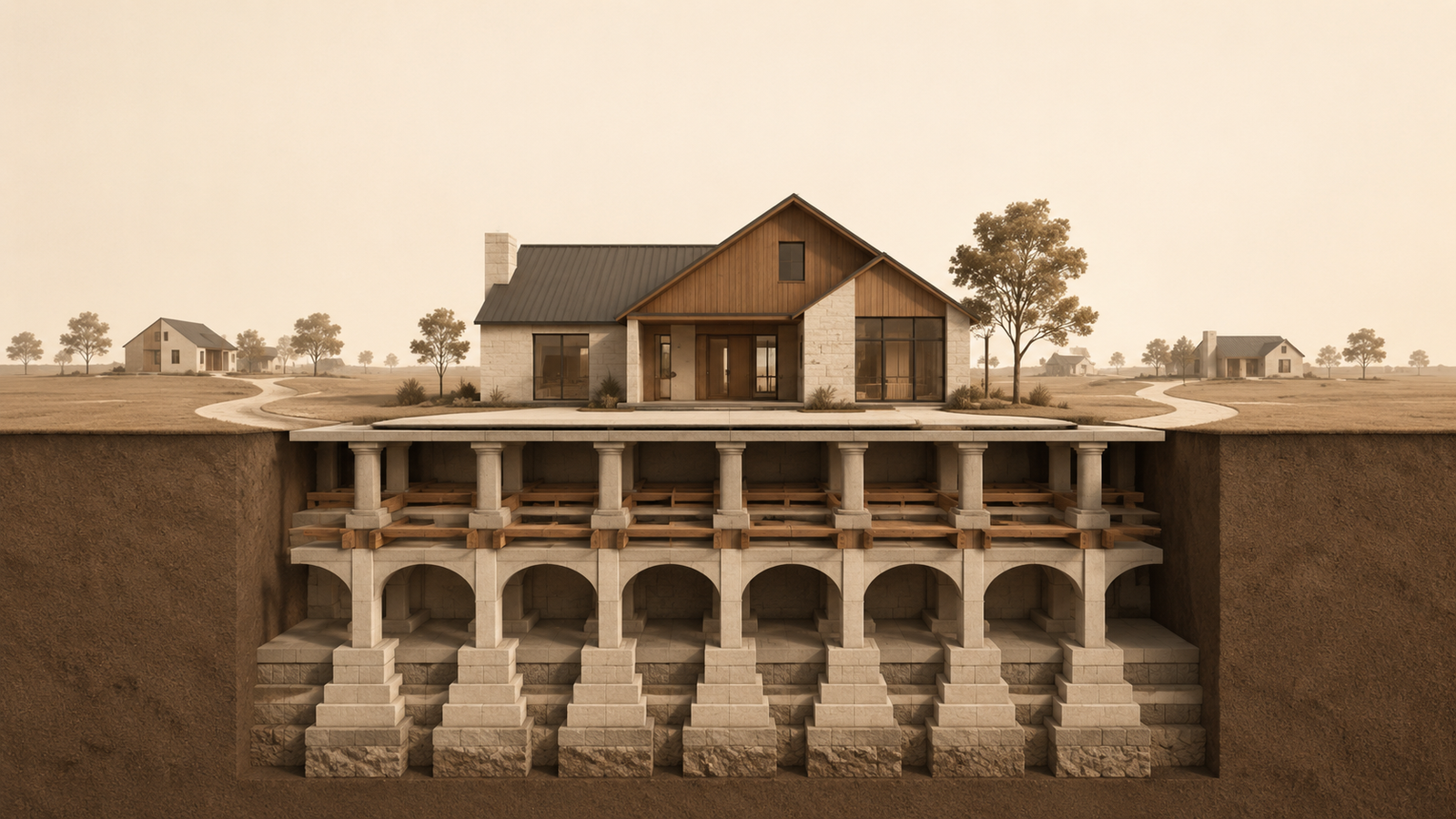
Legacy in Motion · The Architecture of Family Stability · Part 1
Strong families are not built by luck. They are designed through trust, shared purpose, responsibility, and daily rhythms that create stability across generations.
Most people can recognize a stable family. Fewer can explain why it is stable.
Some assume stability comes from money. Others point to personality, tradition, faith, discipline, or good fortune. Those things matter, but none of them explain enough. Families with financial comfort still fracture. Families with modest resources sometimes produce extraordinary resilience. Charismatic adults can create confusion, while quiet households can create strength.
The difference is rarely found in appearance. More often, it is found in architecture.
Family architecture is the invisible design of a household. It includes the rules, rhythms, responsibilities, boundaries, conversations, repairs, habits, and expectations that shape daily life. Every family has an architecture. However, not every family has designed that architecture with intention.
That distinction matters because a household does not become stable by wanting stability. It becomes stable when care is organized into repeatable practices. Affection must become reliability. Values must become habits. Responsibility must become visible. Repair must become normal.
This is the foundation of Legacy in Motion. Legacy is not simply what people leave behind. Instead, legacy is what continues because someone built systems capable of surviving them.
Family Architecture
A family is not just a group of people who share a name, address, bloodline, or history. It is a living system. Like every system, it has patterns, pressure points, incentives, weak spots, habits, and rules.
Some of those rules are spoken. Many are not. A family may say it values honesty, yet punish the first person who tells the truth. It may say it values peace, yet avoid every hard conversation. It may say it values children, yet organize adult life in a way that leaves children guessing where they stand.
Why Love Needs Design
Love matters. Affection matters. Intention matters. Still, love without structure often becomes exhaustion. People can care deeply and still create an unreliable home. They can want peace and still repeat conflict. They can want closeness and still communicate through assumption.
That is why Love Starts With Structure remains an important early text in the Legacy in Motion library. Structure is not the enemy of love. It protects love from confusion, performance, and unmanaged pressure.
A relationship without structure often asks emotion to do work that systems should do. Emotion may start connection, but structure sustains it. Over time, the household needs more than affection. It needs patterns people can trust when life gets difficult.
The Operating System of Home
Every household runs on an operating system. The system may be thoughtful, or it may be accidental. It may be generous, or it may be fragile. Either way, it is teaching people what to expect.
When the operating system is unclear, the family runs on mood, memory, pressure, and reaction. As a result, people spend too much energy interpreting one another. They wonder what matters, who is responsible, what will happen next, and whether promises mean anything.
By contrast, an intentional household lowers confusion. It does not remove every problem. However, it gives people a way to respond without rebuilding the family from scratch every time pressure arrives.
Stable Families Are Designed
Stable families are not perfect families. That distinction needs to be protected.
Even strong families experience grief, disagreement, financial strain, illness, disappointment, transition, and failure. Stability does not mean pressure disappears. Rather, it means the family has enough structure to absorb pressure without losing its center.
A well-built home does not stand because storms avoid it. It stands because the foundation was prepared before the storm arrived. The same is true for family life. A household does not become strong during crisis. Crisis reveals whether strength was already being built.
Preparation Is Protection
The earlier article The Family Stability Framework: How to Build Before You Birth made this point from the front end of family formation. Preparation matters before parenting. Education, finances, emotional discipline, partnership, community, and legacy thinking are load-bearing supports.
This article expands that idea into a broader framework. The question is not only how to prepare before family formation. The deeper question is how families remain stable once ordinary life begins applying weight.
Life applies weight through schedules, bills, parenting, aging relatives, illness, work stress, school expectations, grief, desire, disappointment, and change. If the household has no structure, every new pressure becomes a new emergency.
The Groundwork
Family stability is not a mood. It is a repeatable operating system. When the system is unclear, the household runs on assumption. When the system is intentional, the household has a better chance of becoming a place where people can grow, repair, and endure.
The Five Pillars of Family Stability
Every stable family rests on a small number of supports. These supports may look different across cultures, income levels, religions, and household forms. Even so, the underlying architecture remains consistent.
1. Shared Purpose
A family needs a reason beyond survival. Shared purpose answers the question: what are we building together?
2. Predictable Rhythm
Repeated practices create emotional orientation. Meals, check-ins, routines, holidays, and ordinary habits help people feel grounded.
3. Distributed Responsibility
No healthy home should depend on one person carrying every emotional, financial, and practical burden.
4. Repair
Conflict is inevitable. Collapse is not. Stable families practice apology, correction, and return.
5. Stewardship
Each generation receives something. The work is to preserve what is healthy, repair what is damaged, and improve what comes next.
These pillars are not decorative values. They are practical supports. They show up in calendars, budgets, chores, conversations, discipline, caregiving, decisions, apologies, and traditions.
More importantly, they prevent the family from becoming a place where everyone improvises alone. Stability grows when responsibility has a shape.
Shared Purpose
Shared purpose is the first pillar because direction comes before coordination.
Without shared purpose, a household becomes a collection of individual preferences competing for control. One person wants peace. Another wants status. One person wants savings. Another wants lifestyle. One wants strict routines. Another wants freedom. None of those desires is automatically wrong. However, without shared purpose, they collide.
Purpose answers a basic question: what kind of family are we trying to become?
Purpose Is More Than a Slogan
Families often use words like love, respect, faith, education, success, discipline, or loyalty. Yet words alone do not create direction. A value becomes meaningful only when it shapes decisions.
If a family values education, how does that value affect the calendar? If a family values faith, how does that value shape conflict? If a family values respect, how does that value limit tone? If a family values stability, how does that value shape spending?
In Dating With Purpose, On Purpose, Marcus Vaughn framed early connection as a matter of clarity rather than urgency. That same principle scales into family life. Purpose helps people move together instead of merely living near one another.
A Practical Purpose Statement
A family purpose statement does not need to sound grand. In fact, simple is better. It should be clear enough to guide decisions and humble enough to survive ordinary life.
Family Purpose Starter
Our family exists to build a home where people are loved, corrected, protected, prepared, and expected to contribute.
We value honesty, responsibility, learning, repair, and service.
We measure success not only by what we achieve, but by what kind of people we become.
That may sound basic. Good. Basic is often where stability begins. The issue is not whether a family can produce elegant language. The issue is whether it can make daily choices that match its stated purpose.
Daily Rhythm
Culture is not what a family claims to value. Culture is what the family repeats.
Rhythm is how a household turns values into lived experience. Children do not experience family values as a mission statement. They experience them as mornings, meals, rides, bedtime, tone, birthdays, chores, traditions, greetings, apologies, and how adults behave when tired.
Small Practices Become Structure
A household rhythm can be simple. Dinner at the table twice a week. A Sunday reset. A monthly budget conversation. A short family meeting. A school night routine. A birthday tradition. A habit of checking on elders. A weekly walk. A shared reading time. A quiet morning cadence.
Over time, repeated actions become emotional architecture. Rhythm gives people a way to locate themselves. It tells children what to expect. It also gives adults a place to return when life becomes noisy.
Families that lack rhythm often rely on emergency management. They respond to whatever is loudest. Although they may love each other deeply, the absence of rhythm forces love to work harder than it should.
Rhythm Reduces Decision Fatigue
A household with no rhythm must constantly decide what happens next. Who cooks? Who checks homework? Who handles bills? Who calls the grandparent? Who notices the child is off? Who plans the week?
When everything is undecided, everything becomes negotiation. Eventually, negotiation becomes resentment.
This is why Family Meetings Change Everything belongs inside this collection. A family meeting is not bureaucracy. It is rhythm turned into communication. It gives the household a predictable place to name needs, review pressure, assign responsibility, and reset.
A Simple Household Rhythm
Daily: One point of connection, even if brief.
Weekly: One shared meal, reset, or planning moment.
Monthly: One money, schedule, or responsibility review.
Seasonally: One tradition, service act, or family reflection.
Annually: One honest conversation about what the family is becoming.
Distributed Responsibility
A stable home cannot depend on one person carrying the whole structure.
In many families, one adult becomes the emotional manager, calendar keeper, financial worrier, conflict smoother, family historian, caregiver, reminder system, and invisible operations department. Sometimes this happens because of gender expectations. Sometimes it happens because one person is more competent. Sometimes it happens because everyone else learned to wait.
However it begins, the result is fragile.
Over-Functioning Creates Under-Functioning
When one person over-functions, others often under-function. The more one person carries, the less others learn to carry. At first, this may look efficient. Over time, it weakens the family because responsibility is not being developed across the household.
Distributed responsibility does not mean every person does the same thing. Children should not carry adult burdens. Partners may have different strengths. Elders may contribute through wisdom rather than physical labor. Still, everyone should understand that the household is shared.
Contribution Builds Belonging
People often feel more connected to what they help build. That is true in organizations, neighborhoods, and families. When children contribute appropriately, they learn that home is not a hotel. When adults contribute consistently, they teach that love includes service.
Responsibility should be visible. It should be named, assigned, reviewed, and appreciated. Otherwise, the family risks confusing invisible labor with natural order.
Household Responsibility Check
If one person stopped managing the household for two weeks, what would immediately fail? The answer reveals where responsibility is too concentrated.
Why Families Drift
Families rarely fall apart all at once. More often, they drift.
Drift begins when small patterns go unnamed. One person carries too much. Another withdraws. Children learn to read tension instead of receiving guidance. Meanwhile, money conversations become emergencies, and apologies become rare.
Ambiguity Creates Disappointment
Ambiguity enters when expectations are assumed instead of discussed. Who handles money? Who disciplines children? Who checks on aging parents? Who protects rest? Who names the problem when the home feels off balance?
When expectations are unclear, disappointment becomes predictable. People feel betrayed by agreements that were never actually made.
Inconsistency Teaches Uncertainty
Children cannot build security around rules that shift with adult mood. Likewise, partners cannot build trust around promises that change whenever life becomes inconvenient.
Consistency does not require rigidity. It requires reliability. A reliable home can still be flexible, but its flexibility has boundaries.
Avoidance Is Not Peace
Many families confuse silence with peace. Yet silence often becomes conflict waiting for a more expensive moment. Hard conversations are not threats to the family. They are maintenance.
Avoidance lets small cracks become structural damage. Therefore, healthy families learn to speak before resentment becomes the language of the house.
Stress Becomes Culture
Stress becomes dangerous when it becomes the household’s operating language. People become short. Children become watchful. Partners become defensive. Decisions become reactive.
Stable families do not avoid stress. Instead, they build ways to process stress before it becomes culture.
This is where The Power Struggle matters. Conflict is not proof that a relationship has failed. It reveals whether the structure can hold disagreement without turning every difference into a battle for control.
The Hidden Curriculum of Home
Every home has a curriculum.
Some lessons are intentional. Parents teach manners, chores, school habits, faith practices, cultural traditions, and family stories. However, the deeper curriculum is often hidden.
Children Study Repetition
Children learn how adults handle frustration. They learn whether apologies are normal. They learn whether money is discussed with wisdom or fear. They learn whether love is steady or conditional. They also learn whether leadership means service or control.
In short, children inherit normal.
Before a family transmits wealth, wisdom, faith, property, education, culture, or reputation, it transmits patterns. The first inheritance is the emotional and practical environment children come to expect.
The Goal Is Correction, Not Perfection
This is not about perfect parenting. Perfect parenting is not available. Instead, the goal is a household honest enough to correct itself and stable enough to keep building after correction.
If adults avoid conflict, children learn avoidance. If adults repair conflict, children learn repair. If adults shame mistakes, children learn concealment. If adults correct with steadiness, children learn accountability without humiliation.
The hidden curriculum is always running. Consequently, family architecture requires adults to ask what the household is teaching when no lesson has been announced.
Family Governance
Every household has governance.
The word may sound formal. However, the reality is simple. Governance is how decisions are made, how responsibilities are assigned, how conflict is handled, how expectations are clarified, and how accountability works.
Hidden Governance Is Risky
A family without explicit governance still has governance. The loudest person may govern. The most exhausted person may govern. Tradition may govern. Fear may govern. Avoidance may govern.
Hidden governance is dangerous because no one can improve what no one is willing to name.
The forthcoming article Every Household Has a Constitution should become one of the most important pieces in this collection. A household constitution does not need to be complicated. It simply names the principles, expectations, routines, and boundaries that help the family function.
A Simple Household Constitution
A household constitution is not a legal document. It is a clarity document. It gives the family a shared reference point before pressure makes everything personal.
Household Constitution Outline
Purpose: What kind of family are we building?
Values: What do we protect even when life gets hard?
Speech: How do we speak under pressure?
Responsibility: Who carries what?
Money: How do we plan, save, spend, and teach?
Repair: How do we apologize, correct, and return?
Tradition: What rhythms and memories do we preserve?
This is not about turning a home into a corporation. That would be cold and foolish. The point is not to remove warmth. The point is to protect warmth from chaos.
Clarity is not the opposite of love. Clarity is love refusing to leave people guessing.
The Economics of Home
Money is not the foundation of family stability. Still, financial chaos can damage every other foundation.
A family can have money and still lack wisdom. Meanwhile, a family can have limited money and still practice order. The issue is not only income. The issue is whether money has a structure.
Money Reveals Priorities
Money conversations reveal family values. What gets funded? What gets delayed? What gets hidden? What gets planned? What gets sacrificed? What gets protected?
A budget is not just math. A budget is a moral document written in numbers.
The article Discipline Before Dollars makes an essential Groundwork Daily argument: money without discipline does not create freedom. For families, that truth becomes even sharper.
Predictability Beats Performance
Many households chase financial performance before financial predictability. They want the larger house, the better vacation, the impressive school choice, the visible sign of arrival. Yet a family can look successful and still be financially fragile.
Predictability is different. It means the family understands its obligations, prepares for emergencies, discusses tradeoffs, and refuses to confuse status with security.
Financial predictability lowers emotional volatility. When people know where money stands, they fight less about shadows. They may still face constraints, but constraints are easier to manage than mystery.
Financial Honesty Reduces Fragility
A stable family does not need to be wealthy. However, it does need financial honesty. That means clear conversations about income, bills, debt, savings, goals, and tradeoffs.
- Plan for emergencies before emergencies arrive.
- Teach children age-appropriate money habits.
- Separate status from security.
- Name shared priorities before resentment grows.
- Build savings as protection, not performance.
The economics of home is not about chasing luxury. It is about reducing fragility so the family has more capacity for patience, generosity, and long-term thinking.
Repair Without Collapse
Every family breaks something.
Trust gets strained. Words come out wrong. Needs go unnamed. Parents overcorrect. Children rebel. Partners misunderstand. Siblings compete. Elders wound without realizing it. Even so, conflict does not have to become collapse.
Repair Is a Family Skill
Repair is one of the clearest signs of family maturity. A family that cannot repair must either deny harm or keep reliving it. Both options are expensive.
Repair requires more than saying sorry. It requires responsibility, specificity, changed behavior, and renewed trust over time. A vague apology may end a conversation, but it rarely rebuilds confidence.
The Repair Framework
1. Name the harm. Avoid vague apologies that protect pride more than people.
2. Own the action. Do not blame tone, timing, stress, or another person’s reaction.
3. Ask what repair requires. The person harmed may need clarity, space, correction, or changed behavior.
4. Change the pattern. Repeated apologies without changed behavior become another form of instability.
5. Return to rhythm. Healthy families repair and then rebuild normal life with greater wisdom.
Forgiveness Is Not the Same as Trust
This point matters because families often rush repair. Someone apologizes, and everyone is expected to move on. Yet moving on without changed behavior teaches people that comfort matters more than truth.
Forgiveness may begin internally, but trust must be rebuilt externally. Trust returns through consistent behavior. Therefore, repair has to include a new pattern, not merely a softer tone.
Repair protects families from becoming museums of old injuries. It also teaches children that love does not mean no one fails. Love means failure is handled with truth, accountability, and restoration.
This is where The Quiet Rebellion: Reclaiming Real Connection fits naturally. Real connection is built through presence, attention, humility, and the willingness to return honestly after tension.
Building What Outlives You
Family architecture matters because families are the first institutions most people ever experience.
Before a child understands government, school systems, workplaces, banks, neighborhoods, or civic life, that child understands home. Home becomes the first model of order, leadership, trust, money, conflict, and belonging.
Home Is the First Institution
Stable families have consequences beyond private life. Stable families build stable people. Stable people are better able to build stable relationships, workplaces, neighborhoods, institutions, and communities.
This does not mean unstable families produce doomed people. That would be false and cruel. Many people build remarkable lives after hard beginnings. However, it does mean household stability gives people a stronger launch point.
A stable home gives people practice in trust. It gives them models of responsibility. It teaches them how to disagree without destruction. It helps them understand that freedom and obligation are not enemies.
Legacy Is More Than Wealth
Wealth can be part of legacy. Property can be part of legacy. A business can be part of legacy. Yet legacy also includes habits, names, stories, standards, service, courage, and the quiet expectation that people are responsible for more than themselves.
The final article in this collection, Building What Outlives You, will return to this central idea. The goal is not only to survive the present. The goal is to build something strong enough to serve people you may never meet.
Where the Work Begins
A strong family does not require perfection. It requires shared purpose, predictable rhythm, distributed responsibility, honest repair, and stewardship.
It also requires adults willing to build before crisis. Children need to see consistency practiced, not merely preached. Finally, every home needs enough structure for love to become dependable.
That is how strong families are intentionally built.
That is family architecture.
And that is where Legacy in Motion begins.
Further Groundwork
Continue the Legacy in Motion collection with:
Children Inherit Normal
How ordinary adult patterns become the first inheritance children receive.
Love Needs Structure
Why affection becomes more durable when it is supported by clear expectations.
Every Household Has a Constitution
A practical guide to naming the values, rules, rhythms, and responsibilities that govern home life.
Family Meetings Change Everything
How regular communication turns household pressure into shared responsibility.
Receipts
Pew Research Center · Family and Relationships
Research on family structure, marriage, parenting, and household change.
Harvard Center on the Developing Child
Research on early development, resilience, stress, and the environments that shape children.
Child Trends
Data and research on child well-being, family stability, and youth outcomes.
Urban Institute · Families
Research on household finance, mobility, children, and family policy.
American Psychological Association · Families
Resources on family relationships, stress, parenting, and emotional health.
Subscribe to Groundwork Daily
Every strong family begins with one intentional decision. Subscribe to Groundwork Daily for practical frameworks on structure, responsibility, stewardship, and building what outlives you.
