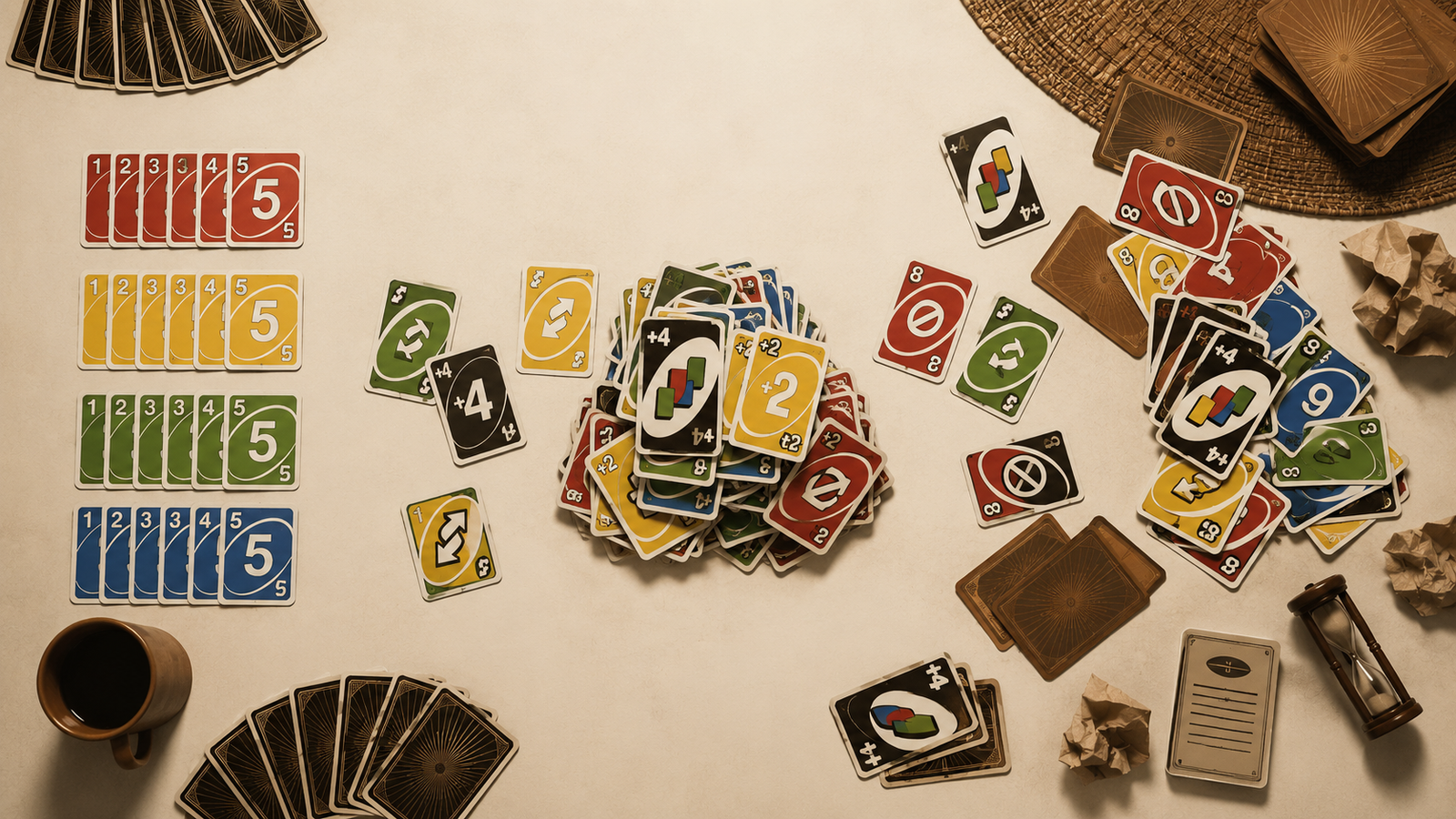
Uno was never just Uno once Black folks got hold of it. That is the part Mattel probably should have seen coming.
You cannot hand a simple card game to a people with cookout politics, cousin hierarchies, auntie enforcement systems, barbershop debate training, and a generational gift for turning anything into a full social institution, then expect the printed rule card to survive untouched.
That was never going to happen.
The box may say one thing.
The table says another.
And at the Black family table, the table is the Supreme Court, the appeals court, the enforcement agency, and the emotional damage department.
That is why Uno became more than a game. It became a cultural system. It became a stress test. It became a personality assessment. It became a family archive. It became a place where somebody’s quiet cousin reveals a villain arc nobody saw coming.
And somehow, everybody still acts surprised when the Draw 4 starts a constitutional crisis.
That is the joke.
Also, that is the system.
This Was Never About Cards
Uno works in Black spaces because it looks simple until people start playing like rent is on the line.
The game is easy enough for a child to understand, but dangerous enough for a grown adult to leave the table talking about respect. That is the sweet spot. A game has to look harmless before it can become dangerous in the correct way.
Spades has gatekeeping. Bid Whist has elders. Dominoes has a whole rhythm of table-slapping authority. Uno, though, is accessible. Everybody can get in. Everybody thinks they know what they are doing.
That is where the trap begins.
Because knowing the cards is not the same as knowing the table.
The table has memory. The table remembers who stacked last game. The table remembers who smiled before dropping that Draw 4. The table remembers who said “I forgot to say Uno” but clearly did not forget. The table remembers who only becomes quiet when they are holding something violent.
The table remembers everything, especially when revenge is possible.
This is not just recreation.
This is social accounting.
Every card played gets entered into the ledger. Every Skip has a history. Every Reverse has a motive. Every Draw 4 has context. The actual game may reset after somebody wins, but the emotional record stays open.
That is why a new round never feels completely new.
It is just the next hearing.
House Rules Are Community Governance
Every Black Uno table has a constitution.
Nobody wrote it down, but somehow everybody knows when you violated it.
That is governance.
House rules decide what counts, what does not count, who gets corrected, and who gets away with something because they are old enough to make the potato salad.
Some tables allow stacking. Some tables let you stack Draw 2 cards but not Draw 4 cards. Some tables allow multiple Skips. Some tables let a Reverse save your life. Some tables treat Reverse like a legal weapon. Some tables are so lawless the printed instructions should just file a complaint and go home.
But the serious part underneath the funny part is simple: house rules are how communities localize systems.
The company creates the product.
The community creates the experience.
That is the whole lesson.
Black culture has always done this. It takes what is given, bends it, seasons it, renames it, argues over it, and turns it into something with its own rhythm. Language does this. Music does this. Fashion does this. Food does this. Church does this. The group chat definitely does this.
So of course Uno got transformed.
Uno came in as a card game.
It left as a cultural operating system.
That is what makes house rules so interesting. They are not random. They are local law. They tell you what the table values.
A table that allows stacking values escalation.
A table that bans stacking values order.
A table that lets elders change rules mid-game values survival.
A table that lets the youngest cousin win one round before destroying them in the next values emotional development with conditions.
Every house rule tells you what kind of community you entered.
That is why people ask the rules before sitting down.
Not because they are confused.
Because they are assessing the government.
Stacking Is a Cultural Position
Let us stop pretending stacking is just a rule preference.
Stacking is philosophy.
If you believe stacking should be illegal, you probably believe in order, mercy, and reading the terms and conditions. That is fine. There is a place for you. It is probably a quiet table with coasters.
If you believe stacking should be legal, you understand consequences, escalation, and the ancient truth that pressure builds character in everybody except the person drawing sixteen cards.
That is a different worldview.
Stacking turns Uno from a simple matching game into a social drama. Suddenly people are managing risk. Saving cards. Watching facial expressions. Trying to decide whether cousin Terrence is calm because he has nothing or calm because he is holding nuclear power.
A Draw 2 is not just a Draw 2 anymore.
It is a warning shot.
A Draw 4 is not just a Draw 4.
It is a declaration that somebody came to ruin the evening.
And when somebody stacks on top of that, the table changes. People sit up. Someone says, “Oh, we playing like that?” Another person starts laughing too hard. Somebody else quietly checks their hand because survival just became math.
That is not chaos.
That is culture under pressure.
Stacking also reveals something else: people are very committed to fairness until fairness stops benefiting them.
The same person who says stacking is tradition when they have the card will suddenly start quoting official rules when they do not.
That is not hypocrisy.
That is table politics with selective legal training.
This is why Uno arguments sound bigger than the game. Nobody is only debating the card. They are debating legitimacy. They are debating precedent. They are debating whether the rules are stable or whether somebody just created a new policy because they were losing.
And honestly, that feels familiar outside the game too.
The Table Has Politics
Every Uno table has roles.
There is the rule lawyer. That person is usually technically correct and socially defeated.
There is the chaos agent. They do not care who wins as long as somebody suffers.
There is the quiet assassin. They say almost nothing for six rounds, then suddenly empty their whole hand like they had a federal strategy memo.
There is the emotional player. Every card played against them is personal. Skip them once and now you have damaged the relationship.
There is the elder who changes rules mid-game and dares anybody to challenge them.
And then there is the person who keeps asking, “Whose turn is it?” after causing most of the confusion.
This is us.
Not because every Black family is the same. That would be lazy. It is because the social patterns are recognizable. The table becomes a small theater where power, memory, humor, status, pressure, and love all show up at the same time.
The table has alliances. Some are spoken. Most are suspicious.
Two people may agree to stop the person who is close to winning. That is strategy. But if they keep doing it to the same person, now it is a pattern. If they deny it, now it is politics. If the person being targeted brings up something from Thanksgiving two years ago, now the game has expanded into family court.
This is why people remember these games.
Not because of the cards.
Because of who became themselves when the cards hit the table.
Uno reveals temperament quickly. Some people win quietly. Some people need a press conference. Some people lose with grace. Some people lose and immediately begin investigating the shuffle.
And every family has at least one person who cannot separate gameplay from betrayal.
That person needs support.
Not during the game, though.
During the game, they need to draw those cards.
Mattel Has Rules. The Cookout Has Law.
Mattel can say stacking is not official.
That is their right.
The cookout can also say, “That is not how we play over here.”
That is its right too.
And there is the cultural tension.
Corporate ownership controls the product. Community usage controls the meaning.
That distinction matters.
Uno belongs to Mattel as intellectual property. But the lived experience of Uno at Black tables has been shaped by families, friends, HBCU game nights, barbershop energy, cousins, aunties, uncles, neighborhood tournaments, and people who absolutely should have been banned from shuffling.
That is cultural transformation.
It is not formal ownership.
It is social ownership.
And social ownership can be powerful because it decides what something means in real life.
That is why the ignored rule card near the edge of the table is funny.
It is also the whole point.
The official system exists.
The community system is what people actually follow.
This is where House Rules becomes bigger than Uno. Every household has a version of this. Every friend group has a version of this. Every workplace has a version of this. There are official rules, and then there are the rules people actually enforce.
The handbook says one thing.
The culture says another.
The sign on the wall says one thing.
The person with seniority says another.
The instruction card says one thing.
Auntie says, “Not at my table.”
Guess which one people follow.
Why Uno Keeps Showing Up in Black Culture
Uno keeps appearing in Black media, podcasts, game nights, tournaments, and jokes because it carries a full emotional world in a small deck.
It signals family. It signals tension. It signals the moment when jokes become accusations. It signals somebody saying, “You cheated,” even though nobody can explain how cheating works in a game where half the table is already ignoring the rules.
That is why it works on screen.
Put a few Black people around an Uno table and the audience already understands the stakes. Nobody has to explain the family history. The cards do it. The side-eyes do it. The silence after the Draw 4 does it.
That is cultural shorthand.
The game becomes a way to show intimacy, conflict, competition, humor, and hierarchy without a speech.
It also works because Uno creates instant recognition. Almost everybody has a story. Somebody stacked wrong. Somebody changed the rule. Somebody got skipped three times in a row. Somebody almost won and forgot to say Uno. Somebody had one card left and started smiling too early.
That smile is always the beginning of disaster.
People remember these moments because they reveal more than game behavior. They reveal how people handle pressure, consequence, attention, and loss.
Some people can take a loss.
Some people can take a loss only after explaining why the loss should not count.
Some people will say, “Run it back,” with the tone of someone requesting justice.
And the table understands.
Because revenge is part of the rhythm.
Why This Keeps Lasting
Games usually fade.
Uno did not.
Not in Black spaces.
Because the game became attached to something bigger than entertainment.
It became ritual.
Cookouts. Dorm rooms. Family reunions. Summer nights. Folding tables. Loud cousins. Somebody bringing up old business halfway through the game. Someone’s plate sitting too close to the draw pile. Someone threatening to leave, then staying for three more rounds.
The cards stayed the same.
The meaning evolved.
That is why the official rules barely matter now.
The social experience replaced the instruction manual a long time ago.
People are not really remembering the game itself.
They are remembering the tension. The laughter. The alliances. The accusations. The revenge rounds. The feeling of surviving a stacked Draw 4 attack and coming back stronger two hands later.
That emotional memory is what turned Uno into cultural infrastructure.
And honestly, that may be the most Black thing about it.
Take something simple.
Add rhythm. Pressure. Humor. Chaos. Community. Adaptation.
Then turn it into something nobody outside the culture fully understands unless they have sat at the table themselves.
This is why House Rules matters as a cluster. It is not just about games. It is about how groups create order when official rules do not capture lived reality. It is about how people negotiate fairness, memory, personality, authority, and consequence in shared spaces.
Uno just makes the system easier to see because somebody is usually yelling.
The Groundwork
The real lesson is not that Black people changed Uno.
Of course we did.
The real lesson is that every table eventually becomes a system.
People bring assumptions. They bring memory. They bring personality. They bring old victories and old wounds. They bring a very selective commitment to fairness. They bring rules they learned somewhere else and expect everyone to honor immediately.
Then the table has to decide what kind of order it will follow.
That is where culture forms.
Not in the instruction booklet.
At the table.
In the argument.
In the correction.
In the moment someone says, “We do not play like that over here.”
That sentence is doing a lot of work.
It is not just about Uno.
It is about belonging. It is about local standards. It is about the small rules that let people know where they are, what is allowed, and what will get challenged.
House rules are not always fair.
But they are revealing.
They show who has authority. They show who can challenge authority. They show who remembers the old rule and who benefits from the new one. They show how quickly a simple game can become a referendum on trust.
That is why Uno works so well as a cultural mirror.
Everybody thinks they are defending the rules.
Most people are defending the version that helped them win last time.
And yes.
That’s still us.
Groundwork Actions
- Notice where official rules and lived rules separate.
- Pay attention to who gets to define fairness at the table.
- Watch what people defend when the rules stop helping them.
- Remember that every shared space has house rules, written or not.
Further Groundwork
Stay With The Work
Groundwork Daily arrives quietly.
Thoughtful observations, systems worth noticing, and articles that usually begin with someone saying, “I never thought about it like that.”