
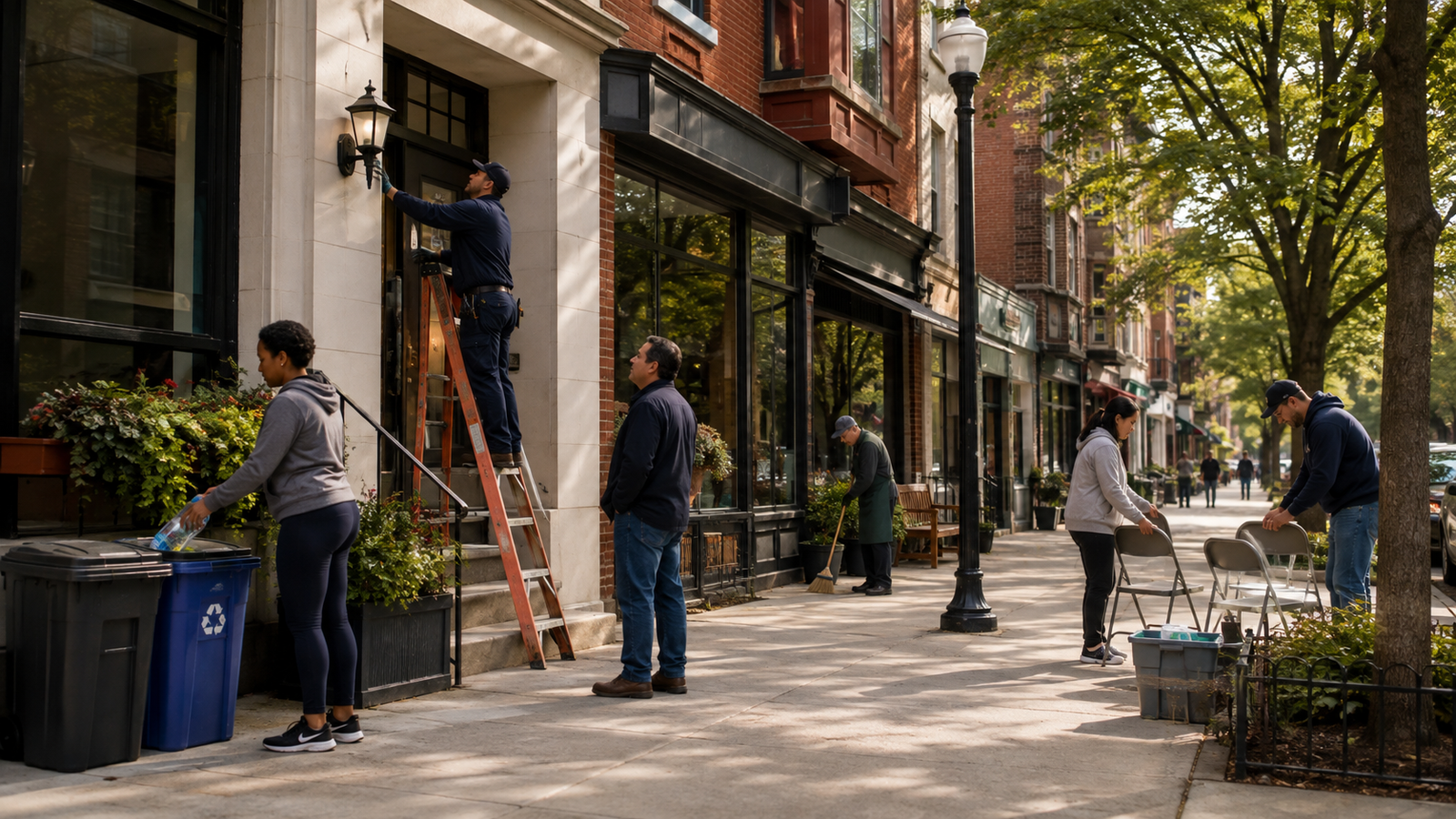
Community stability is usually noticed after it starts disappearing.
The first signs rarely look important. A broken light stays broken. Trash remains outside one extra day. The same neighbor reports another problem. A school event has fewer volunteers. The building meeting gets smaller. Somebody who normally handles things starts saying, “I cannot get to it this week.”
Nothing has collapsed. That is precisely why the warning is easy to miss.
Communities often weaken long before they look unstable. The shift begins when responsibility quietly starts moving toward fewer people. One person organizes. Another keeps reporting the maintenance problems. Someone else always cleans up afterward. A familiar volunteer keeps filling the empty slot because leaving it empty would hurt everybody.
Eventually, the dependable people stop merely participating. They become part of the operating system.
From the outside, that can still look like stability.
Sometimes it is something more fragile: borrowed capacity.
The community continues functioning because a small number of people keep lending their time, memory, relationships, patience, and labor to work the larger system has stopped distributing.
When one of those people finally steps away, everybody sees the weakness at once.
The weakness did not begin when the person left. It began when the system became dependent on that person staying.
Community Stability Starts With Response
Stable communities still have problems.
They have broken fixtures, scheduling conflicts, noise complaints, missed meetings, maintenance delays, difficult personalities, and people who occasionally fail to do what they said they would do.
The difference is not perfection.
The difference is whether ordinary problems continue to meet an ordinary response.
A stable apartment building can have a leak. Someone notices it, the problem enters a known reporting path, responsibility becomes clear, and somebody follows through.
A neighborhood can have litter without becoming neglected. A school can lose volunteers without allowing every responsibility to fall permanently onto the same two parents. A block association can have disagreement without losing its ability to make decisions.
Strong systems keep small failures from becoming permanent conditions.
Instability begins when the response path weakens.
People start adjusting around what no longer works. They step over the trash. They learn which door never gets fixed. They stop expecting the meeting to begin on time. They stop reporting problems because reporting has stopped producing visible consequences.
Eventually, the workaround becomes the standard.
That is how a community changes without formally deciding to lower its expectations.
The Hidden Risk Is Borrowed Capacity
Some communities look stronger than they are because the same dependable people keep absorbing whatever the system fails to distribute.
The building looks organized because one resident keeps following up. The block event happens because one neighbor always finds the volunteers. The church program survives because one person remembers every deadline. The school committee functions because three parents keep covering the assignments nobody else takes.
The outcome is visible.
The concentration underneath it is not.
This is borrowed capacity.
The phrase describes a practical warning sign. The system appears to possess more reliable capacity than it actually owns because a few people repeatedly lend personal time, knowledge, relationships, memory, patience, and labor to keep it functioning.
That arrangement can last for years.
It can also disappear in a week.
A job changes. Caregiving demands increase. Someone moves. A volunteer becomes exhausted. A resident decides that constant follow-up is no longer worth the conflict.
Nothing unusual has to happen. Ordinary life is enough to expose the weakness.
That is why capacity matters here. Reliable capacity is not the amount of effort available on the best day. It is what the system can continue carrying without unacceptable degradation when ordinary people encounter ordinary limits.
Borrowed Capacity Check
Four signs that apparent stability may be concentrated
Stable Communities Often Look Boring
People sometimes imagine stable communities as unusually harmonious places.
Most are not.
They often look ordinary because the basic systems work often enough that nobody needs to celebrate them.
The elevator gets repaired. The entrance light works again. The sidewalk gets cleared. The meeting starts roughly when people were told it would start. Residents know where to report a problem. Parents understand what the school expects. Volunteers are not surprised by what they agreed to do.
Nothing about that is glamorous.
That is the point.
Predictability creates evidence. Evidence gives people a reason to trust the next interaction.
That is more durable than asking people to trust first and hoping performance catches up later.
A resident trusts the building because reports usually produce a response. A parent trusts the program because expectations are clear. A neighbor keeps contributing because previous contribution was not wasted.
Trust, in this sense, is not simply goodwill.
It is a judgment formed from repeated evidence that participation still connects to consequence.
People Often Stop Participating Before They Stop Caring
Leaders often describe declining participation as apathy.
Sometimes that diagnosis is correct. Often it is incomplete.
People can care about a place and still decide that participating in its systems is too expensive, too unclear, too frustrating, or too ineffective.
A resident reports a problem several times and receives no response. A volunteer helps once and discovers that a single yes has become a permanent assignment. A parent raises a concern and learns that disagreement carries a social penalty. A neighbor attends meeting after meeting without seeing a decision become action.
Eventually, some people stop arguing.
They simply reduce their exposure.
That withdrawal matters because participation provides more than labor. It spreads information, memory, observation, relationships, skill, correction, and local knowledge across more people.
When participation narrows, those resources narrow with it.
This is why shared responsibility does not mean equal responsibility.
Equal contribution is usually unrealistic. People have different schedules, money, authority, skills, family obligations, and proximity to the work.
The healthier target is distributed contribution.
One person may attend the meeting. Another may report the broken gate. Someone else can bring supplies twice a year. A local business owner may maintain the storefront edge. A parent may volunteer for one specific activity rather than every activity.
The contribution can vary.
The system becomes stronger when enough people can see a legitimate way to carry a piece of it.
Visible Contribution Needs Visible Response
Participation weakens when people cannot tell whether their effort changes anything.
This is where communities often make an avoidable mistake. They ask for more participation without improving the system that receives participation.
More sign-up sheets do not fix unclear roles.
More meetings do not fix ignored decisions.
More appeals for community spirit do not fix a process that repeatedly converts helpful people into unpaid permanent staff.
If contribution matters, the system has to prove it.
A report should enter a visible path. A volunteer role should have boundaries. A meeting decision should have ownership. A recurring task should have backup. A corrected problem should remain corrected long enough for people to see that response still exists.
This is where accountability strengthens participation. Accountability does not require making every mistake punitive. It means recognizing drift, assigning responsibility, and restoring alignment so that contribution is not absorbed into vagueness.
People are more willing to participate when they know where responsibility begins, what success looks like, and where responsibility ends.
Structure can make participation easier precisely because people are no longer being asked to carry everything.
Children Learn Whether Shared Problems Belong to Anybody
Children notice how adults respond to shared environments long before they have language for community systems.
They see whether people step around problems or address them. They notice whether a shared room is left worse for the next person. They notice whether rules apply consistently or only after somebody powerful complains.
Those repeated observations become expectations.
A child who regularly sees adults report, repair, clean, organize, return, and follow through learns that shared places do not maintain themselves.
The lesson is larger than cleanliness or obedience.
It is about continuity.
The next generation inherits more than the physical condition of a place. It inherits an operating assumption about whether ordinary people are participants in shared systems or merely consumers of them.
The standard becomes cultural when the behavior becomes ordinary.
Communities Usually Recover Through Small Proof
Declining participation is not automatically permanent.
However, communities rarely rebuild trust through announcements alone.
They rebuild it through proof.
A repair gets completed. A meeting starts on time. A resident receives an answer. A volunteer assignment has a clear end. Someone who stopped participating returns for one manageable task and is not immediately handed five more.
These moments can look too small to matter.
They matter because trust compounds through evidence.
Recovery begins when people can once again see a relationship between action and consequence.
That creates a place for participation to land.
The work is basic: clear expectations, visible maintenance, defined responsibility, consistent response, realistic limits, and enough repetition for people to believe the system is not asking them to gamble their effort.
That is also why recovery should not begin by demanding that everybody care more.
Care may already be present.
The better question is whether the system has made caring usable.
The Groundwork
Test the stability underneath the appearance
Look at one shared environment you know well. It can be a hallway, workplace, school, block, church, courtyard, tenant association, family system, neighborhood group, or recurring community program.
Ask what actually keeps it functioning.
- Who notices when something begins to slip?
- Who knows how the important routines actually work?
- Who keeps absorbing responsibilities that were never formally assigned?
- What work stops if one dependable person becomes unavailable?
- Where could one responsibility be made clearer, smaller, easier to transfer, or easier for somebody else to carry?
The purpose is not to find somebody to blame. It is to identify where the system is pretending personal reliability is permanent infrastructure.
Distributed responsibility does not guarantee resilience. A community can still lack money, authority, competence, coordination, or adequate systems.
But concentrated responsibility creates a predictable vulnerability: too much of the outcome depends on too few people remaining available.
Durable communities are not maintained because everybody contributes equally. They endure because responsibility can move, knowledge can transfer, participation has boundaries, and enough people continue carrying a visible piece of the load.
Continue Building
Follow the participation system beneath community stability.
Series: Community Participation
Receipts
Background research for readers who want to examine social trust and social capital beyond this article.
Pew Research Center: Social Trust
Build better. Every day.
Strong communities are built in ordinary moments.
Join Groundwork Daily for practical thinking about the systems, behaviors, standards, and decisions that determine what holds.

Meet the Builder
Cyrus Mbeki
Builder, Community Groundwork
Cyrus Mbeki examines how communities become stronger or weaker through ordinary behavior. His work focuses on participation, stewardship, maintenance, incentives, contribution, public behavior, institutional durability, and the shared systems people often notice only after they begin to fail.
His work begins with observable behavior and follows it into the system underneath: who contributes, who carries excess responsibility, which standards remain visible, and what happens when dependable people stop absorbing the load.