
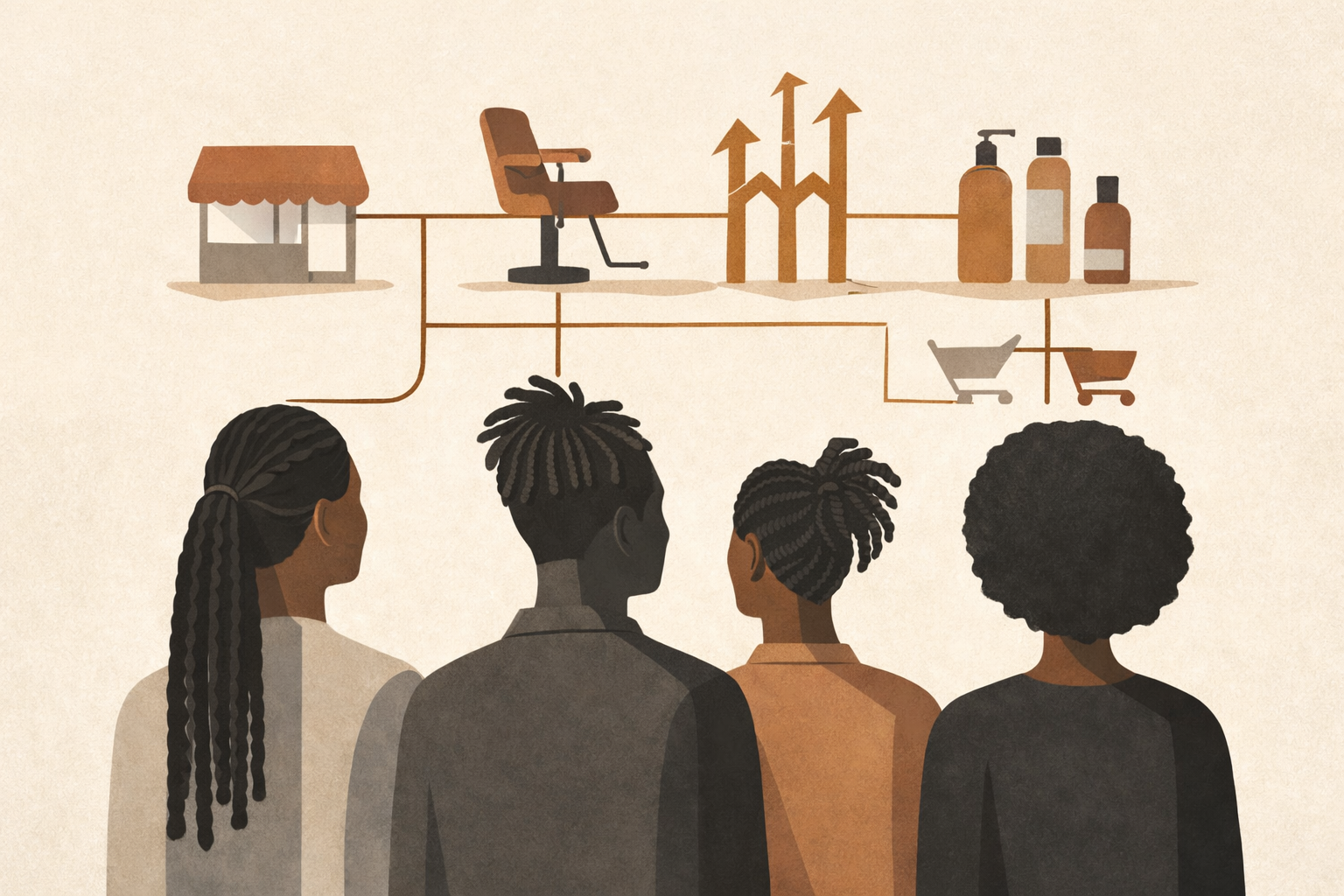
Black hair industry economics are not a niche conversation. They are a real-time case study in demand, distribution, ownership, and leverage. The market moves billions through products, services, and protective styling. Yet the most important question stays simple: who captures the value after the customer pays?
This industry is not only about beauty. It is an ecosystem. It includes manufacturing, imports, wholesalers, beauty supply storefronts, salons, stylists, influencers, and platforms that take a percentage at every step. Because of that, the money trail tells a story about power.
The financial side of this industry is inseparable from the broader politics of Black hair, where culture, identity, and economic influence intersect. Spending patterns, brand ownership, and distribution networks all reveal who benefits from the demand created by Black consumers.
Black Hair Industry Economics Begin With Demand
The demand is consistent because the needs are specific. Hair texture, scalp health, protective styles, and maintenance routines require products that actually work. As a result, consumers spend with intention, then they spend again because maintenance is recurring.
However, recurring demand does not automatically create recurring wealth for the community that drives it. Demand is the engine. Ownership is the steering wheel.
Where the Money Actually Moves
Most people see the front end: the product shelf, the salon chair, the install, the refresh. The deeper economics sit behind the curtain: who manufactures, who imports, who wholesales, and who owns the retail channels. That back end determines margins and control.
In practice, the industry often splits into three profit zones:
- Product margins: shampoos, conditioners, stylers, edge control, and tools with repeat purchasing.
- Service income: braids, loc maintenance, twists, silk press, treatments, and protective styling labor.
- Distribution control: wholesale access, beauty supply retail networks, and the pricing power that comes with shelf space.
Meanwhile, digital platforms created a fourth zone: attention. Tutorials, reviews, and influencer marketing can move product faster than traditional advertising. Yet platform reach still favors whoever can fund production, ads, and inventory.
Ownership, Supply Chains, and Control
Historically, large product lines serving Black consumers did not always sit under Black ownership. That reality created a familiar pattern: the community supplies demand while outside entities control manufacturing and distribution.
However, the last decade brought growth in founder-led brands and direct-to-consumer models. That shift matters because it changes who controls pricing, storytelling, and customer relationships. It also changes who can reinvest profits into hiring, storefronts, and new product development.
Still, supply chain control remains the bottleneck. If a brand cannot scale manufacturing, secure reliable fulfillment, or negotiate wholesale terms, it stays fragile. In other words, the goal is not only to be popular. The goal is to be structurally positioned.
Beauty Supply Stores and the Distribution Gate
Beauty supply retail functions like an access point and a filter. If a product cannot get onto shelves, it loses impulse buying and local visibility. If it can, it gains trust and volume.
Therefore, distribution is not a side detail. It is one of the strongest economic levers in Black hair industry economics. Whoever controls the shelves influences the winners.
Salons, Stylists, and the Service Economy
Salon economics run on skill, time, and reputation. Labor creates value quickly, but labor also caps scale because time has limits. So the strongest operators usually layer income: services plus products, then products plus education, then education plus community trust.
In the platform era, stylists also function as distribution partners. A single trusted professional can influence repeat purchasing for years. That relationship is a business asset, not just a vibe.
Platform Economics and the Speed of Discovery
Social media made product discovery fast. It also made hype fast. So brands that build on volatility burn out, while brands that build on results compound.
The practical takeaway: algorithms reward attention, but customers reward performance. A product that solves a real problem becomes a repeat purchase. That is how the math starts working.
The Politics of Black Hair: History, Identity, and Power
Hair Discrimination in the Workplace: The CROWN Act Explained
Understanding Natural Hair: Texture, Science, and Maintenance
Hair Types Explained: The 1A–4C Curl Pattern Guide
System Updates: When Language Becomes Self-Weaponization
Real Talk Blueprint: When We Start Talking About Ourselves Like the Enemy
Language Builds the Mirror We Live In
The Bottom Line
Black hair industry economics are a mirror: the community has demand, taste, and expertise. The winning question is whether the infrastructure matches that influence. When ownership and distribution align with the customer base, spending stops being a leak and starts being a ladder.
