

Systems making decisions for people rarely feels dramatic. Usually, it feels helpful: a default setting, a recommendation, a route already selected, a form already completed, or a choice marked as the one that “usually works.”
That is what makes the transfer easy to miss. Most people do not wake up and decide to surrender judgment to a system. Instead, the decision moves upstream. The software narrows the field, orders the options, chooses the default, and makes one path easier to continue than the others.
Eventually, the human may still click the button, but clicking is not always the same thing as choosing.
The deeper question is not whether automated systems can make useful decisions. Many can. The question is whether the person using the system can still see where the decision was made, understand the tradeoff, challenge the path, and remain accountable for what happens next.
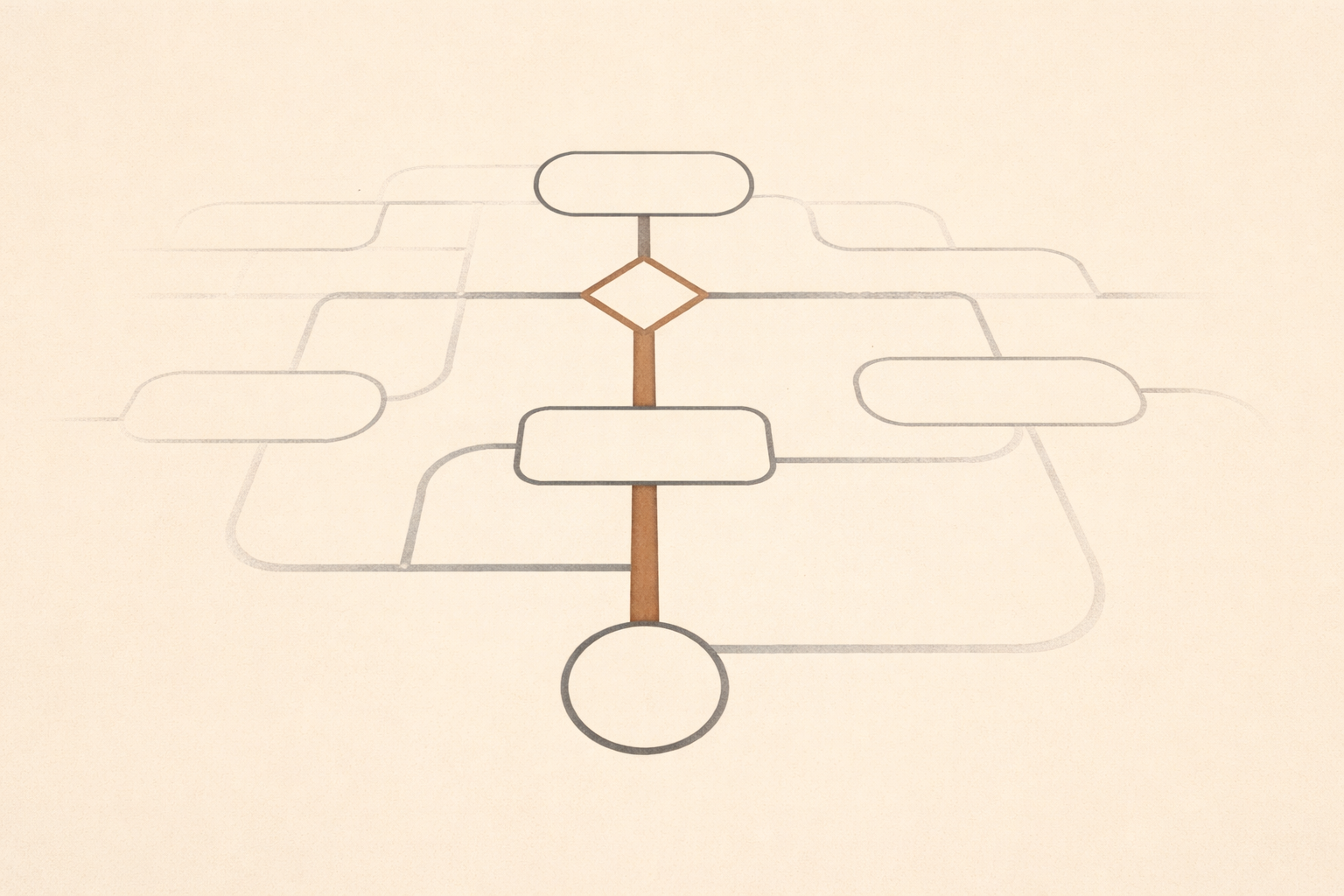
When Systems Make Decisions for You
Modern technology is designed to remove friction, including the friction of deciding. Maps suggest the route. Streaming platforms rank what to watch. Shopping systems recommend what to buy. Financial software categorizes transactions. Workplace tools prioritize tasks, while AI systems increasingly draft, rank, summarize, recommend, and predict.
None of those functions is inherently a problem. In many situations, reducing unnecessary choice is exactly what good technology should do. Nobody needs to spend meaningful judgment deciding every trivial setting, sorting every routine item, or manually repeating every low-risk action.
The problem appears when the system starts resolving choices that carry meaningful tradeoffs while the user experiences the result as mere convenience.
The Decision Can Move Before Authority Appears to Move
Consider a recommendation list. The user may technically remain free to choose any option. Yet the system has already decided what deserves visibility, what appears first, what disappears below the fold, and which alternatives never enter the field at all.
The same mechanism appears in a default. A user can often change it, but the system has already chosen the starting point and made inaction produce a specific outcome.
This is decision architecture: the structure surrounding a choice before the final choice is made.
Agency can narrow before freedom formally disappears.
That distinction matters because modern systems do not need to eliminate choice in order to shape behavior. Often, they only need to make one path easier, more visible, more familiar, or more automatic than the alternatives.
How a System Starts Choosing Before You Do
Systems can influence decisions at several points before a person reaches the final action. These mechanisms often overlap, which is why the transfer of agency can feel almost invisible.
01 · Selection
What Enters the Field
A system can determine which options, posts, products, routes, candidates, or recommendations appear in the first place.
02 · Ranking
What Appears Important
Once options enter the field, their order can influence what receives attention and what is effectively ignored.
03 · Default
What Happens Without Intervention
A default converts inaction into an outcome. The user retains choice, but one path has already been made easier to accept.
04 · Automation
What Happens Without Repeated Choice
Automation can execute the selected rule repeatedly, reducing the number of moments when a person actively reconsiders the decision.
Each layer can be useful. The governance problem appears when users cannot tell which layer is operating or when the stakes have changed but the decision architecture has not.
Defaults Are Decisions Made in Advance
Defaults are powerful partly because they do not feel like instructions. They feel like the absence of an instruction. The system has already selected an option, and the user can simply continue.
Classic research on status quo bias found that people can show a disproportionate preference for maintaining an existing or default state. That does not mean every default manipulates people or that people never override them. It means the starting point can influence the decision.
Good Defaults Reduce Waste
Many defaults are useful. Secure settings can protect users who would otherwise miss an important configuration. Sensible accessibility choices can reduce unnecessary setup, while routine workplace defaults can make repeated processes easier to execute.
A well-designed default can therefore remove low-value decisions and preserve attention for higher-value ones.
But Defaults Also Carry a Point of View
A default is not nothing. Somebody or something selected it.
That choice may reflect safety, convenience, commercial incentives, historical behavior, organizational policy, predicted preference, or a designer’s judgment about what most users should do.
The disciplined question is not, “Are defaults bad?” It is more useful to ask:
Who chose this default, what outcome does it favor, and what happens if I never change it?
A default deserves more scrutiny as its consequences become harder to reverse.
The setting for a display preference and the default governing privacy, money, access, health, identity, or a long-term commitment should not receive the same level of attention.
Delegation and Abdication Are Not the Same
Delegation is not a failure of discipline. Good systems depend on it. People delegate calculations to calculators, navigation to maps, repetitive work to software, and routine execution to automation because human attention is limited.
The difference is that disciplined delegation preserves a boundary around authority.
You know what the system is doing. You know why you delegated the task. You know when the result requires review, and you retain a way to intervene when conditions change.
Abdication Begins When the Boundary Disappears
Abdication is different. The system begins choosing because it has always chosen. Recommendations become instructions through repetition. A default becomes permanent because nobody remembers why it was selected. Automation continues even though the original conditions have changed.
At that point, responsibility has not necessarily vanished. Visibility has.
Three forms of drift can follow:
- Judgment weakens. Tradeoffs become harder to recognize because the system routinely resolves them before the user has to examine them.
- Accountability blurs. When an outcome goes wrong, responsibility can feel abstract because the software recommended, ranked, routed, or executed the action.
- Convenience becomes a proxy for correctness. The path requiring the least resistance can begin to feel like the right path simply because it is the easiest one to continue.
None of this requires malicious technology. It only requires delegation without periodic review.
Automation Bias Changes How People Review Decisions
Human oversight sounds straightforward until the automated system is usually right.
When a tool performs reliably, checking every output begins to feel wasteful. Trust rises, vigilance falls, and the human reviewer can shift from independently evaluating the problem to confirming the system’s recommendation.
Research on automation bias has examined this problem in computerized decision-support environments. Automated recommendations can contribute to errors when people fail to notice information the system misses or follow incorrect recommendations that active review might have challenged.
Reliability Creates Its Own Oversight Problem
Paradoxically, a system does not have to fail constantly to weaken review. If it failed constantly, people would stop trusting it.
The harder governance problem emerges when the system performs well enough that scrutiny begins to feel unnecessary.
This is why “human in the loop” cannot merely mean a person is present somewhere in the workflow. The person must still have enough information, authority, time, and reason to challenge the output.
Groundwork Daily develops that problem further in Keeping Humans in the Loop .
Approval Is Not Always the Same as a Decision
Many digital systems preserve a final confirmation step. Technically, the human remains in control because the person must still click “accept,” “approve,” “continue,” or “submit.”
That safeguard matters, but it can also create an illusion of authorship.
Ask What Happened Before the Button
Before the user arrived at the approval screen, the system may have selected the relevant information, ranked the options, recommended one outcome, prefilled the fields, and framed the tradeoff.
If the human’s role is reduced to approving a conclusion that was assembled elsewhere, the final click may represent consent without much independent judgment.
This does not automatically make the decision invalid. It does mean the real location of authority needs to be examined earlier in the process.
The last click may belong to the human even when most of the decision happened upstream.
The Higher the Stakes, the More Visible the Decision Path Should Be
Not every automated decision deserves the same level of human involvement. Requiring deliberate review for every trivial action would defeat much of the value technology provides.
Stakes should govern scrutiny.
Low-Stakes Decisions Can Tolerate More Automation
Reordering a playlist, sorting routine email, suggesting a meeting time, or choosing a display preference usually allows substantial automation because mistakes are inexpensive and easy to reverse.
Consequential Decisions Need Stronger Boundaries
The standard changes when decisions affect money, privacy, access, identity, employment, education, safety, health, legal rights, or other meaningful consequences.
In those settings, users and organizations need more than a convenient interface. They need clarity about what the system considered, what authority it holds, where review occurs, and who remains accountable.
The NIST AI Risk Management Framework reflects this broader governance concern by treating AI risk as something organizations must govern, map, measure, and manage rather than simply assuming technical performance resolves responsibility.
How to Reclaim Agency When Systems Make Decisions
The goal is not total control. Total control would create its own form of dysfunction because people would spend scarce attention reviewing decisions that technology can handle perfectly well.
The better goal is authorship: knowing which decisions have been delegated, understanding why, and retaining control at the points where judgment still matters.
Groundwork Agency Test
-
Can I identify the decision?
What exactly is the system choosing, ranking, recommending, or executing for me? -
Can I see the default?
What happens if I do nothing? -
Can I explain the tradeoff?
What does the convenient path optimize, and what might it sacrifice? -
Can I override the system?
Is there a practical route to challenge, change, pause, or reverse the decision? -
Do I know who owns the consequence?
If the outcome fails, where does responsibility actually sit?
If those questions have clear answers, delegation can remain disciplined. If they do not, the system may have accumulated more authority than the user realizes.
Four Checkpoints for a Default-Driven World
Most people do not need to inspect every algorithm or reject every recommendation. They need a few durable checkpoints that become more deliberate as the stakes rise.
1. Challenge Important Defaults
Review defaults tied to privacy, money, recurring commitments, access, security, communication, and other meaningful consequences. Do not assume the preselected option is neutral merely because it arrived preselected.
2. Preserve a Manual Checkpoint
Keep a point where consequential decisions require active human judgment rather than passive continuation. The checkpoint should interrupt the process long enough for someone to recognize what is being approved.
3. Learn the Failure Mode
Ask how the system is likely to be wrong. A recommendation engine may optimize engagement rather than importance. A prediction may perform poorly outside the data it learned from. Meanwhile, an automated workflow may continue executing after the context that justified it has changed.
4. Review Outcomes, Not Just Convenience
A system can feel excellent while producing gradual drift. Therefore, evaluate whether the delegated process still serves the goal that justified delegation in the first place.
This is where intentional friction becomes useful. The companion asset Designing Friction on Purpose examines why some decisions deserve a deliberate interruption before action continues.
Further Groundwork
→ The Cost of Convenience: What Automation Removes That You Still Need
→ Designing Friction on Purpose
→ The Structure of Control: Automation, AI, and Human Authority
The Groundwork: Keep the Right to Interrupt
Systems making decisions are not automatically taking freedom away. Good delegation can expand human capability by removing repetitive work and allowing attention to move toward problems that deserve it.
The danger begins when delegation becomes invisible. A recommendation becomes the normal path, the normal path becomes the default, and the default eventually stops feeling like a decision at all.
That is where discipline returns.
Know what has been delegated. Know what happens when you do nothing. Understand the tradeoff. Keep consequential decisions reviewable, and make sure somebody still owns the outcome after the system has done its work.
The measure of agency is not whether technology helps choose. It is whether the human system still knows when and how to say no.
Groundwork Architecture
What Holds Human Agency in Place
The problem is not automation by itself. It is authority without a visible boundary. Two Groundwork ideas help locate where disciplined delegation should stop.
Core Principle
Structure Is Mercy
Good structure removes unnecessary cognitive load before people have to repeatedly negotiate the same low-value decision.
That makes automation useful. Routine decisions can be encoded, defaults can reduce setup, and systems can carry predictable work.
However, mercy becomes drift when the structure hides consequential tradeoffs rather than containing unnecessary complexity.
Good structure reduces noise without erasing authorship.
Primary Condition · Defines Authority
Boundaries
Boundaries determine where a system’s authority begins and where it ends.
In automated decision systems, that means deciding what may be recommended, what may be executed automatically, what requires human review, and what must remain outside the system’s authority.
Without that line, delegation can expand simply because the technology is capable of doing more.
Capability is not permission.
Supporting Conditions: Discernment helps separate useful delegation from authority that should remain human. Accountability keeps ownership attached to the consequence even when software performs much of the work.
Explore the Groundwork Daily Core Principles and Conditions Architecture .
Receipts
- Samuelson, William, and Richard Zeckhauser. “Status Quo Bias in Decision Making.” The research examines how decision makers can disproportionately retain an existing or default option, supporting the discussion of how starting states influence choice. Review Status Quo Bias in Decision Making .
- Goddard, Roudsari, and Wyatt. A systematic review of automation bias in computerized decision-support systems examines omission and commission errors associated with reliance on automated recommendations. Review the systematic review on automation bias .
- National Institute of Standards and Technology. The NIST AI Risk Management Framework provides a governance framework for identifying, measuring, managing, and governing risks associated with artificial intelligence systems. Review the NIST AI Risk Management Framework .