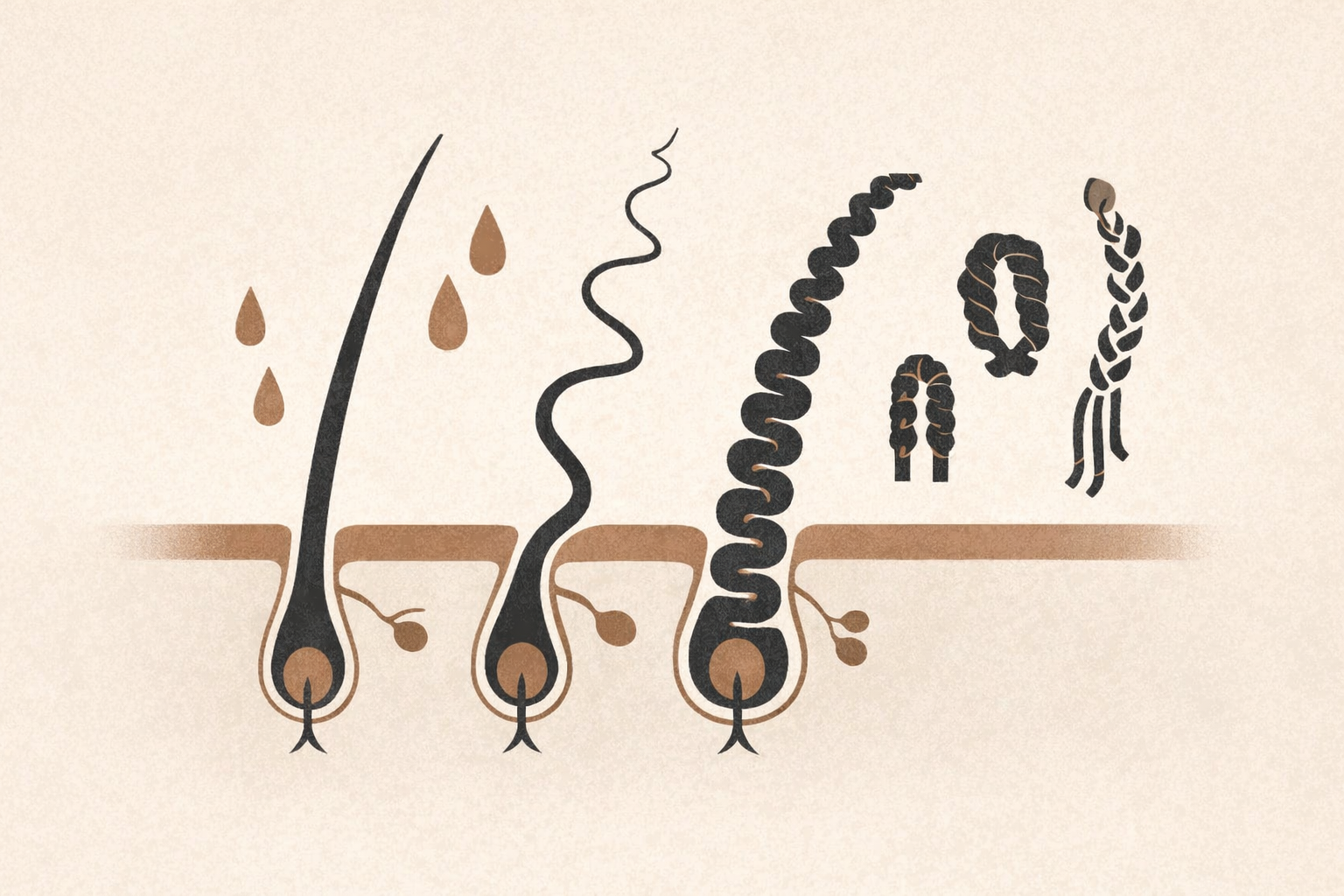
Natural hair science explains what many people learn through trial and error. Hair texture is not random. It reflects follicle shape, strand geometry, and how easily moisture moves from scalp to ends. When the biology is clear, the maintenance stops feeling mysterious.
This is not about chasing one “right” look. It is about learning how hair works so routines match reality. That is how breakage drops, moisture improves, and length retention becomes more predictable.
Natural Hair Science Begins With Follicle Shape
Hair is composed primarily of keratin, a fibrous protein that forms the structure of each strand. The follicle under the scalp shapes the strand as it grows. Round follicles tend to produce straighter hair. Oval follicles often produce wavier hair. More curved follicles tend to produce tightly coiled hair.
That geometry matters because coils create bends. Those bends can increase fragility and make strands more prone to tangling. As a result, tightly coiled textures often benefit from routines that reduce friction and prevent dryness.
Moisture Works Differently in Coiled Textures
Scalp oils help condition hair naturally. However, oils travel more easily down straight strands than down tight coils. In coiled textures, oil movement slows because each bend creates resistance. Therefore, moisture retention becomes a priority.
Practical moisture support usually comes from three actions:
- Hydration: adding water-based moisture regularly, not occasionally.
- Sealing: using oils or butters to slow moisture loss after hydration.
- Low-friction handling: minimizing rough detangling, harsh brushing, and repeated manipulation.
When these actions work together, strands hold moisture longer. Consequently, breakage tends to decrease and styles last longer.
Understanding Hair Types: 4A, 4B, 4C and the Curl Pattern System
Natural hair science often uses the 1A–4C curl classification system developed by stylist Andre Walker. The system groups hair textures by curl pattern using numbers and letters. Type 1 represents straight hair, Type 2 describes wavy hair, Type 3 refers to curly hair, and Type 4 describes tightly coiled or kinky hair.
Within each category, letters A through C describe how tight the curl pattern becomes. While this system does not capture every detail of hair structure, it provides a common language people use when discussing texture and care routines.
- Type 1: Straight hair with no visible curl pattern.
- Type 2: Wavy hair that forms loose S-shaped bends.
- Type 3: Curly hair with defined ringlets or spirals.
- Type 4: Coily or tightly curled hair with dense bends and shrinkage.
Breaking Down Type 4 Hair
Many natural hair discussions focus on Type 4 textures because they require different moisture and handling strategies. These textures often experience higher shrinkage and increased fragility due to the number of bends along each strand.
- 4A Hair: Defined small coils with a visible curl pattern. The strands often form springy spirals and can retain moisture more easily than tighter textures.
- 4B Hair: A zigzag curl pattern with less visible ringlet definition. The strand bends sharply, which can increase dryness and shrinkage.
- 4C Hair: Very tight coils with minimal visible curl pattern. This texture often experiences the highest shrinkage and benefits from consistent hydration and low-manipulation styling.
Hair type alone does not determine the best routine. Strand thickness, hair density, and porosity also influence how hair behaves. Two people with the same curl pattern can still require very different products and styling approaches.
Understanding these differences is part of natural hair science. When people learn how their hair pattern interacts with moisture, friction, and styling tension, they can build routines that support healthier growth over time.
Protective Styling Is a Strategy, Not a Shortcut
Protective styles such as braids, twists, and locs can reduce daily mechanical stress. They help because hair experiences fewer cycles of pulling, rubbing, and re-styling. For many people, that reduction supports length retention.
Still, protective styling works best when the foundation is healthy. If a style is too tight, installed on dry hair, or left in too long without care, it can increase shedding or traction stress. So the real goal is protection plus maintenance.
Natural Hair Science and Scalp Health
Hair growth starts at the scalp, so scalp health affects outcomes. Product buildup can block moisture. Irritation can increase shedding. Inflammation can disrupt the growth cycle. For that reason, routines often improve when they include gentle cleansing, consistent hydration, and breathable styling choices.
This is also where simplicity can win. A routine does not need twenty steps. It needs repeatable steps that match the person’s texture, lifestyle, and tolerance for time.
Education Changed the Natural Hair Learning Curve
For years, reliable guidance for coiled textures was hard to find. Digital platforms changed that fast. Tutorials, shared routines, ingredient breakdowns, and technique demos created a knowledge network. As a result, more people can build routines based on evidence and experience rather than guesswork.
That shared knowledge also built confidence. When people understand what their hair needs, they stop treating texture like a problem and start treating it like a design parameter.
The Politics of Black Hair: History, Identity, and Power
Hair Discrimination in the Workplace: The CROWN Act Explained
The Economics of the Black Hair Industry
Hair Types Explained: The 1A–4C Curl Pattern Guide
Natural hair science makes one thing plain. Texture is not a flaw. Texture is a structure. When routines respect structure, hair health becomes easier to maintain and easier to repeat.