

Hair typing is useful when it helps you see the hair more clearly. It becomes a problem when the label starts replacing observation.
Hair types explained well should make hair care easier to understand. They should not turn texture into a ranking system, a diagnosis, or a product prescription.
The familiar 1A–4C language gives people a practical way to describe visible curl pattern, moving broadly from straight hair through waves, curls, and tightly coiled hair. That shorthand is useful because it creates common language. However, it becomes unreliable when the label is asked to explain everything else about the hair.
Curl pattern does not tell you your scalp condition. It does not fully describe strand thickness, density, damage, chemical history, breakage risk, styling tension, or how a particular product will behave. Two people who both describe their hair as 4C can need substantially different routines.
The label is orientation. The hair itself is the evidence.
A useful health classification should guide observation without replacing it.
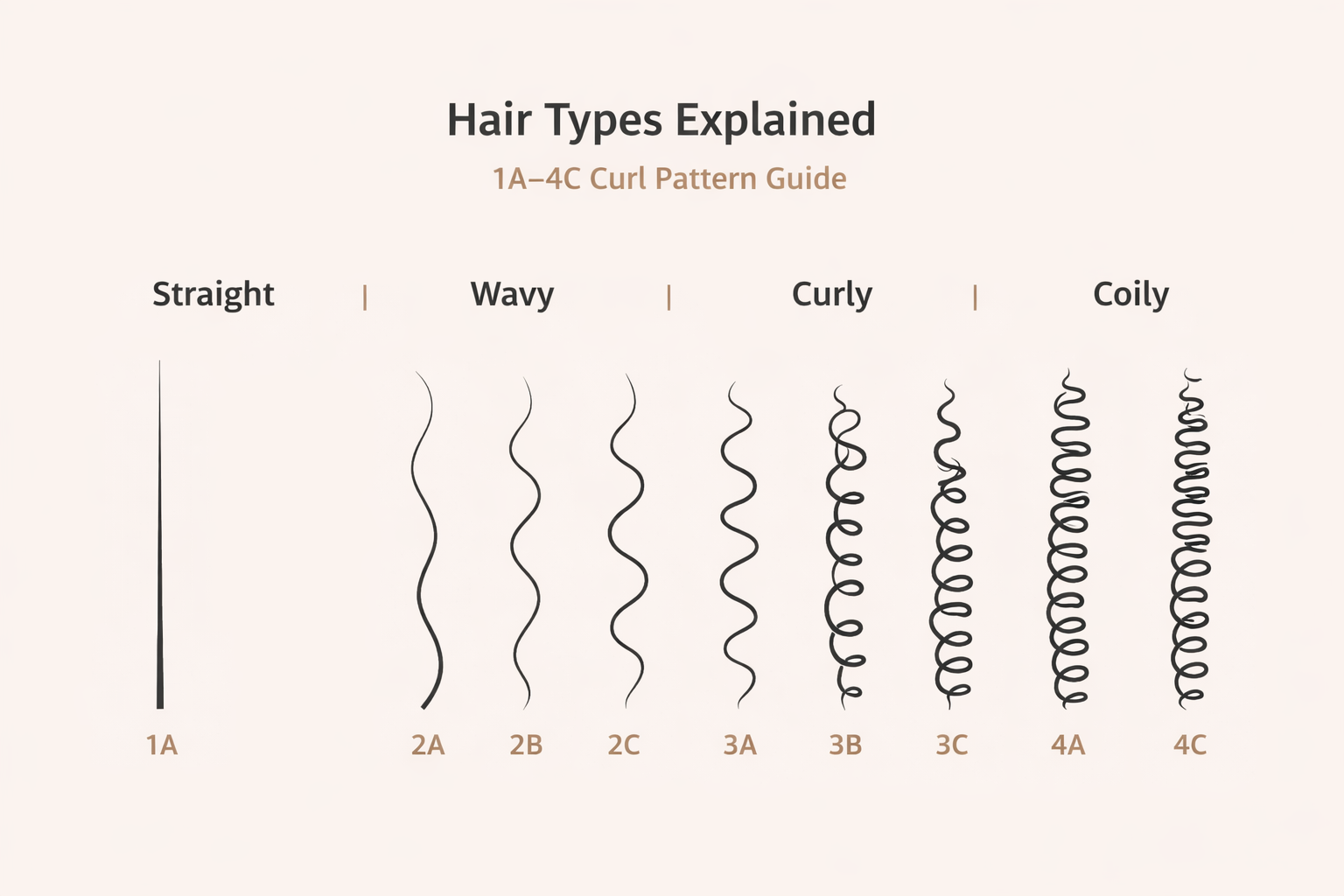
What are the hair types from 1A to 4C? Type 1 describes straight hair. Type 2 describes wavy hair. Type 3 describes curly hair. Type 4 describes tightly curled or coiled hair. The A, B, and C labels provide additional visual shorthand within those broad groups.
The system describes curl pattern. It does not independently determine hair health, porosity, density, strand thickness, scalp condition, damage, or the exact routine a person should use.
What Do Hair Types 1A–4C Actually Mean?
The widely used 1A–4C shorthand grew from the André Walker Hair Typing System and later expanded through common hair-care usage. Its main job is visual classification. Type 1 represents straight hair, Type 2 wavy hair, Type 3 curly hair, and Type 4 tightly curled or coiled hair. Letters help describe visible variation inside those broader categories.
That is much less information than people sometimes assume.
Researchers examining hair morphology can measure characteristics such as curvature, torsion, diameter, cross-sectional shape, and mechanical behavior with far more precision than a visual A, B, or C label provides. Dermatology literature likewise treats curl-pattern classifications as useful descriptive tools rather than complete clinical systems.
That does not make hair typing useless. It gives the tool a boundary.
A map is useful because it simplifies territory. Problems begin when the map is mistaken for the territory itself.
Your hair type describes a visible pattern. Your routine should respond to the actual condition of the hair and scalp.
Hair Types Explained: The 1A–4C Guide
Treat these categories as reference points rather than rigid biological boxes. Individual strands can vary across the same scalp. In addition, styling, heat, chemical processing, length, humidity, damage, and product buildup can change how a pattern appears.
| Type | Common Description | What the Label Can Tell You | What It Cannot Tell You |
|---|---|---|---|
| 1A–1C | Straight | Little to increasing visible bend or body | Oil production, strand strength, damage, or ideal wash frequency |
| 2A–2C | Wavy | Loose to stronger S-shaped wave patterns | Density, porosity, scalp condition, or product tolerance |
| 3A–3C | Curly | Loose to tighter visible curls and spirals | Breakage level, damage history, or exact conditioning needs |
| 4A–4C | Coily / tightly curled | Small coils, tight bends, and varying visible definition | Health, manageability, professionalism, strength, or capacity for length |
Type 1 Hair: Straight
Type 1 hair grows with little visible wave or curl. The common typing system separates it into 1A, 1B, and 1C according to differences in visible body, bend, and texture presentation. Straight hair can range from fine and delicate to thicker strands with more resistance to styling.
Straight does not automatically mean oily, strong, low-maintenance, or resistant to damage. Scalp oil production, heat use, coloring, brushing, washing frequency, strand diameter, and environmental exposure still matter.
1A
Usually describes very straight hair with minimal visible bend. Fine strands are often associated with the label, but curl type should not be used as a substitute for measuring or observing strand thickness.
1B
Generally describes straight hair with somewhat more body or movement. It may behave differently from very fine 1A hair when styled, but the label still does not predict the complete care routine.
1C
Commonly describes straight hair with stronger body or slight visible bending. Some sections may approach a loose wave without consistently forming the S-pattern associated with Type 2 hair.
Type 2 Hair: Wavy
Type 2 hair forms visible waves rather than consistent complete spirals. The pattern may be subtle in some areas and much stronger in others. Wavy hair is also easy to misread when heavy products, brushing, heat styling, or environmental conditions stretch or flatten the natural pattern.
2A
Usually describes a loose, gentle wave. The bend may become more visible through the mid-lengths and ends while the root area remains relatively straight.
2B
Often describes a more visible S-shaped wave. Definition can be stronger, and product weight may noticeably change how the pattern sits.
2C
Generally describes stronger waves that may approach loose curls in some sections. Frizz, tangling, density, and product response can still vary substantially between people.
Type 3 Hair: Curly
Type 3 hair forms recognizable curls or spirals. Curl diameter can range from broad loops to tighter corkscrews. Because repeated bends can affect how strands interact with one another, conditioning, gentle detangling, and friction management become particularly relevant.
The American Academy of Dermatology notes that curly hair can be prone to dryness and breakage. It recommends approaches that include conditioning, careful detangling, moisturizing, and reducing friction.
3A
Usually describes larger, looser curls. The pattern may form broad spirals that stretch more visibly with length or certain styling methods.
3B
Generally describes tighter and more numerous curls. Tangling and shrinkage may become more noticeable, although neither can be predicted accurately from the label alone.
3C
Commonly describes tight corkscrew curls. Hair in this range can share some handling considerations with more tightly coiled patterns, particularly around detangling, conditioning, and mechanical stress.
Type 4 Hair: Coily and Tightly Curled
Type 4 hair contains very tight bends, coils, or zigzag patterns. The visible pattern may be small and compact, and shrinkage can make the hair appear considerably shorter than its stretched length. The category contains enormous variation. Therefore, treating all Type 4 hair as if it behaves the same way is a poor care strategy.
Tightly coiled hair can be particularly vulnerable to dryness and mechanical breakage. As a result, conditioning, gentle detangling, friction management, careful heat use, and avoiding excessive styling tension deserve attention.
4A
Often describes small but relatively visible coils. Individual sections may form defined loops, particularly when wet or styled.
4B
Usually describes tighter bends that can appear less circular and more angular or zigzagged. Shrinkage can be substantial, while visible definition changes with technique, moisture, length, and product use.
4C
Commonly describes very tight coil patterns with substantial shrinkage and less obvious visible definition in an unstretched state.
That description needs a hard boundary.
4C is not a diagnosis of dryness.
It is not a measure of damage.
It is not evidence that the hair is unmanageable.
It is not a statement about attractiveness, professionalism, strength, or the ability to retain length.
4C Hair Is Not the Bottom of a Ranking
The numerical order of the typing system can quietly create a bad mental model. People begin treating the sequence as if hair progresses from easy to difficult, polished to unruly, or desirable to undesirable as the number rises.
That is not hair science. It is cultural judgment attached to a visual classification.
Type 4 hair is not an unfinished version of straighter hair. Tight coils are not evidence that the hair needs to be corrected, softened into another pattern, or forced into visible definition before it can be considered healthy.
This distinction matters because texture language carries history. Hair has been tied to identity, race, professionalism, gender expectations, beauty standards, and discrimination. A classification can begin as description and become hierarchy when people attach social value to its categories.
Groundwork Daily examines that larger history in The Politics of Black Hair: History, Identity, and Power .
Describe the pattern without assigning the pattern a value.
Curl Pattern Is Only One Part of Understanding Your Hair
This is where most hair-typing guides stop too early.
Knowing that hair looks like 3C or 4C may help describe its visible pattern. A useful routine, however, can depend just as much on strand thickness, density, scalp condition, damage history, styling load, chemical processing, and how the fiber actually behaves during cleansing and handling.
Curl type gives you one coordinate.
Hair care requires the rest of the map.
Strand Thickness
Individual hair fibers can be relatively fine, medium, or thick in diameter. This is different from curl type. A person can have fine 4C hair or thick Type 2 hair. Treating “coily” and “coarse” as interchangeable is inaccurate.
Strand thickness can influence how easily the hair tolerates tension, heat, brushing, and product weight. A head of hair can look very full while its individual strands remain fine and vulnerable to rough handling.
Density
Density refers broadly to how much hair is present across the scalp. High-density hair can look extremely full even when individual strands are fine. Lower-density hair may reveal more scalp even when individual strands are thick.
Density affects section size, styling strategy, drying time, product quantity, and how easily the scalp can be reached during cleansing. It is another reason identical curl labels do not produce identical routines.
Porosity and Hair Condition
Porosity is commonly used in hair care to describe how readily hair takes up and loses water. In practical terms, the condition of the cuticle and previous chemical, thermal, or mechanical damage can influence how the fiber behaves around water and products.
The mistake is turning porosity into another internet personality test.
A single strand floating in a glass of water does not provide a complete scientific assessment of your hair. Product residue, surface tension, and other variables can affect what you see.
Observe behavior instead. Does the hair wet readily? Has chemical processing changed its feel? Does conditioning improve flexibility and manageability? Does the hair remain rough despite changes in routine?
Use behavior as data.
Scalp Condition
Healthy hair care includes the scalp.
Persistent itching, inflammation, scaling, pain, sores, sudden thinning, or changing density should not be assigned to a curl type. A classification of the hair fiber cannot diagnose a scalp disorder or hair-loss condition.
This is where discernment matters. Useful classification helps you organize information. Discernment tells you when the available explanation is no longer sufficient.
Can You Have More Than One Hair Type?
Yes. One head does not always equal one visible curl pattern.
The crown may coil more tightly than the sides. The front can appear looser. One section may resemble 3C while another sits closer to 4A or 4B. Previous heat or chemical damage can also alter selected areas and make the pattern less uniform.
That is not a classification failure.
It is ordinary variation.
The useful response is not forcing every section into one label. Instead, notice where the hair behaves differently and adjust handling where necessary.
Your routine does not need a perfectly uniform answer.
Hair Typing Should Not Become Race Typing
Hair texture and racial identity intersect historically and culturally, but they should not be treated as interchangeable biological categories.
People within the same racial or ethnic group can have substantially different curl patterns, strand characteristics, densities, and hair-care needs. Similar curl patterns can also appear across different populations.
Hair research can describe measurable fiber characteristics more precisely than broad assumptions about racial categories. That approach is more useful for care because the hair itself provides better information than stereotypes about the person attached to it.
Describe hair.
Do not turn texture into ancestry science.
Build Hair Care Around Need, Not the Letter
This is the governing practical principle of the guide.
Curl type can start the conversation. The routine should be built around what actually happens to the hair and scalp.
Clean the Scalp and Hair Appropriately
There is no universal wash schedule for every hair type. Cleansing frequency depends on scalp oil, sweat, product buildup, styling practices, dandruff or other scalp conditions, hair characteristics, and personal needs.
Curly and tightly coiled hair may not need the same cleansing frequency as an oily straight-hair routine. However, that does not mean avoiding cleansing indefinitely is a healthy strategy.
Watch the scalp.
Watch buildup.
Adjust from evidence.
Condition According to Dryness and Handling Needs
Conditioning is particularly useful for hair that becomes dry, tangles easily, or experiences mechanical stress during detangling. Improved slip and manageability can reduce the force required to separate strands.
That does not mean every Type 4 head needs the heaviest formulation available. Fine strands can become weighed down, scalps differ, and product tolerance varies.
The hair gets the final vote.
Detangle With Less Mechanical Stress
Curly and coily hair can tangle readily, and aggressive detangling creates unnecessary breakage risk. Dermatology guidance favors gentler approaches, including conditioning and careful use of fingers, wide-tooth combs, or other appropriate tools.
Technique matters more than proving the hair can tolerate force.
Reduce Unnecessary Friction
Repeated friction can contribute to tangling, frizz, and breakage. Loose nighttime styles and smoother fabric surfaces can help reduce unnecessary rubbing for some curly and coily hair.
The principle is not to create a complicated nighttime ritual. It is to stop adding preventable mechanical stress where a simpler environment can remove it.
Respect Styling Tension
Protective styling is not automatically protective.
Braids, cornrows, extensions, ponytails, loc styling, wigs, and other styles can become damaging when they repeatedly create excessive traction. Dermatologists warn that repeated pulling can contribute to traction alopecia and, in advanced cases, permanent hair loss.
A style hurting because it is pulling is not proof that the installation is correct.
Pain is information.
Use Heat Deliberately
Heat styling is a legitimate styling choice. The structural question is whether temperature, frequency, and technique are creating more damage than the fiber can tolerate.
Use the lowest effective temperature for the intended result, use appropriate heat protection, and reduce repeated thermal stress when the hair is already showing signs of damage.
Another product cannot always compensate for another insult.
Healthy Hair Does Not Mean Maximum Curl Definition
A highly defined wash-and-go is a styling result.
It is not a clinical definition of healthy hair.
Healthy hair can appear fluffy. It can contain frizz. One section can form obvious spirals while another does not. Type 4 hair does not need to be manipulated until every strand displays a visible coil in order to prove that it is properly maintained.
Stretched hair is not automatically damaged.
Straightened hair is not automatically unhealthy.
Natural hair is not automatically healthy simply because it has not been chemically relaxed.
Condition matters more than ideology.
What Hair Type Cannot Tell You
A curl label cannot tell you why your hair is suddenly thinning. It cannot diagnose alopecia. It cannot explain persistent scalp inflammation. It cannot tell you whether a medication, nutritional issue, hormonal change, illness, styling tension, or another condition is contributing to unexpected hair loss.
It also cannot guarantee that a product marketed “for 4C hair” will work for you.
This is where classification has to stop pretending to be diagnosis.
The better question is not simply, “What type am I?”
Ask what the label explains.
Then ask what it does not.
Curl type can narrow the starting options. The hair and scalp still get the final vote. Build the routine from observed need, not from what somebody with the same letter combination does online.
The Hair Type and Care Audit
Identification becomes useful when it improves decisions. Use this audit to build a clearer picture of the system you are actually caring for rather than hunting for a perfect letter.
Hair Type and Care Audit
1. Curl pattern:
When the hair is clean and relatively free of heavy styling products, is the natural pattern primarily straight, wavy, curly, tightly curled, or mixed?
2. Variation:
Which areas are looser or tighter? Does one section consistently behave differently from another?
3. Strand thickness:
Do individual strands feel relatively fine, medium, or thick? Are they breaking easily during ordinary handling?
4. Density:
Does the hair appear dense across the scalp, or are there areas where density seems meaningfully lower?
5. Dryness and condition:
Does the hair feel persistently rough or brittle? Does conditioning significantly improve flexibility and manageability?
6. Detangling:
Where does breakage happen during manipulation? Is the current method creating more force than necessary?
7. Scalp:
Is the scalp comfortable, or are itching, scaling, inflammation, tenderness, sores, or recurring buildup present?
8. Styling load:
How much heat, tension, chemical processing, extension weight, brushing, combing, or repeated manipulation is the hair carrying?
9. Change:
Has texture, density, shedding, breakage, or scalp condition changed meaningfully over time?
10. Simplify:
What unnecessary source of dryness, friction, tension, or manipulation can be removed before another product is added?
When Hair Changes Need More Than a New Routine
Hair-care content has a limit.
New or progressive thinning, bald patches, significant unexplained shedding, scalp pain, persistent itching, inflammation, sores, or a meaningful unexplained change in texture or density deserve more than another product experiment.
A board-certified dermatologist can assess whether a hair or scalp condition is present and whether additional evaluation is appropriate. Earlier assessment can matter because some forms of hair loss become harder to reverse after long-term follicle damage or scarring.
Do not spend months rotating oils while a medical problem progresses underneath the routine.
Health governance includes knowing when home maintenance has reached its boundary.
The Groundwork
Hair types explained correctly should reduce confusion.
Type 1 is straight. Type 2 is wavy. Type 3 is curly. Type 4 is tightly curled or coiled. The letters provide additional visual shorthand.
Useful.
Not complete.
Your care plan also has to account for strand thickness, density, scalp condition, dryness, damage history, styling practices, tension, friction, and how the hair responds over time.
Stop asking a curl chart to solve every hair question.
Use it to orient yourself.
Then observe.
Clean appropriately.
Condition according to need.
Reduce unnecessary friction.
Respect tension.
Use heat deliberately.
Pay attention when something changes.
And never confuse tighter texture with lesser hair.
The label describes the pattern.
The routine should serve the hair.
Move from curl classification to hair structure.
Hair type is only the visible beginning. The next guide moves deeper into texture, fiber behavior, condition, moisture, and maintenance.
Read Understanding Natural Hair: Texture, Science, and Maintenance →
→ The Politics of Black Hair: History, Identity, and Power
→ Hair Discrimination in the Workplace: The CROWN Act Explained
The Principle and Condition Beneath This Work
This guide uses classification as structure while keeping judgment with the person observing the actual hair and scalp.
Structure Builds Freedom
A useful classification reduces confusion and creates a starting structure without trapping the person inside the label.
Discernment
Hair care improves when curl pattern, strand behavior, scalp condition, damage history, and changing evidence are given the weight they actually deserve.
See the full Groundwork Daily Core Principles and Conditions architecture.
Continue with Health as Discipline by Malik Rivers

This article provides general educational information about hair classification and hair-care principles. The 1A–4C system is a descriptive curl-pattern framework, not a medical diagnostic system. Persistent hair loss, scalp pain, inflammation, sores, significant shedding, or major unexplained changes in density or texture should be evaluated by an appropriate qualified healthcare professional.