
Sidewalks are usually treated as background. That is the mistake.
A sidewalk is not just a strip of concrete beside a road. It is pedestrian infrastructure. It decides how people move, where they stop, what businesses they pass, which routes feel safe, and how connected a neighborhood becomes. In a serious city, sidewalks are not decorative. They are economic infrastructure.
As part of Urban Logic, this article studies sidewalks as one of the basic systems people experience every day but rarely examine. They sit underfoot, quiet and familiar, while shaping commerce, safety, access, public health, wayfinding, and neighborhood trust.
When sidewalks are strong, people move with confidence. When they are broken, missing, narrow, blocked, confusing, or unsafe, the neighborhood pays. That cost shows up in fewer customers, fewer casual encounters, weaker accessibility, less street activity, and more dependence on cars for basic life.
Therefore, sidewalks matter because they connect more than buildings.
They connect opportunity.
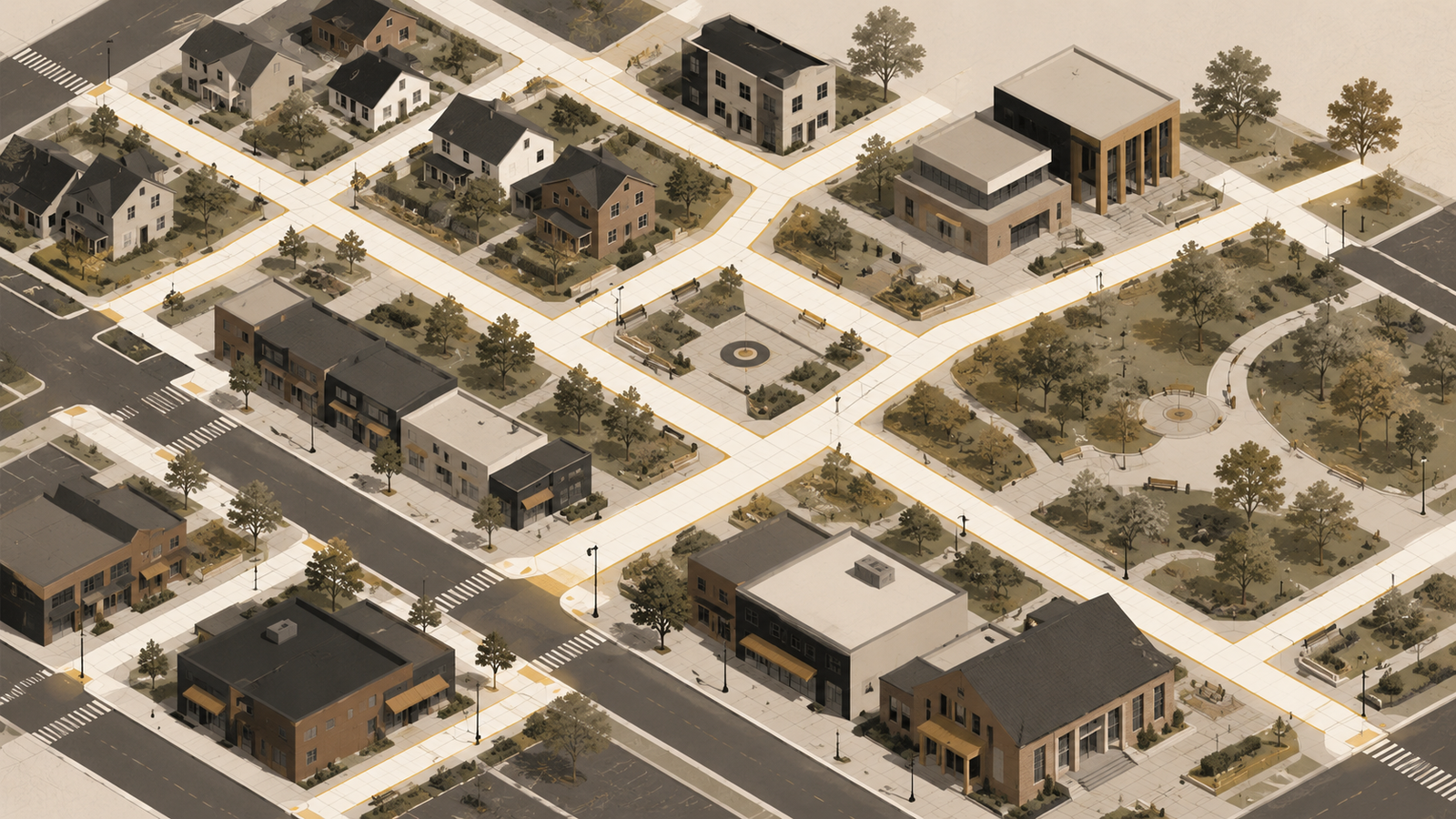
Sidewalks Do More Than Move People
Most people describe sidewalks as transportation space. That is true, but incomplete.
Sidewalks move people. However, they also slow people down in useful ways. They create room to notice a storefront, greet a neighbor, read a flyer, enter a library, stop at a bench, or let a child walk beside an adult without fear. In other words, they turn streets from corridors into places.
That distinction matters.
A road is designed mainly for movement. A sidewalk supports movement and presence. It allows people to travel through a neighborhood while also participating in it.
Without sidewalks, walking becomes stressful. People must negotiate traffic, uneven ground, missing curb cuts, parked cars, poor lighting, unsafe crossings, and unclear routes. As a result, the simple act of moving through a neighborhood becomes a calculation.
Good pedestrian infrastructure reduces that calculation. It makes ordinary movement easier. It gives people more confidence to walk to stores, schools, parks, bus stops, clinics, public buildings, and one another.
This is why sidewalks belong in the same conversation as crosswalks, bus stops, street trees, lighting, public benches, and wayfinding. Each one shapes whether the public realm feels usable or hostile.
Walk one familiar block. Notice whether the sidewalk invites movement, waiting, stopping, or only passing through. Then ask who can use it comfortably and who has to compensate.
Walkable Communities Spend Differently
Walkable communities create different economic behavior.
When people walk, they see more. They notice small businesses. They pass storefronts repeatedly. They make small purchases. They return without needing to plan a major trip. A bakery, bookstore, corner store, pharmacy, café, barbershop, or neighborhood market benefits from that steady presence.
Cars can bring customers, but they also move people past businesses quickly. Walking creates a different relationship. It turns commerce into routine. It makes local spending easier because the business is already inside the path of daily life.
This is why sidewalks are economic infrastructure. They support the circulation of money at the neighborhood level.
A strong sidewalk network can help small businesses survive by increasing visibility and access. By contrast, a weak sidewalk network can isolate those same businesses, even when they are only a few blocks away. Distance is not only measured in miles. It is measured in friction.
If people do not feel safe walking, they are less likely to browse. If crossings are hostile, they are less likely to cross. If sidewalks are broken or blocked, they are less likely to bring children, elders, strollers, wheelchairs, carts, or mobility devices.
Wayfinding adds another layer. A commercial corridor works better when people can understand where shops, transit stops, public squares, parking areas, crosswalks, and civic buildings sit in relation to one another. A sidewalk does more economic work when the route explains itself.
Every barrier reduces participation.
Commerce depends on access. Sidewalks create access at human speed.
Pedestrian Infrastructure Shapes Public Safety
Pedestrian infrastructure affects how safe a street feels and how safe it actually becomes.
A sidewalk with lighting, clear crossings, visible storefronts, benches, trees, useful signs, and steady foot traffic creates a different environment from a sidewalk that is dark, narrow, empty, cracked, confusing, or interrupted. People read those signals quickly. The body often understands the street before the mind has language for it.
Safety is not only about policing or enforcement. It is also about design.
When sidewalks support regular public presence, streets become more observed. Neighbors see one another. Store owners notice patterns. Children become familiar. Elders become visible. Public life produces informal awareness.
That awareness does not solve every problem. Still, it matters. A street with active sidewalks is harder to ignore. It carries more witnesses, more routine, and more shared ownership.
Meanwhile, streets without usable sidewalks often become emptier. Empty space can feel abandoned even when people live nearby. When people cannot comfortably occupy the public edge of a neighborhood, the street loses one of its stabilizing forces.
Good sidewalks do not guarantee safety. However, poor sidewalks almost always weaken it.
Accessibility Is Not a Side Issue
Sidewalk quality determines who gets to participate.
A broken sidewalk may be inconvenient for one person and impossible for another. A missing curb cut can block a wheelchair user. A narrow path can make walking difficult for someone with a cane. A sidewalk blocked by trash bins, scooters, poles, snow, or construction can force people into the street.
Parents with strollers feel this. Delivery workers feel this. Older adults feel this. People with temporary injuries feel this. Children feel this. Anyone carrying bags, pushing carts, or moving slowly feels this.
Accessibility is often treated like a compliance category. That framing is too small.
Accessibility is economic participation. It determines who can reach stores, services, jobs, transit, schools, and public space without unnecessary risk.
Wayfinding is also accessibility. As explored in Wayfinding Is Public Infrastructure, people need clear signs, visible entrances, reliable maps, route cues, and landmarks to understand where they are and where they can go next. A sidewalk that exists but leaves people guessing still creates friction.
When sidewalks are accessible, more people can move independently. That independence has value. It supports dignity, commerce, health, and community life.
When sidewalks fail, the city silently tells some residents that movement will cost them more. More time. More effort. More planning. More dependence on others. More exposure to danger.
That is not a small design problem.
It is a structural failure.
Sidewalks Support Aging in Place
Aging in place is not only about housing. It is also about the street outside the housing.
Older adults may want to remain in their neighborhoods, but that choice depends on more than rent, ownership, or family support. It also depends on whether they can walk safely to groceries, pharmacies, parks, clinics, transit stops, places of worship, and social spaces.
A usable sidewalk can extend independence. A dangerous sidewalk can shorten it.
This is where infrastructure becomes intimate. A cracked walkway may look minor from a planning desk. For an older resident, it can decide whether they leave the house that day. A missing bench may seem insignificant. For someone who needs to rest between destinations, it changes the route entirely.
That is why public benches matter within the sidewalk system. They are not decorative furniture. They are rest points that help people remain part of neighborhood life.
Clear wayfinding strengthens that independence. Older residents should not have to guess where the nearest safe crossing, transit stop, public entrance, restroom, or resting point sits. A legible sidewalk network protects confidence as much as movement.
Walkable communities allow people to age with more connection. They reduce isolation by making ordinary outings possible. They also help neighbors remain visible to one another.
That visibility matters. When older adults are regularly seen in public life, they are harder to forget. A neighborhood that supports walking supports continuity between generations.
Sidewalks Help Children Learn Independence
Children learn the city through movement.
A safe sidewalk teaches a child that the neighborhood is something they can understand. They learn corners, crossings, stores, trees, houses, bus stops, public signs, and familiar faces. Over time, the map becomes part of their confidence.
That kind of independence does not appear all at once. It develops through repeated, low-risk exposure. A child walking with an adult may later walk with siblings, then friends, then alone. Each stage depends on the design of the street.
When sidewalks are unsafe or missing, children lose that gradual training. Their world becomes more dependent on adult transportation. The neighborhood becomes something they are driven through instead of something they learn by moving through it.
That shift has consequences. It affects confidence, health, social connection, and family logistics. It also changes how children understand public life.
A city that wants capable young people should care about sidewalks.
Independence begins with safe routes.
Sidewalks Make Transit Work Better
Transit does not begin at the station. It begins at the front door.
A bus stop is less useful if people cannot reach it safely. A train station is less effective if the surrounding sidewalks are broken, poorly lit, confusing, or hostile to pedestrians. Public transportation depends on pedestrian infrastructure because almost every transit trip includes walking.
This is the missing link in many conversations about mobility.
Cities may invest in buses, trains, schedules, and stations. Yet if the walking environment around those systems is weak, the rider still pays. They pay through stress, delay, exposure, and risk.
Sidewalks extend the reach of transit. They make stops more usable. They help people complete the first and last parts of a trip. They also support people who do not own cars or cannot rely on them.
Wayfinding also makes transit work better. Riders need to find the stop, understand which direction the bus travels, locate the nearest crossing, and continue after they exit. A sidewalk that connects to transit but fails to communicate the route leaves riders doing extra work.
This is also why long commutes carry hidden costs. Distance becomes harder when the walking pieces of the trip are weak. A bus route may exist on paper, but the full trip fails if the sidewalk, crossing, lighting, shelter, or wayfinding fails.
In this sense, sidewalks multiply the value of other infrastructure. They are not separate from transportation systems.
They are part of the system.
Sidewalks Create Neighborhood Memory
Neighborhoods are remembered through repeated movement.
People remember the corner where they meet a friend. They remember the bench where an elder sits. They remember the storefront that changed hands. They remember the tree that marks a familiar block. They remember the route to school, the walk to church, and the path to the park.
Sidewalks hold those patterns.
People do not only travel on sidewalks. They build a relationship with place through them. That relationship creates belonging.
Without walkable routes, neighborhoods become less legible. People may know their home and destination, but not the connective tissue between them. They may live near others without developing local familiarity.
This is where third places and sidewalks meet. Gathering spaces matter, but people still need everyday routes that connect them. A library, park, barbershop, café, stoop, or public square becomes more powerful when sidewalks make returning easy.
Wayfinding helps turn that repetition into clarity. Signs, landmarks, street names, lighting, and visible entrances help residents and visitors build a mental map of the neighborhood. A place becomes easier to trust when it becomes easier to read.
Urban Logic pays attention to this because a city is not only infrastructure in the technical sense. It is also infrastructure in the emotional and social sense.
The built environment shapes what people notice, repeat, remember, and trust.
Broken Sidewalks Create Hidden Costs
Bad sidewalks create costs that rarely show up in one clean line item.
A fall can become a medical bill. A blocked route can become a late arrival. A missing curb cut can create dependence on someone else. A dangerous crossing can become a decision not to walk. A poorly maintained corridor can reduce foot traffic for nearby businesses.
These costs are scattered, so they are easy to ignore.
Residents carry some. Businesses carry some. Families carry some. Public agencies carry some. Health systems carry some. Over time, the neighborhood absorbs the total cost through reduced movement, reduced confidence, reduced commerce, and reduced connection.
Unclear navigation adds another hidden cost. People lose time finding entrances, stops, crossings, parking areas, public facilities, and safe routes. That extra attention may seem minor, but daily confusion compounds just like broken pavement.
That is the danger of weak infrastructure. It does not always fail dramatically. Sometimes it just makes daily life heavier.
A strong city tracks that heaviness. It asks where friction keeps appearing. It asks who pays when sidewalks are ignored. It asks how small maintenance failures become large quality-of-life problems.
Neglect compounds.
Maintenance also compounds.
Sidewalks Are Part of Public Health
Walking is one of the most basic forms of daily movement. Sidewalks either support it or suppress it.
When walking feels safe and useful, people are more likely to include movement in ordinary life. They walk to errands, transit, school, parks, or local businesses. Physical activity becomes built into the day instead of treated as a separate task.
That matters because not everyone has time, money, or access for formal exercise. A neighborhood that supports walking gives residents a practical health tool.
Sidewalks also affect mental load. A pleasant walk can reduce stress. A dangerous walk can increase it. Noise, poor crossings, lack of shade, bad lighting, unclear routes, and broken pavement all change how the body experiences the path.
Public health is not only hospitals and clinics. It is also the design of everyday movement.
Street trees make this point stronger. As explored in Street Trees Are Public Infrastructure, shade changes whether sidewalks remain usable in heat. Meanwhile, street lighting extends the useful life of pedestrian routes after sunset.
A city that wants healthier residents should not only tell people to move more.
It should build places where movement is safe, useful, clear, and normal.
Sidewalks Support Local Democracy
Public life needs places where people can see one another.
Sidewalks are one of the simplest spaces where that happens. They allow casual contact across age, class, work schedule, and background. People do not need a formal meeting to share a neighborhood. They need routes where everyday visibility can happen.
This matters for civic life.
People are more likely to care about places they experience directly. A sidewalk lets residents notice what is changing. A closed store. A broken light. A missing tree. A new development. A recurring hazard. A neglected corner.
That awareness can become action. It can lead to a call, a meeting, a repair request, a conversation, a shared concern, or a local campaign. Civic participation often begins with noticing.
If people only move through a neighborhood by car, they may miss the details that create civic attention. Sidewalks slow the city down enough for residents to see it.
Wayfinding supports this civic attention because it helps people understand the public realm. A resident who can read routes, landmarks, public buildings, and civic spaces can participate with more confidence.
Democracy is not only practiced in voting booths.
It is also practiced in the shared spaces where people learn what needs care.
Walkability Is Not a Luxury
Walkability is often marketed as a premium feature. That framing is backwards.
Walkable communities should not be treated as boutique urbanism for people who can afford special neighborhoods. Walkability is basic infrastructure. It should belong to working neighborhoods, aging neighborhoods, dense neighborhoods, suburban corridors, small towns, and commercial districts.
When walkability becomes a luxury, opportunity narrows.
The people who benefit most from safe pedestrian infrastructure are often the people with the least margin. Workers without cars. Students. Older adults. Disabled residents. Families managing tight schedules. People using transit. Small business owners depending on local foot traffic.
Sidewalks are not amenities for aesthetics.
They are tools for participation.
A city that treats them as optional is admitting that some residents will be expected to absorb more friction than others.
Designing Sidewalks as Infrastructure
Better sidewalks require more than pouring concrete.
A serious sidewalk system considers width, surface quality, curb cuts, shade, lighting, drainage, crossings, signage, seating, snow clearance, maintenance schedules, and protection from traffic. It also considers where people actually need to go.
A beautiful sidewalk that connects nothing is weak infrastructure.
A useful sidewalk connects homes to daily needs. It reaches transit. It supports business corridors. It protects school routes. It links parks and public spaces. It gives people safe ways to cross streets. It invites use across ages and abilities.
Design also has to account for conflict. Sidewalks are asked to hold many uses. Walking, waiting, vending, dining, deliveries, trees, utilities, trash, bikes, scooters, signage, and accessibility can all compete for space.
If cities do not manage that competition, the pedestrian loses.
That is why sidewalks need governance as much as design. Clear rules, consistent maintenance, accurate wayfinding, and thoughtful allocation of space matter. Without them, sidewalks become cluttered, uneven, confusing, and unreliable.
The economic case is simple. People need to reach things. Businesses need customers. Transit needs access. Families need safe routes. Older adults need independence. Children need movement. Neighborhoods need public life.
Sidewalks help all of that happen.
This does not mean sidewalks solve every economic problem. That would be lazy thinking. A sidewalk will not fix disinvestment by itself. It will not replace fair wages, affordable housing, business financing, or strong public services.
However, ignoring sidewalks weakens all of those efforts.
Economic development that forgets pedestrian infrastructure is incomplete. It may build destinations while failing to build access.
The Groundwork Principle
Sidewalks teach a simple lesson: infrastructure is not only what carries vehicles, water, power, or data. Infrastructure is anything that helps people participate in daily life with less friction.
Sidewalks carry movement. They carry commerce. They carry memory. They carry public trust. They carry access to schools, stores, parks, transit, work, services, and neighbors.
They are humble, but they are not minor.
Urban Logic asks readers to look again at what the city trains them to overlook. Sidewalks are a perfect example. They are easy to ignore when they work. They become impossible to ignore when they fail.
A neighborhood with strong sidewalks has more than concrete. It has connection. It has visibility. It has circulation. It has more ways for people to reach what they need without surrendering their time, safety, or dignity.
Wayfinding strengthens that connection. Clear signs, landmarks, crossings, lighting, and route cues help sidewalks become understandable public systems rather than isolated strips of pavement.
That is why sidewalks are economic infrastructure.
They turn distance into access. They turn streets into places. They turn movement into participation.
Keep Seeing the Systems Around You
Most people move through cities without noticing the systems shaping their choices. Urban Logic helps you read the built environment differently, from sidewalks and transit to public space, housing, parking, lighting, wayfinding, and neighborhood design.
Subscribe to the Groundwork Daily newsletter for weekly essays that reveal the hidden systems behind modern life and help you navigate them with greater clarity, capability, and intention.

→ Urban Logic: Understanding the Hidden Systems That Shape Cities
→ Wayfinding Is Public Infrastructure
→ Crosswalks Are Civic Infrastructure
→ Bus Stops Are Public Infrastructure
→ Street Lighting Is Public Infrastructure
→ Why Third Places Matter More Than Ever
→ The Hidden Cost of Long Commutes
Receipts:
→ Federal Highway Administration
→ NACTO Sidewalk Design Guidance
→ Project for Public Spaces
→ American Planning Association