
Public benches are easy to underestimate. That is exactly why they matter.
Most people notice benches only when they need one. A long walk becomes heavier. A bus is late. A child needs a break. An older adult needs to pause. Someone wants to eat lunch outside. Someone needs a quiet place to sit before going home.
Then the bench becomes visible.
A public bench is not just street furniture. It is civic infrastructure. It tells people whether a city allows them to remain in public space or only pass through it.
As part of Urban Logic, this article studies public benches as one of the ordinary systems that shape everyday life. They reveal a simple truth: cities often invest heavily in movement but neglect rest.
That is a design failure.
People do not only move through neighborhoods. They wait, gather, watch, recover, think, talk, eat, read, and belong. A city that provides no place to sit is not neutral. It is telling people that public life should be brief.
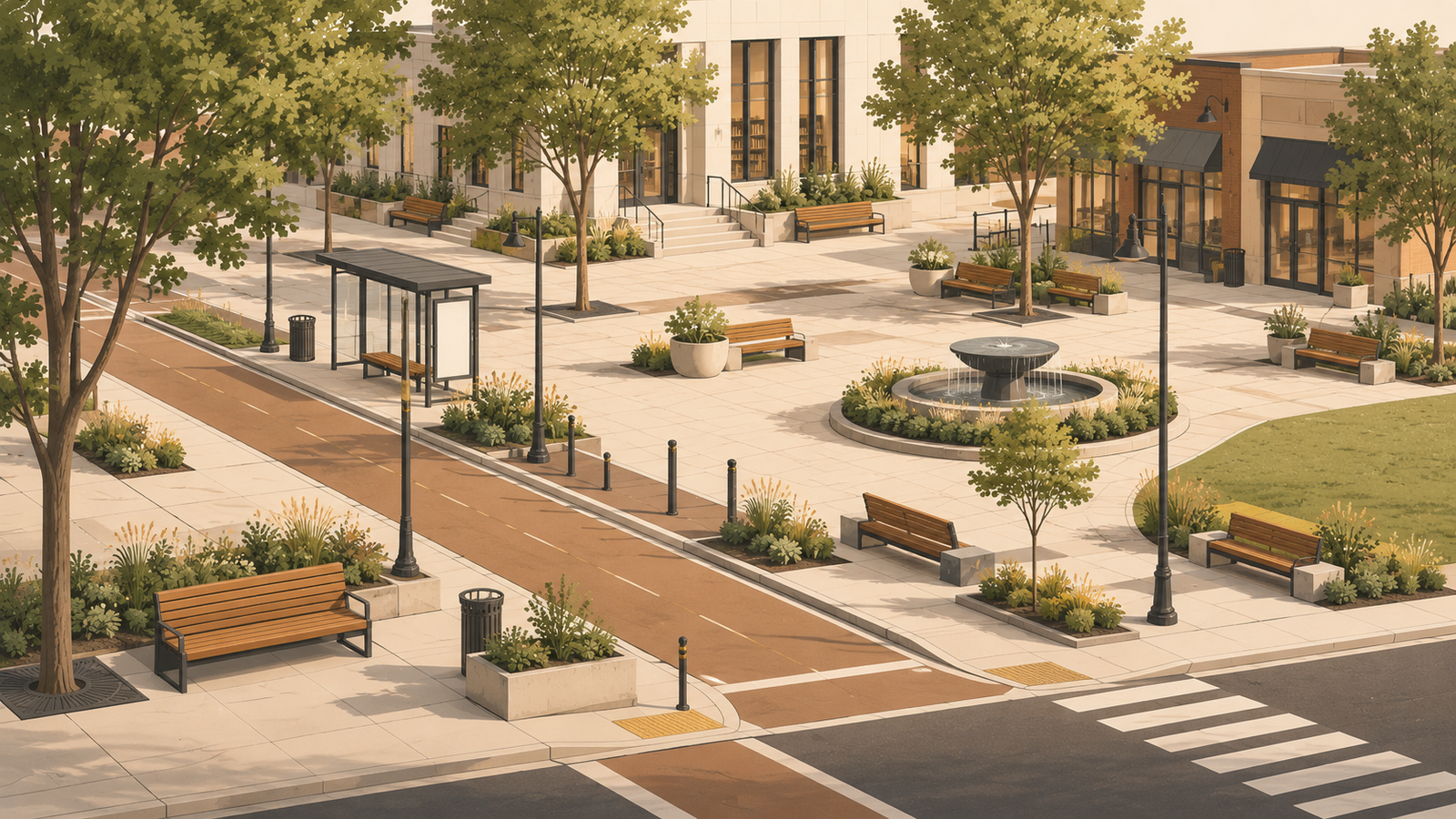
Public Benches Are More Than Furniture
A bench looks simple because its function is simple.
That does not make it minor.
Public benches turn open space into usable space. A plaza without seating can look complete while still failing people. A sidewalk without rest points can move bodies while ignoring human limits. A transit stop without a bench can serve a route while punishing the rider.
The weak reading is that benches are amenities. The stronger reading is that benches are part of the operating system of public space.
They support rest. They support waiting. They support aging. They support disability access. They support parents, workers, students, elders, and visitors. They also support the small pauses that make city life bearable.
A bench gives permission.
It says that stopping is allowed. It says the public realm is not only for circulation. Most importantly, it says the city has considered the body, not just the route.
Walk one familiar route and count the places where someone can sit without paying. Then ask who disappears from public life when those places are missing.
Public Seating Creates Public Life
Public seating creates public life because people stay where they can remain comfortably.
That sounds obvious. Yet many public spaces are designed as if presence happens automatically. It does not.
People need reasons to linger. Shade helps. Safety helps. Cleanliness helps. Walkability helps. However, seating is one of the clearest signals that a space is meant to be used.
A bench changes behavior.
Someone sits while waiting for a friend. Two neighbors talk. A parent watches a child play. A worker eats lunch outside. A reader opens a book near the library. A rider waits for the bus without standing in discomfort.
These moments may seem small. Together, they form the social life of a neighborhood.
Without seating, public space becomes temporary. People pass through quickly. They do not settle. They do not observe. They do not build casual familiarity with the place or with one another.
That matters because community is not built only in meetings. It is also built through repeated, low-pressure contact. This is why third places matter. They give community a physical setting, and benches often make that setting usable.
Public Benches Support Accessibility
Accessibility is not only ramps, elevators, and curb cuts.
It is also the ability to rest.
Not everyone can walk continuously. Older adults may need frequent pauses. Disabled people may need seating between destinations. A person recovering from illness or injury may need support during short trips. Parents with children may need places to reset. Workers may need a place to sit between shifts.
If a neighborhood has no benches, distance becomes harder than it appears on a map.
A park may be nearby but unusable. A library may be close but difficult to reach. A transit stop may be technically accessible but physically exhausting. A commercial street may invite spending while offering no place to rest.
This is where public benches become infrastructure.
They extend the usable range of the city. They help people participate in public life with less strain. They reduce the hidden tax that bad design places on bodies with less margin.
This also connects directly to sidewalk infrastructure. A sidewalk may be continuous, but if it offers no rest points along a long route, it still excludes people who cannot move without pause.
Clear navigation matters here too. As explored in Wayfinding Is Public Infrastructure, people need to understand where routes, entrances, transit stops, public spaces, and rest points are located. A bench is more useful when people can actually find it along a legible public route.
A city that removes seating makes movement harder for the very people who need public space most.
Public Benches Support Local Business
Local business depends on more than storefronts.
It depends on street life.
People are more likely to visit, linger, browse, and return when a commercial corridor feels comfortable. Benches help create that comfort. They give people a place to pause between errands. They support lunch breaks. They make waiting easier. They turn sidewalks from passages into places.
This does not mean a bench automatically saves a business district.
That would be lazy analysis.
Benches work best when they sit inside a larger system. They need clean sidewalks, safe crossings, shade, lighting, nearby activity, clear wayfinding, and regular maintenance. When those pieces align, public seating supports commerce by making the street feel more usable.
People spend time where time feels welcome.
That is the practical economic logic.
A corridor that offers no place to sit asks people to keep moving. By contrast, a corridor that offers thoughtful seating gives people a reason to stay. That extra time can support cafés, shops, libraries, markets, public squares, and neighborhood services.
Wayfinding also supports that economic function. Visitors should be able to find a public square, a transit stop, a library entrance, or a commercial corridor without guessing. When benches sit along clear routes, they become part of the business district’s access system rather than isolated objects.
Small design choices shape local economic behavior.
Defensive Architecture Removes Comfort
Some cities remove benches or design them to be uncomfortable on purpose.
That choice is often defended as safety, cleanliness, or order. Sometimes public space does need management. Disorder is real. Maintenance matters. Public comfort should not mean neglect.
But removing comfort is a blunt tool.
When cities eliminate benches to discourage one group, they punish everyone. Older adults lose rest. Transit riders lose dignity. Parents lose support. Workers lose lunch spots. People with disabilities lose access. Public space becomes colder for the entire community.
Defensive architecture often solves visibility rather than the actual problem.
It pushes people away without addressing housing instability, mental health needs, sanitation, public management, or social services. It makes discomfort the policy.
That is not a serious civic strategy.
A better city manages public space without making it hostile. It designs for use, sets standards, maintains the environment, and addresses social problems directly. It does not treat every seated body as a threat.
Public benches test whether a city can handle public life without turning against the public.
Small Infrastructure Has Large Effects
Public benches are small infrastructure with large effects.
They do not require the scale of a transit line, bridge, or school building. Yet they can change how people experience a block, plaza, park, sidewalk, or bus stop.
That is why they are powerful.
A bench beneath a tree can make a sidewalk usable in summer. A bench near a transit stop can make waiting less punishing. A bench outside a library can support reading, gathering, and quiet observation. A bench near a public square can turn empty pavement into civic space.
Small investments often determine whether larger investments work.
A plaza without benches underperforms. A transit stop without seating feels incomplete. A park path without rest points excludes some users. A commercial corridor without seating loses dwell time.
The lesson is clear.
Infrastructure does not only operate at large scale. It also works through repeated small supports that make public life easier.
Maintenance Matters
A broken bench communicates neglect.
So does a dirty bench. So does a bench placed in direct sun with no shade. So does a bench surrounded by trash, poor lighting, cracked pavement, or blocked access.
Maintenance is not separate from design. It is part of the promise.
A city can install benches and still fail if it does not care for them. Public seating needs inspection, cleaning, repair, placement review, and seasonal attention. It also needs thoughtful material choices that can survive weather, heavy use, and time.
Good maintenance protects public trust.
People read the condition of public space quickly. When a bench is clean, sturdy, and well placed, it signals care. When it is broken, neglected, or hostile, it signals abandonment.
That signal spreads beyond the bench itself.
It shapes how people interpret the whole area.
Wayfinding requires the same discipline. A sign that points toward seating, transit, restrooms, or civic destinations only works if the information remains accurate and readable. Public infrastructure is not finished when it is installed. It is finished only when it is maintained.
Public Benches Connect the Urban Logic Network
Public benches connect many Urban Logic themes.
Sidewalks move people. Crosswalks protect passage. Street trees improve comfort. Bus stops connect people to transit. Bike lanes organize another mode of movement. Third places create social infrastructure.
Benches help all of those systems work better.
They support sidewalks by making walking more manageable. They support bus stops by making waiting more humane. They support street trees by turning shade into usable comfort. They support third places by giving people a reason to remain nearby.
Wayfinding helps people locate those supports. A bench beside a transit stop, plaza, park path, or library entrance gains value when the city makes the route clear. Signs, maps, landmarks, and lighting help turn individual benches into part of a usable public network.
That is why benches are not isolated objects.
They are small nodes inside a larger civic network.
When benches are placed well, they help people use the city with more confidence. When they are missing, the city becomes less forgiving. The route may still exist, but the experience becomes harder.
Urban design is often judged by what it builds. It should also be judged by what it allows people to do.
A bench allows people to stop without leaving public life.
Where Benches Belong
Bench placement is not random.
Bad placement can make a bench useless. Good placement can turn a quiet corner into a working piece of public space.
Benches belong where people already pause. Near transit stops. Near libraries. Near parks. Near commercial corridors. Near civic buildings. Along long walking routes. Under shade. Near crosswalks. Near public squares. Near places where people wait for others.
Design should follow behavior.
People show cities where rest is needed. They sit on walls, steps, planters, railings, curbs, and ledges. Those informal choices are data. They reveal unmet demand.
A serious city observes those patterns and responds with better infrastructure.
Placement also has to work with wayfinding. If a bench is near a key transfer point, park entrance, or public building, the city should help people understand that connection. A place to sit becomes more valuable when it clearly belongs to a route people can read.
That response does not need to be extravagant. It needs to be thoughtful. A well-placed bench can do more than an expensive plaza feature that nobody uses.
The goal is not decoration.
The goal is public usefulness.
The Politics of Sitting Down
Public seating carries politics because public presence carries politics.
Who gets to sit? Who gets watched? Who gets moved along? Who gets comfort? Who gets treated as a legitimate user of public space?
These questions surface quickly around benches.
Some communities demand more seating for elders, transit riders, and families. Other voices oppose benches because they fear loitering, disorder, or homelessness. Both concerns point to the same issue. Public space requires governance.
But governance should not mean removing every sign of human need.
A city cannot become more humane by making itself less usable.
The harder task is better management. Clean the space. Maintain the benches. Provide sanitation. Improve lighting. Address homelessness directly. Support outreach. Enforce reasonable standards without designing hostility into the furniture.
This is not soft thinking. It is sharper than removal because it deals with the real system.
Removing benches is easy. Building public space that can hold complexity is the work.
Read Your City
Choose one plaza, bus stop, park path, or commercial corridor. Count the seats. Then count the people who might need one. The gap between those numbers is civic information.
Reading a bench means looking beyond the object.
Where is it placed? Is it shaded? Is it clean? Is it near transit, a library, a public square, or a commercial corridor? Can an older adult use it? Can a parent sit with a child nearby? Can a worker eat lunch there without feeling pushed out?
Then ask whether people can find it. Does the route explain itself? Are there signs, landmarks, lighting, or clear paths that help someone reach the bench without guesswork? A public seat that is hidden from the public is not doing enough civic work.
After that, ask who the bench seems designed to welcome.
If the answer is narrow, the public space is narrow too.
Benches may be small, but they reveal whether a city understands public life as more than movement.
The Groundwork Principle
Public benches matter because cities are not only systems of motion.
They are systems of presence.
A city that only moves people is incomplete. People also need places to pause, gather, observe, recover, and belong. Without those places, public life becomes thin. The city may function, but it does not fully welcome.
Public benches show whether a city understands human limits.
They show whether public space is designed for bodies, not just routes. They show whether elders, children, workers, disabled residents, transit riders, and neighbors are included in the daily logic of the street.
Wayfinding strengthens that promise by helping people locate the public supports that make a city usable. A bench, bus stop, park path, or civic entrance has more value when people can understand how to reach it.
That is the deeper point.
A bench is a small object carrying a large civic message.
It says the city has room for people who need to stop.
It says public life does not belong only to those in motion.
The principle is simple.
Cities should be designed for people who stay, not only people who pass through.
Keep Seeing the Systems Around You
Most people move through cities without noticing the systems shaping their choices. Urban Logic helps you read the built environment differently, from public benches and sidewalks to bus stops, bike lanes, street trees, wayfinding, and third places.
Subscribe to the Groundwork Daily newsletter for weekly essays that reveal the hidden systems behind modern life and help you navigate them with greater clarity, capability, and intention.

→ Urban Logic: Understanding the Hidden Systems That Shape Cities
→ Why Third Places Matter More Than Ever
→ Wayfinding Is Public Infrastructure
→ Sidewalks Are Economic Infrastructure
→ Street Trees Are Public Infrastructure
→ Bus Stops Are Public Infrastructure
→ Crosswalks Are Civic Infrastructure
Receipts:
→ Project for Public Spaces
→ National Recreation and Park Association
→ Gehl
→ NACTO Urban Street Design Guide