Long commutes are not simply transportation problems. They are capacity problems. Every extra minute required to reach work, school, childcare, groceries, healthcare, or home takes something from the rest of the day.
The obvious costs are easy to count: gas, fares, tolls, parking, mileage, and vehicle maintenance. However, the harder costs rarely appear on a receipt. They are paid in attention, patience, sleep, recovery, family time, flexibility, and the ability to absorb whatever goes wrong next.
This is where Urban Logic becomes useful. A commute is a diagnostic. It reveals how a city distributes proximity and delay. It also shows how housing connects to employment, how transportation connects to opportunity, and how much personal capacity residents surrender simply to participate in ordinary life.
At first, commuting can look like a private choice. A worker chose a job. A household chose a neighborhood. A traveler chose a route.
Yet that explanation is incomplete.
Housing costs, zoning, job concentration, transit frequency, road design, parking policy, sidewalks, crossings, lighting, wayfinding, and public investment all shape the menu of available choices before an individual makes one.
People still make decisions. Nevertheless, those decisions happen inside systems already built around them.
It is a daily negotiation between time, distance, money, stress, opportunity, and dignity.
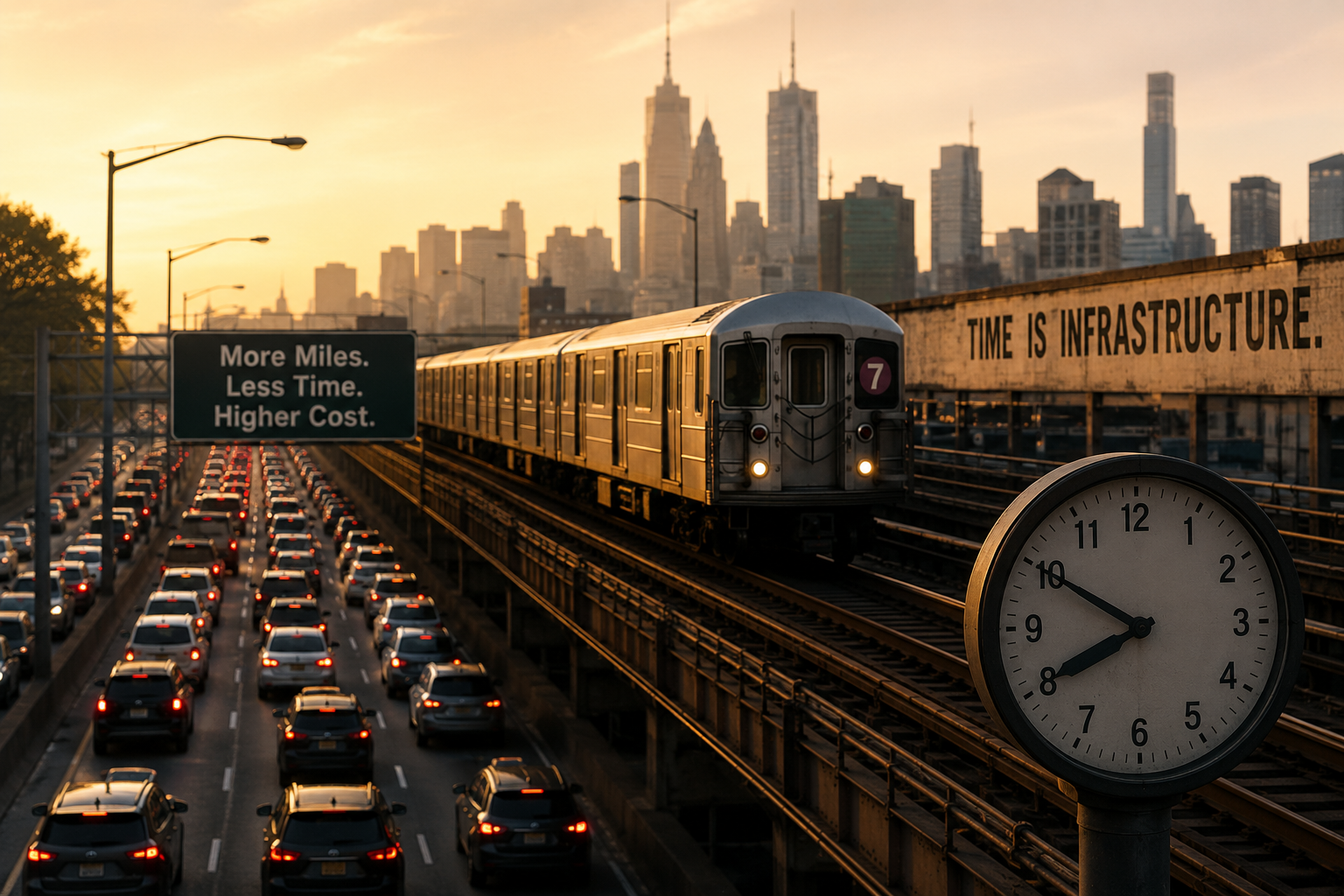
Long Commutes Are a Hidden Tax
A long commute behaves like a tax, except no bill arrives.
Instead, the payment appears somewhere else. It may show up as a shorter morning, a rushed meal, an earlier alarm, a late pickup, a missed workout, an expensive parking charge, or another hour taken from sleep.
Over time, commute time becomes part of the household budget even when nobody writes it down.
Some commuters pay primarily with money, while others pay primarily with time. Many pay heavily with both. Gas, fares, tolls, parking, vehicle maintenance, rideshare costs, and missed wages are simply the visible side of the equation.
Where the Cost Actually Lands
The deeper bill is harder to measure.
Fatigue follows someone through the front door. Patience may already be depleted before work begins. Meanwhile, another hour disappears that could have supported cooking, parenting, studying, exercise, planning, community participation, or sleep.
Most importantly, margin disappears before a real problem even occurs.
That distinction matters because a routine can appear manageable when everything performs perfectly. Systems reveal their actual strength when something goes wrong.
For example, a delayed train, stalled bus, traffic collision, sick child, late meeting, weather event, or missed connection can expose how little reserve the commute leaves behind.
The city never sends a commute invoice. Even so, the payment is collected every morning and every evening.
Long Commutes Consume Daily Capacity
Two people can work the same eight-hour shift and still experience radically different days.
One may travel twenty minutes each way, while the other travels ninety.
The difference is not merely 140 additional minutes of transportation. Instead, each worker operates inside a different daily system.
A longer commute changes when the alarm rings, when breakfast happens, whether an errand fits before work, how childcare must be arranged, when dinner begins, how much evening remains, and when sleep becomes possible.
That is a capacity problem.
Capacity is not simply how much a person can endure. Rather, it describes how much a system can reliably carry without unacceptable degradation. Therefore, a transportation system that delivers a worker to the job while steadily consuming the worker’s ability to function everywhere else has not solved the whole movement problem.
More Distance Means More Exposure
Commute length also increases exposure to failure.
A ten-minute trip depends on relatively few things going right. By contrast, a ninety-minute trip involving a walk, bus, transfer, train, and another walk depends on an entire chain of systems performing well enough and in the correct sequence.
One late bus can become a missed transfer. From there, the missed transfer can create a late arrival. Eventually, the late arrival may become lost pay, a warning, a childcare penalty, or another difficult negotiation at home.
Transportation planners may call that a delay. The household experiences it as pressure.
Commute Time Changes Opportunity
Opportunity does not begin with whether something exists.
More importantly, it begins with whether people can realistically reach it.
A job requiring two buses and a train is not operationally equivalent to the same job ten minutes away. Likewise, a grocery store across the street is not equivalent to one requiring a car. A nearby school also creates a different daily reality from one that turns every morning into a transportation drill.
The map may show access while daily life shows burden.
Reliable transportation can make distance manageable. On the other hand, unreliable transportation converts distance into risk.
A delay may threaten attendance, wages, childcare, medical appointments, school pickup, or sleep. Consequently, reliability is not a minor operational detail. It separates access that functions from access that merely exists on paper.
This is why bus stops are public infrastructure. Transit begins before the vehicle arrives. It starts with the walk to the stop, the safety of the crossing, shelter from weather, the clarity of route information, lighting after dark, and the dignity of waiting.
Access therefore requires more than availability. It requires reachable distance, dependable movement, understandable navigation, and enough remaining capacity to use what the city supposedly provides.
The Commute Also Taxes Attention
Time is not the only resource consumed in transit.
Attention goes with it.
During a routine trip, a commuter may track delays, transfers, safety, weather, arrival times, route changes, platform announcements, traffic, parking, missed connections, and backup plans.
Although the body may be sitting still, the mind continues working.
That constant calculation creates cognitive load. Therefore, by the time someone arrives, part of the day’s attention has already been spent. It was not used for work, recovery, or restoration.
Better infrastructure reduces unnecessary calculation. Routes become legible. Timing becomes dependable. Transfers make sense. Costs become predictable. Waiting spaces become usable.
As explained in Wayfinding Is Public Infrastructure, navigation is part of access. Clear signs, maps, route information, station exits, landmarks, and understandable transfers prevent residents from wasting attention deciphering systems that should explain themselves.
The First and Last Mile Still Count
Sidewalks matter for the same reason. As explored in Sidewalks Are Economic Infrastructure, walking infrastructure connects people to work, transit, commerce, schools, and public life.
If the sidewalk is broken, flooded, missing, or inaccessible, friction begins before a bus, train, or car even enters the story.
Crossings matter too. A dangerous crossing near a station, school, or bus stop can redefine an otherwise workable trip. That is why crosswalks are civic infrastructure. They organize risk where movement becomes negotiation.
When these pieces fail, residents become unpaid system managers. They compensate for weaknesses they did not create.
The hidden labor of commuting is not only movement. It is monitoring.
The Commute Follows You Home
A commute does not end at the station, parking lot, or front door.
Eventually, it enters the household.
A longer trip can change dinner time, homework help, childcare handoffs, exercise, errands, cleaning, sleep, and the amount of patience left for everyone else.
As a result, the household absorbs the overflow created by the transportation system.
Consider one adult losing two hours every workday to travel. That equals ten hours across a five-day workweek and roughly forty hours across four weeks.
In practical terms, an entire workweek can disappear into commuting each month.
Those hours might otherwise support care, repair, study, planning, exercise, rest, or participation in community life. Instead, distance claims them.
The Cost Spreads Beyond the Commuter
Household consequences rarely stay with one person. Someone else may cook. Another person may handle pickup. A partner may supervise homework, postpone an appointment, or carry the task that no longer fits.
Leisure changes too.
Someone arriving home depleted may be less likely to walk to a park, visit a library, attend a neighborhood meeting, patronize a nearby business, or spend time in a public gathering place.
That is one reason third places matter. Public life depends on people having enough time and energy left to participate in it.
When the commute consumes the margin, community life becomes thinner as well.
Proximity Is a Form of Power
Living close to work, transit, schools, groceries, parks, healthcare, and other services is more than convenient.
It is a form of practical power.
Proximity protects time, reduces friction, and lowers the number of negotiations required to complete ordinary life. As a result, people gain more room to recover, plan, respond, participate, and change course when something goes wrong.
Yet proximity is often expensive.
Consequently, households with the least financial margin may be pushed farthest from the systems they need most.
Distance then becomes a sorting mechanism.
People may technically participate in the same regional economy while experiencing radically different access to it. One household lives near the center of opportunity. Another spends hours each day trying to reach it.
Distance Changes the Value of Opportunity
The difference compounds over time.
Someone living nearby can respond faster, stay later when necessary, return home sooner, accept a new opportunity with less disruption, or recover more quickly from a scheduling problem.
Meanwhile, someone farther away must calculate the same opportunity against travel time, transfer risk, transportation cost, childcare, parking, household strain, and route uncertainty.
Parking also shapes this geography. As discussed in Parking Shapes Cities More Than You Think, land dedicated to vehicle storage cannot simultaneously become housing, shops, schools, parks, workplaces, or public space.
Those land-use choices affect how far apart daily life becomes.
Distance is not merely inconvenience. Distance creates structural friction.
Long Commutes Reveal Urban Priorities
Commutes are civic receipts.
When jobs concentrate in one area while affordable housing moves farther away, the commute records the result. Likewise, when transit routes fail to connect workers efficiently to employment centers, the commute shows the consequence.
Incomplete sidewalks tell another part of the story. So do missing shelters, dangerous crossings, inconsistent service, confusing information, and unreliable transfers.
Every route passes through a network of decisions.
Of course, cities cannot fix every pattern immediately. Infrastructure is expensive. Land-use decisions compound over decades. Budgets have limits. Political priorities collide, and existing systems age.
Complexity is real. Still, complexity cannot become an excuse for blindness.
What the Route Reveals
Urban Logic therefore asks a more disciplined set of questions.
These questions matter because a city is not measured only by what it builds. It is also measured by what residents must endure to use what it builds.
Street lighting offers one example. A commute after sunset is fundamentally different from the same trip in daylight. As explained in Street Lighting Is Public Infrastructure, lighting extends the usable life of sidewalks, transit stops, crossings, and commercial corridors.
Street trees reveal another layer. Shade can materially change the experience of walking to transit, waiting outdoors, or moving through a commercial corridor during extreme heat. Therefore, street trees are public infrastructure, not decoration.
Wayfinding exposes a quieter form of friction. A route may technically exist, but if people cannot understand where to transfer, exit, cross, or continue, the system transfers its complexity onto the traveler.
The commute exposes all of it.
Designing for Less Friction
Better transportation does not always require a megaproject.
Sometimes the highest-value improvement is simply a better connection.
A safer walk to transit can reduce stress. Similarly, a protected bus stop can make waiting more humane. Better schedule coordination can prevent missed transfers, while clear signage can eliminate unnecessary confusion.
Mixed-use development can shorten routine trips. Reliable service can also give people confidence that tomorrow’s trip will work because today’s trip worked.
Small Fixes Compound
These interventions may look modest beside a new highway, rail line, or station. Their cumulative effect, however, is not modest.
Small reductions in repeated friction compound precisely because residents encounter them every day.
The goal is not to eliminate travel. Movement is part of urban life. Instead, the goal is to stop making necessary movement unnecessarily punishing.
This is where the argument reaches Structure Is Mercy.
Good structure absorbs preventable disorder before people have to absorb it themselves. Applied to transportation, the system should therefore carry as much of the coordination burden as reasonably possible rather than repeatedly transferring that burden onto residents.
A strong city does not require people to spend their best energy simply reaching the systems they need. Instead, it helps them arrive with enough capacity left to live.
Sidewalks, crosswalks, bus stops, lighting, parking, housing, benches, trees, wayfinding, and third places are not isolated amenities. Together, they form an operating environment.
If one part fails, movement gets heavier. If several parts fail together, ordinary mobility becomes a recurring tax on daily life.
Read Your City
Choose one commute you know well and identify its weakest point.
Perhaps it is the distance itself. Maybe the walk creates the problem. In another case, the weak point may be the wait, transfer, crossing, parking, lighting, signage, or reliability.
Whatever the answer, that weak point shows where the system is asking residents to compensate.
Next, ask who gets the easiest trip.
Who lives close enough to walk? Who needs three connections? Who pays for parking? Who loses sleep? Who can absorb twenty minutes of delay, and who cannot?
These questions turn transportation from lines on a map into a system of lived consequences.
That is the work of Urban Logic. It teaches us to see what ordinary routines have been telling us all along.
The Groundwork
Long commutes teach a difficult lesson about systems.
A system does not have to fail dramatically to drain the people living inside it.
Some burdens arrive five minutes at a time: a late bus, a missed train, a crowded platform, a slow highway, a dangerous crossing, a confusing transfer, or a route that works only when nothing goes wrong.
Individually, each incident can look small.
Repetition changes the math.
Over months and years, transportation can take recovery, flexibility, family time, attention, opportunity, and the reserve people need to handle the rest of life.
Therefore, the sharper question is not simply:
How long is the commute?
Ask instead:
What does the commute require people to surrender in order to make the rest of the city usable?
That question changes the analysis. It moves the conversation away from individual tolerance and toward system performance. More importantly, it asks whether the trip is consuming capacity that should have remained available for life.
Cities cannot eliminate distance. They can, however, decide how much unnecessary friction that distance carries.
— Omari Steele
Groundwork Architecture
What Holds This Argument Up
Good systems absorb preventable disorder before people are forced to absorb it themselves. Transportation succeeds when movement requires less unnecessary personal compensation.
Capacity is what a system can reliably carry without unacceptable degradation. Commutes matter because transportation can consume the human capacity required for work, family, recovery, and participation.