
Third places matter because cities cannot survive on housing and work alone.
A city needs more than apartments, offices, roads, stores, and transit routes. It also needs places where people can exist without rushing, performing, or proving why they belong. These places may look ordinary: a library, a park, a barbershop, a public square, a coffee shop, a community center, a stoop, a church basement, or a neighborhood diner.
However, their ordinary quality is the point.
Third places are the spaces between private life and formal obligation. They are where social trust forms before anyone calls it trust. They are where people recognize faces, learn routines, exchange greetings, hear local information, and begin to understand the rhythm of a neighborhood.
As part of Urban Logic, this article looks at third places as civic infrastructure, not lifestyle decoration. Roads and transit matter. So do sidewalks, crosswalks, public benches, street trees, lighting, and parking. But cities also need spaces where people can remain long enough to become familiar to one another.
Without those places, a city may still function. Yet it becomes colder, thinner, and more transactional.
A city without third places becomes a corridor. People move through it, but they do not root inside it.
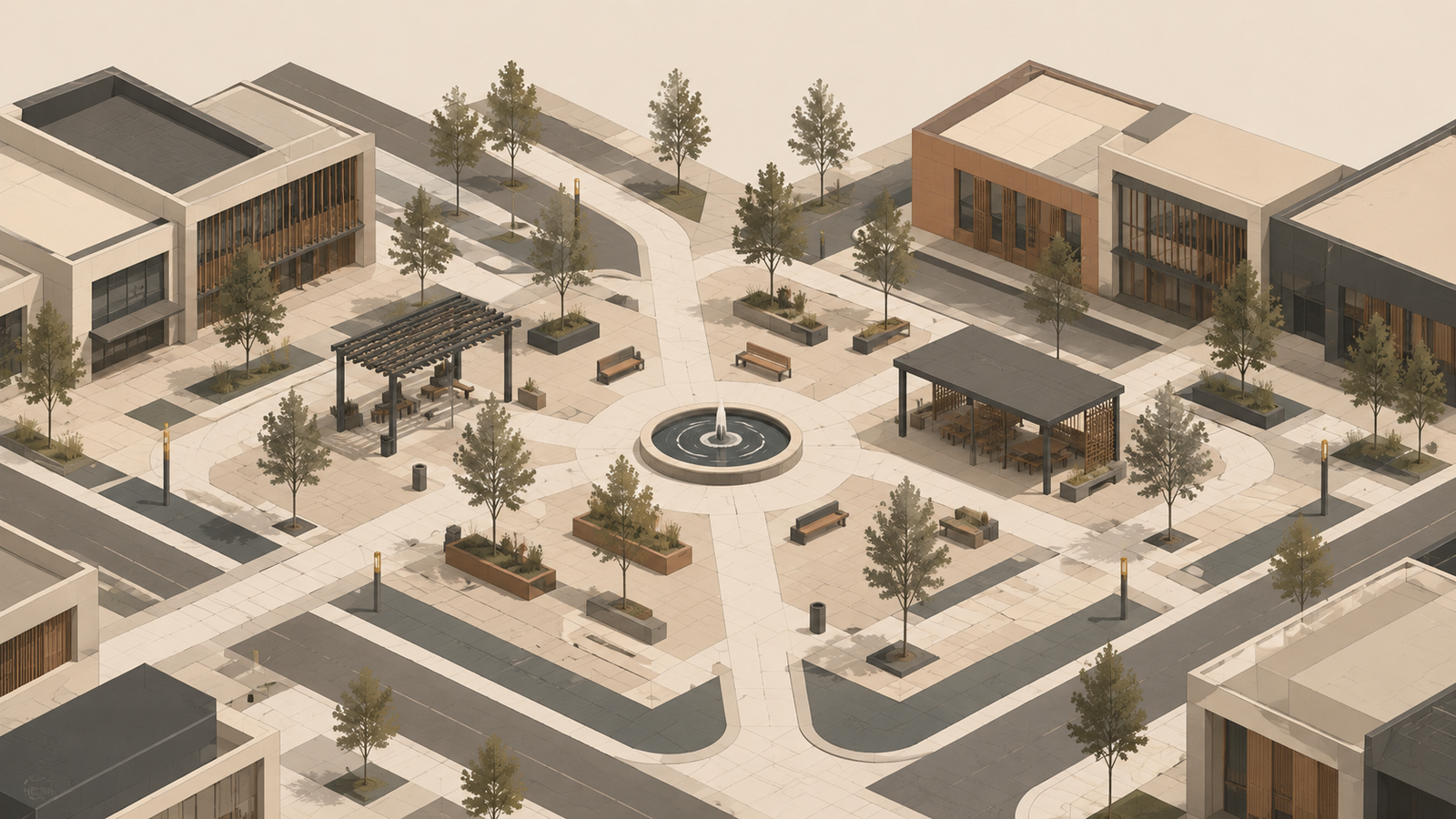
What Third Places Are
Third places are regular gathering spaces outside the home and workplace.
The home is the first place. Work is the second place. The third place is where informal community life happens. It is not usually dramatic. In fact, its power comes from repetition. People return. They sit. They talk. They wait. They read. They watch. They check in. Over time, they become known without needing an appointment.
Different communities create different third places. Some are public. Others are privately owned but open to public use. Some require spending. Others do not. A park bench and a coffee shop are not the same thing, but both can support social familiarity when people use them regularly and safely.
The deeper issue is not the label. The deeper issue is function.
A true third place lowers the pressure of participation. It gives people a reason to linger. It allows casual contact. It does not require intimacy, but it makes familiarity possible. Over time, that familiarity becomes part of neighborhood life.
Because of this, third places should not be dismissed as amenities. They are civic infrastructure. They create the soft connective tissue that helps a neighborhood become more than a collection of addresses.
That connective tissue matters because social life does not form only from intention. It needs places, rhythms, and repeated contact. A city can talk about community all day. Still, if there is nowhere to gather, nowhere to sit, nowhere to wait, and nowhere to return, the language has no physical home.
Third Places Build Social Infrastructure
Social infrastructure is the physical setting that allows relationships to form.
That phrase can sound abstract. In practice, it is simple. People do not build community only through belief. They build it through repeated contact inside shared environments. When a city creates places where people can gather, pause, and return, it gives trust somewhere to grow.
Trust rarely begins with a formal meeting. Often, it begins with recognition.
You see the same person at the library every Saturday. You notice the same elder sitting near the park path. You recognize the barber who knows every family on the block. You hear the same parents talking outside the school. Over time, small signals accumulate. As a result, the neighborhood becomes more legible.
That legibility matters. People are less anonymous when they are seen regularly. They are also more accountable. A community with repeated contact has more ways to notice change, need, absence, conflict, and care.
Still, third places are not magic. Public life includes friction. People disagree. Noise happens. Space gets contested. Even so, shared space gives a community somewhere to practice coexistence.
No city can build civic trust only through messaging. Trust needs a place to happen.
This is where third places connect to other Urban Logic systems. Public benches matter because they give people permission to pause. Sidewalks matter because they connect people to gathering places. Street lighting matters because it extends the usable life of public space after sunset.
Third places sit at the center of those systems. They depend on access, comfort, visibility, and maintenance.
Why Third Places Are Disappearing
Third places are disappearing because modern city life keeps raising the cost of lingering.
Commercial rents rise. Small businesses close. Libraries face budget pressure. Parks become over-policed in some areas and under-maintained in others. Public bathrooms disappear. Benches are removed or redesigned to prevent resting. Coffee shops become expensive. Community centers age without investment. Faith institutions lose attendance. Meanwhile, sidewalks become places of movement rather than contact.
At the same time, digital life offers a substitute that feels convenient. People can talk online. They can join group chats, comment sections, forums, livestreams, and social platforms. These tools are useful. However, they do not fully replace the public presence that third places create.
Time is another pressure. Long commutes, multiple jobs, childcare demands, and unstable schedules make informal gathering harder. If people have no margin, they cannot linger. If every hour is already assigned, community becomes another task instead of a natural rhythm.
Car dependency also weakens third places. When every trip requires driving, casual contact declines. People move from private home to private vehicle to private destination. Therefore, the city becomes a set of isolated transactions.
This is not only a cultural problem. It is a design problem.
When shared spaces disappear, loneliness is not only personal. It becomes structural.
That structure shows up in daily choices. Someone may want community but have nowhere affordable to gather. A teenager may need a safe place after school but find only commercial spaces that require money. An elder may want to remain visible in neighborhood life but have no seating, shade, or restroom access. A worker may want to stay in the area after a shift but have no welcoming public space nearby.
The city still exists. However, its social surface gets thinner.
Public Spaces Create Public Trust
Public spaces do something private spaces cannot do as easily. They allow people to share presence without needing permission from one another.
A good public square does not require everyone to know each other. A good library does not require everyone to speak. A good park does not require everyone to participate in the same activity. Instead, these spaces allow parallel life. People can be near one another without being forced into performance.
This matters because public trust often begins at low intensity.
People learn that others can share space without threat. Children see elders. Elders see families. Workers see students. Neighbors see visitors. In other words, the city becomes visible to itself.
When public space is weak, fear fills the gap. People imagine each other from a distance. They rely on rumors, headlines, stereotypes, and isolated incidents. Repeated public contact can complicate those assumptions. It gives people more information than fear alone.
Maintenance also matters. A neglected public space sends a message. It tells residents that no one is responsible. It also tells them that care is temporary. By contrast, a clean, shaded, well-lit, accessible space tells people that public life is worth protecting.
Maintenance is not cosmetic. It is a trust signal.
That same trust signal appears across the built environment. A faded crosswalk, a broken light, a missing bench, or an uncovered bus stop all communicate something. As Urban Logic argues across the series, infrastructure is not neutral. It teaches people what to expect.
Third places are one of the clearest places where expectation becomes civic life.
Digital Communities Cannot Replace Physical Ones
Digital communities are real. Still, they are not complete replacements for third places.
Online spaces can extend relationships. They can help people organize, learn, share information, and stay connected across distance. However, they usually struggle to create the same embodied familiarity that physical spaces produce.
In a third place, people encounter more than opinions. They encounter presence, tone, pace, silence, facial expression, routine, shared weather, shared waiting, and shared inconvenience. These details matter because human trust is not built from information alone.
Digital spaces also tend to sort people by interest, identity, outrage, entertainment, or algorithmic preference. Third places are less controlled. That can be uncomfortable, but it is also valuable. A neighborhood library or public plaza may bring together people who would never join the same online group.
That mixed presence is part of civic life.
The goal is not to reject technology. That would be unserious. Instead, the goal is to understand its limits. Technology can help people coordinate. It can help people communicate. It can even help people maintain relationships. But cities still need physical places where community can become visible.
A group chat can spread information.
A third place can build recognition.
The Economics of Lingering
Lingering has an economy.
That may sound strange, but cities reveal it every day. Some places let people stay without pressure. Others make staying expensive, uncomfortable, or suspicious.
A coffee shop can function as a third place, but only for people who can afford repeated purchases. A park can function as a third place, but only if it has seating, shade, lighting, bathrooms, and maintenance. A library can function as a third place, but only if it has hours that match real lives. A public square can function as a third place, but only if people feel invited to use it rather than merely pass through it.
In other words, a third place is not created by architecture alone.
It is created by conditions.
Those conditions include cost, access, comfort, visibility, social permission, and time. If each visit requires money, the space becomes selective. If the space lacks seating, it becomes less useful to elders, parents, workers, and disabled residents. If transit access is poor, only people with flexible mobility can use it easily. If lighting is weak, the place may stop functioning after dark.
This is why bus stops, crosswalks, and sidewalks matter to third places. A gathering place is only as accessible as the systems that connect people to it.
The economics of lingering also shapes local business. A corridor with seating, shade, public life, and safe crossings gives people more reasons to stay nearby. That can support small businesses. However, if the corridor is designed only for passing traffic or quick parking turnover, local life becomes thinner.
Commerce follows usable public space.
Community does too.
Designing Third Places for Belonging
Third places do not thrive by accident. They need design, maintenance, access, and permission.
Design matters because space teaches behavior. A plaza with no shade tells people not to stay long. A park with no seating limits who can use it. A library with short hours excludes people with difficult schedules. A community center without programming becomes an empty shell. A sidewalk without safe crossings turns access into risk.
Belonging is not created by slogans. It is created by usable conditions.
Strong third places usually share a few traits. They are easy to reach. They feel safe without feeling controlled. They offer seating. They allow different ages to coexist. They support low-cost or no-cost presence. They are maintained consistently. They also make room for both solitude and conversation.
This is where cities often lose the plot. They build spaces that photograph well but do not function well. They create plazas without shade, seating without comfort, parks without bathrooms, and cultural spaces that feel more like branding exercises than neighborhood assets.
That is weak infrastructure dressed as design.
A serious city asks better questions. Can people get there? Can they sit? Can they stay without spending too much money? Can elders use it? Can children use it? Can workers pass through and return later? Does the space invite care, or does it feel disposable?
If the answer is no, the space may be attractive, but it is not doing the deeper work.
By contrast, a strong third place feels almost ordinary because it works. People know how to enter. They know where to sit. They know what behavior is acceptable. They know they can return. That predictability is part of the value.
Third Places Make Neighborhoods More Resilient
Resilience is often discussed after crisis. However, it is built before crisis through ordinary familiarity.
When people already know one another, they can respond faster. They can check on the elder who usually sits outside. They can notice when a store closes unexpectedly. They can share information when transit fails. They can organize around a local problem because the relationships are not starting from zero.
Third places make that possible because they lower the cost of connection.
A neighborhood with strong third places has more informal channels. Information moves through trusted relationships, not only official announcements. Support can begin before institutions arrive. People are more likely to notice who is missing, who is struggling, and what has changed.
Again, this is not romance. It is structure.
Communities do not become strong because everyone agrees. They become strong because enough relationships exist before disagreement, pressure, or emergency arrives.
That is why third places should be treated as part of civic resilience. They help communities practice recognition before they need response. They create the routines that make care easier to organize later.
Without them, every crisis begins from a colder start.
Read Your City
Visit a neighborhood you know well. Count the places where someone can sit without paying. Count the places where someone can gather without making a purchase. Notice which spaces invite people to stay and which ones quietly tell them to keep moving.
Third places become easier to see once you stop looking only for official labels.
Do not only ask whether a neighborhood has a park, library, or plaza. Ask whether those places actually function as shared civic space. Can people reach them? Can they sit? Can they use the bathroom? Can they stay without pressure? Can teenagers exist there without being treated as a problem? Can elders return regularly? Can workers use the space between shifts? Can families gather without paying too much?
These questions reveal the difference between public space and usable public life.
A bench outside a library may do more civic work than a large plaza with no shade. A barbershop may carry more neighborhood information than an official bulletin board. A stoop may hold more social trust than a branded community activation.
The point is not to romanticize the informal. The point is to notice function.
Urban Logic teaches that cities are systems. Third places show how those systems become human.
The Groundwork Principle
Third places matter because community needs a physical address.
People can care in theory. They can believe in connection. They can speak about neighborhood, belonging, and trust. However, without shared spaces, those values have nowhere to gather.
A city that removes third places should expect weaker social life. A city that prices them out should expect loneliness to rise. A city that neglects public space should expect public trust to thin. These outcomes are not mysterious. They are the predictable result of design choices.
Urban Logic teaches that the built environment shapes behavior. Third places prove that the built environment also shapes relationships.
The question is not whether people need community. They do. The sharper question is whether the city has made room for community to happen without requiring heroic effort.
When shared spaces are accessible, maintained, and welcoming, they create more than comfort. They create civic capacity. They help strangers become familiar. They help neighbors become visible. They help neighborhoods become communities.
That is why third places matter more than ever.
Keep Seeing the Systems Around You
Most people move through cities without noticing the systems shaping their choices. Urban Logic helps you read the built environment differently, from third places and sidewalks to public benches, bus stops, lighting, street trees, and parking.
Subscribe to the Groundwork Daily newsletter for essays that reveal the hidden systems behind modern life.
→ Urban Logic: Understanding the Hidden Systems That Shape Cities
→ Public Benches Matter More Than You Think
→ Sidewalks Are Economic Infrastructure
→ Street Lighting Is Public Infrastructure
→ Street Trees Are Public Infrastructure
→ Bus Stops Are Public Infrastructure
Receipts:
→ Project for Public Spaces
→ American Planning Association
→ Brookings Institution
→ National Recreation and Park Association
Keep Seeing the Systems Around You
Most people experience cities without ever noticing the structures shaping their decisions. Urban Logic helps you read the built environment differently—revealing how infrastructure, public space, transportation, and everyday design influence opportunity, trust, and daily life.
Subscribe to the Groundwork Daily newsletter for weekly essays that uncover the hidden systems behind modern life and help you navigate them with greater clarity, capability, and intention.