
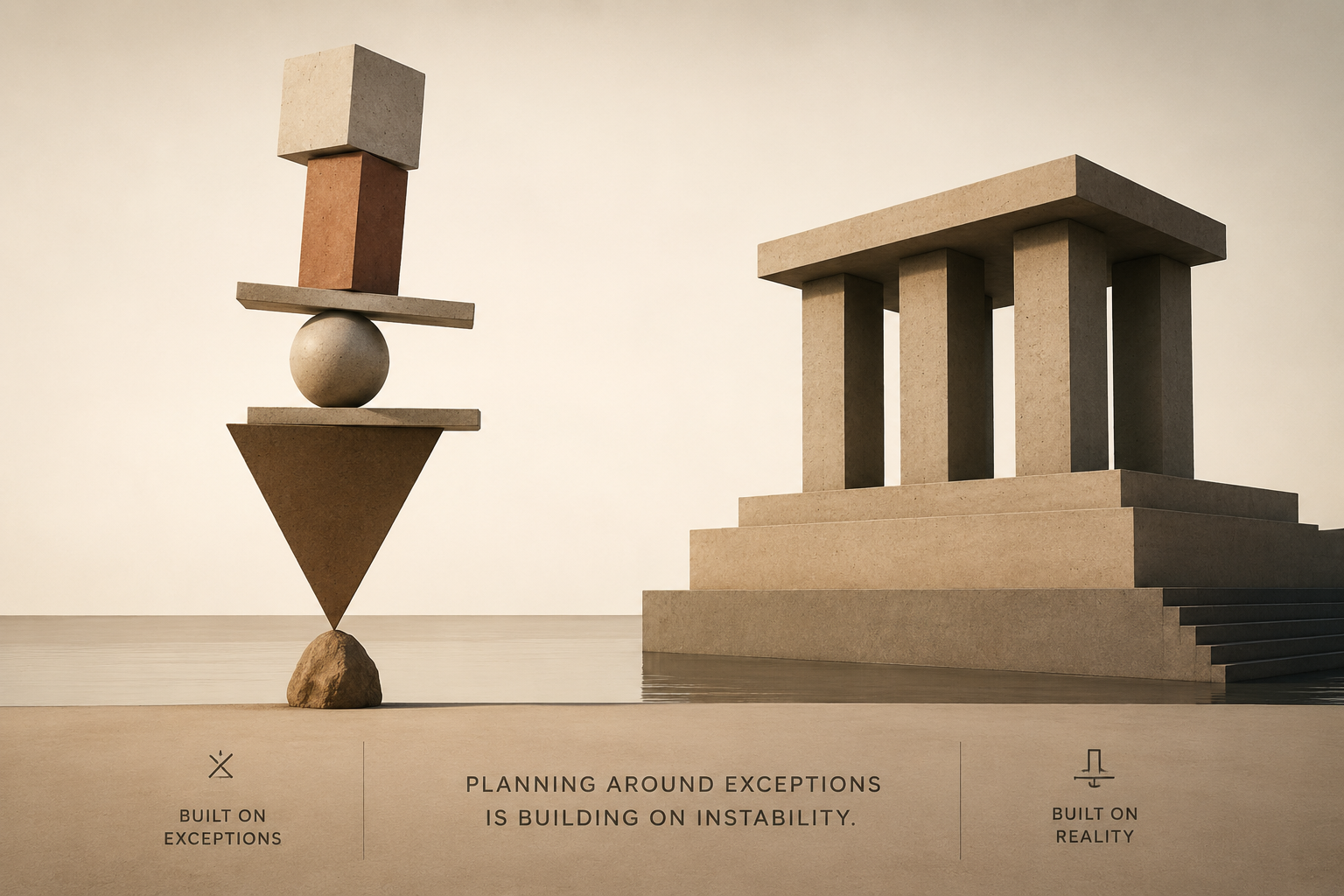
Exception-based thinking is not strategy. It is hope wearing a hard hat.
Every life contains exceptions. Someone beats the odds. Someone succeeds without much preparation. Someone ignores the pattern and still lands well. Someone makes a reckless choice and gets rewarded anyway.
Those stories stay with us because they are unusual. That is exactly why they should be handled carefully.
Trouble begins when a rare outcome is promoted into a normal plan. One person points to an exception, strips away the luck, timing, support, resources, risk, and context around it, then decides the result is broadly repeatable.
That is not disciplined optimism. It is exposure dressed up as confidence.
A serious life cannot be built around what occasionally happens. It needs a wider foundation: what usually happens when choices, habits, incentives, standards, and consequences repeat over time.
The Distinction
An Exception Proves Possibility, Not Reliability
Exception-based thinking takes an unusual outcome and treats it like a dependable path.
The examples are familiar. Someone dropped out of school and became wealthy. Someone ignored the conventional career path and built a remarkable company. Someone entered a deeply complicated relationship and eventually made it work. Someone waited much longer than expected and still found exactly what they wanted.
Any of those stories may be true.
But truth and transferability are not the same thing.
The useful question is not whether an exception exists. It is whether that exception deserves authority over the plan.
Usually, it does not.
One person can survive a poor decision without making the decision wise. One person can succeed with almost no structure without making structure unnecessary. One person can escape an ordinary consequence without making the consequence imaginary.
Exceptions can teach us something. Sometimes they reveal hidden opportunity, expose a bad assumption, or show that an old rule has become too rigid. But an exception has to be examined before it is copied.
What made the unusual result possible? Which advantages were visible? Which ones were hidden? How much downside did the person carry? Could the result be repeated by someone without the same network, timing, capital, skill, support, or luck?
Those questions turn inspiration into judgment.
Risk and Reality
Preference Cannot Overrule Probability
Preference matters. So do ambition, values, instinct, and imagination. Still, none of them erase risk.
A person may prefer to believe a situation will break in their favor. They may believe they are unusually talented, unusually resilient, unusually prepared, or simply different from the people who came before them.
Maybe they are.
But good judgment does not ask reality to disappear because the preferred outcome feels compelling.
Instead, it asks what the evidence says, what repeated behavior tends to produce, what the downside looks like, and whether the decision can still hold if the best-case scenario does not arrive.
This is where discernment becomes structural rather than philosophical. Discernment gives the right things the right weight. A vivid story may deserve attention. It does not automatically deserve the same weight as a persistent pattern.
Why Rare Outcomes Distort Judgment
Rare outcomes are memorable because they are vivid.
A gambler does not need every loss to feel exciting. One memorable win can keep the lever moving. Exceptional success stories can work the same way. One spectacular outcome can crowd hundreds of ordinary outcomes out of view.
That does not make exceptional stories useless. It means they need context.
Stable habits tend to outperform emotional improvisation. Preparation tends to improve a person’s options. Clear standards tend to protect better than vague hope. Saving before a crisis usually creates more room than trying to solve the crisis with urgency alone.
None of those patterns guarantee success. They improve the odds and reduce avoidable exposure.
The Better Question
Do not ask only, “Could this work?”
Also ask, “What happens to me if it does not?”
That question does not kill ambition. It gives ambition a floor.
The Human Trap
Sometimes the Exception Protects an Identity
Exception-based thinking is especially seductive when it protects the story someone wants to believe about themselves.
If a person sees themselves as unusually gifted, attractive, intelligent, strong, connected, educated, resilient, or destined for more, ordinary requirements can start to feel beneath them.
Structure can even feel insulting.
Structure says that talent still needs execution. Intelligence still needs judgment. Education still needs usefulness. Charm still needs character. Resilience still needs direction. Potential still needs a way to become dependable.
Most importantly, structure says no one is automatically exempt from consequences.
That is uncomfortable because people rarely experience their self-image as a theory. They experience it as truth.
So when evidence threatens the story, the exception becomes useful. It provides an escape route.
Someone else did it. Someone else survived it. Someone else waited longer. Someone else recovered. Someone else beat the pattern.
Therefore, maybe no adjustment is necessary.
That conclusion is where identity begins interfering with judgment.
When the Exception Becomes an Excuse
The exception becomes dangerous when it is used to avoid the ordinary requirement.
Someone delays the hard conversation because one struggling relationship eventually turned around. They avoid financial preparation because one entrepreneur recovered from enormous debt. They ignore feedback because one brilliant person was misunderstood before becoming successful.
In each case, the exception is doing more than offering hope. It is blocking correction.
That matters because pressure does not make planning less necessary. Pressure makes good planning more valuable.
The less room a person has for error, the less useful fantasy becomes.
Applied Groundwork
The Pattern Appears Everywhere
Exception-based thinking is not limited to one kind of decision. It shows up wherever people want a preferred outcome badly enough to make the unusual feel ordinary.
It appears in careers when one famous dropout becomes evidence that skill development does not matter. It appears in money when one lucky investment becomes evidence that concentrated risk is sound. It appears in health when one person’s unusual resilience is treated like a universal rule.
It also appears in relationships, where hope and identity can carry enormous emotional weight.

Relationships Make the Problem Easy to See
People often point to couples who overcame enormous incompatibility. They remember the person who waited much longer than expected and still found a stable partner. They cite marriages that survived years of conflict, poor communication, or wildly different expectations.
Again, those relationships may be real.
But outliers make poor blueprints.
Healthy relationships still depend on the ordinary structural work of alignment, timing, character, communication, responsibility, boundaries, repair, and shared expectations.
If a relationship repeatedly produces confusion, resentment, instability, disrespect, or avoidance, the existence of a rare success story does not erase the pattern in front of the people living it.
Hope can justify another conversation. It cannot substitute for evidence that the relationship itself is changing.
The same principle applies elsewhere. A person can admire an unusual career without copying its risk profile. They can celebrate a founder who bet everything without betting everything themselves. They can learn from someone else’s remarkable recovery without pretending recovery is guaranteed.
Maturity allows inspiration and judgment to occupy the same room.
Decision Architecture
Build the Plan So It Can Survive Ordinary Reality
A stronger decision process starts with patterns rather than fantasies.
Ask what usually happens when the behavior repeats. Ask what the downside looks like if the preferred outcome never arrives. Ask how much of the plan depends on timing, luck, rescue, perfect execution, or another person’s cooperation.
Then ask whether the structure still works without those things.
That is the heart of Structure Builds Freedom. Reliable structure does not eliminate uncertainty. It creates enough order, capacity, and options that uncertainty does not get to own the entire outcome.
Good planning does not require guaranteed success. Nothing can provide that. It should, however, reduce exposure to predictable harm and make progress more repeatable.
A sound structure gives a person somewhere to stand when the exciting scenario does not happen.
The Foundation Test
Before building a major decision around an exception, ask:
- Does this decision still make sense if the rare outcome never happens?
- What protects me if the best-case scenario fails?
- Am I considering ordinary consequences as seriously as the exciting possibility?
- Am I using one unusual story to avoid a larger pattern?
- How much of this plan depends on luck, rescue, timing, or another person’s change?
- Would I recommend the same decision to someone I love with the same information?
Those questions do not make a decision for you. They make the structure of the decision visible.
If a plan collapses the moment the exception disappears, it was carrying more hope than structure.
That does not mean the dream must be abandoned. It means the foundation needs more work.
The Groundwork
Let the Exception Inform the Plan, Not Become the Plan
Exceptions matter. They can reveal new possibilities, challenge bad assumptions, and remind us that probability is not destiny.
But possibility and foundation are different jobs.
A durable life is usually built from less glamorous material: sound judgment, standards, buffers, useful habits, preparation, correction, patience, and structures that continue working when conditions are not ideal.
- Study the exception without mistaking it for the baseline.
- Build around what can hold if luck, timing, or rescue does not arrive.
- Leave enough structure in the plan to preserve choices when reality changes.
Hope asks, “What could happen?”
Stewardship asks, “What needs to be built so the life can still hold?”
Both questions have value. Only one of them can carry ordinary weight.
Groundwork Architecture
The Structure Beneath This Framework
Exception-based thinking sits inside a larger Groundwork Daily architecture. Two canonical ideas do most of the work underneath this framework.
Core Principle
Reliable structure reduces unnecessary exposure and preserves meaningful options when conditions change.
Primary Condition
Discernment gives evidence, risk, preference, possibility, and consequence the weight each actually deserves.
Closing Principle
Build for the Weight Life Is Likely to Place on It
Exception-based thinking becomes fragile when it asks an unusual outcome to carry ordinary weight.
A durable life needs stronger material. It needs judgment, standards, preparation, buffers, correction, and enough structure to survive disappointment without collapsing.
This is not an argument for timid living. It is an argument for building ambition well.
Take the unusual opportunity. Make the unconventional move. Challenge the pattern when there is good reason to challenge it.
Just do not confuse the existence of an exception with the existence of a foundation.
Plan for reality. Leave room for possibility.
Let exceptions remain what they are: rare, instructive, sometimes beautiful, and insufficient on their own to hold the structure.
Receipts
U.S. Securities and Exchange Commission, Investor.gov: Risk explains investment risk as uncertainty around outcomes and the possibility that actual results may differ from what is expected. The framework applies that basic risk-awareness principle more broadly to decision-making.
External sources were available at the links shown at the time of publication. Groundwork Daily verifies source links during publication, but third-party websites may later move, revise, or remove material.
