
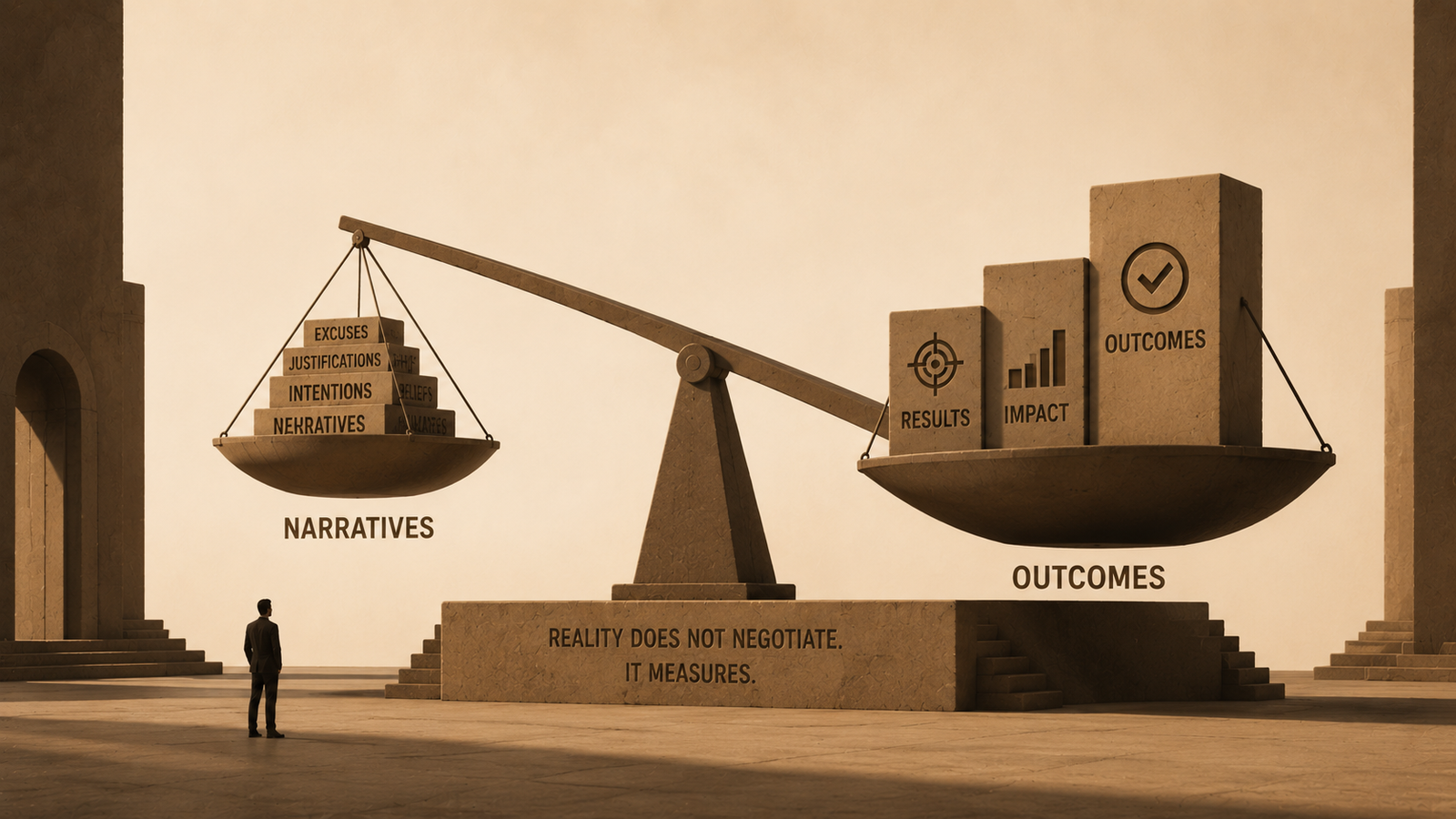
Outcomes do not care about narratives.
That sounds harsh until life proves it true.
Stories matter because they help people organize experience. Human beings use stories to understand hardship, preserve identity, transmit family lessons, and give shape to memory. Without stories, life becomes difficult to carry.
However, the problem begins when stories stop explaining reality and start replacing it.
That is where the collapse starts.
A person can tell a story about why the relationship failed. Likewise, a family can tell a story about why stability never arrived. In the same way, an institution can tell a story about why results did not match promises. A culture can also tell a story about why outcomes remain uneven.
Some of those stories may be true.
Even so, they still have to face the result.
Reality eventually asks one question that every narrative must answer:
What happened?
Not what was intended. Not what was hoped for. Not what was promised. Not what sounded good in the beginning. What happened.
That question is the audit.
Outcomes Do Not Care About Narratives
Outcomes do not respond to emotional framing.
They do not respond to slogans. They do not respond to good intentions. They do not respond to personal branding, family explanations, political language, or motivational vocabulary.
Instead, outcomes respond to behavior.
They respond to preparation, incentives, habits, constraints, timing, execution, and correction.
For example, a bridge either holds weight or it does not.
Similarly, a budget either balances or it does not.
Meanwhile, a household either becomes more stable or less stable over time.
In the same way, a relationship either builds trust or gradually erodes it.
As a result, a strategy either improves conditions or repeats the same failure with cleaner language.
That is why outcomes are uncomfortable. They remove decoration.
They do not ask whether the story was moving. They ask whether the structure worked.
The Stories We Tell Ourselves
Every person carries narratives.
Some are inherited from parents. Others are absorbed from culture. Many come from pain, success, fear, or survival. In some cases, a story formed because a person had no better way to survive what was happening.
Those stories deserve attention.
Still, attention is not obedience.
A story can explain how a person learned distrust. However, it does not prove that distrust should govern every future relationship.
A story can explain why someone values achievement. Yet it does not prove achievement can replace connection.
A story can explain why someone fears dependence. Nevertheless, it does not prove independence is the same as stability.
A story can explain why someone built a life around exceptions. Even then, it does not make rare outcomes reliable.
This is where maturity begins.
Maturity does not erase the story. It puts the story under review.
The question becomes simple: is this narrative helping the life produce better outcomes, or is it protecting patterns that keep producing damage?
That question cuts through performance.
The Difference Between Explanation and Excuse
Explanation is necessary.
Excuse is expensive.
An explanation identifies cause. It names conditions. It clarifies what shaped the behavior, decision, or outcome.
By contrast, an excuse uses that explanation to avoid responsibility.
That difference is not small. It is the difference between growth and repetition.
Explanation says, “This is where the pattern came from.”
Excuse says, “This is why the pattern does not need to change.”
On one hand, explanation creates awareness.
On the other hand, excuse protects dysfunction.
Furthermore, explanation opens the door to correction.
By contrast, excuse locks the room and calls it identity.
Many people confuse compassion with exemption. They assume that because a pattern has a painful origin, it should not be challenged. That is weak thinking. Pain deserves compassion. Repeated harm still requires correction.
Therefore, understanding where something came from does not remove the need to measure what it is producing now.
That is the standard.
Credentials Did Not Guarantee Capability
The first article in this journey, The Credential Trap, examined a structural mistake that shows up everywhere.
People confuse proof of passage with proof of capacity.
A credential may show that someone completed a program. It may show persistence, exposure, training, and institutional recognition. That matters.
However, a credential does not guarantee judgment.
It does not guarantee leadership, emotional steadiness, or the ability to solve a real problem when the script breaks.
That is why credentials alone cannot carry the full weight of adulthood.
Capability is revealed under load.
When pressure arrives, the certificate does not make the decision. The person does.
Ultimately, the outcome becomes the measure.
Survival Did Not Guarantee Stability
Raised to Survive addressed another hard reality.
Survival is not the same as stability.
Survival strategies often begin as protection. A child learns to stay alert. A household learns to stretch resources. A person learns not to ask for too much, trust too quickly, or depend too deeply.
Those adaptations may have been necessary.
However, every adaptation has an expiration date if the conditions change.
What protected someone in chaos may limit them in peace.
Likewise, what helped someone endure instability may prevent them from building stability.
In addition, what kept someone from being disappointed may also keep them from being loved.
That is the hard audit.
The question is not whether the survival pattern made sense then.
The question is whether it is still producing the life the person claims to want now.
Childhood Models Did Not Guarantee Adult Repair
What Did Love Look Like Growing Up? moved the journey into emotional inheritance.
Most people learn love before they understand it.
They watch tone. They watch silence. They watch conflict. They watch affection. Over time, they also watch who apologizes, who avoids, who controls, who gives, who disappears, and who stays.
Those early models matter.
Even so, inherited models are not permanent law.
They are starting material.
At some point, adulthood requires review.
A person can say, “This is what I saw.”
That is honest.
Still, a person cannot stop there forever.
The stronger sentence is, “This is what I saw, and this is what I am choosing to repair.”
That is where outcomes begin to change.
Exceptions Did Not Change Probability
Building Your Life Around Exceptions named a quiet form of self-deception.
People love rare stories because rare stories feel like permission.
Someone beat the odds. Someone ignored the pattern and still won. Someone made a fragile decision and landed well anyway.
Fine.
Exceptions exist.
Still, they do not make strong foundations.
Planning around rare outcomes is not strategy. It is emotional gambling with better language.
Probability does not care how inspiring the exception sounds.
If a plan only works when luck arrives, the plan is weak.
That applies to money, health, relationships, career, family, and leadership.
The existence of an exception proves possibility.
It does not prove reliability.
Achievement Did Not Guarantee Connection
Degrees, Boss Energy, and the Dating Delusion brought the arc into lived behavior.
Achievement matters. Discipline matters. Education matters. Professional success matters.
However, achievement and connection are not scored on the same rubric.
A résumé can impress a room, but it cannot build trust.
A title can command attention, yet it cannot create warmth.
A salary can improve options, but it cannot guarantee emotional availability.
A person can be successful and still difficult to build with.
That sentence bothers people because it removes the hiding place.
Professional achievement is not proof of relational maturity.
It may support stability. It may create resources. It may show discipline. However, it cannot substitute for humility, repair, listening, cooperation, and emotional steadiness.
Again, the outcome tells the truth.
Economics Did Not Disappear Because We Ignored Them
Hypergamy, Reality, and the New Economic Dating Divide widened the lens.
Relationship expectations do not exist outside economic conditions.
First, housing costs matter.
Second, income distribution matters.
Third, educational sorting influences opportunity and partner selection.
In addition, debt burdens shape household decision-making.
Finally, labor markets affect when and how people build long-term stability.
Ignoring those constraints does not remove them.
This is where many narratives fail. They describe what people want without examining what the environment allows, rewards, or punishes.
Desire is real.
Constraint is also real.
Adults must learn to hold both truths at the same time.
When Relationship Expectations Meet Reality
This entire journey has been about expectation.
It has examined where expectations come from, how they are shaped, why they harden, and what happens when they meet systems that do not bend.
Many people do not fail because they lack desire.
Instead, they fail because their expectations are not aligned with the behavior, preparation, and conditions required to produce the outcome they want.
They want stability but practice avoidance.
They want trust but reward suspicion.
They want partnership but protect individual control.
They want family but refuse repair.
In other words, they want outcomes that their systems are not designed to produce.
That is not bad luck.
That is misalignment.
The Reality Audit
Every system eventually gets audited.
Not by opinion.
By outcome.
A household is audited by its stability.
A relationship is audited by its trust.
A budget is audited by its margin.
A body is audited by its capacity.
A career is audited by its usefulness.
A culture is audited by what it normalizes.
An institution is audited by whether it fulfills its stated function.
This audit cannot be avoided. It can only be delayed.
And delay is not neutral.
Delayed audits compound damage.
Small inconsistencies become patterns.
Eventually, patterns become systems.
Consequently, systems become outcomes.
By the time the result becomes visible, the structure has usually been speaking for a long time.
Why Reality Is Not Being Cruel
People often experience reality as cruelty because reality refuses to honor the story without evidence.
But reality is not cruel.
Reality is clarifying.
It shows what is working. It also shows what is weak. In practice, it reveals what cannot hold weight and what needs repair before collapse becomes permanent.
That is why outcomes can be a form of mercy.
They tell the truth while correction is still possible.
A failed pattern is not always a final judgment.
Sometimes it is an early warning.
However, warnings only help people who are willing to listen.
What Actually Determines Results
Results are rarely determined by one dramatic moment.
They are usually determined by repeated inputs.
Results are influenced by repeated decisions.
Over time, habits reinforce those decisions.
Likewise, incentives shape behavior in predictable ways.
Unfortunately, avoidance often compounds existing problems.
Conversely, correction creates opportunities for improvement.
This is why outcomes often feel sudden but are usually accumulated.
The breakup seems sudden.
The debt seems sudden.
The burnout seems sudden.
The collapse seems sudden.
Yet most outcomes were built before they were visible.
The structure was already moving.
How to Judge a Story by Its Results
Not every story should be rejected.
Some stories are accurate. Some are useful. Some preserve truth that statistics alone cannot carry.
Therefore, the point is not to abandon narrative.
The point is to test narrative.
Ask what the story produces.
Does it make responsibility clearer?
Does it make repair more likely?
Does it reduce confusion?
Does it improve judgment?
Does it create better behavior?
Most importantly, does it help the person build what they claim to value?
If the answer is no, the story may be emotionally satisfying but structurally weak.
A story that protects failure is not wisdom.
It is insulation.
Accountability Is Not the Enemy of Compassion
Accountability is often treated as harsh because it interrupts comfort.
That is a mistake.
Accountability and compassion are not enemies.
Compassion recognizes what happened. Accountability asks what must happen next.
Compassion honors context. Accountability protects the future.
Compassion says the wound matters. Accountability says the wound cannot be allowed to govern every decision forever.
Both are necessary.
Compassion without accountability becomes indulgence.
Accountability without compassion becomes punishment.
The goal is neither.
The goal is repair with standards.

Related Groundwork
This capstone closes the Relationship Expectations journey by bringing every prior layer back to one governing question: what did the story produce?
- The Credential Trap — credentials can open doors, but outcomes reveal capability.
- Raised to Survive — survival explains adaptation, but stability requires a different structure.
- What Did Love Look Like Growing Up? — inherited models explain patterns, but adults must examine what those patterns produce.
- Building Your Life Around Exceptions — rare outcomes can inspire, but probability still governs planning.
- Degrees, Boss Energy, and the Dating Delusion — achievement matters, but connection requires a different kind of work.
- Hypergamy, Reality, and the New Economic Dating Divide — relationship expectations operate inside economic conditions.
The Principle
Stories matter because they help people understand experience.
Narratives matter because they organize meaning.
Context matters because outcomes do not emerge from nowhere.
History matters because present conditions often have roots.
Understanding matters because accurate diagnosis makes correction possible.
However, none of them replace outcomes.
Every explanation eventually encounters reality.
Every belief eventually encounters evidence.
Every strategy eventually encounters results.
Every system eventually encounters an audit.
That audit is outcomes.
Outcomes do not care about narratives.
They do not respond to slogans.
They do not respond to intentions.
They do not respond to wishful thinking.
Instead, they respond to preparation, behavior, incentives, correction, execution, and truth.
The story may explain the result.
The result still remains.
Build accordingly.
