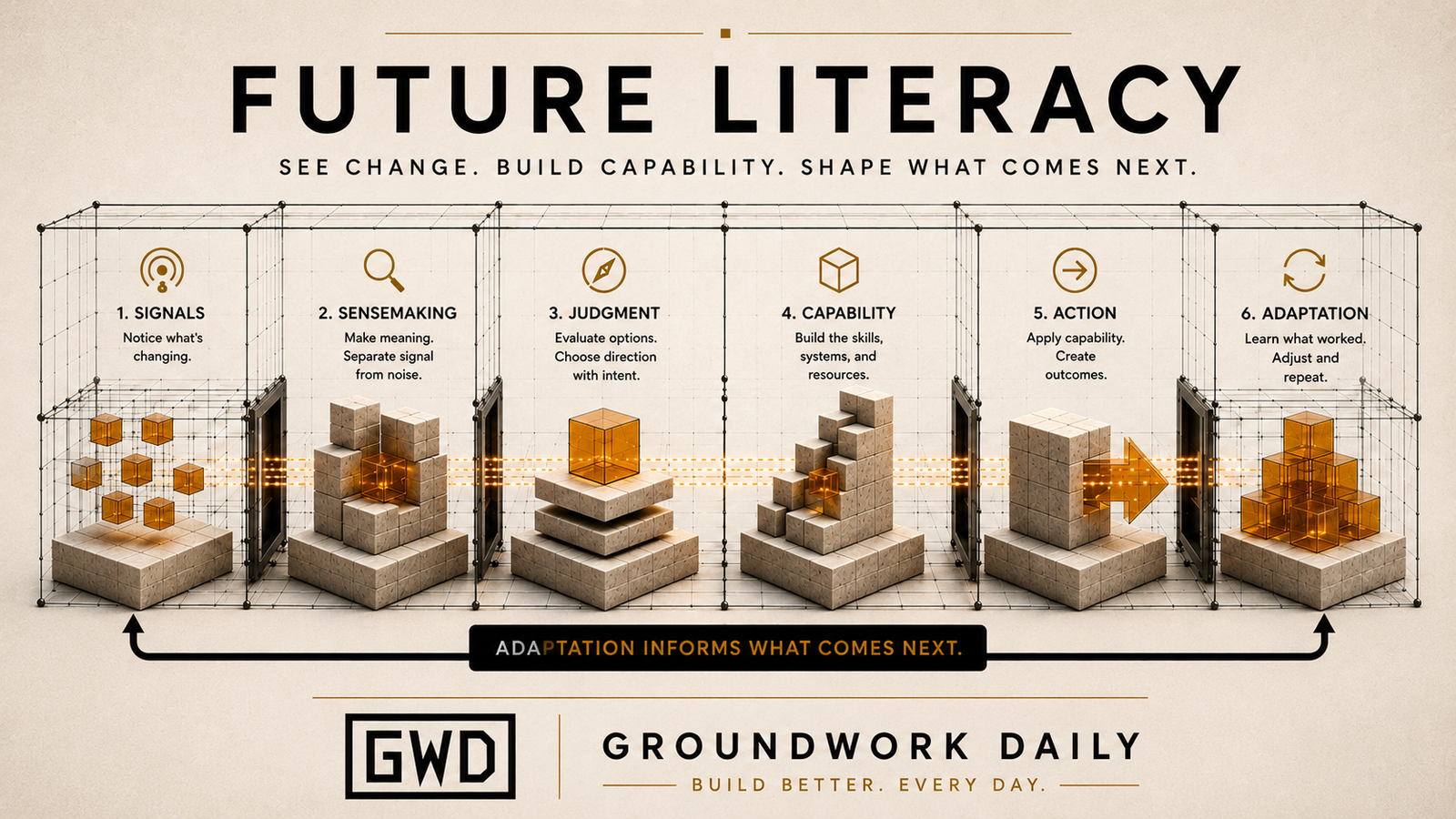
A practical structure for future literacy turns clear thinking, protected bandwidth, capability, pattern recognition, and systems thinking into something you can actually use every day.
The first nine articles in this series developed those capabilities one layer at a time. However, a collection of strong ideas is not yet an operating system.
The pieces still have to work together when the calendar fills, attention fragments, conditions change, and reality refuses to follow the plan.
That is the job of this final article.
Rather than adding another capability, Post 10 creates a container for the original Future Literacy sequence. It brings the work into one repeatable loop:
Orient → Protect → Observe → Close → Adapt
This is the daily structure for future literacy.
It is not another productivity routine. Productivity usually asks how to get more done. Future Literacy asks a harder question: how do you remain clear, capable, and directional while the environment itself keeps moving?
That distinction matters because a perfectly optimized day aimed at the wrong future is still a bad system.
This tenth article in Groundwork Daily’s Future Literacy series therefore closes the original sequence by connecting the previous nine articles into one practical architecture for daily use.
The Future Literacy Series Built the Pieces
Post 10 does not introduce another capability.
Instead, it gives the existing capabilities a shared operating structure.
Each previous article addressed a different constraint on future readiness. Together, they built the components that this finale now connects.
Post 01: Build the Foundational Skill Stack
The Skill Stack You Actually Need in 2026 established the foundation.
Its central idea was straightforward: future readiness depends less on chasing every emerging tool and more on building durable capabilities that remain useful across changing environments.
Post 02: Protect Clear Thinking
How to Think Clearly When Everything Pulls at You addressed attention and judgment.
After all, capability is difficult to use when noise, urgency, and emotional pressure control perception.
Post 03: Recover Bandwidth
The Bandwidth Trap examined the hidden cognitive load created by unresolved decisions, open loops, digital clutter, and competing obligations.
Accordingly, the lesson was not simply to become less busy. It was to preserve enough mental capacity to think well.
Post 04: Give Capacity a Daily Structure
How to Build a Daily System That Protects Your Time, Energy, and Clarity moved the framework from cognitive capacity into daily design.
This distinction matters for the finale.
Post 04 teaches you how to protect the operating day. Post 10 shows how the entire structure for future literacy works through that day.
Post 05: Adapt Selectively
How to Stay Capable When the Future Moves Faster Than You Do rejected permanent adaptation panic.
Instead of responding to every new tool, trend, or disruption, the model asks which changes matter enough to justify learning and which can safely remain outside your operating horizon.
Post 06: Give Capability a Direction
How to Build a Two-Year Direction gave adaptation a longer arc.
Without direction, every opportunity competes equally. With direction, however, learning, work, money, and capability decisions can be filtered against where you are trying to go.
Post 07: Diagnose Capability
The Three Levels of Capability distinguished baseline, functional, and adaptive capability.
As a result, the framework helps identify whether a skill merely exists, works reliably under ordinary conditions, or remains usable when circumstances change.
Post 08: Read Patterns Earlier
How to Read the Patterns That Shape Your Future turned the lens outward.
Rather than looking only at your own capability, pattern literacy asks what is changing around you and whether the evidence is strong enough to justify a response.
Post 09: Understand the Structure Beneath the Pattern
How to Use Systems Thinking in Real Life went beneath repeated outcomes to examine inputs, processes, incentives, constraints, feedback loops, and leverage points.
Pattern recognition tells you that something may be changing. Systems thinking then helps you investigate why.
Post 10: Make the Framework Operational
Now the pieces have to work together.
Clarity gives you signal.
Bandwidth gives you capacity.
Direction gives you a filter.
Capability gives you options.
Pattern recognition gives you lead time.
Systems thinking gives you leverage.
The daily operating loop connects them into a working structure for future literacy.
Why Daily Structure Matters More Than Another Plan
A plan can point in the right direction. However, repeated days determine whether you actually move there.
That is why long-term strategy and daily structure cannot be separated.
A two-year direction that never influences Tuesday morning is mostly aspiration. Likewise, a capability goal that never receives protected practice time remains theoretical.
Similarly, a pattern you notice but never review cannot improve a decision.
Your day is therefore the interface between intention and reality.
It is where direction encounters fatigue, distraction, work demands, family needs, unexpected problems, financial pressure, technology, opportunity, and uncertainty.
Consequently, Future Literacy needs an architecture that can operate inside imperfect conditions rather than only when conditions are calm.
The Five-Part Structure for Future Literacy
The complete framework can be reduced to five recurring moves.
1. Orient → What matters now, and what direction am I protecting?
2. Protect → What time, attention, energy, or capability must not be consumed by noise?
3. Observe → What changed, repeated, created friction, or challenged an assumption?
4. Close → What needs to be completed, captured, delegated, scheduled, or consciously left unfinished?
5. Adapt → What evidence justifies changing tomorrow, the system, or the longer direction?
This structure for future literacy works because the stages correct one another.
If you observe everything without direction, you drown in signals. If you orient without protecting capacity, priorities lose to interruption. Meanwhile, if you protect time but never observe the environment, routines can become rigid.
Likewise, collecting feedback without adapting turns insight into inventory.
The loop keeps the framework alive because each stage produces information for the next.
1. Orient: Begin With Direction Before Demand
The first task is not to predict the day.
Instead, establish orientation before incoming demands define what matters.
A future-literate beginning asks three questions:
- What matters today?
- What longer direction does today’s work support?
- What deserves my best available attention?
This does not require a complicated morning ritual. In practice, five deliberate minutes can be enough.
Choose Outcomes Instead of a Wall of Tasks
A task list can contain twenty items and still provide no direction.
For that reason, identify a small number of outcomes that would make the day meaningfully stronger.
Examples include:
- finish the first draft;
- resolve the decision blocking the project;
- complete the application;
- review the financial numbers;
- practice the capability currently being developed.
The objective is not to pretend other responsibilities do not exist.
Rather, it prevents every responsibility from receiving equal strategic weight.
Use Direction as a Filter
Your two-year direction should occasionally change what you choose today.
If it never affects the calendar, it is not functioning as direction.
Therefore, ask:
Does today’s most important work strengthen the future I say I am building?
Not every day will produce a perfect yes because immediate responsibilities are real.
However, repeated weeks with no connection between present effort and future direction should be treated as feedback.
2. Protect: Give Capability Somewhere to Live
Orientation without protection is fragile.
You can know exactly what matters and still watch the day consume the capacity required to do it.
This is where bandwidth, daily systems, and capability converge inside the structure for future literacy.
The practical move is to protect enough capacity for meaningful work before lower-value demand absorbs all of it.
Build a Capability Zone
A capability zone is a protected period used for work that strengthens current usefulness or future options.
Depending on your responsibilities, it may contain:
- deep work;
- deliberate practice;
- writing;
- technical learning;
- portfolio development;
- financial planning;
- career preparation;
- solving a consequential problem.
The block does not need to consume half the day.
For example, thirty focused minutes used consistently can outperform an ambitious learning plan that rarely survives the week.
Protect Against Fragmentation
The primary threat is often not lack of time. Instead, it is fragmentation.
Ten interruptions across an hour can make the hour technically available but practically unusable.
Protection may therefore require closing communication channels, moving the phone, clarifying availability, preparing materials in advance, or defining what “done enough” means before the block begins.
The purpose is not isolation.
It is usable attention.
3. Observe: Let the Day Produce Information
A future-literate day does more than execute a plan.
It also generates evidence.
Perhaps something takes longer than expected. A customer asks a new question. A tool removes a task that previously required skill. Maybe the same workflow fails at the same handoff again.
These are signals.
Most of them should not trigger immediate action. Instead, capture them before they disappear.
Use a Lightweight Signal Log
When something potentially meaningful occurs, record it in one neutral sentence.
For example:
- Three clients requested the same reporting capability this week.
- The approval stage delayed the project for the third time.
- Two employers in my field now list the same tool as a requirement.
- This expense category has exceeded the plan for three months.
Notice what those sentences do not contain: prophecy.
Observation comes before interpretation.
Do Not Turn Every Signal Into Work
This is one of the most important disciplines in the entire structure for future literacy.
Every signal is not an obligation.
Some will disappear. Others will repeat. A small number may eventually connect to meaningful structural change.
Therefore, capture first and review later.
That sequence protects both attention and judgment.
4. Close: Give the Day a Clean Handoff
Without closure, unfinished work remains cognitively active.
The goal is not to finish everything. Instead, decide what happens next.
An undefined open task is heavier than a scheduled task because the mind still has to remember that a decision exists.
Close the Important Loops
At the end of the workday or evening, review unfinished items and choose a disposition:
Complete → finish it now if the remaining work is small.
Schedule → give it a real future place.
Delegate → transfer ownership clearly.
Capture → preserve the information without turning it into immediate work.
Drop → consciously remove work that no longer deserves capacity.
Closing loops protects tomorrow from inheriting unnecessary ambiguity.
Set Tomorrow’s Starting Point
Before ending the day, identify the first meaningful action for the next work period.
Consequently, tomorrow requires less orientation before useful work can begin.
You are creating a handoff between days.
That is systems thinking applied to personal operation.
5. Adapt: Change the System When the Evidence Earns It
Adaptation is the final move.
It is also the move most easily abused.
Constantly rebuilding your routine because one day went badly is not adaptability. It is instability.
A stronger structure for future literacy uses a higher threshold.
Change the system when repeated evidence suggests that the current structure is no longer producing the result you need.
Use Small Adjustments First
At the end of an ordinary day, most adjustments should remain small.
For instance, you may:
- move one task earlier;
- remove one source of interruption;
- clarify one handoff;
- reduce one unrealistic commitment;
- protect a different capability block;
- capture a signal for weekly review.
Larger changes should usually wait for more evidence.
Otherwise, one difficult Tuesday can become an unnecessary redesign of the entire system.
Separate Adaptation From Reaction
Reaction changes direction because pressure feels uncomfortable.
Adaptation changes the method because evidence shows that the old method no longer fits.
That difference is central to Future Literacy.
The goal is not constant movement. It is disciplined adjustment.
The Daily Structure for Future Literacy
The five-part operating loop does not require five separate planning sessions.
Instead, it can live inside three simple parts of an ordinary day.
Beginning: Orient
Before the day becomes fully reactive, review your direction and choose the important outcomes.
Then identify the capability or problem that deserves protected attention.
Primary function: clarity and direction.
Middle: Protect and Observe
During the active part of the day, protect one meaningful block and execute the important work.
At the same time, notice friction and change. Capture meaningful signals without chasing all of them.
Primary function: capability and environmental sensing.
Ending: Close and Adapt
Before one day disappears into the next, close or assign open loops.
Next, review what created friction, capture useful feedback, set tomorrow’s first anchor, and make only the adjustments the evidence supports.
Primary function: recovery, learning, and system maintenance.
The Five-Minute Future Literacy Reset
On difficult days, use the smallest viable version of the framework.
Direction: What matters most now?
Protection: What deserves my best remaining attention?
Signal: What changed or repeated today?
Closure: What open loop needs a next action?
Adjustment: What is the smallest useful change for tomorrow?
That is enough.
A framework that works only when life is calm is not a resilient framework.
The Weekly Review That Keeps the Structure Useful
Daily review keeps the system functioning.
Weekly review, however, helps you see what individual days cannot reveal.
Once a week, examine five areas.
1. Direction
- Did my calendar reflect what I say matters?
- Where did urgent work repeatedly displace important work?
- Is my two-year direction still useful as a decision filter?
2. Capacity
- What consistently consumed bandwidth?
- Where did attention fragment?
- What created useful energy or recovery?
3. Capability
- What did I practice?
- What became easier?
- Which capability is still too fragile under pressure?
4. Signals
- What repeated?
- Which signal disappeared?
- What may be becoming a pattern?
- What evidence would challenge that interpretation?
5. Systems
- What friction returned?
- Which process repeatedly created delay or confusion?
- Where might one small structural change create leverage?
In this way, the weekly review converts experience into learning.
Without review, weeks can repeat without teaching you anything.
Use a Monthly Check to Prevent Strategic Drift
Some changes are too slow to see clearly inside one week.
Therefore, once a month, widen the lens.
Ask:
- What has become more normal?
- What capability is becoming more valuable?
- What work is becoming less valuable?
- What assumption no longer fits the evidence?
- What recurring system deserves redesign?
- What should I stop learning, tracking, or maintaining?
- Does my longer direction still fit the environment?
The final question matters because direction should create stability without becoming a prison.
A future-literate direction is stable enough to guide action and flexible enough to respond when the evidence materially changes.
Five Ways the Structure for Future Literacy Breaks
A useful system also needs known failure modes.
Otherwise, predictable weaknesses keep arriving as surprises.
1. The Framework Becomes Another Burden
If you need an elaborate dashboard, multiple apps, a complicated journal, and an hour of daily administration to practice Future Literacy, the system has failed.
The framework should reduce cognitive overhead rather than create more of it.
2. Every Signal Becomes an Emergency
Environmental awareness can become hypervigilance when every change triggers immediate response.
Instead, capture the signal, look for repetition, and act only when the evidence and consequence justify action.
3. Protection Becomes Rigidity
Protected time matters, but real life contains interruptions, emergencies, relationships, and responsibilities.
Therefore, a resilient system must bend without disappearing.
4. Direction Becomes Attachment
A two-year direction is a working orientation, not a contract with reality.
If strong evidence shows that the environment or your priorities have materially changed, revise the direction.
5. Reflection Replaces Action
You can understand every pattern, map every system, and still avoid the decision.
Eventually, however, insight has to change behavior.
Future Literacy is not complete until something moves.
How to Know the Structure Is Becoming Capability
The strongest signs are usually quieter than dramatic transformation.
You Create More Space Between Signal and Response
Not every notification, headline, request, or trend becomes a command.
Instead, you become more selective about what deserves attention.
Your Priorities Survive More of the Week
Important work still gets disrupted sometimes. Nevertheless, it is less likely to disappear completely beneath incoming demand.
Stress Becomes More Specific
Rather than experiencing everything as generalized overwhelm, you can identify the actual constraint: time, energy, money, uncertainty, skill, ownership, information, or capacity.
Specific problems are easier to work with.
You Notice Change Earlier Without Panicking
Signals become information rather than automatic threats.
You can observe a change, test whether it is repeating, and decide whether it deserves action.
Your Capabilities Become More Deliberate
You stop collecting skills simply because they are fashionable.
Instead, learning becomes connected to direction, evidence, and actual usefulness.
Your Systems Become Easier to Revise
You know which part of a process you are changing and what result you expect to move.
Consequently, adaptation becomes more disciplined.
The Original Future Literacy Sequence in One Framework
The ten-post sequence can now be read as one progression:
Build the skills.
Protect clarity.
Recover bandwidth.
Structure the day.
Adapt selectively.
Choose a direction.
Diagnose capability.
Read the patterns.
Understand the systems.
Turn the whole framework into a repeatable operating loop.
That sequence is the broader structure for future literacy.
It is not prediction, constant optimization, or a promise that uncertainty disappears.
Instead, the objective is stronger agency inside uncertainty.
The Path Forward
This article closes the original ten-post Future Literacy sequence.
The work, however, does not close with it.
The future will keep producing new technologies, constraints, opportunities, risks, and assumptions to test.
No framework can remove that uncertainty, nor should it try.
The practical objective is to build enough clarity to recognize what matters, enough bandwidth to think before reacting, enough capability to preserve options, enough pattern literacy to notice change early, and enough systems thinking to intervene where effort has leverage.
Then bring those capabilities back into the day.
Begin by orienting before demand takes over. Next, protect what deserves your best capacity. Observe without turning every signal into an emergency.
Afterward, close the loops that would otherwise follow you forward. Finally, adapt when the evidence earns the change.
Then repeat.
The strongest structure for future literacy is not built in one decisive moment. It accumulates through ordinary days that keep direction visible while reality keeps moving.
Further Groundwork
Future Literacy
Explore the complete framework, original sequence, workforce signals, Career Capital, and the broader Future Literacy body of work.
The Skill Stack You Actually Need in 2026
Return to the first article and revisit the foundational capabilities with the full framework now in view.
How to Build a Daily System That Protects Your Time, Energy, and Clarity
Go deeper into the capacity-protection system that supports the broader daily operating loop.
How to Read the Patterns That Shape Your Future
Strengthen the environmental sensing required to notice meaningful change before pressure forces the response.
How to Use Systems Thinking in Real Life
Examine the structures, feedback loops, and leverage points beneath recurring outcomes.
Receipts
OECD Skills Outlook 2025
Research on adult skills, adaptive problem solving, skill use, and the capabilities required to operate in changing environments.
World Economic Forum · Future of Jobs Report 2025
Employer research on workforce transformation, technological change, evolving skill demand, and capabilities expected to grow in importance.
The Systems Thinker
Practical resources on systems thinking, feedback loops, organizational learning, and leverage.