The skill stack you actually need in 2026 is not the one people were taught to chase.
Titles move slower than reality. Systems shift faster than institutions. Credentials still matter in many rooms. However, capability increasingly determines who can adapt, decide, and stay useful when conditions change.
That is the heart of future literacy.
Future literacy is not prediction or trend watching. Instead, it is the ability to read changing conditions, make cleaner decisions, and build enough personal infrastructure to remain useful and steady while the environment moves.
This first article in Groundwork Daily’s Future Literacy series establishes seven trainable capabilities: clarity, decision hygiene, communication, digital literacy, emotional precision, structural thinking, and financial fluency.
Each skill solves a different problem. Together, they create a more durable operating system for work, money, attention, technology, and decision-making under changing conditions.
Future Literacy Is a Capability System, Not a Prediction System
The first mistake is assuming the future belongs to people who can guess what happens next.
Prediction is fragile because it depends on being right about conditions that can still change. By contrast, future literacy takes a stronger position: build capabilities that remain useful even when the forecast fails.
In practical terms, that means being able to operate when the rules move.
You can filter information without drowning in it, make decisions without waiting for perfect certainty, and learn new tools without becoming dependent on every new tool. At the same time, you can communicate clearly, regulate emotion, understand systems, and protect financial stability.
The point is not to become excellent at everything. Instead, the goal is to become structurally capable across the areas that repeatedly determine whether change becomes manageable or destabilizing.
Why These Capabilities Matter Now
Several pressures make this skill stack more consequential.
Information became abundant. Access improved, but sorting became harder. As a result, more information does not automatically create better judgment because attention still has limits.
Decision environments became faster. Work messages, financial choices, digital tools, family obligations, and professional demands increasingly compete for the same cognitive capacity.
Work became more tool-dependent. Digital systems and AI can increase capability. However, the gain depends on whether people can evaluate, integrate, and govern the tools rather than simply react to them.
Career stability became more dependent on adaptation. A title or credential can still matter, yet neither guarantees that current capability will remain relevant under changing conditions.
Therefore, future literacy is best understood as a stability capability: the ability to preserve judgment, usefulness, and direction while conditions move.
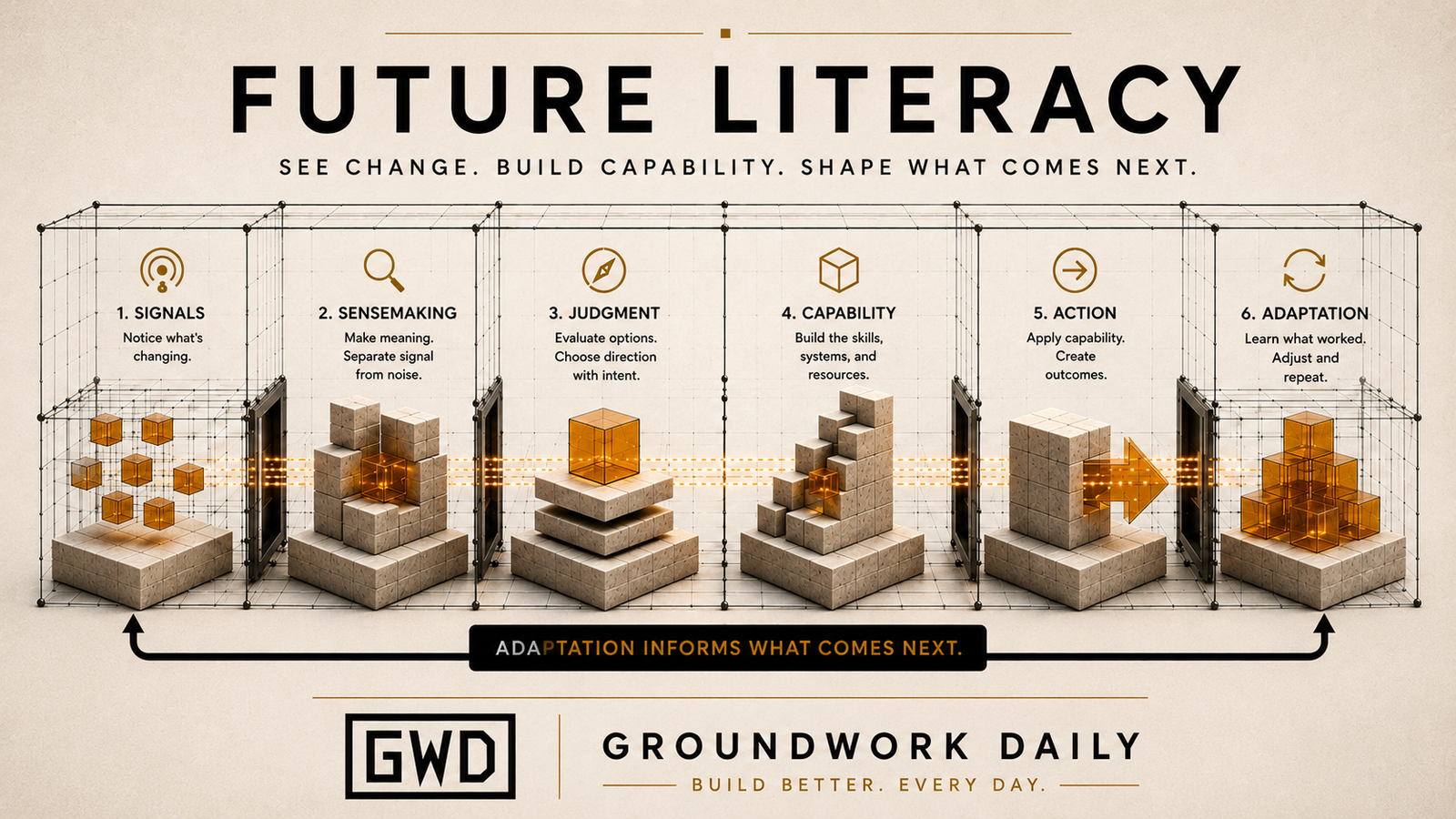
The Future Literacy Capability Loop
The skill stack works as a reinforcing loop rather than a collection of isolated competencies.
Input → what receives your attention
Interpretation → how you make sense of what you receive
Decision → what you choose to do
Capability → what you can reliably execute
Stability → what continues to hold under pressure
Adaptation → what you update after receiving feedback
Weak inputs distort interpretation, which damages decisions and, in turn, limits capability. By contrast, a stronger loop gives you more room to adapt without rebuilding everything from zero.
The Seven Core Future Literacy Skills
The seven skills below are not personality traits. Instead, they are trainable disciplines that strengthen the larger capability system.
1. Clarity
Clarity is the ability to see what is actually happening without letting urgency, noise, or emotion distort the picture.
Modern pressure creates false emergencies. Notifications compete for priority, while unresolved tasks become background noise. As a result, too many simultaneous inputs make it harder to distinguish what matters from what is merely loud.
Clarity begins by reducing competition for attention.
A clear person does not start every morning by opening every channel. Instead, they identify what is true, what matters, and what deserves the next unit of attention.
How to Train Clarity
The common mistake is confusing awareness with clarity. Knowing about more things can make you less clear if the information has no hierarchy.
Train this week: Write the real problem in one sentence before solving it. Then remove one source of unnecessary input before noon.
Continue building: How to Think Clearly When Everything Pulls at You.
2. Decision Hygiene
Decision hygiene is the practice of designing conditions that make good decisions easier and poor decisions less likely.
Tired judgment often reaches for speed, comfort, or avoidance. Consequently, preventable damage can enter before the decision receives proper scrutiny.
Good decision hygiene creates useful friction before costly choices. It uses timing, rules, thresholds, and review rather than asking mood to make every call.
For example, a large purchase does not need to be decided at midnight because anxiety created urgency. A cleaner rule may require a waiting period, a cost check, and a review of the effect on cash flow.
How to Train Decision Hygiene
Not every decision deserves equal attention. Some choices need defaults, others need delay, and only a small number deserve deeper review.
Train this week: Use a simple filter before one meaningful decision: cost, risk, impact.
Continue building: Discipline Before Dollars.
3. Communication That Creates Action
Communication is the ability to express what matters clearly enough that another person can understand the point and act.
Fragmented attention changes the value of clarity. Long, indirect, emotionally overloaded messages force the reader to perform extra interpretive work.
Strong communication reduces that friction.
A useful message usually makes the point, provides necessary context, and identifies the requested action.
For example, instead of circling a scheduling problem for five paragraphs, a clearer message might say: “The current time no longer works. Tuesday at 2 p.m. or Thursday at 11 a.m. both work. Please confirm one by noon.”
How to Train Communication
Overexplaining often feels safer because it creates the illusion of completeness. However, useful communication depends more on structure than volume.
Train this week: Before sending one important message, remove one repeated idea, one unnecessary qualifier, and one sentence that does not help the reader act.
Continue building: The Rational Field.
4. Digital Literacy
Digital literacy is the ability to use tools, information, data, files, platforms, and AI systems without allowing the digital environment to govern your attention.
Digital disorder becomes operational disorder. Scattered files, weak security, poorly chosen tools, redundant workflows, and constant notifications all create invisible cognitive cost.
The relevant question is no longer whether you use technology. Instead, ask whether the technology increases capability or simply increases surface area.
Digital literacy includes basic cybersecurity, file organization, data judgment, workflow design, AI fluency, and the discipline to reject a tool when it adds more complexity than value.
How to Train Digital Literacy
App familiarity is not the same thing as digital competence. After all, clicking through interfaces proves very little about whether the underlying system works.
Train this week: Clean one digital folder, remove three tools you no longer use, update one weak password, and identify one workflow where technology genuinely reduces friction.
Related Groundwork: Education & Skills.
5. Emotional Precision
Emotional precision is the ability to name what you are feeling accurately enough that the feeling does not automatically become the strategy.
Stress changes interpretation. For instance, fatigue can make delay feel like disrespect, anxiety can make uncertainty feel like danger, and frustration can turn a temporary problem into a permanent story.
Precision creates space between the signal and the response.
“Everything is falling apart” gives you little to work with. By comparison, “I am overloaded, under-rested, and unclear about the next step” creates a much more usable diagnosis.
How to Train Emotional Precision
Feelings contain information, but they do not automatically contain instructions.
Train this week: Before one response made under pressure, name the emotional state plainly: tired, anxious, irritated, rushed, disappointed, embarrassed, or unclear.
Related Groundwork: Stillness & Soul.
6. Structural Thinking
Structural thinking is the ability to understand the systems, incentives, constraints, processes, and feedback loops underneath recurring outcomes.
Many repeated problems are not random. Rather, a structure is producing them.
If a team repeatedly misses deadlines, the visible issue may be lateness. However, the structural issue may be unclear ownership, poor handoffs, weak documentation, or a planning process that consistently underestimates the work.
The same principle applies to households, careers, finances, technology, and routines. Therefore, repetition is often a clue that the system deserves inspection.
How to Train Structural Thinking
Start with four questions:
- What inputs keep entering the system?
- What process turns those inputs into the outcome?
- What incentive or constraint keeps the process in place?
- Where could one intervention change the pattern?
The common mistake is blaming character before inspecting structure. Accountability still matters, but it becomes more accurate when the mechanism is visible.
Train this week: Pick one recurring problem and map its inputs, process, outputs, and consequences.
Continue building: Systems Thinking for Real Life.
7. Financial Fluency
Financial fluency is the ability to understand how money behaves across time, risk, timing, obligation, and consequence.
Financial pressure exposes weak systems quickly because money connects to housing, transportation, food, debt, family obligations, taxes, and employment decisions.
Financial fluency does not require becoming a financial professional. Instead, it requires understanding the household system well enough to stop guessing.
That includes cash flow, timing, debt, credit, taxes, emergency capacity, recurring obligations, and the difference between a temporary expense and a structural mismatch.
How to Train Financial Fluency
Knowing financial terminology is not the same as operating a working money system. Therefore, the goal is usable visibility rather than vocabulary alone.
Train this week: Review one month of cash flow. Identify the next income date, the next major obligation, the current buffer, and one avoidable leak.
Continue building: Discipline Before Dollars.
The Capability Ladder
These seven skills do not become durable in one step. Instead, they move through levels of increasing reliability.
Level 1: Awareness
At the first level, you can recognize the skill and identify where weakness is producing friction.
Awareness matters. However, it is still diagnosis rather than dependable capability.
Level 2: Practice
With practice, the skill becomes something you can perform intentionally when you remember to use it.
At this stage, execution still requires attention and deliberate effort.
Level 3: Functional Capability
Eventually, the skill becomes reliable enough to use under ordinary pressure.
Ideal conditions are no longer required before clarity, decision rules, communication standards, or structural thinking become available.
Level 4: Adaptive Capability
At the adaptive level, the underlying skill transfers into unfamiliar conditions.
A new tool, employer, financial constraint, team, or environment may change the surface problem. Nevertheless, the capability remains usable.
At that point, the skill stack begins functioning as infrastructure rather than a collection of tips.
Continue building: The Three Levels of Capability: Baseline, Functional, Adaptive.
Where This Fits in the Future Literacy Series
This article is the first layer of the original Future Literacy sequence. It establishes the capabilities that later articles develop in more detail.
Posts 01–05: Build the Operating Base
The first half of the sequence moves from the foundational skill stack into clarity, bandwidth, daily structure, and adaptability.
The Skill Stack You Actually Need in 2026
The capability foundation.
How to Think Clearly When Everything Pulls at You
Clarity under pressure.
The difference between time and usable capacity.
Build a Daily System That Protects Time, Energy, and Clarity
Daily capacity protection.
How to Stay Capable When the Future Moves Faster Than You Do
Capability under acceleration.
Posts 06–10: Extend the System
The second half moves outward. Direction, adaptive capability, pattern recognition, systems thinking, and daily architecture turn the operating base into a broader Future Literacy practice.
How to Build a Two-Year Direction
Direction without rigid prediction.
The Three Levels of Capability
Baseline, functional, and adaptive capability.
How to Read the Patterns That Shape Your Future
Pattern literacy before pressure arrives.
Systems Thinking for Real Life
How repeated outcomes are produced.
The Structure That Makes Future Literacy Work Every Day
The daily architecture that brings the sequence together.
Beyond this original sequence, the Future Literacy hub extends the framework into Career Capital, workforce signals, and additional capability work.
The 30-Day Future Literacy Sprint
You do not need a dramatic overhaul to begin strengthening the stack. Instead, you need enough repetition to see where capability is weak and where structure already works.
Week 1: Attention and Clarity
First, reduce one recurring source of noise. Clean one digital space. Then begin each morning by naming the most meaningful problem before opening multiple channels.
Week 2: Decisions and Communication
Next, use the cost-risk-impact filter on meaningful choices. Create one decision rule. In addition, tighten one recurring form of communication so the requested action becomes obvious.
Week 3: Systems and Digital Structure
During the third week, map one recurring problem. Identify its inputs, process, output, incentives, and constraints. Afterward, remove one piece of digital friction from the same environment.
Week 4: Money and Adaptation
Finally, review cash flow, open loops, recurring stress points, and what changed during the month. Keep the structures that reduced friction, and revise the ones that did not.
The sprint is not a test of intensity. Rather, it is a diagnostic.
After thirty days, you should have enough evidence to see which capabilities need deliberate practice and which ones are beginning to function as defaults.
How to Know the Skill Stack Is Becoming Capability
Progress will not always look dramatic. In fact, the strongest signs are often quieter.
You Respond With More Control
Not every stimulus becomes a command. Instead, more space appears between incoming pressure and your response.
Open Loops Close Earlier
Messages, bills, decisions, files, and unresolved tasks spend less time occupying background attention because the system addresses them before they compound.
Stress Becomes More Specific
Rather than feeling generally overwhelmed, you can identify the actual constraint: time, money, uncertainty, fatigue, unclear ownership, or missing information.
Your Environment Creates Less Friction
Over time, files become easier to find, decisions gain rules, and messages become clearer. Meanwhile, money becomes less mysterious and routines develop more rhythm.
That is what capability often looks like before anyone else can see it.
The Path Forward
The skill stack you actually need in 2026 is not glamorous.
That is one reason it matters.
Clarity rarely announces itself, and decision hygiene does not perform. Digital order is mostly invisible, while emotional precision can look like restraint. Structural thinking may look slower than reaction, and financial fluency can feel ordinary.
Yet these capabilities hold weight when conditions become less predictable.
Together, they help you separate signal from noise and act without needing certainty. In addition, they make learning more usable, communication cleaner, money more legible, and adaptation less chaotic.
You do not become future literate through one burst of intensity.
Instead, capability grows through repeated practice until it remains available when conditions are not ideal.
Read the signal. Build the capability. Protect the structure.
Further Groundwork
How to Think Clearly When Everything Pulls at You
Strengthen the clarity layer of the skill stack and protect judgment when attention is fragmented.
The Three Levels of Capability
Distinguish between knowing a skill, using it reliably, and adapting it when conditions change.
Systems Thinking for Real Life
Learn how incentives, constraints, processes, and feedback create repeated outcomes.
Education & Skills
Explore the broader Groundwork Daily category for capability, learning, technology, and practical skill development.
Receipts
OECD Skills Outlook 2025
Research on literacy, numeracy, adaptive problem solving, skill use, and the capabilities associated with economic and social resilience.
FINRA Foundation · National Financial Capability Study
Findings on household financial capability, saving, financial knowledge, and financial resilience.
Pew Research Center · Information Overload
Context on information access, digital abundance, and how people experience information overload.