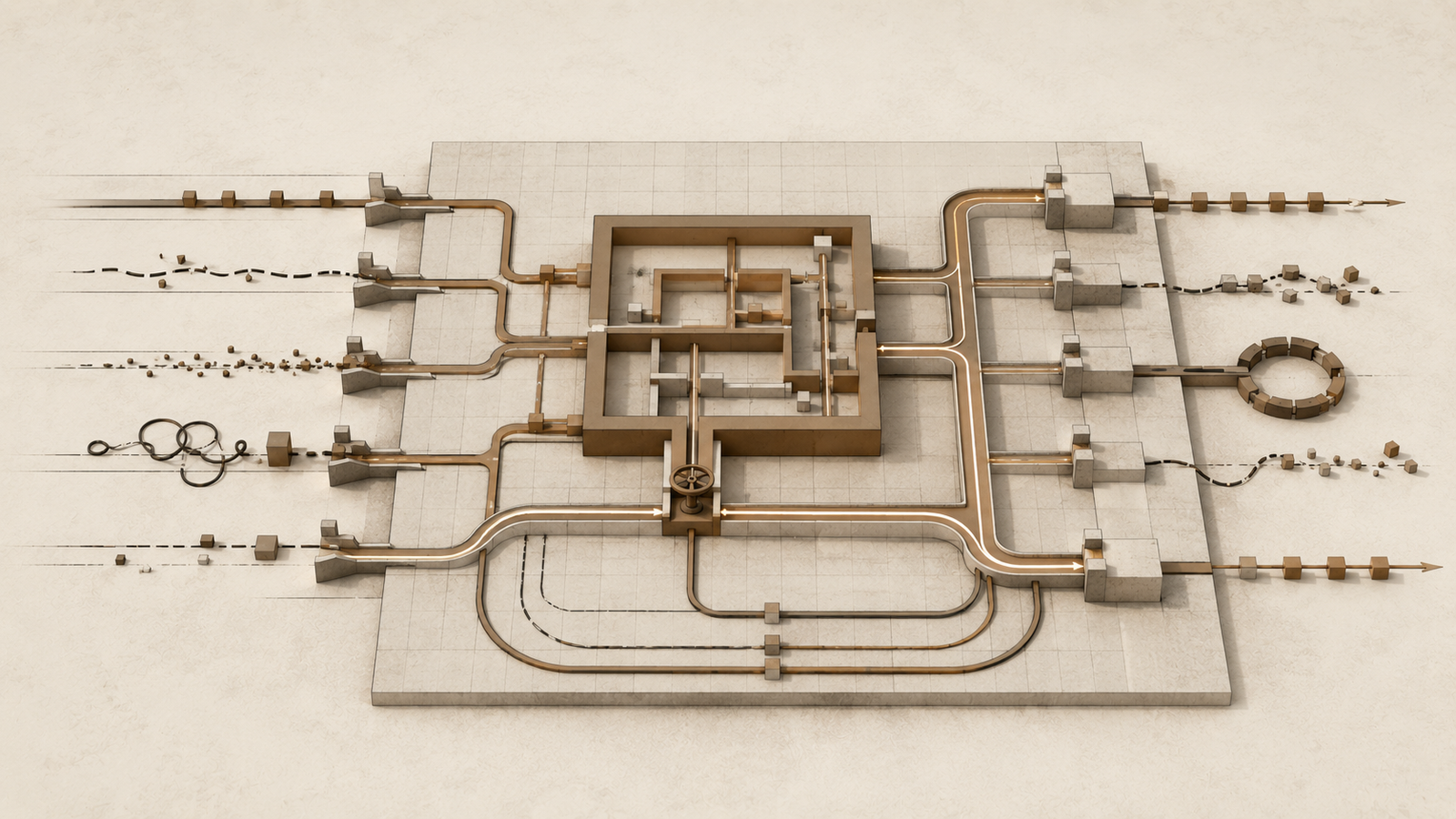
Systems thinking is the practice of examining repeated outcomes, identifying the structures that may be producing them, and changing the part of the system most likely to alter what happens next.
Most people naturally respond to problems where the pain becomes visible.
A deadline slips, so everyone works later. Spending rises, so the household cuts purchases. A meeting fails, so another meeting gets scheduled. The same disagreement returns, so the conversation becomes more intense.
Sometimes those responses are appropriate.
However, when the same outcome keeps returning, another question becomes necessary:
What keeps making this outcome likely?
That question is the entry point to systems thinking.
A missed deadline may involve individual execution, but it may also expose unclear ownership, unrealistic estimates, late approvals, or poor handoffs. Financial pressure may involve spending choices, while the larger system may include volatile income, recurring obligations, weak cash-flow timing, or expensive defaults.
Likewise, recurring conflict may involve individual behavior while also revealing unclear expectations, uneven responsibility, poor timing, or the absence of a reliable repair process.
Systems thinking does not remove personal accountability. Instead, it makes accountability more precise by separating individual decisions from the environment that repeatedly shapes those decisions.
This ninth article in Groundwork Daily’s Future Literacy series builds directly on How to Read the Patterns That Shape Your Future. Pattern recognition helps you notice what is repeating. Systems thinking asks what structure could be generating the repetition.
The Systems Thinking Method
Groundwork Daily uses a practical six-stage method:
Outcome → What keeps happening?
Boundary → What part of the larger environment are you actually examining?
Structure → What inputs, processes, incentives, constraints, and dependencies shape the outcome?
Loop → How does one result feed the next condition?
Leverage → Where could a relatively small intervention materially change the pattern?
Test → What happens after one variable changes?
The last stage matters because systems thinking can become another form of storytelling if the diagnosis is never tested.
A plausible explanation is not automatically the correct explanation.
Systems Thinking Starts by Separating Events From Systems
Events are visible. Systems are often harder to see.
That difference matters because visible problems naturally attract intervention. Yet the visible problem may be occurring downstream from the mechanism that repeatedly creates it.
| Visible Event | Systems Questions Worth Testing |
|---|---|
| Missed deadline | Were priorities clear? Did work enter faster than capacity? Were approvals or handoffs delayed? |
| Financial stress | Is the problem spending, income volatility, debt cost, timing, fixed obligations, or missing buffers? |
| Relationship conflict | Are expectations clear? Is responsibility uneven? Is there a reliable process for repair? |
| Repeated exhaustion | Is workload exceeding capacity? Is recovery protected? What commitments repeatedly consume the margin? |
| Low focus | What interruptions, task switches, unclear priorities, or environmental cues compete for attention? |
The event tells you where to investigate.
It does not automatically tell you which system caused it.
That distinction protects systems thinking from becoming a reflexive search for elaborate explanations when a simple explanation may be sufficient.
Not Every Event Is a Systems Problem
One error should not automatically trigger a process redesign.
People make mistakes. Machines fail. Weather changes plans. A customer cancels. Someone has an unusually difficult day.
Therefore, before redesigning anything, ask whether the outcome is recurring, consequential, or revealing enough to justify deeper investigation.
This is where Post 08’s pattern recognition framework matters. First establish that the signal deserves attention. Then investigate the system.
Why Systems Thinking Changes Decisions
Systems thinking slows premature blame and premature solutions.
That is valuable because both can feel satisfying before they prove useful.
Blame gives the mind a target. A quick solution gives the mind closure. Neither guarantees that the underlying mechanism has been understood.
Instead, systems thinking asks you to inspect how several elements interact over time.
Those elements can include incentives, defaults, timing, information, roles, constraints, workload, dependencies, feedback, and the consequences attached to different behaviors.
Afterward, the goal is not endless analysis.
The goal is a better intervention.
Define the System Before You Diagnose It
A system does not have a natural edge.
You have to decide what is inside the analysis and what remains outside it.
This is called the system boundary.
Without a boundary, every problem can expand until it appears connected to everything. At that point, the model becomes too broad to guide action.
Start Small Enough to Act
Suppose a team repeatedly misses deadlines.
You could define the system as the entire company. You could also include the labor market, customer demand, leadership culture, software stack, and broader economy.
All of those factors might matter.
However, the first useful boundary might simply be:
Work enters the team → priorities are assigned → work moves between people → approvals occur → the deliverable leaves the team.
That boundary is narrow enough to inspect.
If the problem cannot be explained there, widen the system deliberately.
Ask What You May Be Leaving Out
A narrow boundary can also create bad diagnosis.
For example, a productivity problem may look like poor personal discipline until the analysis includes workload volume, caregiving responsibilities, chronic interruptions, or unclear expectations.
Therefore, treat the boundary as a working assumption rather than permanent truth.
The Five-Part Architecture of a Practical System
For everyday diagnosis, five components provide a useful map:
Inputs → what enters the system.
Process → what happens to those inputs.
Outputs → what the system produces.
Feedback → what the result tells the system.
Reinforcement → what makes the pattern more or less likely to repeat.
1. Inputs
Inputs are the resources and conditions entering the system before the result appears.
Depending on the problem, inputs may include time, information, staffing, money, sleep, tools, instructions, customer demand, emotional state, physical materials, or available attention.
Inputs matter because an output cannot be judged cleanly without considering the conditions that preceded it.
A person may appear slow because the process is weak. Yet the problem could begin even earlier if the work arrived with incomplete information or contradictory requirements.
2. Process
The process is what happens after the inputs enter.
Processes include decisions, routines, approvals, handoffs, defaults, sequencing, communication, and rules.
Many systems fail here because the process exists only as an assumption.
If everyone thinks someone else owns the next step, ownership is not clear. If work depends on remembering an undocumented sequence, the process is fragile. If approval criteria change from person to person, the system contains unnecessary uncertainty.
3. Outputs
Outputs are what the system actually produces.
That might be completed work, errors, delay, savings, debt, trust, conflict, customer satisfaction, fatigue, or another measurable result.
The crucial discipline is to distinguish the output you intended from the output the system repeatedly creates.
Intentions do not override recurring evidence.
4. Feedback
Feedback is information generated by the output.
A delay can be feedback. So can an error rate, customer complaint, financial shortfall, repeated repair, missed handoff, or exhausted team.
However, not all feedback is equally useful.
Some feedback arrives too late. Some is noisy. Some gets ignored because nobody owns the review.
A healthier system makes important feedback visible early enough to change behavior.
5. Reinforcement
Reinforcement helps explain why a pattern persists.
A system may formally reward one thing while practically rewarding another.
For example, leadership may say quality matters while consistently rewarding only speed. A household may value saving while making convenience spending effortless and savings transfers optional.
Similarly, a team may claim that ownership matters while allowing vague assignments to leave every meeting.
What the system repeatedly rewards usually matters more than what the system says it values.
Systems Thinking Depends on Feedback Loops
A feedback loop forms when one result changes the conditions that produce the next result.
For example:
Late scrolling → less sleep → rushed morning → greater fatigue → weaker evening self-control → more late scrolling
The visible problem may appear in the morning.
The loop, however, begins earlier.
Once the sequence becomes visible, the intervention can move upstream.
Reinforcing Loops Amplify Change
A reinforcing loop makes movement in one direction increasingly likely.
Avoidance can create more unresolved work. More unresolved work creates more pressure. Higher pressure can then increase avoidance.
Yet reinforcing loops can also compound useful behavior.
A small savings buffer can reduce financial panic. Reduced panic can improve decision quality. Better decisions can protect the buffer and make future saving easier.
Therefore, the important question is not whether reinforcement exists.
It is what the loop is reinforcing.
Balancing Loops Limit Drift
Balancing loops push a system back toward a desired range.
A weekly financial review may detect overspending before the end of the month. A project checkpoint can expose delay before the final deadline. A recovery routine can interrupt accumulating fatigue.
These loops create correction before emergency.
Future Literacy benefits from balancing loops because adaptation becomes easier when drift is detected early.
Watch for Delays Between Cause and Consequence
Systems can be difficult to understand because consequences do not always appear immediately.
A poor process may continue for months before enough errors accumulate to become visible. A weak financial habit can remain manageable until a second expense arrives. Training decisions may take months or years to affect career mobility.
That delay can create false confidence.
A system can appear healthy simply because the cost has not arrived yet.
Ask Where the Delay Lives
When an intervention appears ineffective, consider whether enough time has passed to observe the result.
Conversely, when a risky practice appears harmless, consider whether the system simply has not produced the consequence yet.
Time is part of the system.
Find the Leverage Point, Not the Loudest Problem
A leverage point is a place where a change can alter more of the system than its apparent size would suggest.
Leverage does not necessarily mean dramatic intervention.
In ordinary life, useful leverage can look like:
- clarifying one owner before a meeting ends;
- creating one automatic savings transfer;
- moving a phone away from the bed;
- defining what information must accompany a work request;
- establishing one decision deadline;
- removing one unnecessary approval;
- creating one review point before a failure becomes expensive.
The strategic question is not, “What is the biggest action I can take?”
It is: Where can I intervene while the outcome is still being formed?
Weak Leverage Treats the Symptom Late
Trying to recover from overload only after every day has become chaotic is weak leverage.
By contrast, reducing recurring inputs, clarifying priorities, and protecting focused time earlier can change the conditions producing the overload.
Similarly, repeated apologies may be necessary after relationship conflict. However, apologies alone are weak leverage if the same unclear expectation keeps recreating the conflict.
Leverage Must Be Tested
Do not fall in love with a clever intervention.
Change one variable where possible. Then observe whether the outcome actually moves.
If nothing improves, the assumed leverage point may have been wrong.
That is information, not failure.
How to Use Systems Thinking in Real Life
You do not need specialized software to begin.
Start with one recurring problem that is consequential enough to inspect and narrow enough to influence.
Step One: Name the Repeated Outcome
Describe what keeps happening without explaining it yet.
For example:
- Our projects regularly enter final review late.
- I repeatedly run short before the next pay period.
- The first hour of my workday disappears into messages.
- The same household responsibility creates conflict every week.
A neutral description preserves the difference between evidence and interpretation.
Step Two: Define the Boundary
Decide what system you are examining.
Keep it small enough to map but broad enough to include the likely mechanism.
Step Three: Map Inputs and Process
Write down what enters the system and what happens next.
Look for handoffs, delays, missing information, unclear ownership, defaults, bottlenecks, and decisions that repeatedly have to be rediscovered.
Step Four: Identify Feedback and Reinforcement
Ask what signals the system produces and who sees them.
Then ask what behavior is actually rewarded or made easier by the current structure.
Step Five: Map the Loop
Use a simple sequence:
Condition → Behavior → Result → Feedback → Next Condition
The map does not need to be academically perfect.
It needs to be useful enough to reveal where intervention may matter.
Step Six: Change One Variable
Adjust one input, rule, default, handoff, feedback mechanism, or constraint.
Avoid changing everything simultaneously. Otherwise, attribution becomes difficult and the redesign creates more complexity than learning.
Step Seven: Review the Result
Did the outcome improve?
If it did, keep testing the intervention under real conditions.
If it did not, revisit the diagnosis. The boundary, structure, or leverage point may need revision.
Six Common Systems Thinking Traps
1. More Effort Instead of Better Structure
Effort matters, but bad structure can consume effort faster than people can supply it.
If the same problem keeps returning, repeatedly demanding more effort deserves scrutiny.
2. Treating Every Problem as Structural
Sometimes a person made a mistake.
Sometimes one unusual event happened.
Do not create an elaborate systems diagnosis when ordinary accountability or a simple correction is sufficient.
3. Tracking Outputs Without Inputs
Outputs tell you what occurred.
Inputs and process help explain why it may have occurred.
Ignoring upstream conditions keeps intervention late.
4. Changing Too Many Variables
A dramatic overhaul can feel decisive while making learning harder.
Where feasible, change one important variable and observe the effect before adding another.
5. Ignoring Incentives
A system tends to reproduce behavior that is rewarded, protected, or made easier.
Therefore, stated expectations should always be compared with actual consequences.
6. Confusing the Model With Reality
Your map of the system is not the system itself.
Every model simplifies.
That means a systems thinker must remain willing to revise the map when evidence does not behave as expected.
Systems Thinking Examples in Real Life
Work: The Team Keeps Falling Behind
A manager might initially conclude that the team lacks urgency.
After mapping the workflow, another explanation could emerge: tasks repeatedly leave meetings without a clear owner, deadline, or next action.
In that case, another motivational speech would attack the symptom.
A more useful test might be a handoff rule:
Every assigned task leaves the meeting with one owner, one deadline, and one defined next action.
After several cycles, the team can compare deadline performance before and after the change.
That turns a theory into a test.
Money: The Budget Never Holds
Repeated overspending may look like a discipline problem.
However, a category review might reveal that irregular expenses are repeatedly treated as surprises, bills cluster before income arrives, or discretionary money has no explicit boundary.
A structural response could include sinking funds, automated transfers, different bill timing where available, or a clearer spending allocation.
Related Groundwork: Discipline Before Dollars.
Attention: Focus Disappears Every Morning
The obvious conclusion might be poor concentration.
Yet the system could begin with an open inbox, multiple notifications, undefined priorities, and a workspace designed around interruption.
One test might be to establish the first task before opening communication channels and delay nonessential notifications for a defined block.
The intervention targets the environment instead of relying only on willpower.
Relationships: The Same Argument Keeps Returning
Recurring conflict can have many causes, so a systems lens should not flatten everything into process.
Individual behavior, values, trust, power, safety, and compatibility can all matter.
However, when the issue genuinely involves a recurring operating problem, useful questions include:
- Is the expectation explicit?
- Is responsibility understood the same way by both people?
- When does the conversation usually occur?
- What happens after conflict?
- Is there a reliable repair process?
The purpose is not to engineer human beings.
It is to identify recurring conditions that can be changed without pretending structure explains everything.
The Seven-Day Systems Thinking Audit
Use this audit when an outcome keeps repeating and the current explanation is not producing improvement.
Day One: Name the Outcome
Write one neutral sentence describing what keeps happening.
Do not diagnose it yet.
Day Two: Define the Boundary
Decide what part of the larger system you will examine first.
Write down one important factor that may sit outside that boundary so you do not forget the limitation.
Day Three: Map Inputs and Process
Record what enters the system and the sequence that follows.
Look for delays, missing information, friction, unclear ownership, and repeated workarounds.
Day Four: Study the Feedback
What signals indicate whether the system is working?
Who sees them, and how quickly?
Feedback that arrives after the damage is difficult to use.
Day Five: Find the Reinforcement
Ask what the current system makes easy, protects, or rewards.
Compare that with what the system claims to value.
Day Six: Test One Leverage Point
Change one variable that is small enough to reverse but meaningful enough to affect the outcome.
Day Seven: Review the Evidence
Did the result move in the expected direction?
If yes, continue testing.
If not, revise the model instead of forcing reality to fit it.
Why Future Literacy Requires Systems Thinking
Future Literacy is not only about noticing change.
It is also about understanding how change is produced.
That is why systems thinking follows pattern recognition in this sequence.
Pattern literacy establishes that signals are connecting. Systems thinking then asks which mechanisms, incentives, dependencies, processes, and feedback loops could explain the pattern.
Posts 01–03: Build the Cognitive Foundation
Post 01 established the foundational skill stack.
Post 02 developed clarity under pressure, while Post 03 examined the hidden cognitive load that can make clear thinking harder to access.
Posts 04–07: Build Direction and Capability
Post 04 turned capacity protection into daily structure.
Post 05 introduced selective adaptation, while Post 06 gave that capability a practical direction.
Then Post 07 distinguished baseline, functional, and adaptive capability.
Posts 08–09: Read the Environment
Post 08 introduced pattern recognition: signal, repetition, structure, direction, disconfirmation, and decision.
Post 09 goes underneath those patterns.
Signals → Patterns → Systems → Leverage → Adaptation
Next: Turn the Framework Into Daily Structure
The final article, The Structure That Makes Future Literacy Work Every Day, closes the original sequence by turning the ideas into a repeatable daily operating structure.
The progression matters.
Seeing the system is useful. However, Future Literacy is not complete until understanding changes how you operate.
The Path Forward
Systems thinking changes the quality of the question.
Instead of immediately asking who failed, ask what outcome keeps repeating.
Next, define the part of the system you can reasonably inspect.
Then examine the inputs, process, outputs, feedback, reinforcement, and delays shaping the pattern.
After that, identify one plausible leverage point and test it.
If the outcome changes, you have evidence that the intervention mattered.
If it does not, revise the model.
The objective is not to explain everything as a system. It is to recognize when structure is repeatedly shaping outcomes strongly enough that changing the structure becomes smarter than repeatedly treating the symptom.
Further Groundwork
How to Read the Patterns That Shape Your Future
Learn to distinguish isolated signals from patterns worth investigating.
The Structure That Makes Future Literacy Work Every Day
Continue into the original series finale and convert Future Literacy into a repeatable daily operating structure.
How to Build a Daily System That Protects Your Time, Energy, and Clarity
See how system design can protect cognitive capacity before daily pressure consumes it.
The Bandwidth Trap
Examine the hidden cognitive load that can make better judgment difficult to access.
How to Build a Two-Year Direction
Use direction to decide which systems deserve improvement and which do not justify the investment.
Education & Skills
Explore Groundwork Daily’s broader work on learning, capability, judgment, technology, and practical skill development.
Receipts
The Systems Thinker
Practical material on systems thinking, feedback, causal relationships, system behavior, and leverage.
MIT Sloan · Ideas Made to Matter
Research and analysis on organizations, decision-making, operations, management, and changing systems.
OECD Skills Outlook 2025
Research on adult skills, adaptive problem solving, skill use, and capabilities required in changing environments.