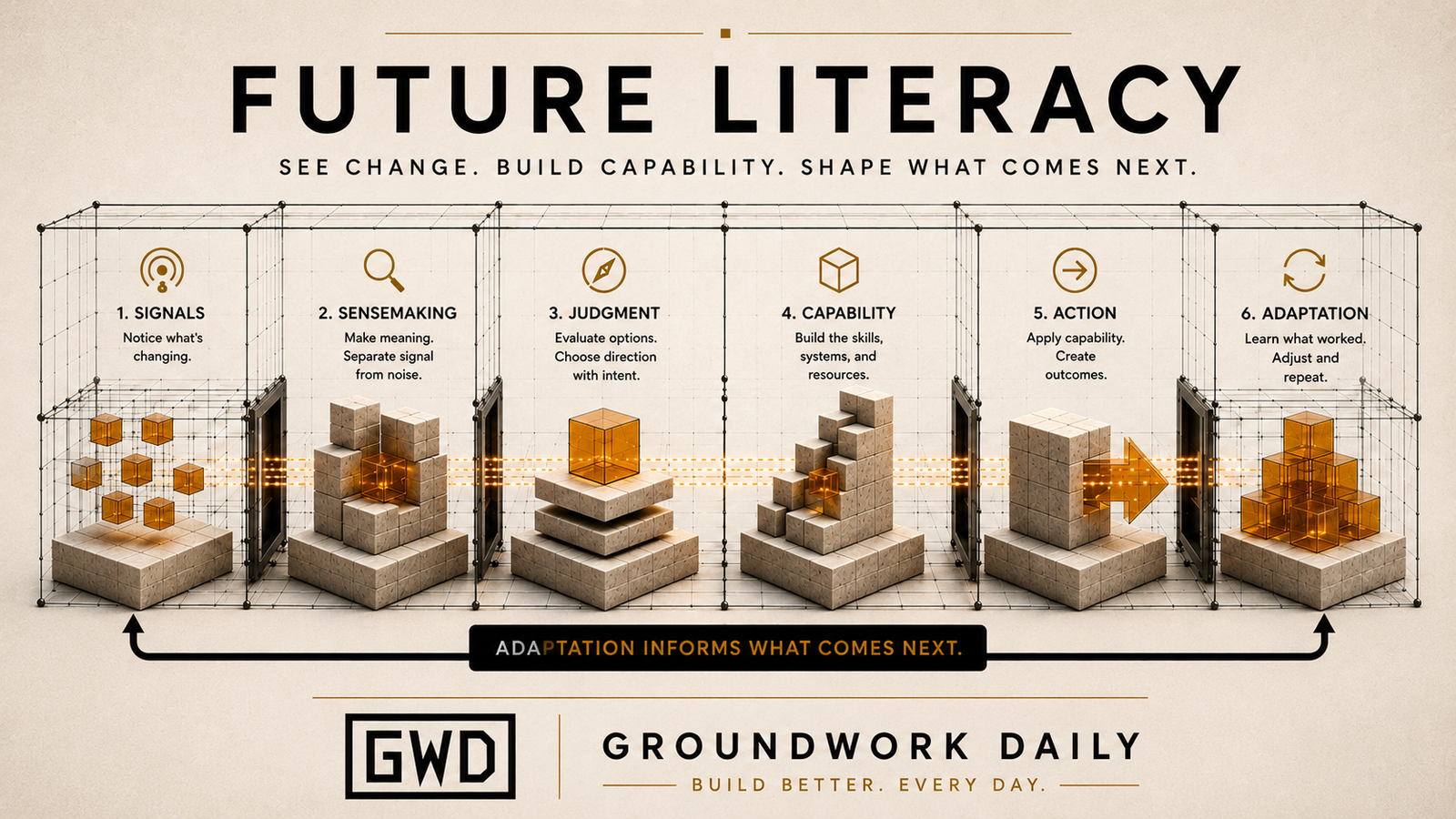
Pattern recognition skills help you notice meaningful signals, determine whether they form a real pattern, understand the structure producing them, and decide whether the pattern deserves action.
Groundwork Daily calls the broader discipline pattern literacy. It is not simply the ability to notice repetition. Instead, it combines observation, interpretation, testing, and proportionate response.
Most people do not miss change because they lack intelligence. More often, they either react too strongly to isolated events or wait until a pattern has become impossible to ignore.
Both approaches are expensive.
One unusual meeting does not prove an organization is changing direction. Likewise, one expensive grocery trip does not establish a financial trend, and one disagreement does not define a relationship.
However, repeated shifts in behavior, incentives, costs, expectations, demand, language, or operating rules can reveal that something deeper is moving.
The work is learning to tell the difference.
That is why pattern recognition skills matter inside Future Literacy. The objective is not to predict every outcome. Rather, it is to recognize meaningful change early enough that you still have choices.
This eighth article in Groundwork Daily’s Future Literacy series follows The Three Levels of Capability. Post 07 asked what you can reliably do today. Post 08 asks the next question: what is changing around that capability, and how should you interpret it?
The Pattern Recognition Skills Method
To build reliable pattern recognition skills, Groundwork Daily uses a six-stage method for reading emerging change without confusing observation with prediction:
Signal → What changed or caught your attention?
Repetition → Is it recurring, or is it still an isolated event?
Structure → What incentives, constraints, dependencies, or processes may be producing it?
Direction → If the pattern persists, what becomes more or less likely?
Disconfirmation → What evidence would show that your interpretation is wrong?
Decision → Does this require action, experimentation, monitoring, or no response?
The final two stages matter as much as the first four.
Without disconfirmation, pattern recognition can become storytelling. Without a decision rule, observation can become endless monitoring.
What Pattern Recognition Skills Actually Do
Pattern recognition skills support practical sensemaking under uncertainty.
Observation is the starting point, but observation alone is not enough. You also need to determine whether a signal repeats, identify what may be producing it, and test whether your interpretation holds up against competing explanations.
That makes disciplined pattern recognition different from intuition alone.
Intuition can be useful, especially when it grows from deep experience. However, intuition can also be distorted by memory, emotion, recent events, or the desire to confirm what you already believe.
Pattern literacy therefore adds structure to perception.
Pattern Recognition Is Not Prediction
A pattern does not tell you exactly what will happen next.
At best, a well-supported pattern changes the probability of certain outcomes and gives you a better basis for preparation.
That distinction is critical.
For example, if several employers in one field reduce entry-level hiring, increase automation, and rewrite job descriptions around higher technical expectations, the pattern may justify strengthening adjacent skills.
It does not justify claiming that every job in the field will disappear.
Strong pattern recognition skills produce proportionate action rather than exaggerated certainty.
Pattern Recognition Creates Lead Time
The strategic value of pattern recognition is not certainty. It is lead time.
Earlier recognition can give you more room to learn, save, negotiate, change a process, test an assumption, or prepare an alternative before pressure forces the decision.
That is why this capability belongs inside Future Literacy.
The future rarely arrives as one clean announcement. Instead, it often appears first as changing incentives, repeated complaints, new defaults, altered language, rising costs, declining demand, new requirements, or quiet shifts in behavior.
Pattern Recognition Skills Begin by Separating Events From Patterns
Events attract attention because they are visible.
Patterns matter because they connect events across time.
One missed deadline may be an isolated event. By contrast, five missed deadlines from the same workflow may justify closer examination.
A single price increase may be temporary. Several months of rising costs across the same household categories may indicate something more persistent.
Similarly, one difficult conversation can happen for many reasons. Repeated tension around the same unresolved responsibility may reveal a structural issue.
The discipline is resisting premature conclusions.
Ask Before You Generalize
Before labeling something a pattern, ask:
- How many times has this happened?
- Across what period?
- Under similar or different conditions?
- Is the signal increasing, decreasing, or merely fluctuating?
- What other explanation could account for it?
This does not require statistical modeling for every personal decision.
Instead, it requires enough discipline to distinguish repeated evidence from a vivid anecdote.
Frequency Is Not the Only Test
Some signals matter before they repeat many times.
A major regulatory change, company restructuring, new licensing requirement, or removal of a critical product can alter the environment immediately.
In those cases, the pattern may sit above the individual event.
The event matters because it reflects a broader structural movement already underway.
Consequently, good pattern recognition requires more than counting repetitions. Context matters too.
Three Pattern Types Your Recognition Skills Should Detect
The six-stage method tells you how to read a pattern.
The next framework tells you what kind of pattern you are examining.
Future Literacy uses three useful categories: surface patterns, structural patterns, and directional patterns.
1. Surface Patterns: What Keeps Happening?
Surface patterns are repeated outcomes you can observe directly.
They may appear in work, money, attention, relationships, health, technology, or household systems.
Examples include:
- the same project stage repeatedly missing deadlines;
- one expense category increasing every month;
- the same time block repeatedly getting interrupted;
- a particular customer question appearing again and again in support requests;
- the same task requiring rework.
A surface pattern tells you that repetition exists.
However, it does not yet tell you why.
How to Read a Surface Pattern
Record the pattern in plain language.
Instead of writing, “Work is chaotic,” write, “The handoff between design and production has required rework in four of the last six projects.”
Specific observations produce better diagnosis because they preserve the evidence before interpretation takes over.
2. Structural Patterns: What Keeps Producing It?
Structural patterns sit underneath repeated outcomes.
They involve incentives, constraints, roles, information flows, dependencies, rules, defaults, or processes that make certain results more likely.
This is where pattern literacy begins to overlap with systems thinking.
Suppose a team repeatedly misses deadlines.
The visible pattern is lateness. Yet the underlying structure may involve unclear ownership, unrealistic estimates, excessive approvals, late requirement changes, or work entering the system faster than capacity can absorb it.
Changing the behavior without changing the structure may therefore produce only temporary improvement.
Questions That Reveal Structure
- What process keeps producing this outcome?
- Which incentive rewards the current behavior?
- What constraint repeatedly blocks progress?
- Where does information arrive too late?
- Who owns the decision?
- What dependency makes the system fragile?
Pressure can make these structures easier to see. Weak handoffs, unclear ownership, and hidden dependencies often become more visible when capacity tightens.
3. Directional Patterns: What Is Becoming More Likely?
Directional patterns concern movement over time.
They do not tell you exactly where the system will end. Instead, they help identify trajectories worth monitoring or preparing for.
Look for changes in:
- demand;
- cost;
- frequency;
- expectations;
- language;
- technology adoption;
- staffing patterns;
- regulation;
- customer behavior;
- training requirements.
A directional pattern becomes more meaningful when several signals point toward the same underlying movement.
Direction Is Not Destiny
One of the easiest mistakes is converting a trajectory into certainty.
If remote work declines in one industry, that does not prove it will disappear everywhere. Likewise, if AI adoption increases in a profession, that does not prove the profession will be automated away.
Instead, the pattern may indicate that expectations, workflows, or skill requirements are changing.
That alone may justify preparation without pretending the destination is known.
Pattern Recognition Skills Must Also Reject False Patterns
Human beings are good at finding stories in incomplete information.
That ability can accelerate learning. Unfortunately, it can also create false confidence.
For that reason, strong pattern recognition skills include the ability to challenge an interpretation rather than merely notice supporting evidence.
Recency Can Distort the Pattern
Recent events feel more important because they are easier to remember.
A difficult week can make a stable job feel permanently unstable. Similarly, one unusually expensive month can make ordinary financial variation look like structural collapse.
Before acting, widen the time window where possible.
Confirmation Bias Can Protect the Story
Once you believe a pattern exists, supporting evidence becomes easier to notice.
At the same time, contradictory evidence becomes easier to dismiss.
That is why pattern literacy needs a disconfirmation step.
Ask: What would I expect to see if my interpretation were wrong?
Small Samples Can Create False Confidence
Three similar events may matter. They may also be coincidence.
The appropriate response depends partly on cost and reversibility.
If acting is inexpensive and reversible, a small experiment may make sense. However, if acting would be expensive, disruptive, or irreversible, demand stronger evidence.
Correlation Is Not Structure
Two things moving together does not prove one caused the other.
For example, rising workload and lower morale may occur together. Yet the underlying causes could include staffing, leadership changes, compensation, unclear priorities, or conditions outside the workplace.
Good pattern recognition therefore stays curious longer than a convenient explanation.
Use Disconfirmation to Strengthen Pattern Recognition Skills
Disconfirmation prevents pattern literacy from turning into narrative certainty.
Before making a consequential decision, ask what evidence would weaken your interpretation.
My current interpretation: What do I think is happening?
Supporting evidence: What signals point in that direction?
Competing explanation: What else could produce the same signals?
Disconfirming evidence: What would make me revise the interpretation?
This discipline does not weaken judgment.
On the contrary, it makes judgment harder to fool.
Pattern Recognition Skills in Real Life
The framework becomes useful when it changes decisions.
The following examples show how the same six-stage method can be used without pretending the initial interpretation is automatically correct.
Example One: Workload Creep
Signal: Additional work keeps entering the role.
Repetition: The increase continues across several planning cycles rather than appearing during one temporary emergency.
Structure: Possible causes include staffing shortages, unclear role boundaries, reliable employees absorbing overflow, or demand growing faster than capacity.
Direction: If the pattern continues, quality, recovery time, or role clarity may deteriorate.
Disconfirmation: Is there evidence that the added work is temporary, staffing is already changing, or responsibilities will be removed elsewhere?
Decision: Document the workload, clarify priorities, ask what should stop when something new is added, and monitor whether the structure changes.
Example Two: Household Spending Drift
Signal: Monthly spending is rising even though major household needs appear unchanged.
Repetition: The increase persists across several months.
Structure: Possible causes include price increases, subscription accumulation, convenience spending, transportation changes, debt costs, or a routine that repeatedly creates expensive defaults.
Direction: If spending continues to rise faster than income, financial margin will shrink.
Disconfirmation: Were the recent months distorted by one-time expenses, annual bills, travel, repairs, or seasonal costs?
Decision: Run a category-level review before imposing a broad spending restriction.
Example Three: Skill Expectations Are Changing
Signal: Job descriptions in your field increasingly request a tool, credential, workflow, or capability that was previously optional.
Repetition: The requirement appears across multiple employers rather than one unusual posting.
Structure: Employers may be changing processes, adopting new technology, consolidating roles, or shifting how work is measured.
Direction: The capability may move from differentiator to baseline expectation.
Disconfirmation: Is the requirement concentrated in one type of employer, geography, seniority level, or niche rather than the broader field?
Decision: Test the skill through a small project before committing to a large credential or expensive training program.
Example Four: Recurring Relationship Friction
Signal: The same disagreement keeps returning.
Repetition: Conflict repeatedly centers on the same responsibility, boundary, expectation, or communication problem.
Structure: Possible causes include unclear agreements, uneven workload, incompatible expectations, missing information, or weak repair habits.
Direction: If the issue remains unresolved, frustration may become part of the relationship’s normal operating environment.
Disconfirmation: Could the recent pattern reflect a temporary period of unusual stress rather than a durable relationship structure?
Decision: Name the repeated issue precisely and address the underlying agreement rather than relitigating each individual event.
Not Every Pattern Requires Action
Pattern literacy should improve judgment, not create more work.
Some patterns require intervention. Others justify monitoring. In addition, some deserve a small experiment, while many deserve no action at all.
Use four response categories:
Act → the evidence is strong enough and delay materially increases cost.
Experiment → uncertainty remains, but a small reversible test can generate information.
Monitor → the pattern may matter, but the evidence or consequence is not strong enough yet.
Ignore → the signal is weak, irrelevant to your direction, or too costly to pursue relative to its importance.
This is where pattern recognition skills become operational.
A signal should not automatically become a project.
How to Build Pattern Recognition Skills
Pattern recognition skills improve through deliberate observation and periodic review.
You do not need to track everything. Instead, focus on the domains that actually affect your responsibilities and direction.
Daily: Capture Signals
Record one signal that changed, repeated, or created friction.
Keep the observation neutral.
For example, write “three clients asked for the same reporting feature this week” rather than “clients are demanding a completely different product.”
The first sentence captures evidence. The second jumps to a conclusion.
Weekly: Look for Repetition
Review the week’s signals and ask whether any belong together.
- What repeated?
- What increased or decreased?
- Which new expectation appeared more than once?
- What friction kept returning?
If the evidence does not connect, leave it alone. Do not manufacture a pattern because a narrative feels satisfying.
Monthly: Examine Structure
Select one recurring pattern and ask what system may be producing it.
Map the following elements:
- inputs;
- process;
- incentives;
- constraints;
- dependencies;
- outputs;
- feedback.
At this stage, pattern literacy becomes stronger through systems thinking.
Quarterly: Review Direction
Look for patterns that have persisted long enough to challenge your assumptions.
Ask:
- Which signals became structural?
- Which concerns disappeared?
- What became more normal?
- What became less useful?
- Which capability now deserves investment?
- Which assumption should be retired?
A quarterly horizon reduces the temptation to rebuild your strategy around every new event.
The Pattern Recognition Review
Use this review whenever a change feels important but its meaning remains uncertain.
- Signal: What changed?
- Repetition: Is it recurring?
- Structure: What may be producing it?
- Direction: What becomes more likely if it continues?
- Disconfirmation: What evidence would prove my interpretation incomplete or wrong?
- Decision: Should I act, experiment, monitor, or ignore?
This sequence protects against two expensive errors.
First, it reduces the chance of reacting before the evidence is strong enough. Second, it reduces the chance of waiting until the evidence becomes so obvious that your options have disappeared.
How Pattern Recognition Skills Fit Into Future Literacy
Pattern recognition skills mark an important transition in the Future Literacy sequence.
The earlier articles focused primarily on the operating capacity of the individual: clarity, bandwidth, daily structure, selective adaptation, direction, and capability diagnosis.
Post 08 turns the lens outward.
Posts 01–03: Build the Cognitive Foundation
Post 01 established the foundational skill stack.
From there, Post 02 strengthened clarity. Then Post 03 examined the hidden load that makes clarity harder to access.
Posts 04–07: Build Direction and Capability
Post 04 turned capacity protection into daily structure.
Next, Post 05 introduced selective adaptation: deciding what deserves attention when conditions accelerate.
Post 06 gave that capability an operating direction. Rather than pretending to predict the next decade, it established a practical twenty-four-month horizon for aligning work, learning, money, health, and major decisions.
Finally, Post 07 distinguished baseline, functional, and adaptive capability so development can match the level actually required.
Post 08: Read the Environment
Post 08 introduces environmental sensing.
At this point, the question changes from “What can I do?” to “What is changing around me, how strong is the evidence, and what response is proportionate?”
Capability → Pattern Recognition → Systems Thinking → Adaptation
Next: Systems Thinking
The next article, How to Use Systems Thinking in Real Life, moves beneath the pattern itself.
Pattern recognition tells you that something keeps happening. Systems thinking asks what processes, incentives, constraints, relationships, and feedback loops keep producing the outcome.
That distinction moves Future Literacy from sensing change toward understanding the machinery underneath it.
The Path Forward
The goal of pattern literacy is not to make the future feel predictable.
That would create false confidence.
Instead, the goal is to improve your ability to notice when isolated signals begin to connect, identify what structure may be producing them, and decide whether the pattern deserves a response.
Start with evidence, then look for repetition.
Next, study the structure and estimate the direction without turning it into destiny.
Before committing resources, challenge your own interpretation.
Finally, choose the smallest response that matches the evidence.
The future becomes more navigable when every signal does not become an emergency and every pattern does not become a prophecy.
Further Groundwork
The Three Levels of Capability
Diagnose whether a capability is baseline, functional, or adaptive before asking how it must respond to changing conditions.
How to Use Systems Thinking in Real Life
Go beneath repeated outcomes and examine the processes, incentives, dependencies, and feedback loops producing them.
How to Build a Two-Year Direction
Give changing signals a decision horizon so short-term noise does not continuously rewrite long-term direction.
How to Stay Capable When the Future Moves Faster Than You Do
Use selective adaptation so every new signal does not automatically become a learning obligation.
How to Think Clearly When Everything Pulls at You
Protect the clarity required to distinguish meaningful signals from noise.
Education & Skills
Explore Groundwork Daily’s broader work on capability, learning, technology, judgment, and practical skill development.
Receipts
World Economic Forum · Future of Jobs Report 2025
Employer research on workforce transformation, technology adoption, changing skill demand, and structural shifts affecting jobs and training.
OECD · Future of Work
Research and policy analysis on structural labor-market change, technology, skills, employment, and adaptation.
Pew Research Center · Future of Work
Research on how technology, work expectations, public attitudes, and employment conditions change over time.