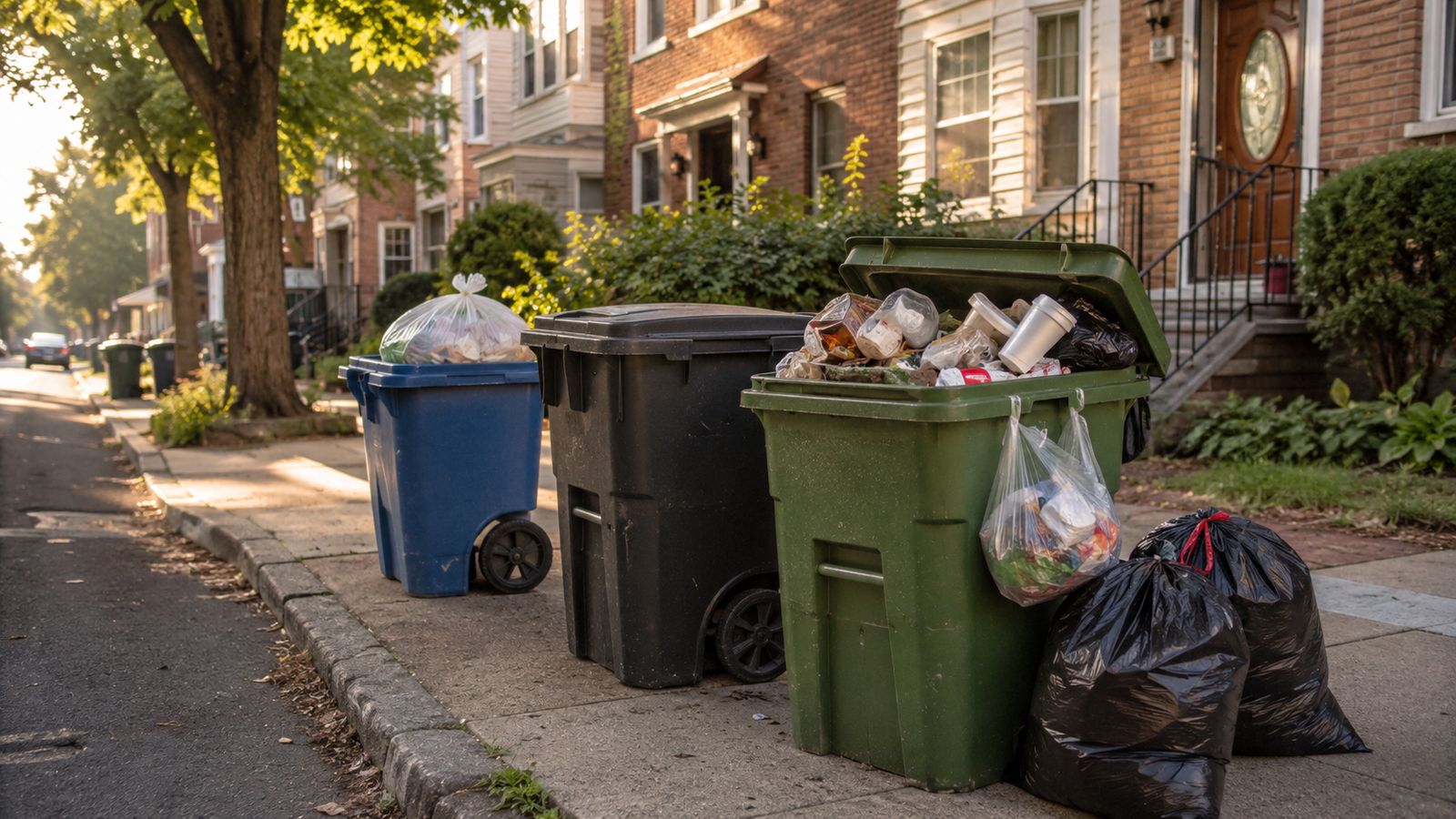
What your trash reveals about your household is not always flattering, but it is usually honest. Trash shows what a household repeats. It shows what gets overbought, forgotten, rushed, neglected, replaced, wasted, or left for someone else to handle.
You can learn a lot about a home from what ends up on the curb. Not because trash makes people bad. That is too easy. Trash is evidence. It records household routines after the excuses are gone.
Expired food tells a story. Delivery containers reveal another one. Broken items expose delayed maintenance. Packaging overflow points toward convenience, pressure, and habit. Meanwhile, empty bins, organized bags, compost containers, and recycling habits show a different kind of household rhythm.
Trash is not random. It is the final stop in a chain of decisions.
Household Waste Patterns Start Before the Trash Bag
Household waste patterns rarely begin at the trash can. They usually begin earlier, when someone shops without checking what is already home, cooks without planning for leftovers, buys more than the household can store, or replaces something that could have been maintained.
The trash bag is only the receipt.
Most people look at waste as an end point. Something gets used, finished, spoiled, broken, or unwanted. Then it leaves the house. However, the more useful question is what happened before it became waste.
Food waste may point to poor planning. Packaging waste may point to convenience habits. Replacement waste may point to weak maintenance. Clutter waste may point to impulse buying. In practice, none of those patterns appears out of nowhere.
A household does not need perfection to see the pattern. It needs honesty.
What Your Trash Reveals About Routine
Every household has a rhythm. Some homes plan meals. Others improvise every night. Some keep a running list. Others buy whatever looks useful in the moment. Some repair small things quickly. Others let problems sit until replacement feels easier than attention.
Trash exposes that rhythm because it shows what the household could not absorb, use, organize, maintain, or finish.
For example, when produce expires every week, the problem may not be produce at all. More often, planning broke earlier in the process.
Likewise, unopened pantry items rarely point to food itself. Instead, they often reveal buying without visibility.
By contrast, repeated replacement of household goods usually signals delayed maintenance rather than poor quality.
Meanwhile, when takeout containers dominate the bin, the issue may reflect exhaustion, schedule pressure, limited preparation, or a household rhythm that no longer fits everyday life.
That distinction matters. The goal is not shame. The goal is diagnosis.
Waste Shows Where Maintenance Behavior Is Missing
Maintenance behavior is the repeated work that keeps a household from drifting into disorder. It includes cleaning, storing, repairing, sorting, checking, planning, and resetting before problems become expensive.
When maintenance behavior gets weak, waste increases.
A refrigerator that nobody checks produces expired food. A closet that nobody organizes produces duplicate purchases. A cabinet that nobody repairs eventually creates replacement costs. A trash area that nobody owns becomes a shared resentment point.
In many homes, the trash reveals who carries the system. One person may know what needs to be used, what needs to be thrown away, what needs to be cleaned, and what needs to be replaced. Everyone else simply experiences the result.
That is not a household system. That is hidden labor.
When the work stays invisible, responsibility becomes uneven. As a result, waste becomes more than a material issue. It becomes a burden issue.
The Family Tree of Waste
Your trash has a family tree because every discarded item has a history. It came from somewhere. It entered the home for a reason. It stayed for a period of time. Then it left because the household used it, lost track of it, neglected it, outgrew it, broke it, or never needed it in the first place.
That family tree usually includes several branches:
- Buying decisions
- Storage habits
- Meal planning
- Repair behavior
- Cleaning rhythm
- Shared responsibility
- Convenience patterns
Once you see those branches, the trash becomes more than a chore. It becomes a map of household behavior.
The point is not to become obsessive. Instead, the point is to stop pretending waste appears by accident.
What Children Learn From What Gets Thrown Away
Children rarely inherit lectures as deeply as they inherit repeated behavior.
They notice whether food gets respected or wasted. They notice whether broken things get fixed or ignored. They notice whether shared rooms receive care or become nobody’s responsibility. They also notice whether adults clean up after themselves or leave work behind for someone else.
A child who grows up watching constant replacement may learn that maintenance does not matter. A child who watches adults waste food may learn that planning is optional. A child who watches one person carry the household alone may learn that responsibility is uneven by default.
The opposite is also true.
When children see adults use what they buy, repair what they can, clean shared areas, and reduce unnecessary waste, care becomes ordinary. It does not need a speech. Over time, it becomes the household standard.
Shared Responsibility Starts Inside the Home
Shared responsibility does not begin in public meetings. It begins in the ordinary spaces people use every day.
A household is one of the first shared systems a person experiences. People share food, rooms, bathrooms, laundry, dishes, storage, bills, time, and labor. If the household does not have clear responsibility, the work does not disappear. It moves onto whoever is most reliable.
That is how resentment grows quietly.
Sometimes one person empties the trash. Another checks the refrigerator. Meanwhile, someone else notices what must be used before it spoils. In many households, the same dependable person resets the shared spaces again and again.
Everyone benefits, but not everyone contributes.
That pattern does not stay inside the home. People carry it into apartments, workplaces, schools, churches, parks, and neighborhoods. The person trained to notice will keep noticing. The person trained to ignore will keep ignoring.
This is why household waste matters to the commons. Private habits become public behavior.
Why Household Waste Becomes a Community Issue
Household trash does not disappear when it leaves the kitchen. It enters a larger system. Sanitation workers handle it. Municipal services collect it. Landfills, recycling centers, compost programs, and neighborhood streets absorb the result.
Therefore, household waste is not only private behavior. It becomes public infrastructure pressure.
When a household overbuys food, the cost does not stop at the grocery bill. When packaging piles up every week, the burden moves into collection systems. When broken items get replaced instead of repaired, more material enters the waste stream. In other words, private routines scale outward.
That does not mean every household decision carries the same weight. However, repeated behavior across many homes creates visible community conditions.
Cleaner blocks do not happen by accident. Neither do overflowing bins, constant litter, and trash areas that nobody wants to manage. The pattern begins somewhere. Often, it begins inside ordinary homes.
How to Read Your Household Trash Without Shame
The wrong approach is to turn this into a guilt exercise. Shame makes people defensive. It does not build better systems.
The better approach is observation.
For one week, look at what leaves your home. Do not overcorrect yet. Do not perform discipline for a day and call it change. Just watch the pattern.
Sort the waste into three simple categories:
- Food waste: expired, spoiled, uneaten, or discarded food
- Packaging waste: delivery containers, wrappers, bags, boxes, and disposable convenience items
- Replacement waste: broken, duplicated, unused, or discarded household goods
At the end of the week, ask which category keeps showing up.
Then move upstream.
If food waste is high, shop smaller or plan fewer meals at a time. If packaging waste is high, reduce convenience purchases where possible. If replacement waste is high, build a repair list before buying new items. Additionally, if trash overflow is common, assign a clear household rhythm instead of waiting for someone to get tired of the mess.
The Groundwork
Start with one small reset.
Open the refrigerator before grocery shopping. Check what must be used first. Then plan two meals around what is already there. After that, buy less than usual.
That one act changes the waste pattern.
Next, choose one shared household area and assign clear responsibility for one week. Who checks it? Who resets it? Who notices when it is drifting?
Clarity reduces resentment. Rhythm reduces waste. Visibility reduces duplication.
The goal is not a perfect household. Perfection does not survive real life. Instead, the goal is a household that sees its own patterns clearly enough to correct them.
The Structural Takeaway
What your trash reveals about your household is simple: the home is always producing evidence.
The waste stream shows what gets planned and what gets improvised. Additionally, it reveals what receives maintenance and what gets ignored. Most importantly, it shows whether responsibility is truly shared or quietly transferred to the most dependable person in the house.
Trash is not the whole story. However, it captures a part of household life people often ignore because it feels ordinary.
That assumption creates blind spots.
Over time, ordinary patterns become the environment people experience every day. What leaves the house tells you how the house is being run.
The bin does not lie. It only repeats what the household already practiced. — Cyrus Mbeki
Continue Building
This piece is part of Cultivating the Commons, a larger framework on shared systems, maintenance behavior, and responsibility.
→ Framework: Cultivating the Commons
→ Mechanism: The Work Nobody Notices Until It Stops
→ Mechanism: Maintenance Without Ownership
Receipts