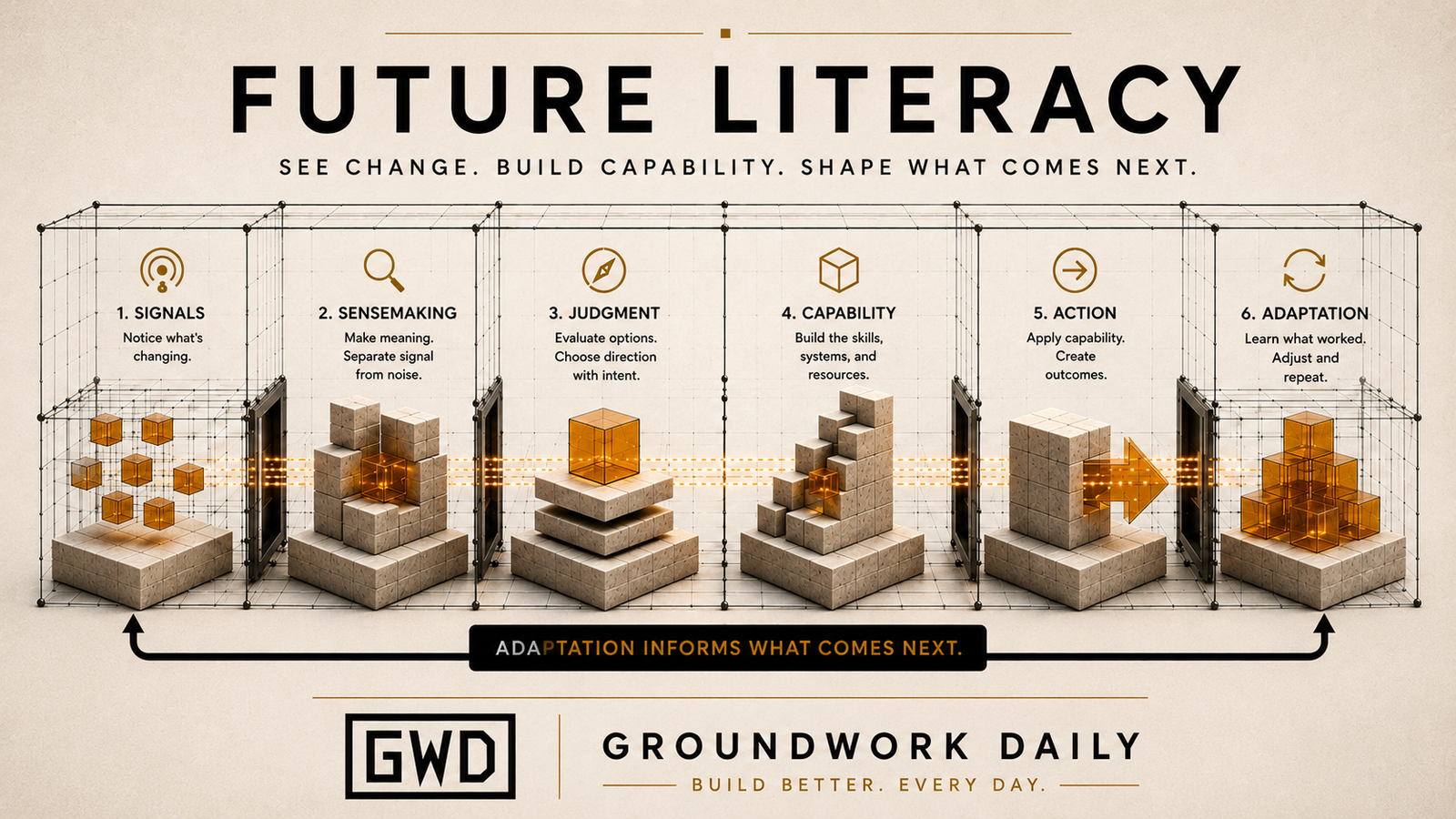
The three levels of capability—baseline, functional, and adaptive—give you a practical way to diagnose what you can reliably do today and what kind of development should come next.
Capability is often discussed too loosely. Someone is described as capable, disciplined, ready, or talented as though the label settles the question.
It does not.
A more useful definition focuses on observable performance: what can you reliably do, under what conditions, and what happens when those conditions change?
That distinction matters because knowing a skill, performing it under familiar conditions, and adapting it when the environment changes are different forms of competence.
The Three Levels of Capability
The three levels of capability make those differences visible and give each development stage a clearer job.
Baseline Capability → you can perform the capability under familiar, ordinary conditions.
Functional Capability → you can perform it reliably under realistic demands and moderate disruption.
Adaptive Capability → you can transfer, modify, or relearn the capability when conditions materially change.
This is a Groundwork Daily diagnostic framework, not a universal psychological or workforce classification system. Its purpose is practical: matching the development problem to the right kind of work.
Just as important, the framework prevents another mistake: assuming one capability level applies across your entire life.
It does not.
A person may be adaptive in technical work, functional in communication, baseline in a new leadership role, and temporarily unstable in another domain. In other words, capability is specific to the task, context, and conditions being tested.
This seventh article in the Future Literacy series follows selective adaptation and the series work on durable capability. Now the question becomes diagnostic: which of the three levels of capability best describes your current performance, and what kind of development would strengthen it?
Why the Three Levels of Capability Matter
Skill is not enough by itself.
Understanding something does not guarantee that you can use it under pressure. Likewise, strong performance in familiar conditions does not guarantee strong performance after the environment changes.
That is why capability needs levels.
The framework separates three different questions:
- Can the capability be performed at all?
- Does it remain reliable under realistic demands?
- Can the method adjust when the rules, tools, or context change?
Each question describes a different development problem. Therefore, each one calls for a different response.
Seen this way, the three levels of capability are not a ranking system. They are a practical way to choose the right development strategy.
Three Levels, Three Development Jobs
Baseline capability usually requires stabilization, repetition, and clearer structure.
By contrast, functional capability depends more on refinement, consistency, and performance under greater load.
At the adaptive level, development shifts toward transfer, experimentation, feedback, and relearning.
A poor diagnosis can waste time because the intervention no longer matches the problem.
For example, someone who lacks baseline capability does not need an elaborate adaptation strategy. The basic skill has to work reliably first.
Meanwhile, someone who is already functional may gain little from more introductory instruction. Harder practice, stronger feedback, or exposure to changing conditions may produce more value.
Capability Becomes Visible Under Load
Capability cannot be measured only by intention or familiarity.
A process may look strong until time pressure appears. Similarly, a financial system may seem adequate until an unexpected expense arrives. Professional competence can also look current until a tool, standard, or customer expectation changes.
Real Conditions Reveal Reliability
A useful assessment therefore asks what the current structure can actually carry.
This does not require manufacturing unnecessary crisis. Instead, look at performance under ordinary constraints: limited time, imperfect information, competing demands, feedback, mistakes, and moderate disruption.
Those conditions reveal whether a capability is merely familiar or genuinely reliable.
Diagnosis Comes Before Development
Clean diagnosis matters because development becomes more efficient when the next move matches the real condition.
Someone struggling with basic execution needs a different intervention from someone whose performance only breaks when the environment changes.
The level tells you where to build next.
Level One of the Capability Framework: Baseline
What Baseline Capability Means
Baseline capability means you can perform a specific capability under familiar, ordinary conditions with enough reliability to meet the basic requirement.
This is the floor, not the failure state.
Every capability begins somewhere. A new software tool, communication skill, financial practice, technical procedure, or management responsibility may all begin at baseline.
At this level, the environment still matters considerably. Familiar instructions, known tools, normal workload, and predictable conditions support performance.
The skill works. However, it may not travel far yet.
Examples of Baseline Capability
- A familiar work process can be completed without constant assistance.
- A known tool works successfully when the workflow is familiar.
- Basic principles can be explained and applied to routine problems.
- An established system can be followed consistently enough to meet normal expectations.
- Limits of current competence can be recognized before the problem becomes larger.
That final point matters because knowing where capability ends is part of responsible performance.
Baseline Is Domain-Specific
Do not turn baseline into a label for the whole person.
Someone can be highly experienced in one area and baseline in another.
For example, a senior professional may have adaptive expertise in the core occupation while remaining baseline with a newly adopted AI tool. An experienced tradesperson may be adaptive in field judgment but baseline with a new digital documentation system.
That pattern is normal.
Capability levels describe performance in a domain. They are not measures of personal worth.
How to Strengthen Baseline Capability
Baseline development should usually emphasize repetition and structure.
- Define what acceptable performance actually looks like.
- Use one consistent process before adding unnecessary variations.
- Practice frequently enough that the basic sequence becomes easier to recall.
- Reduce avoidable friction in the learning environment.
- Get feedback on obvious errors before they become habits.
- Document the process so memory does not carry the entire load.
At this stage, consistency matters more than sophistication.
As a result, the immediate goal is a capability that remains accessible when it is actually needed.
Level Two of the Capability Framework: Functional
What Functional Capability Means
Functional capability means you can perform reliably under realistic demands rather than only under ideal or highly familiar conditions.
The skill has now moved beyond basic familiarity.
Moderate time pressure, shifting priorities, imperfect information, or minor disruptions no longer collapse performance automatically.
At this level, judgment becomes more important because real conditions rarely match the training example perfectly.
What Functional Performance Looks Like
- Work can be completed without step-by-step guidance.
- Competing demands can be prioritized without losing the objective.
- Common errors are recognized and corrected.
- Acceptable quality remains possible under ordinary pressure.
- Reasoning can be explained clearly to someone else.
- Small disruptions can be absorbed without restarting the entire process.
Functional capability is where a skill becomes dependable enough to carry real responsibility.
Reliability Changes the Load Around You
Becoming reliable creates a secondary risk.
Once other people know you can carry something, additional work may begin flowing toward you. This happens in organizations, households, teams, and communities.
As a result, functional capability must be paired with capacity judgment.
The question changes from simply Can I do this? to Can I keep doing this at the required standard without degrading the rest of the system?
That distinction helps prevent capable people from becoming permanent overflow infrastructure.
How to Strengthen Functional Capability
Functional development is usually about refinement rather than introductory exposure.
- Practice the capability under realistic constraints.
- Improve speed without sacrificing quality.
- Build decision rules for recurring situations.
- Review mistakes for patterns instead of treating each one as isolated.
- Strengthen communication and documentation around the work.
- Reduce unnecessary variation in repeatable processes.
This is where the broader Future Literacy skill stack becomes useful. Communication, judgment, digital fluency, and structural thinking often determine whether technical skill works reliably in real environments.
Level Three of the Capability Framework: Adaptive
What Adaptive Capability Means
Adaptive capability means you can transfer, modify, or relearn a capability when operating conditions materially change.
This is not the same as being good at improvisation.
Instead, adaptive capability depends on understanding enough of the underlying structure that the method can change without losing the objective or standard.
A familiar tool may disappear. A role may expand. Regulation might change, a team could reorganize, or new technology may alter the workflow.
Under those conditions, adaptive capability asks: what remains true, what changed, and what needs to be rebuilt?
What Adaptive Performance Looks Like
- A replacement method can be learned without treating the old method as identity.
- Durable principles can be separated from temporary tools.
- Knowledge can move into a new context.
- A process can be updated when evidence shows the old version no longer fits.
- Additional learning needs can be identified clearly.
- Uncertainty can be managed without pretending it has disappeared.
Adaptive capability becomes especially important in fast-changing environments. Rigid competence can remain strong right up until the environment stops rewarding the old method.
Adaptive Does Not Mean Constant Change
There is a trap at this level.
People who value adaptability can begin changing too much. They may adopt tools before the value is proven, redesign working systems merely because something newer exists, or maintain so many experiments that learning becomes fragmented.
That is not adaptive capability. It is uncontrolled change.
Post 05’s selective adaptation model exists for exactly this reason. Adaptation should follow interpretation and judgment, not novelty alone.
How to Strengthen Adaptive Capability
- Practice the capability in more than one environment.
- Study the principle underneath the method.
- Use small experiments before committing to major changes.
- Compare outcomes instead of relying on novelty or preference.
- Seek feedback from people operating under different conditions.
- Review what transferred successfully and what required relearning.
In short, adaptive capability grows when experience becomes portable rather than merely repeated.
The Three Levels of Capability Side by Side
Together, the three levels of capability show how performance changes as familiarity develops into reliability and, eventually, transfer.
| Level | Core Test | Primary Development Need |
|---|---|---|
| Baseline | Can I perform it under familiar, ordinary conditions? | Structure, repetition, feedback |
| Functional | Can I perform it reliably under realistic demands? | Refinement, judgment, consistency |
| Adaptive | Can I transfer or modify it when conditions change? | Experimentation, transfer, relearning |
The framework is intentionally simple. Its value comes from matching the development method to the actual level instead of treating every gap as a generic need to “get better.”
How to Assess the Three Levels of Capability
To use the three levels of capability well, assess one specific domain at a time.
Begin with a defined capability rather than a broad category.
Avoid labels such as “career capability” or “life capability.” Instead, choose something concrete: presenting to senior leaders, using a software platform, managing household cash flow, writing project documentation, troubleshooting equipment, supervising a crew, or analyzing data.
Baseline Questions
- Can I explain the basic process?
- Does the capability work under familiar conditions?
- Do I know what acceptable performance looks like?
- Can I recognize when help is required?
Functional Questions
- Does performance hold under ordinary time pressure?
- Can common exceptions be handled without losing control of the process?
- Is the quality consistent without constant supervision?
- Can routine problems be diagnosed and corrected?
Adaptive Questions
- Can the capability transfer into an unfamiliar context?
- Can the method change when tools or requirements change?
- Which underlying principles still apply?
- Can missing knowledge be learned without rebuilding everything from zero?
Some answers may be yes while others are no. That is useful information.
The objective is not to force yourself into a flattering category. Instead, identify the strongest level that can currently be demonstrated with reasonable consistency.
You Do Not Have One Capability Level
This point is critical because development is uneven.
In practice, the three levels of capability can exist simultaneously across different parts of the same person’s work and life.
You may be adaptive in a long-practiced occupation and baseline with a new technology. Likewise, someone may be functional at managing individual work but baseline when supervising others.
The same person can therefore occupy several levels at once. Each capability has its own history, practice environment, feedback, and load.
Target Development Instead of Ranking Yourself
Because development is uneven, the useful question is not which level describes you as a person.
Instead, identify which capability matters to the direction you are trying to build and determine what level currently exists there.
Development can then be targeted accordingly.
Map Your Own Capability
Capability Map
Choose four capabilities that matter to your current direction and assign a level to each:
- Capability: __________ · Baseline / Functional / Adaptive
- Capability: __________ · Baseline / Functional / Adaptive
- Capability: __________ · Baseline / Functional / Adaptive
- Capability: __________ · Baseline / Functional / Adaptive
Afterward, ask which single capability deserves the next development cycle.
Match the Intervention to the Level
Once the level is visible, the development strategy becomes clearer.
If the Capability Is Baseline
Reduce unnecessary complexity and build one reliable process.
Practice the fundamentals, create references or checklists where appropriate, and get feedback early. At this level, sophistication can become a distraction.
If the Capability Is Functional
Increase realism.
Practice under tighter constraints, handle more varied cases, strengthen judgment, and review performance for recurring inefficiencies. The target is dependable execution, not merely successful completion.
If the Capability Is Adaptive
Increase transfer.
Apply the capability in unfamiliar environments, experiment with alternate methods, teach the underlying principles, and test how well judgment survives changes in tools or assumptions.
At this stage, portability becomes the development target.
Capability Is Not Permanent
Reaching a level does not permanently lock it in.
Capability can strengthen, weaken, or become less relevant as conditions change.
For example, a formerly functional skill may slip toward baseline after years without use. An adaptive capability may also become less effective if the environment changes faster than the person’s knowledge is refreshed.
Meanwhile, a capability can remain technically strong even as its market value changes.
Those are different problems and should not be confused.
Capability Drift
Capability drift occurs when reliable performance slowly weakens because practice, maintenance, feedback, or environmental fit has changed.
Early signs can include:
- tasks that once felt routine requiring more effort;
- increasing dependence on outdated workarounds;
- avoiding newer tools or methods without evaluating them;
- more errors under conditions that were previously manageable;
- difficulty explaining why the current method is still appropriate.
Drift is not always failure. Sometimes the capability simply needs maintenance. In other cases, the environment has changed enough that adaptation is required.
Capability Maintenance
Useful capability needs periodic inspection.
- Am I still practicing this often enough?
- Has the standard changed?
- Have the tools changed?
- Has the context changed?
- Is the capability still worth maintaining at this level?
That final question matters because not every capability deserves permanent investment.
Future Literacy is partly about deciding what to maintain, what to upgrade, and what to release.
How the Three Levels of Capability Fit Into Future Literacy
The first seven Future Literacy articles form a practical operating sequence.
Within that sequence, the three levels of capability connect skill building to a harder question: whether those skills remain reliable when conditions change.
Posts 01–03: Foundation
Post 01 established the foundational skill stack.
From there, Post 02 developed clarity. Then Post 03 identified the cognitive load that can make that clarity difficult to access.
Posts 04–06: Structure and Adaptation
Post 04 turned capacity protection into daily structure.
Next, Post 05 introduced selective adaptation: deciding what deserves attention when conditions accelerate.
Post 06 then developed durable capability as a renewable system of attention, learning, application, recovery, and supporting infrastructure.
Post 07: Diagnosis
Post 07 adds the diagnostic layer.
Rather than asking only whether a capability exists, the framework examines how reliably it works and whether it can transfer when the environment changes.
Baseline → Functional → Adaptive
Next: Pattern Recognition
The next step is earlier recognition.
How to Read the Patterns That Shape Your Future moves from capability diagnosis into signal detection: noticing structural movement before its consequences become obvious.
Build the Next Level
Do not ask whether you are a capable person. The question is too broad to produce a useful development plan.
Instead, ask: Which capability matters, what level can I demonstrate today, and what development method matches that level?
For a baseline capability, strengthen the fundamentals. Functional capability calls for refinement under realistic load, while adaptive capability requires more transfer across changing conditions.
Afterward, reassess.
Capability is not a status you earn once. Rather, it is a working relationship between skill, context, practice, judgment, and change.
The objective is not to reach Level Three everywhere. It is to know which capabilities need baseline reliability, which need functional strength, and which genuinely need adaptive range.
Further Groundwork
How to Stay Capable When the Future Moves Faster Than You Do
Use selective adaptation to decide which changes actually deserve attention and learning capacity.
The Skill Stack You Actually Need in 2026
Revisit the foundational capabilities that support reliable performance across changing conditions.
How to Build a Daily System That Protects Your Time, Energy, and Clarity
Build the daily operating conditions that make practice, learning, and recovery more repeatable.
How to Read the Patterns That Shape Your Future
Continue into the next Future Literacy layer and develop earlier recognition of meaningful change.
Education & Skills
Explore Groundwork Daily’s broader work on learning, judgment, technology, and practical skill development.
Receipts
OECD Skills Outlook 2025
Research on adult skills, skill use, adaptive problem solving, and how capabilities interact with changing economic and social conditions.
OECD · Adult Problem-Solving Skills
Research and measurement work on solving problems in dynamic environments where information and conditions may change.
World Economic Forum · Future of Jobs Report 2025
Employer research on changing skill demand, workforce transformation, technology adoption, and the growing importance of reskilling and adaptability.