Durable capability is not about knowing more than everyone else. It is about remaining useful when the conditions around you change.
The pressure to keep up is everywhere. Learn faster. Adopt the new tool. Watch the new trend. Reinvent yourself. Prepare for the next disruption before the current one has settled.
Some of that pressure reflects real change. However, the operating conclusion is often wrong.
You do not need to rebuild yourself every time the environment moves.
Instead, you need capabilities that can survive changes in tools, workflows, employers, expectations, and circumstances.
This article follows How to Stay Capable When the Future Moves Faster Than You Do. Post 05 showed how to filter change and decide what deserves adaptation. Post 06 goes one level deeper: what infrastructure makes sustained adaptation possible?
The answer is not one perfect skill. Rather, it is a capability system built around attention, learning, application, recovery, and enough supporting infrastructure to keep those capabilities available when conditions are imperfect.
Capability Is Different From Knowledge
Knowledge matters. However, knowledge and capability are not the same thing.
Knowledge helps you understand. Capability helps you act.
You can know what a tool does without being able to use it on real work. Likewise, you can understand a management framework without being able to lead through conflict. You can also read about financial planning without having a functioning household money system.
Knowing is valuable. Yet capability requires another step: converting understanding into reliable performance.
| Knowledge | Capability |
|---|---|
| Understands facts and concepts | Applies judgment |
| Consumes information | Produces useful action |
| Can describe the method | Can execute the method |
| May become outdated | Can be practiced, updated, and transferred |
Knowledge can become outdated. Practiced capability, by contrast, can be renewed.
That distinction matters in a world where information is abundant. Reading about a skill is not the same as developing it, and watching someone demonstrate a tool is not evidence that you can apply it yourself.
Capability therefore requires use, feedback, correction, and repetition.
Capability Reveals Itself Under Imperfect Conditions
The real test usually appears when conditions stop cooperating.
Can you still think clearly when information is incomplete? Can you learn something new without abandoning everything else?
Can useful work still happen with imperfect tools, time pressure, or changing requirements? And after a difficult week, can you recover and return to the system?
Durable capability does not eliminate friction. Instead, it gives you more ways to operate inside it.
The Four Layers of Durable Capability
Durable capability rests on four reinforcing layers.
Attention → stay with what deserves focus.
Learning → acquire and update useful understanding.
Application → turn understanding into evidence and output.
Recovery → restore enough capacity to repeat the cycle.
Layer One: Attention
Attention is the entry point because learning requires somewhere to land.
When attention is constantly fragmented, development becomes shallow. You may consume large amounts of information without holding any one problem long enough to integrate what you are learning.
This is why clear thinking and bandwidth protection appear earlier in the series.
Attention, then, is not merely concentration. It is an allocation decision.
Strengthen Attention
- Protect one meaningful focus block when circumstances allow.
- Reduce one recurring source of unnecessary interruption.
- Define the intended outcome before opening unrelated channels.
- Capture unrelated thoughts rather than switching tasks immediately.
Better attention creates stronger conditions for every layer that follows.
Layer Two: Learning
Learning is more than collecting information.
Saved articles, bookmarked videos, purchased courses, and followed experts can expand access without changing capability.
The learning loop becomes useful when new information changes what you can explain, decide, or do.
Strengthen Learning
- Choose one active learning priority instead of several competing ones.
- Use a small number of strong sources rather than an endless stream of inputs.
- Summarize what changed in your understanding.
- Identify one action that would test the lesson.
The test is not how much material you consumed. Instead, ask what became more usable afterward.
Layer Three: Application
Application converts understanding into evidence.
This layer exposes the difference between familiarity and capability. You may know the terminology, understand the principles, and follow the discussion while still being unable to perform the work reliably.
Application closes that gap.
Strengthen Application
- Build a small project around the capability you are developing.
- Practice with realistic constraints instead of ideal examples only.
- Compare the intended result with the actual result.
- Document what failed, what worked, and what needs another iteration.
Real work produces information that passive learning cannot. Therefore, let the work teach back.
Layer Four: Recovery
Recovery protects repeatability.
Capability you can access once under ideal conditions is less valuable than capability you can return to across many operating cycles.
Recovery does not mean maximizing comfort. Rather, it means restoring enough physical and cognitive capacity for attention, learning, and execution to remain available.
Strengthen Recovery
- Protect adequate sleep where circumstances allow.
- Create a closing ritual that gives important unfinished work a status.
- Use breaks before exhaustion makes the decision for you.
- Reduce recurring commitments that consume more capacity than they return.
Recovery is not separate from performance. It is part of the infrastructure that makes performance repeatable.
Build a Capability Portfolio
One narrow capability can create value. Building your entire position around one capability, however, creates concentration risk.
A capability portfolio gives you several forms of usefulness that can reinforce one another.
1. Technical or Craft Capability
This layer is the ability to produce something useful in a specific domain.
Depending on the work, that might involve operations, writing, analysis, finance, coding, design, construction, maintenance, sales, healthcare, logistics, research, or another trade or profession.
The relevant question is simple: What can you reliably produce, repair, improve, analyze, or execute?
2. Communication
Communication turns individual capability into coordinated capability.
If you cannot explain a problem, document a process, clarify a decision, or make the required action understandable to someone else, technical ability loses leverage.
Clear communication therefore reduces friction between people and systems.
3. Systems Thinking
Systems thinking helps you understand why outcomes repeat.
Instead of treating every problem as isolated, you begin looking for inputs, incentives, processes, constraints, dependencies, and feedback.
That is the operating logic developed in How to Use Systems Thinking in Real Life.
During change, this capability becomes especially useful because the visible event is often only one part of the underlying system.
4. Relationship Capital
Capability is rarely exercised in isolation.
Trust, reputation, reliability, and professional relationships affect access to information, cooperation, opportunities, feedback, and support.
Relationship capital grows through repeated evidence: doing what you said, communicating clearly, helping when useful, and making your work dependable.
5. Physical Capacity
Your body affects the conditions under which capability is available.
Sleep, movement, nutrition, illness, physical workload, stress, and recovery can all affect attention and performance.
Not every physical constraint is individually controllable. Even so, capability planning should not pretend the body is separate from the system doing the work.
6. Financial Resilience
Financial margin affects adaptability because it changes the decisions available under pressure.
A household without any buffer may have less room to experiment, train, change jobs, tolerate an income disruption, or reject a poor opportunity.
Financial resilience does not guarantee freedom. However, additional margin can increase optionality.
Why the Portfolio Matters as a System
The six parts of the portfolio are not independent.
Technical capability may create value, but communication determines whether that value can travel through a team or organization. Systems thinking can improve diagnosis, while relationship capital can improve access to information and cooperation.
Physical capacity affects whether attention and learning remain available. Meanwhile, financial resilience can determine how much room exists to absorb a disruption or invest in a new capability.
Because the layers interact, weakness in one area can limit the usefulness of strength in another.
The goal is not equal mastery across all six. Instead, the goal is enough balance that one weak point does not unnecessarily destabilize the entire system.
Three Threats to Durable Capability
Capability usually does not disappear in one dramatic moment.
More often, it erodes through recurring patterns.
Threat One: Speed Without Interpretation
Fast-moving conditions create pressure to act before the change has been understood.
A new tool appears, so it gets adopted. A headline predicts disruption, so a learning plan changes. A competitor makes an announcement, so a workflow is rebuilt.
Some rapid decisions are necessary. However, speed becomes dangerous when there is no distinction between movement and evidence.
This is why Post 05’s selective adaptation framework matters: observe and interpret before every signal receives investment.
Threat Two: Overload
Too many simultaneous demands reduce the capacity available for deliberate learning and adaptation.
When every channel remains open and every project remains active, even worthwhile improvements have to compete with the rest of the system.
The solution is not simply trying harder. Often, the better move is subtraction, sequencing, or tighter boundaries.
Threat Three: Skill Drift
Skills can become less useful when the surrounding environment changes.
The underlying expertise may still matter while the method, tool, standard, or workflow around it moves.
That creates an important distinction: do not abandon durable capability merely because one implementation of it becomes outdated.
Instead, update the method when the evidence supports an update.
Replace Constant Reinvention With a Renewal Cycle
Continuous reinvention sounds adaptive, but it can create its own instability.
A stronger model is renewal: keep the useful foundation while regularly updating what no longer fits.
Daily · Capture → notice useful signals and friction.
Weekly · Practice → deliberately exercise one capability.
Monthly · Review → inspect what is strengthening, drifting, or consuming capacity.
Quarterly · Upgrade → make one meaningful improvement to the capability system.
Daily: Capture
Capture useful signals without turning every observation into immediate action.
Ask what changed, what repeated, what created unnecessary friction, and what the work revealed.
In this way, the daily layer protects awareness without encouraging constant reaction.
Weekly: Practice
Choose one capability and exercise it deliberately.
That might mean using a new tool on a real task, strengthening a communication habit, practicing a technical method, or improving a recurring workflow.
Keep the learning surface narrow enough that practice remains possible.
Monthly: Review
Review the capability system rather than only the task list.
Look at work, learning, money, relationships, health, attention, and the systems supporting them.
Then ask where capability is strengthening and where the environment is quietly creating more friction.
Quarterly: Upgrade
Choose one meaningful upgrade rather than attempting a complete reinvention.
The upgrade could be a skill, workflow, tool, financial practice, professional relationship, documentation standard, or recovery system.
One useful upgrade integrated well is usually worth more than several abandoned improvements.
This is the deeper durability question: whether capability can keep producing dependable value through repeated load, maintenance, adaptation, and time.
Build for Response, Not Perfect Prediction
The purpose of durable capability is not to make you better at predicting every future condition.
Prediction remains uncertain. Preparation, however, gives you another option.
You can strengthen transferable capability before you know exactly which scenario will arrive. Likewise, you can improve judgment before the next difficult decision and build financial margin before an employment disruption.
Learning systems can be strengthened before a new tool becomes mandatory. Relationships can also be deepened before you need help navigating a transition.
That is a more robust strategy than attempting to forecast every turn correctly.
Weak preparation depends on the forecast being right. Durable capability gives you more ways to respond when it is not.
Durable Capability Check
Ask yourself:
- Which capability can I reliably use today?
- Where am I consuming information without producing evidence?
- Which part of my capability portfolio is overconcentrated?
- What current method may need updating?
- What one upgrade would make the entire system more resilient?
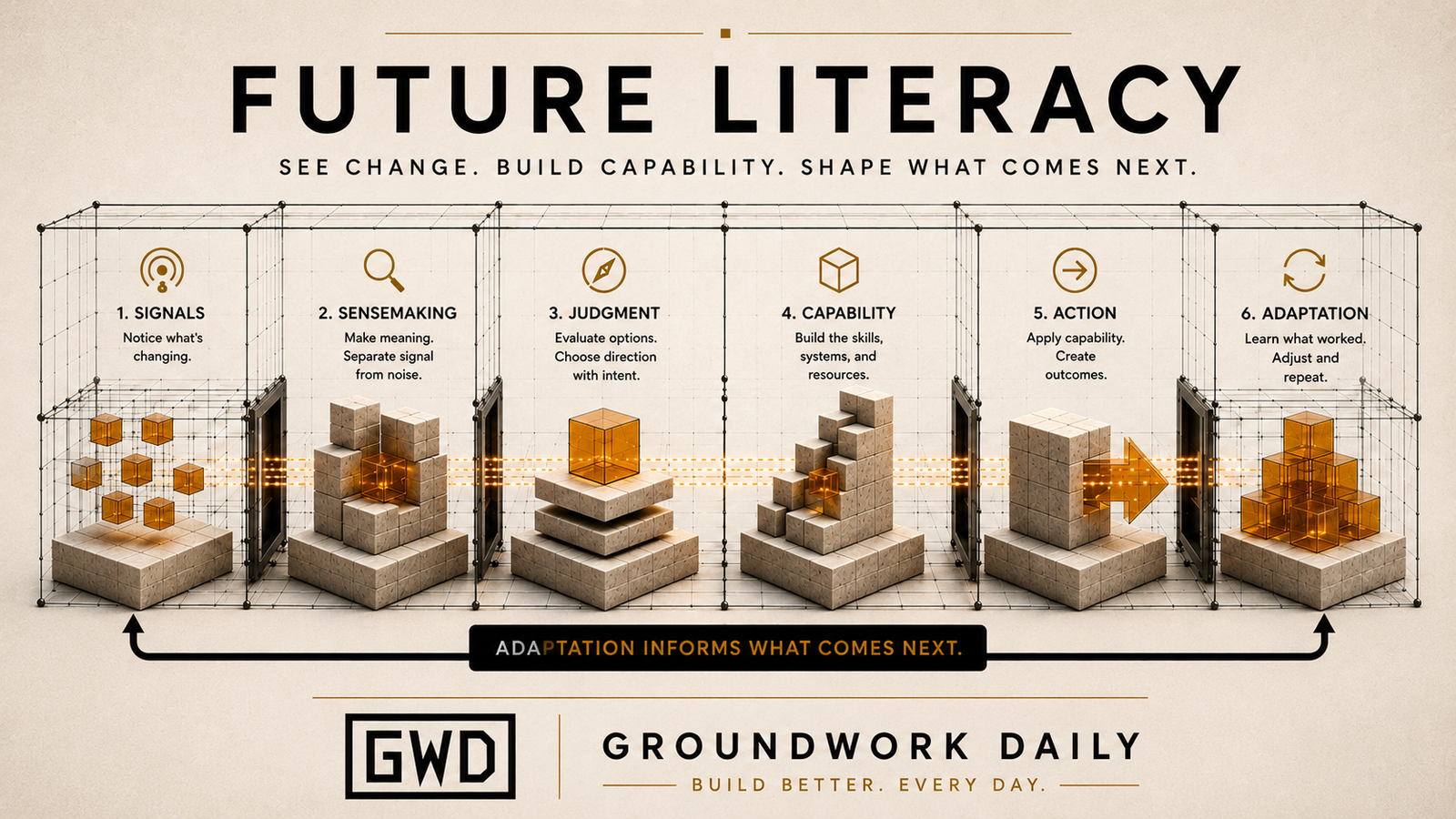
How Durable Capability Fits Into Future Literacy
The Future Literacy sequence is moving from personal operating capacity toward deliberate adaptation.
Posts 01–03: Capability, Clarity, and Bandwidth
Post 01 established the capability foundation.
From there, Post 02 strengthened clarity, while Post 03 identified hidden cognitive load.
Posts 04–05: Structure and Selective Adaptation
Next, Post 04 translated capacity protection into daily structure.
Then Post 05 showed how to filter change and adapt selectively.
Post 06: Durable Capability
Post 06 builds the infrastructure that makes repeated adaptation possible.
Capability → Clarity → Bandwidth → Structure → Adaptation → Durable Capability
Next: Direction
The next question is direction.
A person can become highly adaptable while still scattering that capability across too many possible futures.
That is why the next Future Literacy article moves into How to Build a Two-Year Direction: enough direction to concentrate capability without pretending the future can be predicted precisely.
The Path Forward
You cannot freeze the environment around you.
Tools will change. Roles will change. Standards will move, and some skills will become more valuable while others become less central.
The answer is not permanent panic.
Instead, build capabilities that can travel.
Protect attention so learning has somewhere to land. Then turn learning into application so understanding becomes evidence. Protect recovery so capability remains repeatable.
From there, diversify the supporting portfolio.
Technical capability matters. So do communication, systems thinking, relationships, physical capacity, and financial resilience.
Finally, renew the system instead of rebuilding it from zero every time conditions change.
Durable capability is not resistance to change. It is the ability to change without losing the structure that makes you useful.
Further Groundwork
How to Stay Capable When the Future Moves Faster Than You Do
Use selective adaptation to decide which changes actually deserve your attention and learning capacity.
The Three Levels of Capability: Baseline, Functional, Adaptive
Distinguish between knowing something, using it reliably, and transferring it into unfamiliar conditions.
How to Use Systems Thinking in Real Life
Learn how inputs, constraints, processes, and feedback create repeated outcomes.
How to Build a Two-Year Direction
Give adaptive capability a medium-term direction without pretending the future is fully predictable.
Education & Skills
Explore Groundwork Daily’s broader work on learning, technology, judgment, and practical capability.
Receipts
World Economic Forum · Future of Jobs Report 2025
Employer research on changing jobs, technology adoption, workforce transformation, and evolving skill demand.
OECD Skills Outlook 2025
Research on adult skills, adaptive problem solving, skill use, and the relationship between capability and changing economic conditions.
OECD · Adult Problem-Solving Skills
Research and measurement frameworks for solving problems in dynamic situations where conditions and available information can change.