You do not need to keep up with everything. You need to remain capable of responding to what actually matters.
New tools arrive. Workflows change. Skills gain and lose value. Meanwhile, expectations move faster than any one person can realistically absorb.
That environment creates a dangerous assumption: if everything around you is accelerating, you must accelerate with all of it.
You do not.
Future literacy is not a race to consume every update, master every tool, or predict every disruption. Instead, it is the ability to notice meaningful change, interpret what it means for your life, strengthen the capabilities that matter, and leave the rest alone.
This fifth article in Groundwork Daily’s Future Literacy series builds on the operating structure developed in Post 04. Once your days contain enough structure to protect time, energy, and clarity, a larger question emerges:
How do you keep your capability current without turning adaptation into a permanent emergency?
The answer is selective adaptation: stable direction, protected capacity, flexible methods, and a disciplined way to decide what deserves learning.
The Speed Problem: More Change, Finite Capacity
Acceleration can look like opportunity from a distance.
More tools can create leverage. Likewise, more information can expose possibilities, while new technologies can change what one person or one organization is capable of doing.
However, more options also create more things to evaluate.
Your attention remains finite. So do time, energy, money, working memory, and the number of skills you can meaningfully develop at once.
That creates the central tension.
The environment can expand faster than your capacity to evaluate everything inside it.
Trying to solve that problem by tracking every trend usually makes the operating environment worse. More newsletters, alerts, courses, platforms, experiments, and unfinished learning projects create additional demand on the same limited capacity.
Therefore, the answer is not withdrawal from change.
It is stronger filtering.
Urgency Is Not the Same as Importance
Digital environments are exceptionally good at making new information visible. Visibility, however, does not determine relevance.
A new tool can matter enormously to one occupation while barely affecting another. Similarly, a major technology story may deserve general awareness without requiring immediate personal action.
Future literacy therefore requires discernment: the ability to give signals, evidence, tradeoffs, and consequences the weight they actually deserve.
Start with three questions:
- What changed?
- What does the change affect?
- Does it require anything from me now?
Those questions slow the conversion of information into obligation.
As a result, every signal does not automatically become a project.
What It Actually Means to Stay Capable
Staying capable does not mean remaining equally skilled at everything.
Instead, it means preserving enough direction, capacity, and adaptability that changing conditions do not immediately remove your ability to act.
Three components hold that position together.
1. Clear Direction
Direction tells you what your capability is for.
Without direction, every new option can appear equally important. Courses accumulate. Tools multiply. Career possibilities compete. Eventually, learning becomes reactive because nothing is governing selection.
Direction does not require a rigid ten-year prediction.
Rather, it requires enough clarity about responsibilities, values, interests, economic needs, and desired contribution to make tradeoffs.
You should be able to answer questions such as:
- What am I trying to become more capable of doing?
- Which responsibilities need to remain stable?
- What kind of work or contribution do I want more ability to perform?
- What tradeoffs am I unwilling to make merely to stay current?
In practice, direction turns learning from accumulation into selection.
2. Stable Capacity
Capacity determines whether adaptation is actually possible.
Learning requires somewhere to happen.
That means time, attention, energy, and often some financial margin. Without those resources, even excellent information can remain unused.
This is why The Bandwidth Trap and the Daily System sit before this article in the Future Literacy sequence.
Adaptability built on chronic overload is fragile.
For that reason, the objective is not endless unused capacity. It is enough margin to absorb learning, experimentation, and an occasional disruption without destabilizing the rest of life.
3. Adaptable Methods
Methods should be easier to change than principles.
The software can change. So can the workflow, the platform, or the title.
Underlying capabilities such as judgment, communication, problem-solving, learning, systems thinking, financial fluency, and digital competence can travel across those changes.
This is the logic behind The Skill Stack You Actually Need in 2026.
Consequently, the goal is not loyalty to one method. It is enough underlying capability to replace a method when the environment makes replacement useful.
Direction → what deserves development.
Capacity → what you can realistically absorb.
Adaptable Methods → how you change without rebuilding your identity every time a tool changes.
Why Improvement Can Still Feel Like Falling Behind
Digital comparison changes the measurement environment.
A person can improve substantially while being exposed every day to people who appear further ahead on nearly every dimension.
One feed can contain a younger expert, a faster learner, a more successful entrepreneur, a more experienced professional, and someone who adopted the newest tool six months earlier.
Because the comparison pool is effectively endless, relative measurement becomes a poor operating system.
Measure Capability, Not the Feed
A more useful comparison is longitudinal.
Ask:
- Can I handle problems today that would have overwhelmed me a year ago?
- Do I learn new tools more deliberately?
- Can I distinguish a signal from hype more quickly?
- Do disruptions create less chaos?
- Can I transfer my skills into unfamiliar conditions?
- Am I building evidence that my capability is current?
Those questions measure development rather than visibility.
Meanwhile, capability often compounds quietly. The strongest signal may not be that you know more than everyone else. Instead, it may be that fewer changes completely disorganize you.
The Four Horizons of Capability
One reason future-facing learning becomes overwhelming is that every possible skill gets placed in the same queue.
The Four Horizons model creates a hierarchy.
Horizon One · Now → capability needed to operate reliably today.
Horizon Two · Near → capability likely to improve your position in the next stage.
Horizon Three · Next → exploratory capability connected to a plausible longer-term direction.
Horizon Four · Never → interesting capabilities that do not justify the cost for your direction.
Horizon One: Now Skills
Now Skills keep current responsibilities functioning.
They depend on the person and role, but may include communication, digital basics, financial fluency, job-specific technical competence, documentation, scheduling, judgment, or basic use of tools already embedded in the environment.
Weak Now Skills create recurring friction.
If that base is unstable, chasing advanced future skills can become avoidance disguised as ambition.
Therefore, strengthen obvious present-day gaps first.
Horizon Two: Near Skills
Near Skills sit adjacent to what you already do.
They are often the highest-value learning zone because they can be applied soon while still improving future options.
Depending on the role, examples might include:
- AI-assisted workflow design;
- data literacy for a nontechnical role;
- project coordination;
- better documentation;
- presentation and facilitation;
- automation basics;
- supervisory or leadership skills;
- stronger technical fluency within an existing occupation.
A good Near Skill extends capability without requiring you to abandon the foundation underneath it.
Horizon Three: Next Skills
Next Skills explore a plausible longer-range direction.
They may not produce immediate returns. Therefore, they should not consume the same level of capacity as skills already tied to current work.
Keep experimentation light enough that it does not destabilize existing responsibilities. For example, read selectively, build a small project, take one course, or talk to people already doing the work.
Most importantly, test whether your interest survives contact with reality.
Next Skills are experiments before they become commitments.
Horizon Four: Never Skills
Never Skills are capabilities you deliberately choose not to develop.
The word “never” is intentionally strong. However, it does not mean the decision can never be revisited.
Instead, it means the skill has no claim on your present capacity merely because it is fashionable, impressive, or widely discussed.
Every course consumes time. Likewise, every tool creates maintenance, and every skill carries an opportunity cost.
Refusal is therefore part of capability management.
You cannot build a serious learning strategy without deciding what you will not learn.
Selective Adaptation Beats Continuous Reaction
Consider two workers facing the same wave of technological change.
Worker A subscribes to every update, experiments with every major new tool, joins several platforms, begins multiple courses, and continuously changes workflows to remain current.
Worker B, by contrast, tracks major developments, identifies which changes touch current responsibilities, chooses one adjacent capability to develop, and tests new tools against real work before adopting them.
Both workers are paying attention.
However, the operating models are fundamentally different.
Worker A optimizes for exposure, while Worker B optimizes for usable capability.
Over time, exposure without integration can create a large inventory of unfinished experiments. Selective adaptation creates fewer changes, but each one has a clearer relationship to the work.
The lesson is not that slower is always better.
Rather, learning speed without integration can produce motion without durable capability.
The Capability Loop: How to Respond to Change
When a meaningful change appears, use a four-stage operating loop instead of converting the signal directly into action.
Observe → what actually changed?
Interpret → what does the change affect?
Place → which capability horizon does it belong in?
Practice → what small experiment would create evidence?
Observe Before You Decide
Begin with description before judgment.
What changed in the technology, policy, process, labor market, customer behavior, or operating environment?
Then separate the actual change from the commentary surrounding it.
This is a direct extension of clear thinking: do not let the loudest interpretation become yours automatically.
Interpret the Mechanism
Next, identify how the change actually operates.
Does it affect cost? Speed? Hiring? Quality standards? Required tools? Customer expectations? Regulation? Ownership? Training requirements?
A trend becomes actionable only when you understand how it touches the system around you.
Place the Change in a Horizon
Once the mechanism is clear, assign the change to a horizon.
Does it require a Now Skill because current work is already changing? Is it a Near Skill worth developing gradually, or a Next Skill worth observing or testing?
Alternatively, does it belong in Never because it sits outside your direction?
Placement prevents every development from competing for immediate action.
Practice to Create Evidence
If the change belongs in Now or Near, convert learning into a small experiment.
Do not consume information indefinitely.
Instead, use the tool. Build something. Rewrite the workflow. Solve a real problem. Compare the result. Then document what changed.
Practice turns awareness into evidence.
Without that step, future-facing learning can remain consumption with an educational label.
How the Capability Loop Fits the Larger Framework
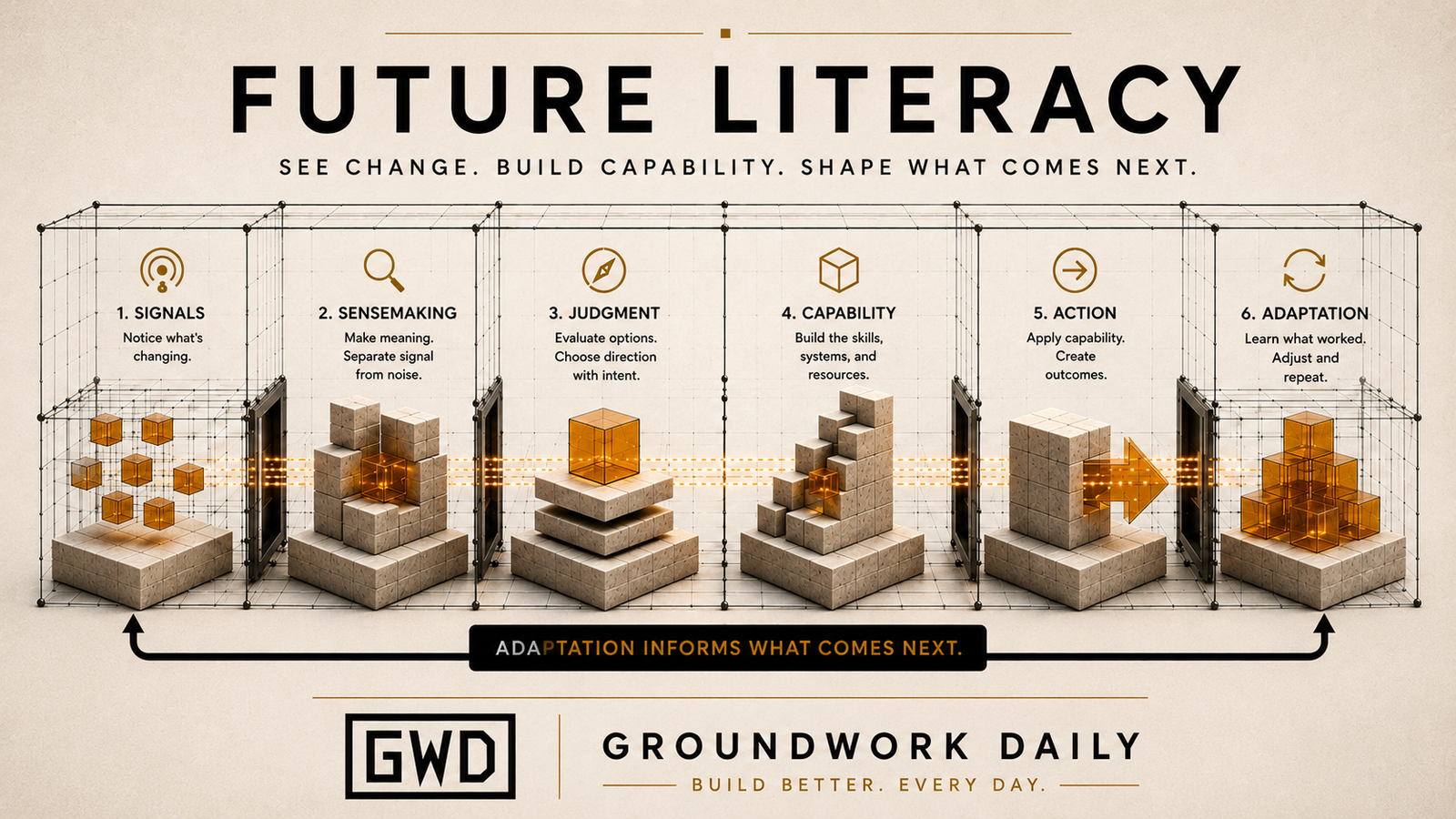
The article-specific loop is a compact version of the larger Future Literacy framework.
Observe supports Signals.
Interpret supports Sensemaking.
Place requires Judgment.
Practice develops Capability, creates Action, and produces feedback for Adaptation.
The point is consistency. Future Literacy should not require a completely different mental model every time a new problem appears.
Instead, the same operating logic should travel.
A Weekly Rhythm for Staying Capable
Capability grows more reliably when learning has a place in the operating system.
You do not need to monitor the future continuously.
For most people, a small rhythm is enough.
Daily: Protect the Base
- Protect at least one meaningful block of focused attention when circumstances allow.
- Capture potentially useful signals instead of immediately reacting to each one.
- Keep current responsibilities functioning before expanding the learning surface.
- Give important unfinished work a defined next step.
The daily layer protects the capacity required for adaptation.
Weekly: Review the Signals
Once a week, review what you captured.
Ask:
- What genuinely changed?
- What was mostly noise?
- Does anything require a Now Skill?
- Which Near Skill deserves continued practice?
- What should remain in observation mode?
- What can be ignored?
In this way, a weekly review converts constant monitoring into periodic sensemaking.
Monthly: Rebalance the Stack
Once a month, inspect the larger position.
- Is my direction still coherent?
- Which current capability is becoming more important?
- Which learning project has earned continued investment?
- Which experiment has produced no useful evidence?
- What commitment or tool is consuming more capacity than it returns?
- Do I have enough margin for the next learning cycle?
Consequently, the monthly review allows subtraction to happen before complexity becomes permanent.
Audit Your Personal Capability Stack
A capability audit separates actual preparedness from the feeling of being busy.
Direction
Can you explain what you are becoming more capable of doing in one or two sentences?
Now Skills
Are there current gaps that repeatedly create mistakes, delays, dependency, or avoidable stress?
Near Skills
Can you name one or two adjacent capabilities that would materially improve your position over the next year or two?
Evidence
Are you producing anything that demonstrates the capability is becoming real: work samples, better outcomes, documented processes, solved problems, certifications where relevant, or measurable improvements?
Daily Structure
Does learning have a sustainable place inside your week, or does every development project compete with everything else?
Recovery
Does the system leave enough capacity to keep operating, or is improvement consistently funded by exhaustion?
Subtraction
Which tools, commitments, subscriptions, projects, or learning goals no longer justify their cost?
Ultimately, capability is not simply what you know.
It is what you can reliably use, update, transfer, and support with enough structure that it remains available under pressure.
Capability Debt: When Adaptation Creates More Friction Than Capacity
Not every attempt at self-improvement leaves the system stronger.
An abandoned course, half-built workflow, unnecessary software subscription, unfinished experiment, or skill with no application can leave behind maintenance and cognitive residue.
Call this capability debt: complexity accumulated in the name of becoming more capable but never fully integrated, retired, or resolved.
The analogy has limits. Capability debt is not a formal economic measure.
Instead, it is a diagnostic concept for recognizing when learning and tool adoption begin producing more unfinished infrastructure than usable capability.
How Capability Debt Accumulates
Capability debt often begins with reasonable intentions.
You try a tool because it might save time. You start a course because the skill appears valuable. A new workflow seems promising, so you build part of it. Then priorities change before any of those experiments become integrated.
Individually, each unfinished piece looks small. Together, however, they can create a growing maintenance burden.
How to Retire Capability Debt
- Delete tools that no longer serve a live workflow.
- Cancel learning subscriptions you are not using.
- Close or formally abandon experiments that produced enough evidence.
- Archive material you do not need in the active system.
- Finish small projects before creating another learning queue.
- Reduce duplicated systems.
Subtraction is not retreat.
On the contrary, it is one way of returning capacity to the system.
How to Know You Are Staying Capable
The strongest evidence is not that you know every new concept.
Look for structural changes instead.
New Information Creates Curiosity Before Panic
You can examine a change without assuming it immediately threatens your position.
You Can Change Methods Without Losing Direction
A tool or workflow can become obsolete without making your entire sense of capability obsolete with it.
Learning Has Boundaries
You know what you are developing now and what remains outside the active queue.
You Produce Evidence
Learning results in better work, stronger processes, new outputs, solved problems, or capabilities you can demonstrate.
You Recover From Disruption More Cleanly
Change can still be uncomfortable. However, fewer changes require rebuilding everything from zero.
You Know What Not to Learn
Refusal becomes part of the strategy.
That is a mature capability signal because attention is being allocated rather than merely consumed.
Capability Check
Before moving on, answer five questions:
- What capability would make my current life meaningfully easier?
- What am I learning mainly because it is receiving attention elsewhere?
- Which Near Skill has the strongest connection to my actual direction?
- What experiment could test that skill without creating a major new commitment?
- What can I remove to create more room for adaptation?
How Staying Capable Fits Into Future Literacy
The first five Future Literacy articles form an operating progression. Post 05 is where the sequence moves from protecting capacity into deciding how that capacity should respond to change.
The sequence began with Post 01: The Skill Stack You Actually Need in 2026, which established the capability foundation.
Next, Post 02: How to Think Clearly When Everything Pulls at You developed clarity.
From there, Post 03: The Bandwidth Trap identified the hidden load consuming usable capacity.
Then Post 04: How to Build a Daily System That Protects Your Time, Energy, and Clarity turned protection into operating structure.
Now, Post 05 extends that structure into selective adaptation: deciding what deserves attention, what deserves learning, and what should remain outside the active system.
Capability → Clarity → Bandwidth → Daily Structure → Selective Adaptation
Next: Durable Capability
Selective adaptation decides what deserves a response. The next article asks whether the underlying capability system can continue working across repeated change.
Post 06: How to Build Durable Capability in a Fast-Changing World develops that infrastructure through attention, learning, application, recovery, and a broader capability portfolio.
In other words, filtering change is one part of future readiness. Building capability that can survive repeated cycles of change is the next.
The Path Forward
The future will continue moving faster than any one person can track in full.
That reality does not make you deficient.
Instead, it makes selection necessary.
Protect a clear direction. Maintain enough capacity to learn. Keep methods flexible. Then sort new demands into Now, Near, Next, or Never.
Observe change before reacting to it. Next, interpret what the change actually affects. Place it in the right horizon. Finally, practice only when the evidence says the capability deserves investment.
Most importantly, subtract.
Every tool does not deserve adoption. Likewise, every skill does not deserve study, and every trend does not deserve a position inside your life.
The strongest adaptive system is not the one carrying the most.
It is the one that can change without losing its center.
You do not need to outrun the future. You need enough direction, capacity, and adaptability to meet what matters when it arrives.
Further Groundwork
How to Build a Daily System That Protects Your Time, Energy, and Clarity
Return to the daily operating structure that creates room for deliberate learning and adaptation.
How to Build Durable Capability in a Fast-Changing World
Continue into Post 06 and build the infrastructure that makes repeated adaptation possible.
The Skill Stack You Actually Need in 2026
Revisit the foundational capabilities designed to remain useful across changing tools and environments.
The Bandwidth Trap
Examine the cognitive capacity required to convert information and learning into usable action.
Education & Skills
Explore Groundwork Daily’s broader work on learning, capability, technology, and practical skill development.