
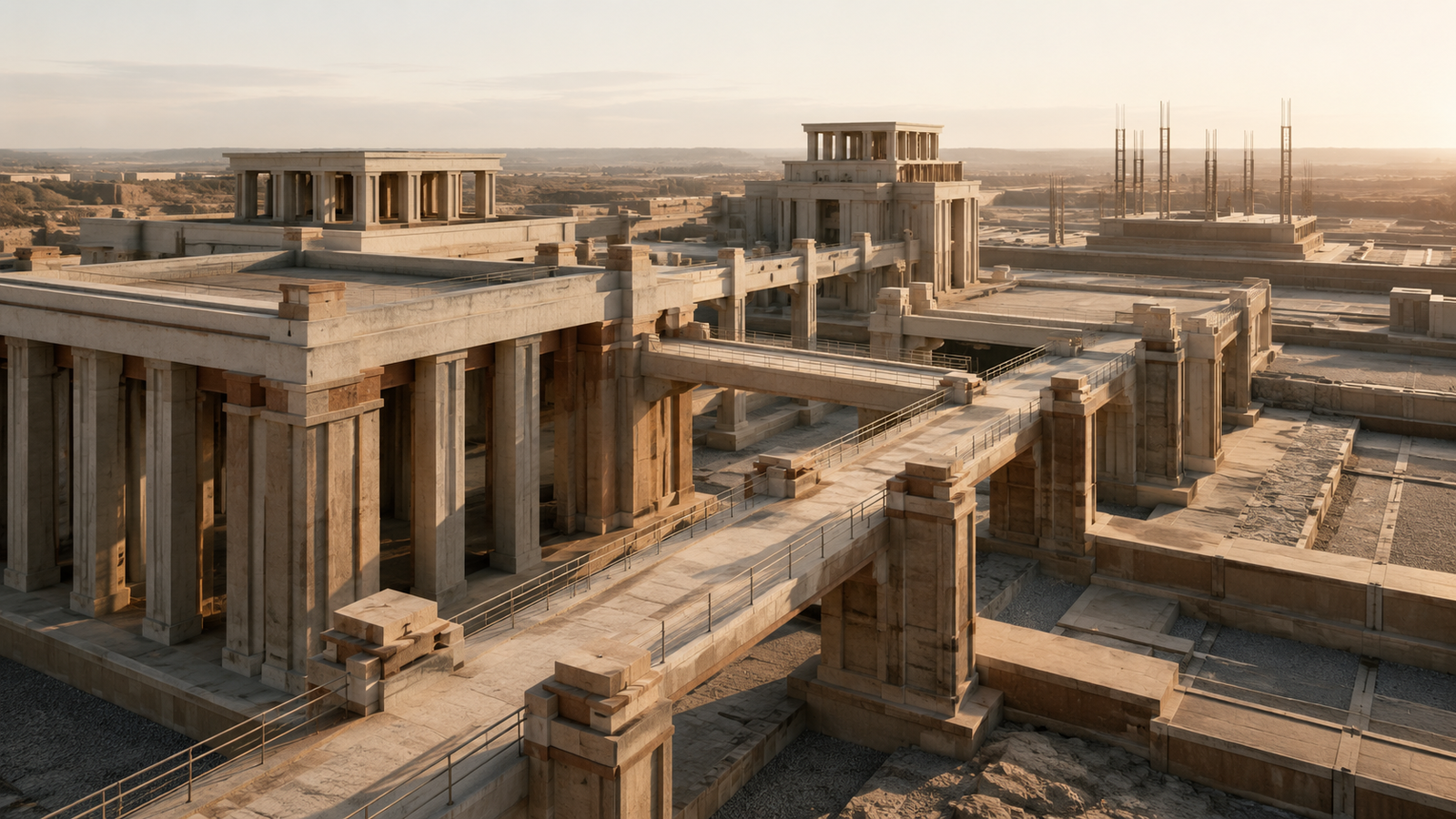
Governance is not about controlling growth. It is about creating the structure that allows growth to endure.
Roundup
The June 2026 Groundwork Daily roundup is not just a monthly recap. It is the mid-year checkpoint.
February made pressure visible. March taught maintenance. April tested capacity. May brought consequence.
June asked the question that comes after all of that:
Who is responsible for keeping the system functional?
That is governance.
Not government alone. Not management alone. Not authority for its own sake.
Governance is the structure that decides what gets reinforced, what gets corrected, what gets protected, and what gets allowed to drift. It lives in institutions, households, communities, relationships, habits, and public systems.
That is why June matters.
Across Groundwork Daily, the month kept returning to one hard truth: growth without governance becomes disorder. Capability without structure becomes waste. Community without contribution becomes resentment. Love without communication becomes confusion. Public systems without stewardship become failure wearing official language.
June Roundup: Governance Before Growth
This June roundup captures a clear shift in the Groundwork Daily system.
The site did not simply publish more. It clarified the rules beneath the work.
That distinction matters because output is easy to mistake for progress. A platform can publish every day and still fail to build authority. The stronger move is to show how the pieces connect, why the patterns matter, and what the reader is supposed to understand after the month is over.
June made that easier because the content converged around governance.
Again and again, the month returned to systems that only work when someone accepts responsibility for structure:
- financial reserves that must be rebuilt after use
- public safety treated as infrastructure
- communication systems that make modern life possible
- relationships that require optimization, repair, and boundaries
- communities that collapse when contribution becomes invisible
- daily discipline that must continue after novelty fades
- policy systems that require more than good intention
That is not random. That is the operating model becoming visible.
Governance Before Growth
June’s strongest opening claim was simple: capability is not enough.
A person can have talent and still lack follow-through. A community can have resources and still lack participation. A country can have policy ideas and still lack implementation. A household can have income and still lack stewardship.
That is the failure point June kept naming.
Capability without governance does not compound. It leaks.
→ Governance Before Capability
→ Outcomes Do Not Care About Narratives
→ Building Your Life Around Exceptions
→ Build Something That Outlives You
These posts worked because they refused the comfort of explanation without responsibility.
That is where a lot of people lose the plot. They can explain why something is hard. They can narrate why the system is unfair. They can identify friction, history, pressure, and constraint.
All of that may be true.
However, governance asks a different question: what structure will keep the work functioning anyway?
That is a harder question. It requires standards. It requires correction. It requires decision-making that survives mood, pressure, and applause.
June made governance the difference between having capacity and being able to use it.
Healthy Systems Recover
June also pushed the health lane into sharper territory.
The best health work did not treat wellness as an aesthetic. It treated recovery, exhaustion, friendship, mental health, and men’s emotional language as infrastructure.
That was the correct move.
A system that cannot recover is not strong. It is only temporarily functional. Eventually, the cost arrives.
→ Men Are Talking. But Are We Saying Anything?
→ Health as Discipline: Exhaustion Is Not a Personality Trait
→ The Friendship Crisis Men Keep Calling Being Busy
→ Mental Health Is Not About Feeling Good
→ Health as Discipline: You Do Not Need a New Life. You Need More Recovery Points.
What stands out is the refusal to romanticize pressure.
That matters because burnout often gets dressed up as discipline. Isolation gets excused as focus. Emotional silence gets mistaken for strength. Exhaustion gets rebranded as ambition.
June pushed back.
It did not argue that life should become soft or effortless. That would be weak thinking. Instead, it argued that a person needs recovery points, language, friendship, rhythm, and internal honesty if the system is going to hold.
That is practical. It is also structural.
Recovery is not retreat. It is maintenance for continued responsibility.
Community Requires Commitment
June’s community work may be some of the most important work of the month.
It refused to treat community as a vibe.
Good. That fantasy has had enough time.
Community does not survive because people like the idea of belonging. It survives because people contribute, maintain, communicate, clean up, show up, and accept that shared life has a cost.
→ What Your Trash Reveals About Your Household
→ The Work Nobody Notices Until It Stops
→ Why Grocery Stores Matter More Than Grocery Stores
→ Why Buying Local Is Not Economic Development
→ Maintenance Without Ownership
→ The Free Rider Problem at Work: When Reliability Becomes Infrastructure
This cluster was strong because it named the hidden labor inside shared systems.
Trash, groceries, local spending, reliability, maintenance, and ownership may look like separate topics. They are not. They are all part of the same governance question:
Who carries the system when the system stops feeling rewarding?
That question matters because communities do not usually collapse all at once. They hollow out. People stop contributing. Reliable people become infrastructure. Maintenance becomes invisible. Then everyone acts shocked when the system no longer works.
June made the invisible visible.
That is the point of a serious community framework. It does not flatter people for wanting community. It asks whether they are willing to sustain one.
Belonging without contribution is consumption.
Relationships Are Governance Systems
June also made one thing painfully clear: relationships do not survive on chemistry alone.
That is childish math.
What actually holds relationships together is governance. Communication. Repair. Emotional timing. Shared standards. The ability to optimize without controlling, correct without humiliating, and disagree without destroying the structure.
That is why June’s relationship work mattered.
→ Relationship Optimization Is Not Control
→ Communication Is a System, Not a Mood
→ Emotional Timing Determines What Gets Heard
→ Conflict Repair Is Relationship Infrastructure
→ Shared Standards Are the Real Compatibility Test
This cluster worked because it refused to confuse intensity with strength.
Intensity can create motion. It cannot create stability.
Stability comes from repeated repair, clear communication, and shared operating rules. Without those, a relationship becomes a performance space where both people keep reacting instead of governing the system they are inside.
June elevated that point.
It showed that communication is not just expression. It is infrastructure.
If the relationship has no governance, every disagreement becomes a referendum on survival.
Economic Stewardship Is Structural
June also strengthened the economic lane by moving beyond income and into stewardship.
That was necessary.
Income is not a system. A budget is not automatically a system. Saving money once is not a system. A system exists only when behavior, reserves, allocation, protection, and correction work together.
June made the financial argument more mature.
→ What to Do After You Use Your Emergency Fund
→ Emergency Fund Mistakes That Keep You Exposed
→ Wealth Is Not Income
→ Ownership Requires Maintenance
→ Financial Discipline After Progress
The strongest insight here is simple:
Money without governance becomes exposure.
That is why emergency funds matter. That is why reserves matter. That is why ownership must be maintained. The goal is not to look stable for a season. The goal is to create a financial structure that can take a hit without collapsing.
This is where Groundwork Daily’s money work keeps getting sharper.
It is not telling readers to worship frugality. It is telling readers to build margin, protect it, and understand what progress costs after the applause fades.
That is stewardship.
Institutions Matter More Than Personalities
June’s civic and institutional work also carried real weight.
The month kept returning to infrastructure, public safety, communication systems, trust, policy design, and institutional literacy. That is the right territory.
Too much civic conversation gets trapped in personalities. Who won. Who lost. Who sounded strong. Who looked weak. That is surface-level analysis.
Groundwork Daily is stronger when it asks what the system is designed to do.
→ Public Safety Is Infrastructure
→ Trust and Surveillance Are Not the Same System
→ Communication Infrastructure Is Civic Infrastructure
→ Policy Design Signals Behavior
→ Institutional Literacy Is a Survival Skill
This section is where June became institutional.
Not in the stiff, academic sense. In the practical sense.
Institutions are the structures people live inside whether they understand them or not. Public safety, communication, infrastructure, administrative systems, and civic trust shape daily life before most people notice the design.
That is why institutional literacy matters.
If people only understand politics as personality conflict, they will miss the machinery that actually governs outcomes.
June pushed readers toward the machinery.
Building the Future Requires Infrastructure
June also widened the future-facing work.
Innovation appeared across the month, but the stronger thread was not novelty. It was infrastructure.
That matters because the future is often sold as a product. A tool. A breakthrough. A shiny platform. A new capability.
That is shallow.
Future systems require governance, ownership, access, maintenance, and clear public understanding. Without those, innovation becomes another way for weak systems to move faster.
→ Innovation Needs Infrastructure
→ Credential Inflation and the Cost of Access
→ Technology Without Governance Becomes Risk
→ Future Literacy Requires Institutional Memory
→ Infrastructure Before Innovation
The throughline is blunt:
The future does not reward people who only chase tools. It rewards people who understand systems.
That is why this cluster matters. It keeps Groundwork Daily from becoming another commentary site reacting to technology and change from the sidelines.
The stronger move is to explain what must exist underneath innovation before it can become durable.
June did that.
The Daily Build Became Governance in Practice
June’s daily discipline work served as the practical engine beneath the larger institutional themes.
That is important.
A platform can talk about governance in big public systems all day. However, if it cannot connect that idea to ordinary habits, it becomes distant and ornamental.
The Daily Build keeps the concept grounded.
→ Follow-Through Is a System
→ Discipline After the Reset
→ Consistency Without Recognition
→ Quiet Correction Builds Stronger Systems
→ Do the Next Right Thing
This is where June lands at the human level.
Governance is not only what institutions do. It is also what people practice when they keep promises, correct drift, rebuild after interruption, and do the next right thing without needing applause.
That is not glamorous.
It is better than glamorous.
It is reliable.
Mid-Year Checkpoint: What the First Half of 2026 Taught Us
By the end of June, Groundwork Daily had published hundreds of pieces across systems, culture, economics, governance, relationships, health, technology, and daily discipline.
However, the first half of the year was never about volume.
It was about convergence.
Looking back from June, a clear pattern emerges. Every category, regardless of topic, kept returning to the same structural lessons.
Strong systems do not happen by accident.
They are designed.
They are maintained.
They are governed.
They are corrected before failure becomes visible.
That is the thread connecting the first six months of Groundwork Daily.
- February showed where pressure begins to accumulate.
- March taught maintenance before deterioration.
- April focused on building capacity before expansion.
- May demonstrated what pressure reveals when systems are tested.
- June established governance as the structure that keeps everything functioning over time.
Viewed together, these months form more than an editorial calendar.
They form a blueprint.
The work repeatedly challenged familiar assumptions.
Progress is not measured by intensity alone.
Capability is not the same as stewardship.
Attention is not neutral.
Money without reserves is exposure.
Community without contribution becomes consumption.
Relationships without communication become negotiation instead of partnership.
Institutions without accountability become fragile.
Health without recovery becomes depletion.
Innovation without governance becomes risk.
These ideas appeared in different categories, written by different builders, through different examples.
Nevertheless, they all reinforced the same operating principle.
Structure determines outcomes long before outcomes become visible.
That is why this midpoint matters.
The first half of 2026 did not simply teach readers how to react more effectively.
It taught them how to design better systems.
Why This Matters
Groundwork Daily has never been built around chasing headlines.
Instead, it is built around understanding the architecture beneath them.
Headlines change every hour.
Systems change much more slowly.
Readers who understand systems gain something more valuable than information.
They gain orientation.
That is the purpose of this roundup.
It is not merely a list of articles.
It is an invitation to step back, identify recurring patterns, and understand why seemingly unrelated topics often share the same structural logic.
Whether the conversation involves housing, friendship, AI, civic policy, family, economics, communication, or leadership, the underlying question remains remarkably consistent:
What kind of system produces this outcome?
That question will continue guiding Groundwork Daily through the second half of the year.
Receipts
Groundwork Daily’s June themes align with ongoing discussions across public policy, behavioral economics, institutional design, workforce development, public health, and governance research. Readers interested in exploring broader data and research may find these organizations useful:
→ U.S. Bureau of Labor Statistics
→ U.S. Census Bureau
→ Pew Research Center
→ Brookings Institution
→ Federal Register
July Preview: From Governance to Coordination
If June asked who is responsible for maintaining the system, July begins asking a different question.
How do people coordinate inside systems that are already under pressure?
That is the next layer.
Governance establishes standards.
Coordination determines whether those standards become lived reality.
Expect July to continue expanding Groundwork Daily’s work around institutions, neighborhoods, families, leadership, organizational behavior, and everyday decision-making.
The focus will move beyond individual capability toward collective execution.
Readers can expect deeper exploration of:
- institutional coordination
- community resilience
- leadership under uncertainty
- organizational trust
- economic adaptation
- social infrastructure
- decision-making under pressure
The conversation becomes less about isolated excellence and more about whether people, organizations, and communities can move together without losing clarity.
That is coordination.
And that may become one of the defining themes of the second half of 2026.
The first half of 2026 has unfolded as a single conversation.
Each monthly roundup builds on the last, revealing how systems are designed, tested, strengthened, and ultimately governed.
If you are joining the journey here, start at the beginning and watch the framework develop month by month.
January 2026 — Structure Before Spectacle
February 2026 — Pressure Changes Everything
March 2026 — Maintenance Becomes Strategy
April 2026 — Capacity Before Expansion
May 2026 — Systems Under Pressure
Subscribe to the Groundwork Daily Newsletter
The First Half of 2026 at a Glance
Every month introduced a new structural principle.
- January established the framework. Structure comes before spectacle.
- February demonstrated how pressure exposes strengths and weaknesses.
- March showed that maintenance is what preserves progress.
- April argued that capacity must be built before expansion.
- May explored what systems reveal when they are placed under sustained load.
- June established governance as the discipline that keeps every other system functioning.
Taken together, these are not six unrelated monthly reports.
They are six chapters of the same operating framework.
Each month answers a different question. Together they explain how durable systems are built.
Structure.
Pressure.
Maintenance.
Capacity.
Consequence.
Governance.
The framework is no longer theoretical.
It is becoming institutional.
July begins the next chapter.

Follow the evolution of Groundwork Daily as each monthly roundup builds on the one before it, creating a growing library of connected ideas, practical frameworks, and systems thinking.