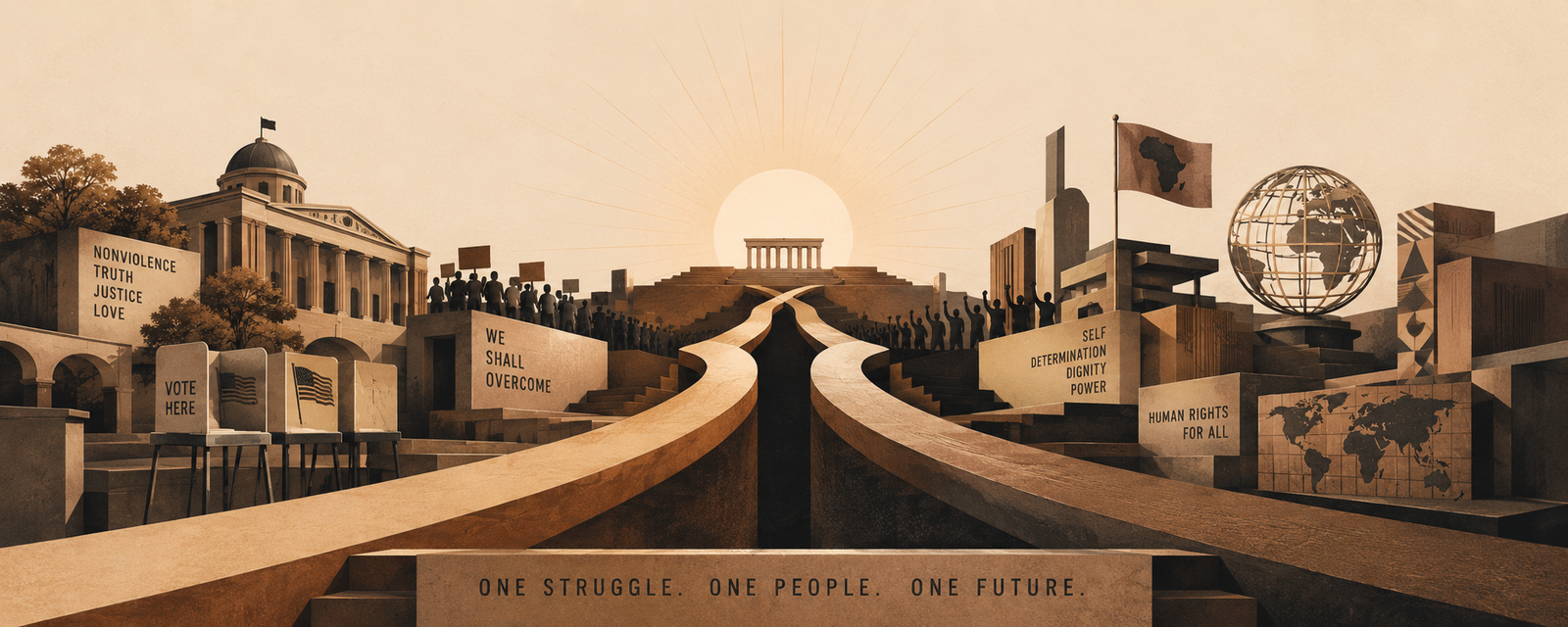
King and Malcolm strategic convergence is a better way to understand the final phase of two of the most important leaders in the Black freedom struggle.
The popular story is simpler.
Martin Luther King Jr. represented nonviolence. Malcolm X represented militancy. One is remembered through marches, churches, and moral appeals. The other is remembered through self-defense, nationalism, and uncompromising critique.
That framing is familiar. It is also incomplete.
The historical record shows two men who disagreed sharply, evolved significantly, and eventually occupied complementary positions inside the same broader struggle. Their methods were different. Their public language was different. Their political audiences were different. But both men increasingly confronted the same structural problem: America could not claim democracy while denying Black people safety, dignity, voting power, economic opportunity, and human rights.
That is where the real lesson begins.
King and Malcolm strategic convergence was not a secret merger. It was not a formal alliance. It was something more useful to study: separate pressure systems moving toward overlapping objectives.
King and Malcolm Strategic Convergence Challenges the Myth
Traditional civil rights memory often turns history into a clean contrast.
King becomes the acceptable reformer. Malcolm becomes the dangerous radical.
That split is convenient because it gives readers a simple moral map. It also removes the strategic complexity that made the Black freedom struggle powerful.
King’s nonviolent movement did not operate in a vacuum. It worked because it dramatized injustice before the nation and forced institutions to respond. Sit-ins, marches, boycotts, arrests, speeches, and mass organizing created moral pressure that could not easily be ignored.
Malcolm’s approach also did not operate in a vacuum. His critique exposed the impatience, anger, and political intelligence of Black Americans who no longer believed that appeals to conscience were enough. He forced America to confront the cost of delay.
Those two forces created a wider field of pressure.
King showed the country what democratic reform could look like.
Malcolm warned the country what could happen if reform remained performative, slow, or empty.
That is not opposition in the simplistic sense. That is strategic tension.
Harlem and Early Contact
The relationship between King and Malcolm was never as distant as popular memory suggests.
One early documented point of contact came in 1960, when Malcolm X invited King to attend a Nation of Islam event at Harlem’s 369th Regiment Armory. King did not attend. According to correspondence preserved by Stanford University’s Martin Luther King, Jr. Research and Education Institute, the invitation arrived too late for participation.
Still, the invitation matters.
It shows that Malcolm was not simply shouting from outside the civil rights orbit. He was attempting to engage leaders who represented a different strategic lane.
Publicly, Malcolm criticized mainstream civil rights organizations and often questioned whether integrationist leadership was too dependent on white approval. Those critiques were sharp. Some were unfair. Some were strategically useful. They forced a conversation about whether legal access alone could deliver real power.
Privately, the record shows more complexity.
Malcolm understood that King had a unique role. King could enter rooms Malcolm could not enter. King could negotiate with presidents, governors, clergy, philanthropic networks, and national media while maintaining a moral discipline that made state violence visible.
That did not make King weak.
It made him structurally necessary.
Malcolm X After 1964
Any serious reading of King and Malcolm strategic convergence has to account for Malcolm’s transformation after 1964.
Many discussions freeze Malcolm X inside his Nation of Islam period. That is bad history. It is also lazy analysis.
After breaking with the Nation of Islam, Malcolm’s political framework widened. His pilgrimage to Mecca challenged earlier assumptions about race and religion. His international travels deepened his understanding of anti-colonial politics, African independence movements, and global systems of racial hierarchy.
He founded the Organization of Afro-American Unity and began framing the Black struggle as a human rights issue, not merely a civil rights issue.
That shift was strategic.
Civil rights claims stayed largely inside the American legal and political system. Human rights claims could move the issue onto the world stage. They could expose the contradiction between American Cold War messaging abroad and racial subordination at home.
This mattered because the United States was presenting itself as the global defender of freedom. Malcolm understood that racial injustice weakened that claim. He wanted to internationalize the pressure.
That did not erase his differences with King.
It did create overlap.
Both men were increasingly looking beyond simple access. Both were asking whether American institutions could be forced to deliver real democratic substance.
King’s Expanding Framework
King also evolved.
Another weak reading of history freezes King at the “I Have a Dream” speech and ignores the later King who spoke about poverty, militarism, economic exploitation, and structural injustice.
King never abandoned nonviolence. That was not a tactic he wore for convenience. It was rooted in his theology, discipline, and theory of social change.
But King’s analysis became more expansive over time.
He increasingly understood that legal desegregation alone could not solve racial inequality. Voting rights mattered. Public accommodations mattered. School access mattered. But economic power, housing, labor, wages, and public investment also mattered.
That later King was more radical than the sanitized version often presented in public memory.
He challenged poverty.
He challenged war.
He challenged economic arrangements that left Black communities formally free but materially constrained.
That is why the convergence with Malcolm matters. Not because King became Malcolm. Not because Malcolm became King. But because both men were being pushed by reality toward a broader critique of American power.
Selma and the Radical Flank Effect
The clearest example of King and Malcolm strategic convergence appeared during the Selma voting rights campaign.
In February 1965, while King was jailed, Malcolm traveled to Selma and addressed activists at Brown Chapel AME Church.
That visit created concern among some civil rights organizers. The Selma campaign was built around disciplined nonviolent action. Malcolm’s reputation carried a different kind of political charge.
But Malcolm’s stated intention was not to sabotage King.
According to Coretta Scott King’s later recollections, Malcolm explained that his presence was meant to make King’s work easier. His argument was simple: if white power structures understood the radical alternative, they might become more willing to negotiate with King.
Political scientists often call this the radical flank effect.
The idea is that moderate movements can gain leverage when institutions fear that ignoring them will strengthen more radical alternatives.
This does not mean every radical flank helps every movement. That would be sloppy. Radical pressure can also trigger backlash, repression, or fragmentation.
But in the King and Malcolm case, the dynamic is important.
King’s movement offered a disciplined path toward democratic reform.
Malcolm represented the possibility that continued delay would delegitimize moderation itself.
That gave King’s approach additional urgency in the eyes of people who might otherwise have preferred slow concession, symbolic sympathy, or procedural delay.
State Surveillance and Shared Threats
Both King and Malcolm attracted federal surveillance.
The FBI monitored King extensively. The Bureau also monitored Malcolm and other Black political leaders, organizations, and movements. The state understood something that public memory often forgets: ideas, networks, and disciplined pressure can threaten existing power even when leaders use very different methods.
King’s nonviolence did not protect him from state scrutiny.
Malcolm’s militancy did not make him the only perceived threat.
Both men challenged the legitimacy of American racial order.
Both men attracted attention because they could move people.
Both men were increasingly difficult to contain inside narrow labels.
That is the real systems point.
Institutions do not only fear violence. They fear organized legitimacy. They fear disciplined people who can name contradictions, mobilize constituencies, and expose structural failure.
King and Malcolm did that differently.
But both did it.
The Systems Lesson
The strategic lesson is not that every movement needs a King and a Malcolm.
That would turn history into a formula.
The better lesson is that movements often require an ecosystem of pressure.
One strategy rarely carries the entire burden. Legal strategy matters. Moral witness matters. Electoral pressure matters. International framing matters. Economic disruption matters. Cultural language matters. Community discipline matters.
King and Malcolm represented different pressure points inside a larger struggle.
King made reform morally unavoidable.
Malcolm made delay politically dangerous.
King gave America a path toward democratic repair.
Malcolm exposed the consequences of refusing that repair.
That is why the binary fails.
The question was never simply nonviolence versus militancy. The deeper question was how Black people could force a system built on exclusion to respond to demands for freedom, dignity, and power.
King answered one way.
Malcolm answered another.
Their answers were not identical, but they increasingly addressed the same institutional failure.
Why This Matters Now
King and Malcolm strategic convergence matters because modern public life still prefers flattened narratives.
People want heroes without contradiction and villains without context. That may be emotionally satisfying, but it produces weak civic understanding.
Real movements are not clean.
They contain disagreement, tension, evolution, correction, and competing theories of change.
The question is not whether every disagreement disappears. The question is whether different strategies can create pressure toward a shared structural outcome.
That is the useful inheritance from King and Malcolm.
They show that liberation work cannot be reduced to one personality, one speech, one tactic, or one institution.
History often celebrates individuals.
Systems are moved by ecosystems.
That is the architecture worth studying.
Further Groundwork
Receipts
System Updates examines the structures, incentives, institutions, and decisions that shape civic life. The series focuses on systems rather than personalities and studies how power, governance, and public pressure influence long-term outcomes.