
Black land loss is usually told as a story about land that disappeared. That is true, but incomplete.
A deed can establish ownership. It cannot guarantee that the land will remain productive, legally secure, financially viable, properly transferred, defended against bad claims, or protected when the owner encounters pressure.
That distinction matters because Black Americans did acquire land. They farmed it, built homes on it, created businesses from it, passed pieces of it through families, and used property as one of the few forms of durable economic independence available to them. The larger historical problem, instead, is that acquiring the asset and building everything required to keep the asset were never the same job.
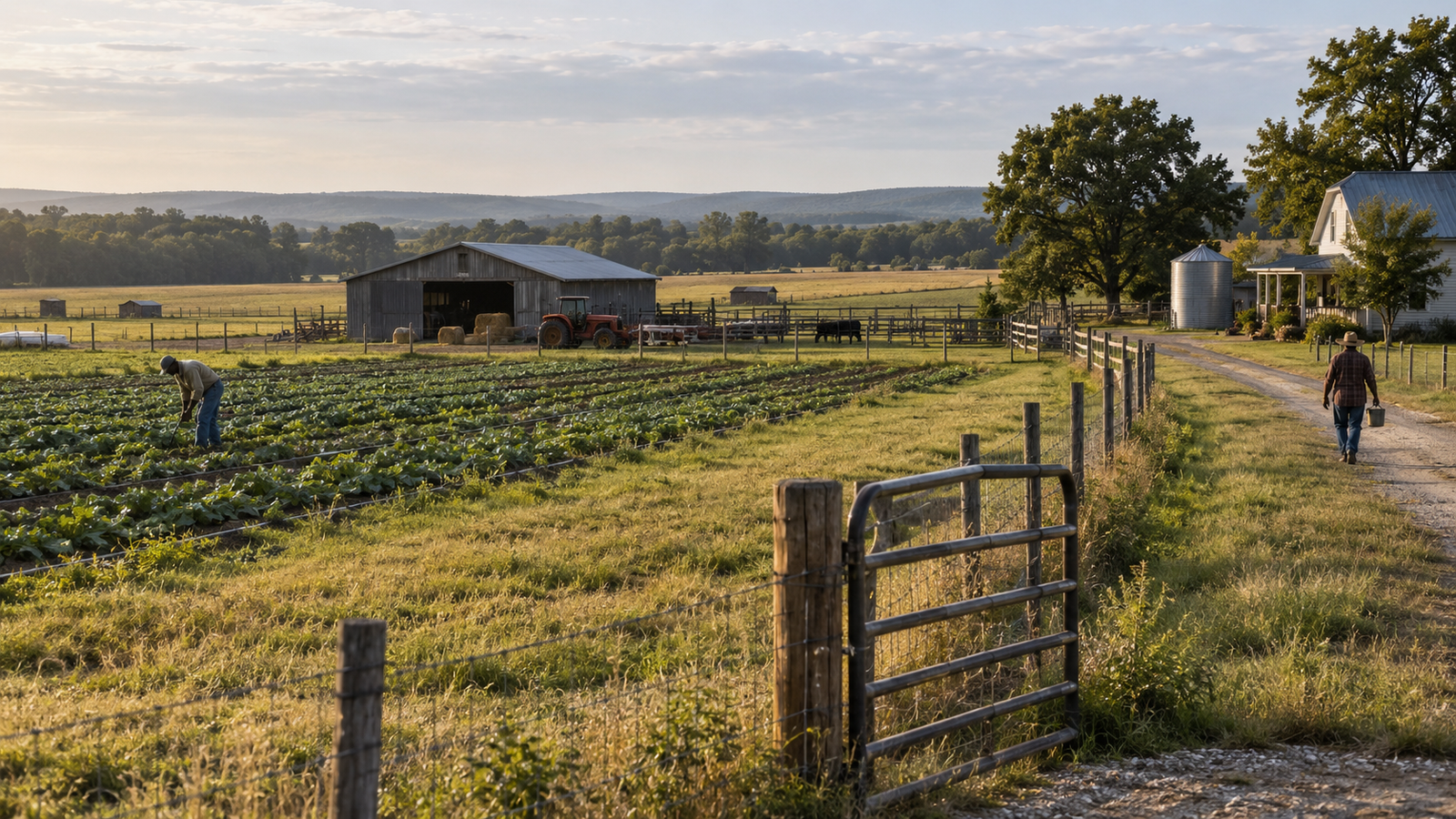
A current land dispute involving Courtney and Nicole Mallery and Freedom Acres Ranch in Colorado has pushed that old question back into public view. Their situation has generated intense commentary about race, neighboring property disputes, boundaries, law enforcement, and community response. Some claims remain contested, however, and should be treated accordingly.
But the larger question does not depend on proving every allegation in one modern dispute.
What does ownership need around it if the property is expected to survive?
The Deed Is Not the Finish Line
Ownership is powerful because it changes the relationship between a person and a place. A renter occupies; an owner has a claim. That claim can support a household, an agricultural operation, a business, collateral, inheritance, community presence, and long-term decision-making.
But ownership is often discussed as though the deed completes the system. It does not.
Land still needs taxes paid. Boundaries need to remain clear, and titles need to remain clean. Insurance has to remain appropriate, and buildings, roads, wells, gates, drainage, equipment, fencing, and soil all require maintenance. An agricultural property needs revenue. A family property needs succession decisions. And if several heirs eventually own undivided interests, those relationships need governance too.
The land can be fully owned and still become increasingly difficult to hold.
Acquisition answers: Who owns this?
Durability answers: What allows that ownership to keep functioning through pressure, transition, cost, conflict, and time?
Those are separate systems. History becomes easier to understand once they are separated.
Black Americans Did Get Land
The history is often compressed so aggressively that it can sound as if Black agricultural ownership barely existed. It did.
After emancipation, Black families acquired millions of acres despite discriminatory laws, constrained credit, racial violence, unequal access to markets, and a political order that frequently resisted Black economic independence.
Historical estimates require care, since different datasets measure different things. USDA-linked research commonly places Black-owned farmland at roughly 16 to 19 million acres around the early twentieth-century peak. Modern USDA Economic Research Service data, using the broader measure of land operated by Black farmers, reports approximately 41.4 million acres in 1920.
Owned acreage and operated acreage are not interchangeable. The distinction matters.
What does not require much interpretation is the direction of the long-term trend. The number of Black-operated farms fell sharply across much of the twentieth century. By 2022, USDA counted 46,738 Black producers involved in decision-making on 32,653 farms covering about 5.3 million operated acres.
There is no responsible way to explain that century of change with one cause.
The Great Migration mattered. Mechanization changed agriculture, and farm consolidation changed the economics of scale. Commodity markets changed, families moved, and some owners sold willingly while other farms simply became economically unsustainable. American agriculture as a whole, meanwhile, went through enormous consolidation.
But Black land loss also developed inside institutions that did not distribute protection, credit, legal capacity, government support, and political power evenly.
That is the part that turns land loss from a historical statistic into a systems question.
Land Usually Leaves Through a Mechanism
Property rarely wakes up one morning and decides to disappear from a family. Instead, something happens to the structure around it.
Title becomes complicated.
One major vulnerability is heirs’ property. When land passes without a will, trust, or other formal succession structure, multiple descendants can eventually inherit undivided interests in the same parcel.
The land may still belong to the family, but control becomes fragmented.
One heir may want to farm, while another lives three states away and wants cash instead; a third may not even know the property’s current condition. As generations pass, the number of owners can grow while the authority to make basic decisions becomes harder to coordinate.
Historically, partition law created another vulnerability. In some jurisdictions, a co-owner could seek a partition sale that resulted in an entire parcel being sold, even when other family members wanted to keep it. Reform efforts such as the Uniform Partition of Heirs Property Act were designed in part to reduce the most destructive versions of that process.
Credit becomes harder to access.
Land is valuable partly because it can support productive investment. But unclear title can make it harder to use property as collateral, qualify for some government programs, secure financing, or make long-term improvements.
That creates a quiet trap.
The family owns the asset, but the structure around the ownership makes the asset harder to finance. The land then produces less income than it could, maintenance gets deferred, taxes become heavier relative to cash flow, and selling begins to look more rational.
The property carries costs whether the system is ready or not.
Ownership does not eliminate operating expenses.
Taxes arrive, equipment breaks, and fences fail. Insurance changes; weather damages crops. Buildings need roofs, roads wash out, a well fails, and a tractor eventually reaches the end of its useful life.
A farm without financial margin can be one bad season away from a decision that changes the family’s ownership forever.
Institutions determine how much pressure the owner absorbs alone.
This is where the history becomes uncomfortable.
Black farmers did not operate outside American institutions. They depended on banks, county governments, courts, USDA offices, markets, extension systems, lawyers, insurers, local political relationships, and neighboring infrastructure just like other farmers.
When access to those systems is weaker, slower, more expensive, or discriminatory, the property owner absorbs more of the risk personally.
The deed stays the same. The operating environment does not.
The Missing Layer Around Ownership Is Protection Capacity
That phrase can sound defensive, but protection is not limited to guards, gates, or courtrooms.
A durable ownership system is surrounded by ordinary capacities that make the asset harder to destabilize.
- Clear title: the ownership structure is legally understandable.
- Succession: the next transfer is planned before death or incapacity forces the question.
- Documentation: surveys, deeds, easements, tax records, insurance, leases, permits, and agreements are maintained.
- Capital: the owner has enough reserve or financing access to respond to maintenance and disruption.
- Legal capacity: counsel can be reached before a dispute becomes a crisis.
- Boundaries: property access, easements, responsibilities, and rights are clearly established.
- Revenue: the land produces enough economic value, or has enough outside support, to carry its continuing cost.
- Relationships: agricultural organizations, local institutions, government offices, customers, neighboring owners, and professional networks know the operation before an emergency.
None of those systems guarantees that a family will keep property forever. They simply change the odds.
That is what Build What Holds means in practical terms. The asset has to survive normal wear, unusual pressure, mistakes, transition, maintenance, and time.
The same principle applies to a neighborhood business, church building, community center, family home, farm, nonprofit, or apartment building.
Acquisition creates the asset. Structure, in turn, keeps the asset from becoming fragile.
Colorado Is a Case to Examine, Not a Shortcut to a Conclusion
The public attention around Freedom Acres Ranch is useful precisely because it exposes how quickly a property dispute can expand beyond a fence line.
Questions about access can become questions about boundaries, which can become questions about documentation. From there, a conflict with neighbors can become a law-enforcement issue, then a legal issue, then a public-relations issue. Once social media enters, a local dispute can become a national symbol before the underlying facts have been fully adjudicated.
That creates two responsibilities.
The first is factual discipline. Serious allegations should not become fact merely because they fit a familiar history. The Mallery dispute should be evaluated through court records, property documents, law-enforcement records, verified reporting, and other evidence rather than reaction commentary alone.
The second responsibility is structural memory.
Historical caution does not require pretending history never happened.
Black landowners have experienced documented discrimination in agricultural programs, credit systems, land tenure, and other institutions. Heirs’ property has created additional vulnerabilities. Rural land ownership has often existed inside social systems where legal ownership alone did not guarantee equal institutional protection.
The question, therefore, is not whether Colorado in the 2020s is identical to the rural South in 1920. Instead, it is whether communities have learned enough from the history to build stronger systems around ownership now.
Build the Protection System Before the Crisis
Community response usually becomes visible after something goes wrong.
Someone starts a fundraiser. A story spreads. People drive to the property. Customers make purchases. Lawyers offer help. Organizers amplify the conflict. Public figures are asked to intervene.
All of that can matter. But emergency solidarity and durable infrastructure are not the same thing.
If a community asset can survive only when somebody famous notices the emergency, there is no protection system yet.
There is an emergency appeal system.
That distinction is bigger than celebrity responsibility.
Asking wealthy individuals to rescue every threatened Black-owned asset turns an institutional problem into a personality test. Sometimes an individual with money can help, but that is not a substitute for durable capacity.
A stronger model is less dramatic.
Agricultural landowners know which lawyers understand property, succession, easements, farm programs, and heirs’ property before a dispute begins. Families know where the deed is. Surveys are current. Taxes are tracked. Succession conversations happen before illness or death. Community institutions know which farms and businesses are worth supporting. Customers have relationships with those enterprises during ordinary months, not only when a crisis goes viral.
Capital pools can help finance maintenance or emergency legal costs. Cooperatives can improve purchasing and market power. Land trusts and other ownership structures can be considered where appropriate. Extension services and agricultural organizations can help owners navigate programs. Families, too, can decide who has authority before ten people inherit ten different expectations.
None of this trends well on social media. That is part of the point: strong systems are often boring before they become valuable.
Ownership Without Protection Is an Incomplete Institution
Black land loss cannot be reduced to one villain, one law, one historical period, or one explanation.
Land was sold, families moved, and some farms could not survive changing agricultural economics. Property became tangled through inheritance; some owners lacked capital, while others faced discriminatory treatment or simply lost property through mechanisms they did not fully understand until the process was already moving.
The lesson is not that ownership is meaningless. It is, instead, that ownership is infrastructure that requires infrastructure.
The deed matters. So does the title. The will matters, and so does the operating income. The boundary matters, as does the lawyer who understands it. The land matters, and so does the family structure that determines what happens when the current owner is no longer carrying the work.
That is the difference between possessing an asset today and building an asset capable of reaching tomorrow.
A deed establishes ownership. Durability determines whether the ownership holds.
This is a standalone Community Groundwork essay. Continue into the larger systems that determine whether shared assets, institutions, and community capacity remain durable.
→ Community Systems: Community Groundwork
→ Shared Stewardship: Cultivating the Commons
→ Participation: Community Participation
→ Behavior Under Pressure: Block Logic
The Principle and Condition Beneath This Work
This article applies one governing principle and one structural condition from the Groundwork Daily architecture.
Build What Holds
Ownership becomes durable only when the structure around the asset can carry pressure, receive maintenance, survive transition, and remain useful over time.
Durability
Durability is the structural job beneath this article because the central question is not whether land can be acquired, but whether ownership can continue performing through cost, conflict, maintenance, succession, and time.
See the full Core Principles and Conditions architecture .

Cyrus Mbeki
Community Groundwork · Shared Systems & Stewardship
Cyrus Mbeki studies what people actually do inside shared systems. His work examines maintenance, participation, incentives, stewardship, responsibility, ownership, and the everyday structures that determine whether communities remain functional under real conditions.
His Community Groundwork essays follow assets and institutions beyond the moment they are created, asking what maintenance, participation, protection, continuity, and structure are required for them to remain useful over time.
This article distinguishes historical measures of land owned from land operated. Those measures are related but should not be treated as interchangeable.
- U.S. Department of Agriculture Rural Business-Cooperative Service: Black Farmers in America, 1865–2000
- USDA Economic Research Service: 2022 Census of Agriculture, Black-operated farm size continues to grow
- USDA National Agricultural Statistics Service: 2022 Census of Agriculture Highlights, Black Producers
- Congressional Research Service: Racial Equity in U.S. Farming, Background in Brief
- U.S. Forest Service Research: Heirs’ Property and Persistent Poverty among African Americans in the Southeastern United States
- USDA Economic Research Service: Farmland Ownership and Tenure
External links were live and accessible when this article was published or last substantively updated. Third-party pages may change, move, or be removed over time.