
Infrastructure maintenance begins the moment a city opens something new. Every public asset has a construction price, but it also carries a second price: what it costs to keep working.
Cities talk constantly about the first price. A road gets funded, a park is announced, a station opens, or a public building gets a ribbon cutting. Once the project enters service, however, the less visible work begins.
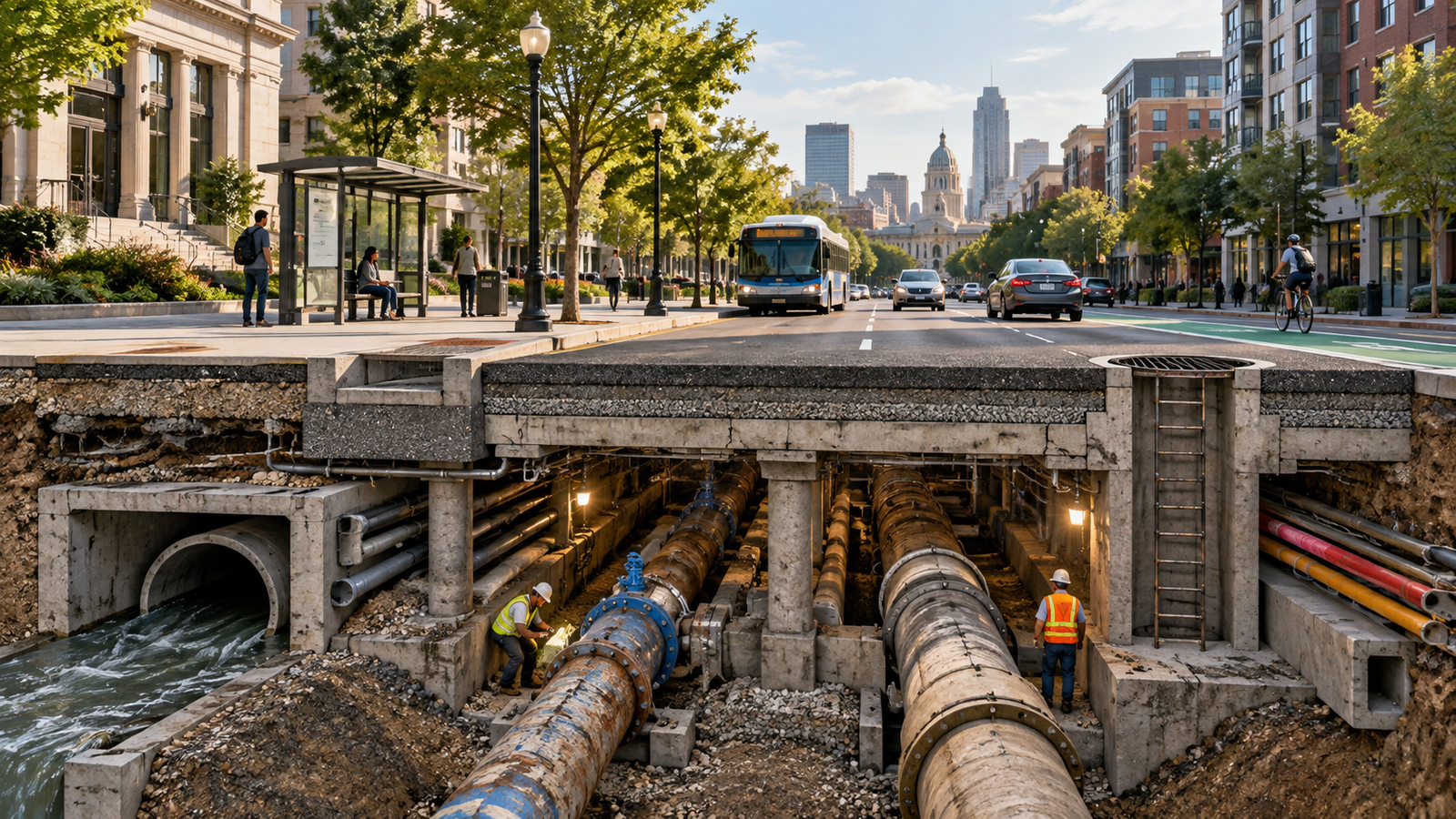
Pavement wears. Pipes corrode. Pumps fail. Trees need care. Signals age. Drainage structures fill. Lighting equipment breaks. Vehicles accumulate miles, while roofs, elevators, public spaces, and electronic systems all require inspection, repair, renewal, and eventual replacement.
Because those costs arrive slowly, they are easy to push into the background. Infrastructure maintenance gets distributed across operating budgets, crews, work orders, inspection cycles, contracts, emergency repairs, capital plans, and future administrations. Yet that second price ultimately determines whether the asset lasts.
Infrastructure Maintenance Has a Second Price
Construction spending is easy to recognize because construction creates something visible. By contrast, successful infrastructure maintenance often produces a quieter result: continuity.
The street remains passable. Water continues to flow. The signal works, the station remains usable, the drain carries runoff, and the public building keeps serving people. Nothing dramatic happened, which is precisely the point.
Good maintenance prevents ordinary assets from becoming extraordinary problems. The U.S. Environmental Protection Agency describes asset management as managing infrastructure capital assets to minimize the total cost of owning and operating them while delivering the service level customers expect.
That definition matters because it refuses to separate construction from operation. In practical terms, the asset is not merely the physical object that was purchased. The real asset is the service that must continue.
The Federal Highway Administration uses similar lifecycle logic. Its transportation asset-management framework connects maintenance, preservation, repair, rehabilitation, and replacement rather than treating construction as the end of the decision.
Seen this way, a road is more than a road project. It brings resurfacing, striping, drainage work, signal upkeep, utility cuts, curb repair, inspection, accessibility work, and eventual reconstruction. Likewise, a transit station carries cleaning, elevators, lighting, communications, roofs, electrical systems, platforms, signage, and replacement cycles. Parks create their own operating load through landscaping, irrigation, paths, drainage, bathrooms, trees, seating, staffing, and stewardship.
The visible asset is therefore only the front end of a much longer obligation.
Infrastructure Maintenance Is an Ownership Cost
Cities can sometimes secure money for construction that does not exist in the same form for long-term upkeep. Federal grants, state programs, bonds, dedicated capital funds, development agreements, and one-time appropriations can help get projects built.
After opening day, however, the operating responsibility remains. Payroll, materials, contracts, equipment, inspections, utilities, replacement parts, inventories, work orders, engineering, procurement, emergency response, and capital renewal all become part of ownership.
Congressional Budget Office data show the scale of that responsibility. In 2023, state and local governments spent about $494 billion on transportation and water infrastructure. Of that total, roughly $307 billion went to operation and maintenance, while about $187 billion went to capital spending.
Those figures do not mean every city spends more maintaining infrastructure than building it. They do show, however, that operations and maintenance are not side expenses. They are a major part of the infrastructure system.
Public debate often treats capital investment as proof of capacity. Yet a city can be very good at acquiring projects while remaining weak at carrying them over time.
That weakness may remain hidden at first. New pavement is smooth, equipment may be under warranty, and recently completed facilities have not accumulated decades of wear. Consequently, expansion can make a system look stronger before the full infrastructure maintenance burden arrives.
The bill is delayed, but it is not cancelled.
Why Infrastructure Maintenance Becomes a Capacity Problem
Poor maintenance is often blamed entirely on laziness, incompetence, or indifference. Those factors can exist, but the sharper structural question is different: does the organization responsible for the asset have enough capacity to keep the promise?
Money is only one part of that capacity. The responsible agency must know what assets exist and understand their condition. It also needs enough workers or contractors, appropriate equipment, functioning procurement, inspection schedules, records, engineering judgment, replacement planning, and sufficient budget discipline.
For that reason, credible asset-management systems begin with inventories and condition assessments. The Federal Transit Administration requires covered transit providers to use asset-management plans that include inventories, condition assessments, performance targets, and investment priorities.
FTA’s state-of-good-repair framework also connects performance with lifecycle investment. A capital asset should perform its designed function without unacceptable safety risk, while scheduled maintenance, rehabilitation, and replacement needs are addressed.
This is not paperwork for its own sake. A city cannot maintain what it has not counted, prioritize what it has not inspected, or budget intelligently when it does not know which assets are approaching failure.
More importantly, a system is not durable when predictable aging repeatedly becomes an emergency surprise.
Deferred Infrastructure Maintenance Does Not Erase the Cost
Maintenance is unusually easy to postpone because the consequence can take time to appear. A skipped repair may leave a road usable tomorrow. A delayed roof replacement may not close the building this month. Similarly, a drainage system can look acceptable until the storm that exposes its weakness.
As a result, deferred infrastructure maintenance can create an accounting illusion. The organization appears to have saved money because the maintenance dollar was not spent. In reality, it may simply have transferred more risk into the future.
Federal property provides a useful illustration of the mechanism. In 2025, the Government Accountability Office reported that deferred maintenance and repair backlogs for Department of Defense and federal civilian buildings had risen from about $171 billion in fiscal year 2017 to about $370 billion in fiscal year 2024.
GAO also warned that continued deterioration can force premature replacement, which may cost substantially more than repairs performed when originally scheduled. Those numbers describe federal buildings rather than municipal infrastructure, so they should not be projected directly onto cities. Still, the underlying lifecycle problem is transferable.
Delay changes the nature of the problem. A minor intervention can become a major repair; repair can become rehabilitation; and rehabilitation can become replacement. Meanwhile, a planned maintenance window can become an emergency shutdown.
Every New Asset Adds Future Infrastructure Maintenance
Infrastructure expansion deserves a more complete accounting. When a city adds an asset, it adds value, but it also adds load to the system responsible for keeping that asset useful.
Additional lane miles require pavement management. Landscaped public space adds horticultural work and irrigation needs. Transit vehicles add mechanics, inspections, parts, cleaning, storage, and eventual replacement. Buildings add roofs, HVAC systems, plumbing, elevators, energy use, inspections, cleaning, and capital renewal. Water and sewer extensions add more pipe to inspect, repair, and ultimately replace.
None of that makes expansion inherently bad. Cities need infrastructure, aging systems require renewal, and growing communities often require more capacity. Furthermore, climate pressures, accessibility requirements, housing growth, technology, and changing mobility patterns can justify substantial new investment.
Expansion without operating capacity, however, is not strength. It is leverage. The city has accepted a larger future obligation, and somebody must carry it.
Therefore, infrastructure planning eventually becomes fiscal and organizational planning. Revenue, staffing, equipment, institutional knowledge, procurement capacity, and maintenance discipline must expand with the physical system or the gap will eventually surface somewhere else.
Why New Construction Often Beats Infrastructure Maintenance
New projects have political advantages that ordinary upkeep does not. A new facility can be named, photographed, announced, funded through a visible program, and tied to a milestone. In other words, construction gives leaders a recognizable story about progress.
Successful infrastructure maintenance is harder to narrate. The bridge remained open, the pump did not fail, the drain was cleared before the storm, and the elevator received service before riders encountered an outage. The public often experiences that success as nothing happening.
That difference creates an incentive problem. Systems can reward the visible act of adding infrastructure more strongly than the quiet discipline of preserving it.
This does not require corruption or bad intent. Instead, the pattern can emerge from grant structures, separate budget categories, election cycles, institutional silos, media attention, public expectations, and the basic human preference for beginnings over upkeep.
Urban Logic treats that pattern as a systems problem. If maintenance is repeatedly sacrificed, demanding better intentions is not enough. Budget rules, asset information, lifecycle assumptions, project approvals, and operating responsibilities must make long-term ownership difficult to ignore.
The Urban Logic Build-to-Maintain Test
Before celebrating a new public asset, ask whether the system responsible for it can carry the entire lifecycle obligation. A useful infrastructure decision should survive more than a construction test; it should survive an ownership test.
Urban Logic Framework
The Build-to-Maintain Test
The Build-to-Maintain Test is an Urban Logic diagnostic for determining whether a proposed public asset has a credible operating life after construction. It does not replace engineering analysis or lifecycle costing. Instead, it exposes the obligations that begin after opening day.
Identify the asset, major components, expected life, inspection needs, operating requirements, and replacement cycle.
Name the department, workforce, contractors, equipment, systems, and institutional knowledge responsible for upkeep.
Separate construction funding from recurring operations, preventive maintenance, rehabilitation, and eventual replacement.
Determine whether the asset expands real operating capacity or simply adds work to an already stretched system.
Identify safety, reliability, access, financial, environmental, service, and public-trust consequences before failure becomes an emergency.
Account for rehabilitation, modernization, replacement, removal, or decommissioning instead of pretending the asset lasts forever.
The framework is intentionally simple. It cannot replace technical lifecycle analysis, professional asset management, engineering judgment, or public budgeting.
Its job is narrower and more useful: make one weak assumption harder to hide—the assumption that being able to construct something proves the ability to sustain it.
Better Infrastructure Maintenance Starts Before Construction
The cheapest maintenance problem is often the one removed during design. FHWA’s asset-management framework emphasizes lifecycle planning because decisions made early can shape costs and performance for decades.
For example, material choices matter, but so do standardization, maintenance access, inspection design, replacement parts, and workforce capability. A one-off technology can create unnecessary complexity if nobody has the tools or knowledge to service it. Likewise, a public facility that is difficult to access for repair can make routine work slower and more expensive.
Landscape design carries the same logic. A beautiful plan that requires irrigation, staffing, replacement planting, or specialized care beyond the city’s operating capacity is not durable simply because the opening-day photograph looks good.
Durability, then, is not only a property of materials. It is the relationship between design and the system expected to care for that design over time.
That question changes planning because it brings operating departments into the conversation earlier. It also makes staffing, maintenance access, replacement schedules, procurement, and lifecycle funding visible before the city commits itself.
Most importantly, the question exposes whether a city is truly adding an asset or merely adding a future backlog.
Read the City Through Its Infrastructure Maintenance
A city can impress you with what it builds. To understand its operating strength, study what remains functional after the opening-day attention disappears.
Start with pavement, curb ramps, street trees, bus shelters, drainage, public bathrooms, lighting, signs, elevators, paths, irrigation, benches, and temporary repairs. Their condition reveals whether systems of inspection, staffing, budgeting, procurement, and repair are functioning behind the scenes.
Then notice the assets that have remained dependable for years without becoming news. Somewhere behind that reliability, somebody counted them, inspected them, budgeted for them, repaired them, and replaced components before ordinary wear became public failure.
That quiet work is infrastructure too. In many cases, it is the more revealing form of infrastructure competence.
Construction proves that a city can mobilize resources. Maintenance proves whether it can sustain responsibility.
The Groundwork
Cities should build. Failing systems need replacement, growing neighborhoods require capacity, accessibility must improve, and public infrastructure has to adapt to changing conditions.
However, construction should never be confused with durability. The stronger standard appears years later, after the grant closes, the contractor leaves, the administration changes, the cameras disappear, and the equipment is no longer new.
That is when the real system becomes visible. A durable city connects ambition to obligation and understands that every road, pipe, vehicle, building, tree, signal, station, park, light, drain, bridge, and civic facility enters a lifecycle on the day it enters service.
Infrastructure maintenance is therefore not the work that comes after infrastructure. It is part of the infrastructure itself.
The ribbon cutting proves we could build it. The maintenance record proves whether we deserved to own it.
A city reveals its priorities in what it keeps working.

Groundwork Architecture
What Holds This Argument Up
A structure must carry load, survive pressure, receive maintenance, transfer beyond concentrated dependency, and remain valuable over time.
Durability keeps a system performing through repeated load, wear, maintenance, repair, changing conditions, and time.
Meet the Builder
Omari Steele
Omari Steele builds Urban Logic for Groundwork Daily, making the infrastructure, spatial decisions, maintenance systems, incentives, and civic structures beneath cities easier to see, understand, and evaluate.