
Culture becomes capital when cultural value can be converted into an asset, carried through infrastructure, and captured by people with a meaningful claim on what that asset produces.
That distinction matters because culture can be economically powerful long before the people creating it become economically powerful.
A sound can travel without the artist owning the catalog. A style can move through fashion without the originating community controlling the brand. A phrase can become commercial language without the person who shaped it participating in the downstream value. An audience can grow on a platform while the platform still controls access, distribution, monetization, and the customer relationship.
Influence is real.
So is the gap between creating value and capturing it.
The Culture Ledger question is not simply whether culture creates economic value. It is who owns the structures that turn cultural value into durable economic advantage.
When culture creates demand, who owns what happens after the demand arrives?
That is where culture stops being merely expressive and starts becoming an ownership question.
Culture Already Has Economic Weight
The idea that culture and economics occupy separate rooms has never held up particularly well.
Music is culture and commerce. Film is culture and commerce. Fashion, publishing, design, photography, broadcasting, performance, museums, architecture, and digital creative production all move through economic systems.
The U.S. Bureau of Economic Analysis reported that arts and cultural economic activity contributed $1.17 trillion to the U.S. economy in 2023, representing 4.2 percent of gross domestic product.
That figure matters because it makes something visible that culture often obscures: cultural production is not peripheral economic activity. It produces work, intellectual property, compensation, demand, products, services, brands, and assets.
Still, aggregate value tells us only part of the story. The harder question is how that value gets divided.
Groundwork Definition
Cultural Value Capture: the ability to retain a meaningful economic claim on the assets, relationships, rights, distribution, or infrastructure created from cultural influence.
Creating cultural value and capturing cultural value are related activities. They are not the same activity.
Attention Is Not the Same Asset as Ownership
Culture tends to make visibility look like the finish line.
A creator becomes widely recognized. A phrase spreads. A style becomes recognizable. A community creates a new aesthetic. A song catches. A video moves. Suddenly, attention appears everywhere.
Attention can be enormously valuable because it lowers the cost of reaching people. However, attention alone does not answer the ownership question.
Who owns the catalog?
Who controls the trademark?
Who owns the customer relationship?
Who has the contractual rights?
Who controls the platform?
Who owns the product?
And who receives recurring revenue after the cultural moment becomes commercially useful?
Those questions live downstream from visibility. Therefore, visibility can be economically significant while still being structurally incomplete.
Being culturally important does not automatically mean owning the infrastructure that monetizes cultural importance.
The Value-Transfer Problem
Cultural ideas move because people imitate, adapt, translate, remix, distribute, and commercialize them. That movement is part of what makes culture culture.
Not every cultural influence should be privately owned. Likewise, not every idea qualifies for intellectual-property protection. Not every aesthetic borrowing is theft. Culture depends on exchange, influence, reinterpretation, and shared language.
Still, economic extraction deserves scrutiny when value consistently flows away from the people or communities creating the demand while ownership accumulates somewhere else.
How Cultural Value Moves
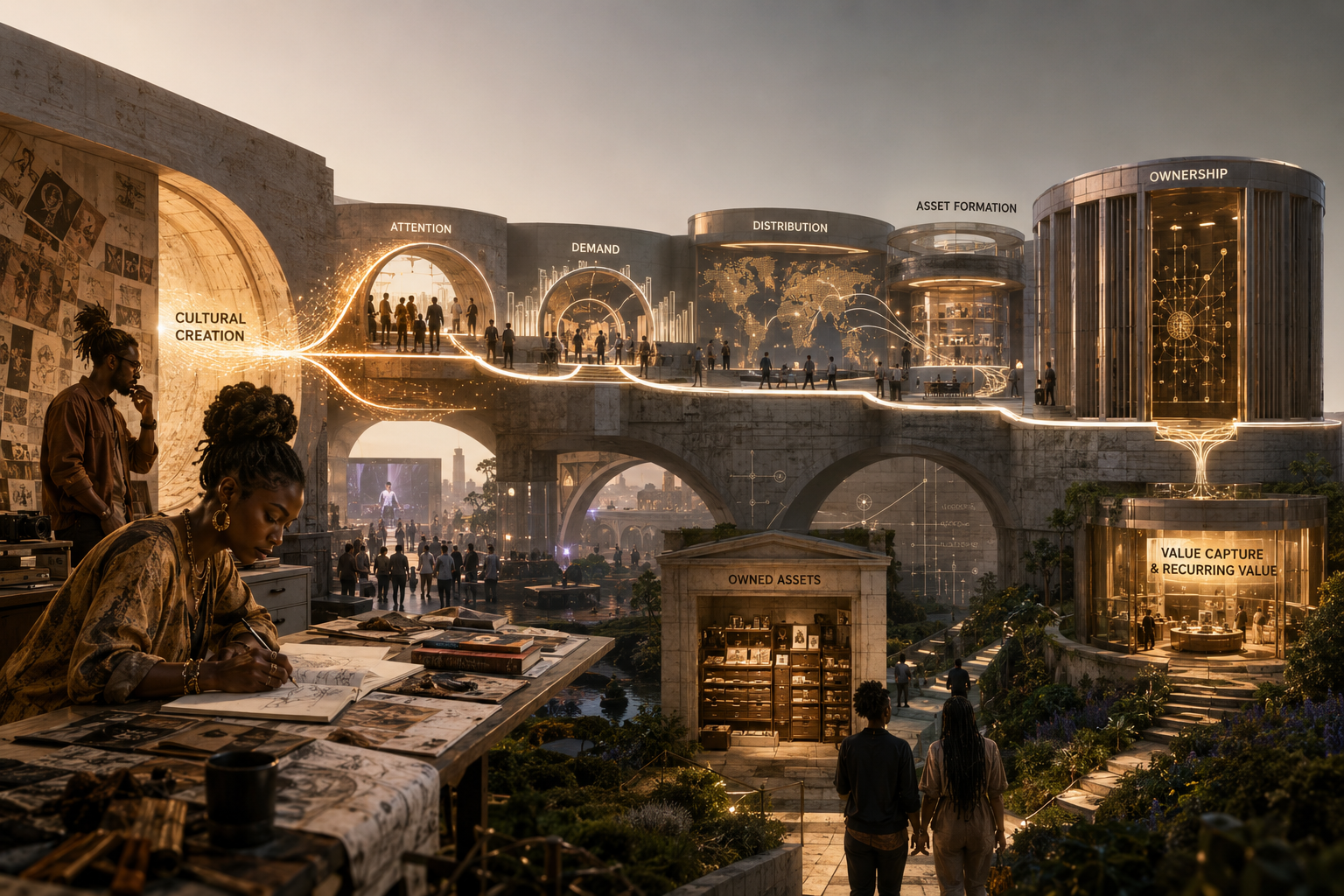
A recognizable cultural signal can move through several layers before becoming capital.
Cultural Creation → Attention → Demand → Distribution → Asset → Ownership → Value Capture
Cultural creation produces the idea, aesthetic, story, sound, practice, or experience.
Attention makes the cultural signal visible.
Next, demand reveals that people want more of it.
Distribution determines how widely that demand can be served.
Then asset formation turns some portion of the cultural value into something durable: a catalog, brand, product, right, platform, archive, customer base, format, or commercial system.
Ownership determines who controls the asset.
Finally, value capture determines who participates economically as the asset continues producing value.
The cultural creator may occupy every stage. In other cases, the creator may occupy only the first one.
Distribution Is Where Influence Starts Traveling Faster
Culture scales through distribution.
Before mass media, distribution depended heavily on physical proximity, institutions, publishers, venues, broadcasters, retailers, and other gatekeepers. Digital platforms changed that equation by making distribution dramatically easier and faster.
As a result, a creator can now reach an audience without owning a television network, record store, magazine, movie theater, or national retail chain.
However, easier access to distribution does not mean ownership of distribution.
Watch This
A platform can expand cultural reach while retaining control over recommendation systems, monetization rules, account access, advertising economics, data, and the relationship with the audience. Reach and control should therefore be valued separately.
That does not make platforms inherently bad. In fact, rented distribution can be useful distribution. The strategic mistake is treating access to somebody else’s infrastructure as if it were equivalent to owning infrastructure yourself.
Intellectual Property Is One Value-Capture Mechanism
Intellectual property matters because some cultural and creative outputs can become legally recognized assets.
Copyright can protect qualifying original creative expression. Trademarks can identify sources of goods and services. Patents can protect qualifying inventions and designs. Trade secrets can protect certain valuable confidential business information.
Still, those tools do not guarantee commercial success. Protection is not demand.
A copyright nobody values remains economically weak. Similarly, a trademark without customer recognition does not suddenly become powerful because paperwork exists.
Nevertheless, the larger economic significance of intangible ownership is substantial.
Intangible Assets Are Not Side Economics
The U.S. Patent and Trademark Office reported that IP-intensive industries accounted for approximately 44 percent of U.S. private-sector gross domestic product in 2024.
The same analysis identified entertainment, literary, and artistic originals as forms of intangible capital alongside software, research, and other knowledge-producing investments.
That distinction matters for Culture Ledger because it shows how something nonphysical can become economically durable once rights, institutions, markets, and ownership structures allow it to persist beyond the initial act of creation.
In other words, culture can become an asset.
The unresolved question is who owns the asset.
Ownership Without Demand Is Not the Goal Either
This argument can become sloppy if ownership is treated as a magic word.
It is not.
For example, owning a weak asset does not create economic power.
A musician can own every master and still have no meaningful audience.
Likewise, a creator can own a website nobody visits. A designer can hold rights to work nobody wants. A company can control intellectual property that generates more expense than revenue.
Therefore, the Builder standard cannot simply be “own everything.”
The better standard is:
Own meaningful claims on productive assets where ownership materially improves control, durability, bargaining power, or participation in future value.
That is more disciplined than ownership theater.
Culture Can Create Capital for Someone Else
This is the tension that deserves more attention.
A community can generate a cultural signal. A creator can make it visible. An intermediary can distribute it. A company can commercialize it.
From there, an investor can capitalize the company. A platform can capture the audience data. A rights holder can receive recurring payments.
Meanwhile, the original cultural contribution may receive recognition without receiving durable participation in the economics.
That outcome is not automatically evidence of exploitation. Contracts, labor, capital, risk, execution, distribution, and commercialization all contribute real value too.
However, Culture Ledger should resist the opposite mistake: pretending the cultural contribution had no economic importance merely because somebody else built the monetization layer.
Both contributions can matter.
The ledger should price both.
The Difference Between Cultural Influence and Cultural Infrastructure
Influence changes what people notice, imitate, desire, discuss, wear, watch, listen to, or believe has status.
Infrastructure determines how that demand is organized.
That infrastructure can include rights, contracts, brands, distribution, customer relationships, archives, catalogs, production systems, financing, data, institutions, and operating knowledge.
The strongest cultural businesses usually connect the two. They create or recognize demand and then build structures capable of serving, retaining, protecting, and extending that demand.
That is where influence begins becoming capital.
The Builder Audit: What Happens After Culture Creates Demand?
Start with the cultural contribution itself. Then follow the value downstream.
Creation: What are you actually producing that people value?
Attention: Where does recognition come from, and who controls access to that audience?
Demand: What evidence shows that attention is becoming sustained interest, use, purchase, participation, or loyalty?
Distribution: Which channels allow the value to travel?
Asset: What durable thing remains after the cultural moment passes?
Rights: Which parts can legitimately be protected or controlled?
Ownership: Who owns the relevant asset, relationship, catalog, brand, system, or right?
Value Capture: Who continues participating economically after the original act of creation?
Durability: What survives when attention moves somewhere else?
Together, those questions separate cultural importance from cultural infrastructure.
The Goal Is Not to Financialize Every Part of Culture
There is a boundary here too.
Not every cultural exchange should become a transaction. Community traditions do not need a monetization strategy simply because they matter.
Friendship is not a funnel. Identity is not an asset class. Likewise, every creative impulse does not need a product roadmap.
Turning all human expression into commerce would make culture poorer, not richer.
The argument is narrower. When culture is already producing commercial demand, the people generating meaningful portions of that value should understand the economic architecture surrounding it.
Otherwise, cultural influence can grow while economic agency remains unchanged.
The Repricing: Recognition Is Not the Final Return
Culture often treats recognition as proof that the creator won.
Sometimes recognition is a meaningful return in itself. However, when cultural activity creates substantial commercial value, recognition should not prevent us from asking what happened downstream.
Who converted the attention into demand?
Who built the distribution?
Who formed the asset?
Who secured the rights?
Who owns the customer relationship?
Who receives recurring value?
And who still has negotiating power after the cultural moment moves on?
What This Means
Culture creates capital when influence becomes productive infrastructure. The strongest position is not merely being visible inside the value chain, but retaining a meaningful claim on what the value chain continues to produce.
The Groundwork: Build a Claim on What Your Culture Creates
If your work creates attention, understand where the attention goes next.
If it creates demand, understand who owns the channel serving that demand.
If it creates something durable, identify whether there is an asset underneath the moment.
If rights matter, learn which rights actually apply rather than treating “IP” as a generic business slogan.
If somebody else owns the infrastructure, understand the trade clearly. Sometimes renting access is the smartest move. Likewise, partnership can create more value than independence. In other cases, capital, expertise, distribution, or scale justifies sharing economics.
The point is not total control.
It is informed participation.
Culture can travel farther than the people who created it.
The Builder question is whether some durable portion of the value travels back.
Create the value. Understand the structure. Build a meaningful claim on what compounds.
Receipts
U.S. Bureau of Economic Analysis — Arts and Culture
Evidence: BEA reports that arts and cultural economic activity accounted for $1.17 trillion, or 4.2 percent of U.S. GDP, in 2023.
Why it matters: Cultural production is not peripheral to the economy. It represents substantial measurable economic activity across creative and supporting industries.
View source →
U.S. Patent and Trademark Office — Intellectual Property and the U.S. Economy in 2024
Evidence: USPTO reports that IP-intensive industries accounted for about $11.4 trillion, or 44 percent, of U.S. private-sector GDP in 2024. Its definition of intangible capital includes software as well as entertainment, literary, and artistic originals.
Why it matters: Intangible assets can represent economically significant productive capital when ownership rights, markets, and business structures allow their value to persist beyond the initial creative act.
View source →
U.S. Copyright Office — The Resilience of Creativity
Evidence: The Copyright Office examined employment, revenues, and creative output across eighteen copyright-reliant industries using federal and Copyright Office data.
Why it matters: Copyright-reliant creative activity operates through measurable industries, employment structures, revenues, and rights systems rather than existing outside the formal economy.
View source →
Evidence note: These sources establish the scale of arts, cultural, copyright-reliant, and intellectual-property-intensive economic activity. They do not prove that all cultural influence should be owned, that creators are always entitled to downstream revenue, or that intellectual-property protection automatically produces commercial success. The article distinguishes cultural creation, distribution, asset formation, ownership, and value capture precisely because each contributes something different.
Groundwork Principle
Build What Holds
Cultural attention can move quickly. Durable value requires something capable of remaining useful after the moment moves on.
Load. Pressure. Maintenance. Transfer. Durability.
Apply those tests to the rights, relationships, catalogs, brands, platforms, institutions, and other structures carrying cultural value.
If the value disappears with the attention, the structure was never carrying much weight.
Further Groundwork
→ Leverage Is Currency
Examine how capability becomes proof, systems, distribution, productive assets, ownership, and economic leverage.
→ Build What Holds
Test whether the structures beneath an advantage can carry load, survive pressure, transfer, and remain useful after favorable conditions disappear.
→ Discipline Before Dollars
More resources do not repair weak operating habits. Structure and disciplined allocation determine what additional capital can actually accomplish.
→ More from Culture Ledger
Follow the gap between cultural price and underlying value across ownership, attention, work, media, status, institutions, leadership, and capital.
Explore Culture, Media & Leadership
Culture teaches us what deserves attention, prestige, ownership, and value. Culture Ledger asks the next question: are we pricing those things correctly?
→ Explore Culture, Media & Leadership
→ Explore Culture Ledger
Keep the Ledger
See what culture is overpricing before you build your life around it.
Attention can masquerade as value. Intensity can masquerade as connection. Prestige can hide weak fundamentals. Culture Ledger follows those gaps and asks what is actually carrying the weight.
Get the next Groundwork analysis on relationships, culture, incentives, leadership, ownership, and the systems underneath what we are taught to value.

Meet the Builder
André Toussaint
Culture Ledger | Culture, Media & Leadership
André Toussaint is the Builder behind Groundwork Daily, where he examines what sits beneath everyday outcomes and what might work better. In Culture Ledger, he follows the gap between what culture teaches us to value and what actually produces durable value.