Penny production ended in the United States in 2025, but the more interesting story is how long the economics had been broken before the machinery finally stopped. By the time the U.S. Mint struck the final circulating one-cent coins in November, producing a penny had cost more than one cent for years.
That contradiction makes the penny more than loose change. It makes it a Culture Ledger case study.
America did not keep producing the penny because one cent had suddenly become more useful. We kept carrying a familiar institution after its underlying economics had weakened. Eventually, the arithmetic became difficult to defend. Production stopped. The pennies already sitting in pockets, jars, cash drawers, banks, and couch cushions did not suddenly become worthless.
The system simply stopped making more of them.
How long should familiarity keep something alive after the fundamentals stop justifying the cost?
That is the larger question. The penny matters because institutions rarely announce that they have become outdated. More often, yesterday’s logic keeps moving through today’s machinery because changing the system creates friction of its own.
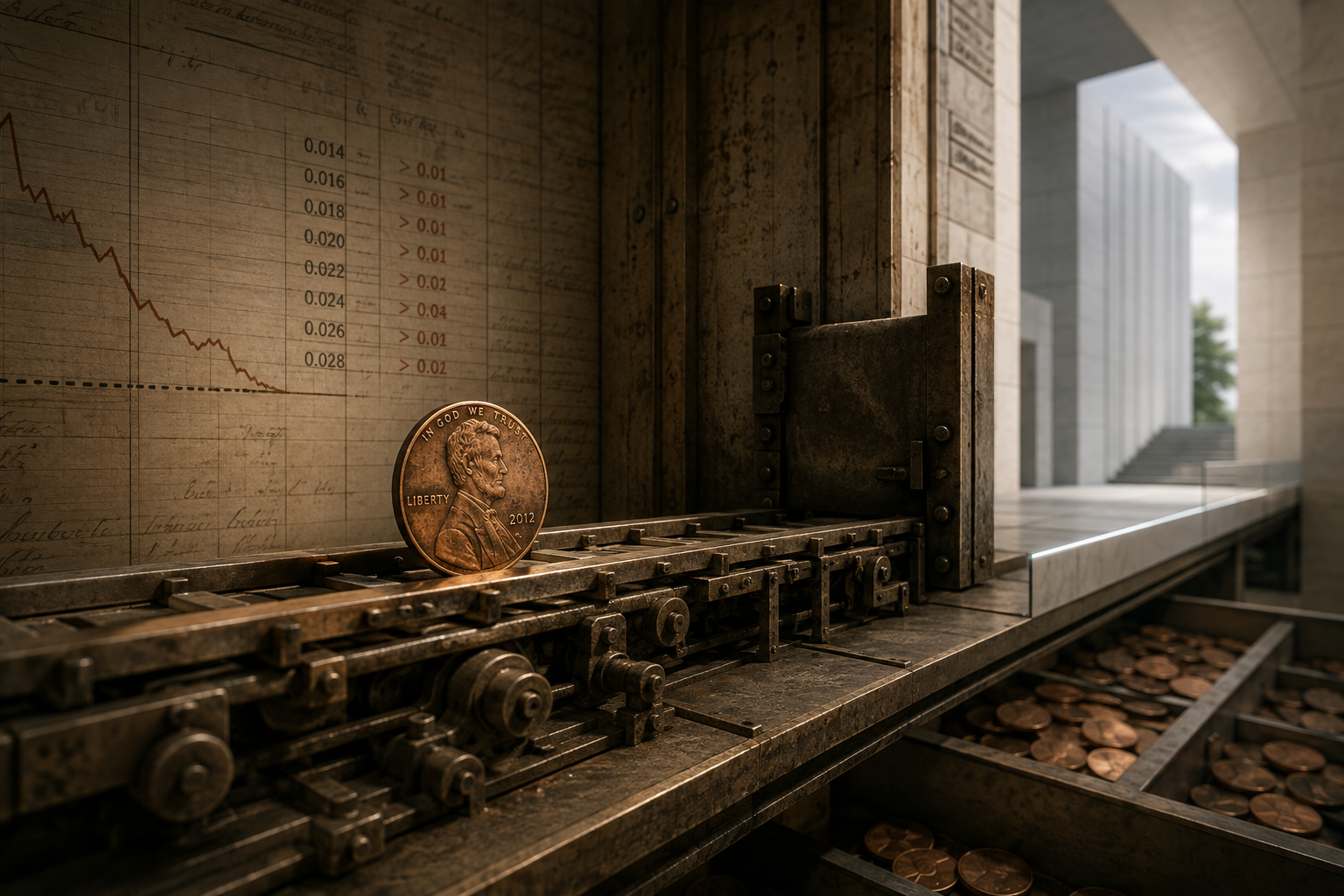
Penny Production Ended After the Economics Changed
For years, the penny carried a simple contradiction: its face value stayed at one cent while its production cost moved well beyond that amount.
According to the U.S. Mint’s 2024 annual report, producing and distributing a penny cost about 3.7 cents during fiscal year 2024. That meant the government was spending several times the coin’s face value to manufacture it.
One penny does not create a fiscal crisis. Scale is what changes the picture.
When billions of coins move through a production system, a small unit loss becomes a recurring institutional cost. Treasury estimated that ending penny production would save approximately $56 million annually in material costs.
Eventually, the government changed the operating model. The U.S. Mint struck the final circulating pennies in November 2025, ending more than two centuries of continuous one-cent coin production.
The important distinction is that production ended; the penny did not.
Existing pennies remain legal tender and can continue circulating. The Federal Reserve can continue recirculating the enormous supply already in the economy. America did not erase the penny from history or invalidate the coins people already hold. It stopped manufacturing additional circulating units.
Groundwork Definition
Institutional Lag: the gap between a change in underlying conditions and the point when an institution finally updates the system built around them.
The penny is almost too perfect an example. The economics changed first. The institution changed later.
The Penny Carried More Than One Cent of Meaning
If the decision were purely mathematical, the penny would have been easier to resolve. But currency is not purely mathematical.
Coins carry habit, memory, language, design, ritual, and national continuity. The penny has been part of American commerce for generations. People grew up dropping them into jars, collecting wheat cents, leaving them beside cash registers, and picking them up from sidewalks.
We even built language around them: a penny saved, a penny for your thoughts, lucky penny.
That cultural meaning is real. Dismissing it as stupidity would miss the point.
But cultural meaning and operational usefulness are not the same asset.
Culture Ledger is interested in the moment when those values separate. Something can remain familiar, recognizable, historically meaningful, and even beloved while becoming increasingly difficult to justify under the system that keeps producing it.
The mistake is not valuing history. The mistake is assuming history automatically settles a present-day operating decision.
The Penny Was Mispriced in Two Directions
There are actually two prices operating here.
The first is obvious: the penny says it is worth one cent.
The second is cultural. Familiarity gives an institution a kind of invisible premium. People know how it works. Businesses have systems built around it. Cash registers recognize it. Accounting conventions expect it. Consumers understand it. Changing any established standard imposes transition costs.
That means the penny was not simply an irrational object hanging around because America enjoys wasting money. The harder problem was that the existing system had accumulated infrastructure around the coin.
Still, infrastructure can become part of the trap.
Once enough processes depend on an old convention, the inconvenience of changing it can become an argument for preserving it. Yesterday’s system then begins generating its own defense: we should keep doing this because we have always built around doing this.
The strongest defense of an outdated system is often the infrastructure we built while assuming it would never change.
That is where familiarity starts acquiring a premium that the fundamentals may no longer support.
Ending Production Does Not Make the Transition Free
There is a lazy version of this argument that says the penny cost too much, therefore ending production was obvious and anybody who resisted was defending nonsense.
That is too easy.
Changing a denomination creates real operational questions. Cash transactions still need to settle. Retailers need clear practices. Financial institutions need coin-distribution systems. Consumers need to understand that existing pennies remain valid. State and local rules can complicate how cash transactions are handled.
Treasury’s own guidance recognizes that transition rather than pretending it does not exist.
That matters because institutional inertia is not always irrational. Sometimes systems move slowly because millions of people and transactions depend on them working predictably.
Watch This
Institutional Lag is not proof that an institution is foolish. Transition has costs too. The serious question is whether those costs still justify preserving the old system after its underlying conditions have changed.
The argument gets stronger when we acknowledge that friction instead of pretending modernization is free.
The Smallest Coin Exposes a Larger Institutional Habit
The penny is interesting precisely because the stakes are relatively small.
It gives us a clean view of a larger pattern without requiring us to pretend that ending one-cent production will transform the federal balance sheet.
Institutions accumulate procedures. Procedures accumulate constituencies. Constituencies accumulate expectations. Eventually, a temporary arrangement can begin looking permanent simply because everybody has organized around it.
You can see versions of that problem far beyond currency.
A company keeps a reporting process nobody uses because it has always produced the report. A school preserves a requirement after the labor market it was designed around has changed. A household keeps paying for something because the charge has become invisible. A public institution maintains infrastructure whose original purpose no longer matches present conditions.
None of those examples proves the system should automatically disappear.
They do suggest a better question: if we were designing this from scratch under today’s conditions, would we build it the same way?
That question is uncomfortable because it removes tradition from the witness stand and asks the fundamentals to testify for themselves.
What Was Actually Carrying the Penny?
Culture Ledger eventually has to ask the load question.
What was actually carrying the penny once its production economics deteriorated?
Part of the answer was usefulness. Cash transactions still exist, and a one-cent denomination allows exact settlement to the cent.
Part was installed infrastructure. America’s retail, banking, accounting, and currency systems had spent generations accommodating the coin.
Part was familiarity. The penny required no explanation because everybody already understood it.
And part was cultural attachment. Small denominations can carry symbolic weight far beyond their purchasing power.
Those are legitimate forms of value. But none should receive permanent immunity from repricing.
When the underlying conditions change, institutions need a mechanism for asking whether yesterday’s solution is still earning today’s resources.
Penny Production Ended. The Lesson Should Travel.
The useful lesson is not that old things are bad.
That would be a terrible operating principle. Some old systems survive because they are remarkably durable. Some traditions encode wisdom that fashionable replacements rediscover the hard way. Longevity can be evidence of value.
But longevity can also be evidence of inertia.
The difference has to be tested.
Does the system still carry useful load? What happens under pressure? Can it be maintained at a reasonable cost? Does it still solve the problem it was designed to solve? If conditions have changed, can the useful parts transfer into a better structure?
The penny eventually reached that test.
Its history survived. Its legal value survived. Existing coins survived. What did not survive was the assumption that America needed to keep manufacturing more of them indefinitely.
What This Means
Modernization does not require contempt for what came before. It requires the discipline to separate what deserves preservation from what survives mainly because changing it is inconvenient.
The Groundwork: Make Familiar Systems Re-Earn Their Place
There is a practical discipline hiding inside the smallest denomination in American currency.
Do not preserve a system merely because replacing it creates friction. Do not eliminate a system merely because it is old. Make it re-earn its place against current conditions.
That means pricing maintenance honestly. It means counting transition costs honestly too. It means separating sentimental value from operational value without pretending either is imaginary.
Most importantly, it means building institutions capable of changing before contradiction becomes absurdity.
The penny did not fail because it was old. Its production model became harder to justify because the relationship among face value, production cost, purchasing power, and the surrounding payments system had changed.
America eventually updated the machinery.
The better question is how many larger systems are still waiting for the same audit.
Receipts
United States Mint — Final Production of the Circulating One-Cent Coin
Evidence: The U.S. Mint documents the November 2025 ceremonial strike marking the final production of circulating one-cent coins and the end of a 232-year production run.
Why it matters: This establishes the central fact of the article: circulating penny production ended, while the penny itself remains part of American currency history and circulation.
View source →
U.S. Department of the Treasury — Penny Production Cessation FAQs
Evidence: Treasury explains the production decision, transition considerations, continued legal-tender status of existing pennies, and anticipated savings from ending production.
Why it matters: It distinguishes stopping new production from eliminating existing pennies and provides primary-source context for the operational transition.
View source →
United States Mint — Annual Report
Evidence: U.S. Mint reporting shows that the unit cost of producing and distributing the one-cent coin exceeded its face value before production ceased.
Why it matters: The production-cost mismatch establishes the economic fundamental underneath the Culture Ledger valuation argument.
View source →
Federal Reserve — Payment and Coin Distribution Context
Context: Federal Reserve materials document the changing U.S. payments environment and the infrastructure through which currency and coin circulate.
Why it matters: The penny did not exist in isolation. Its usefulness and transition have to be understood within a broader payments system that includes both cash and electronic methods.
View source →
Evidence note: The end of penny production demonstrates a specific federal currency decision. The broader discussion of Institutional Lag is Groundwork’s analytical application of that case, not a claim that every longstanding institution is inefficient or should be eliminated.
Groundwork Principle
Build What Holds
A system should not survive merely because removing it is inconvenient. It should survive because it still carries useful weight under present conditions.
Load. Pressure. Maintenance. Transfer. Durability.
The penny offers a simple durability test: preserve what still creates value, transfer what remains useful, and stop confusing longevity with proof that the existing structure should continue unchanged.
History deserves respect. Infrastructure still has to earn its maintenance.
Further Groundwork
→ Build What Holds
Groundwork’s durability test asks whether a structure can carry weight, survive pressure, be maintained, transfer, and remain useful after favorable conditions disappear.
→ Structure Builds Freedom
Strong systems create room for better outcomes, but structure only works when it remains aligned with the problem it is supposed to solve.
→ Discipline Before Dollars
More resources cannot repair weak operating habits. Better stewardship begins by examining where resources are going and why.
→ More from Culture Ledger
Follow the gap between cultural price and underlying value across institutions, work, ownership, relationships, media, status, and leadership.
Explore Culture, Media & Leadership
Culture teaches us what deserves attention, status, preservation, and value. Culture Ledger asks the next question: are we pricing those things correctly?
→ Explore Culture, Media & Leadership
→ Explore Culture Ledger
Keep the Ledger With Us
Culture tells us what to notice. Groundwork asks what actually deserves the value.
Follow Culture Ledger and the wider Groundwork Daily inquiry into the systems, incentives, decisions, and structures shaping everyday life—and the better ways we might build around them.

Meet the Builder
André Toussaint
Culture Ledger | Culture, Media & Leadership
André Toussaint is the founder and Builder behind Groundwork Daily, where he examines what sits beneath everyday outcomes—and what might work better. In Culture Ledger, he follows the gap between what culture teaches us to value and what actually produces durable value.